
Pesticide Residue Testing Market Report 2026
Global Outlook – By Type (Herbicides, Fungicides, Insecticides, Other Types), By Technology (LC-MS Or GC-MS, HPCL, Gas Chromatography, Other Technologies), By Food Tested (Meat And Poultry, Dairy Products, Processed Foods, Fruits And Vegetables, Cereals, Grains And Pulses, Other Foods Tested), By Class (Organ chlorines, Organophosphates, Organonitrogens, Carbamates, Other Classes) – Market Size, Trends, Strategies, and Forecast to 2030
Pesticide Residue Testing Market Overview
• Pesticide Residue Testing market size has reached to $1.95 billion in 2025 • Expected to grow to $2.94 billion in 2030 at a compound annual growth rate (CAGR) of 8.6% • Growth Driver: Pesticide Residue Testing Market Expands Amidst Rising Organic Food Craze • Market Trend: AI-Driven Residue Detection Kit Revolutionizes Pesticide Testing In Agricultural Products • Europe was the largest region in 2025 and North America is the fastest growing region.What Is Covered Under Pesticide Residue Testing Market?
Pesticide residue testing refers to the process of checking the levels of pesticide residue present in food products. Pesticide residue testing is used for checking the chemicals in the food and assures the manufacturers and producers about the quality of their food. The main pesticide residue testing types are herbicides, fungicides, insecticides, and other. Herbicides are chemical substances that are used to kill unwanted plants, which are mainly weeds. The. various technology LC-MS or GC-MS, HPCL, gas chromatography, and others that are tested on various foods includes meat and poultry, dairy products, processed foods, fruits and vegetables, cereals, grains and pulses, and others. The various classes are organ chlorines, organophosphates, organonitrogens, carbamates, and others.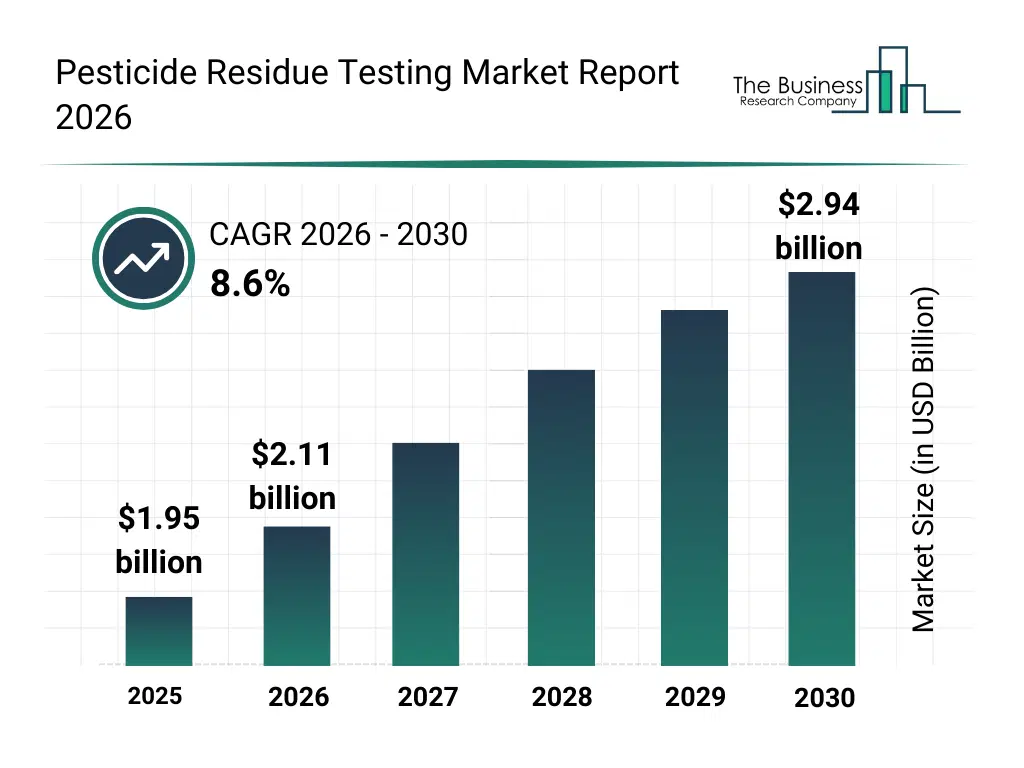
What Is The Pesticide Residue Testing Market Size and Share 2026?
The pesticide residue testing market size has grown strongly in recent years. It will grow from $1.95 billion in 2025 to $2.11 billion in 2026 at a compound annual growth rate (CAGR) of 8.4%. The growth in the historic period can be attributed to stricter food safety regulations, increasing global food trade, growth of analytical testing laboratories, rising incidence of food contamination concerns, availability of advanced testing technologies.What Is The Pesticide Residue Testing Market Growth Forecast?
The pesticide residue testing market size is expected to see strong growth in the next few years. It will grow to $2.94 billion in 2030 at a compound annual growth rate (CAGR) of 8.6%. The growth in the forecast period can be attributed to increasing demand for real-time testing solutions, expansion of residue testing in emerging markets, growing adoption of automated laboratory systems, rising investments in food quality assurance, increasing focus on export compliance standards. Major trends in the forecast period include increasing adoption of advanced chromatography techniques, rising demand for food safety testing services, expansion of multi-residue testing capabilities, growing use of rapid and automated testing systems, enhanced focus on regulatory compliance.
Global Pesticide Residue Testing Market Segmentation
1) By Type: Herbicides, Fungicides, Insecticides, Other Types 2) By Technology: LC-MS Or GC-MS, HPCL, Gas Chromatography, Other Technologies 3) By Food Tested: Meat And Poultry, Dairy Products, Processed Foods, Fruits And Vegetables, Cereals, Grains And Pulses, Other Foods Tested 4) By Class: Organ chlorines, Organophosphates, Organonitrogens, Carbamates, Other Classes Subsegments: 1) By Herbicides: Chlorinated Herbicide Residues, Triazine Herbicide Residues, Phenoxy Herbicide Residues, Glyphosate And Aminophosphonic Acid (AMPA) Residues, Other Herbicide Residues 2) By Fungicides: Azole Fungicide Residues, Dithiocarbamate Fungicide Residues, Strobilurin Fungicide Residues, Inorganic Fungicide Residues, Other Fungicide Residues 3) By Insecticides: Organochlorine Insecticide Residues, Organophosphate Insecticide Residues, Carbamate Insecticide Residues, Pyrethroid Insecticide Residues, Neonicotinoid Insecticide Residues, Other Insecticide Residues 4) By Other Types: Acaricide Residues, Nematicide Residues, Rodenticide Residues, Plant Growth Regulator Residues, Pesticide Mixture And Multi-Residue PanelsWhat Is The Driver Of The Pesticide Residue Testing Market?
Increasing demand for organic food is expected to propel the pesticide residue testing market going forward. Organic food refers to agricultural products produced using environmentally and socially responsible practices that avoid the use of synthetic pesticides, fertilizers, genetically modified organisms (GMOs), irradiation, and sewage sludge. Pesticide residue testing is instrumental in upholding the authenticity and safety of organic food, ensuring compliance with regulations, and promoting consumer trust in organic products and practices. For instance, in February 2024, according to the IFOAM (International Federation of Organic Agriculture Movements), a Germany-based an international organization, the global area under organic farming expanded by 2.5 million hectares in 2023, bringing the total to nearly 99 million hectares. Meanwhile, global sales of organic food rose to approximately 136 billion euros that same year. Therefore, increasing demand for organic food is driving the growth of the pesticide residue testing industry.Key Players In The Global Pesticide Residue Testing Market
Major companies operating in the pesticide residue testing market are SGS SA, Eurofins Scientific SE, Intertek Group plc, Bureau Veritas S.A., ALS Limited, TÜV SÜD AG, TÜV Rheinland AG, Mérieux NutriSciences Corporation, AsureQuality Limited, Neogen Corporation, Romer Labs Division Holding GmbH, Merck KGaA, Agilent Technologies, Inc., Thermo Fisher Scientific Inc., Shimadzu Corporation, Bruker Corporation, PerkinElmer, Inc., Waters Corporation, Danaher Corporation, Hitachi High-Tech Corporation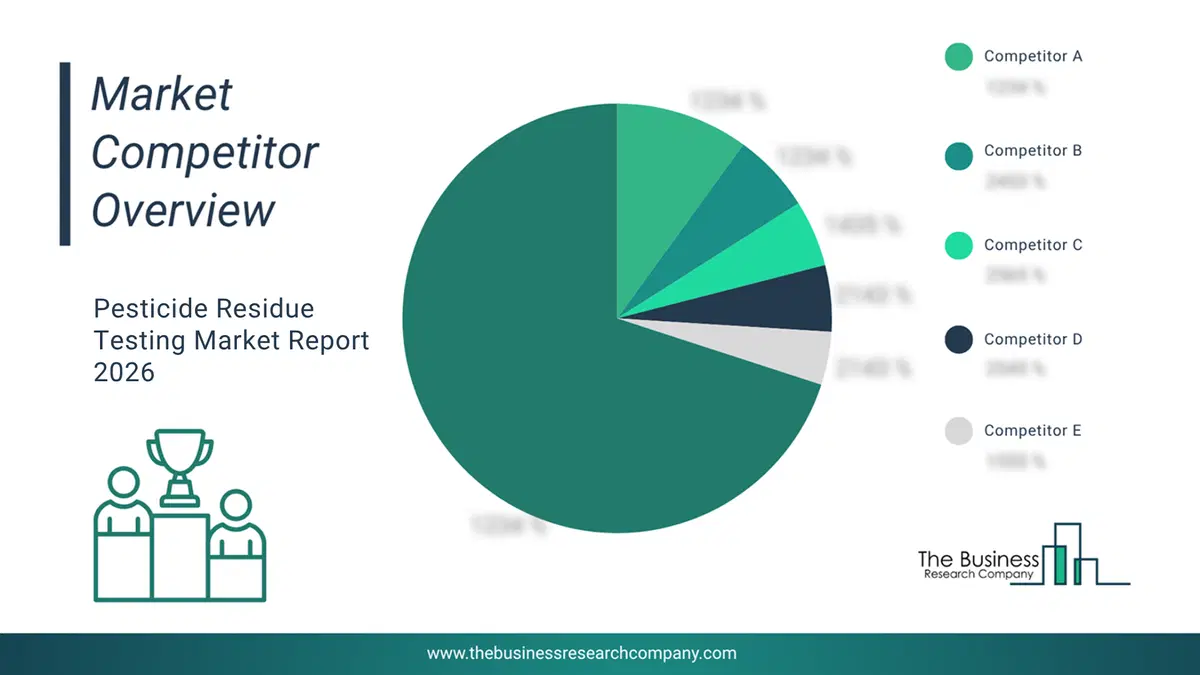
This chart is for illustrative purposes; the full report includes a detailed competitor analysis and comprehensive overview of the top 10 companies in the market.
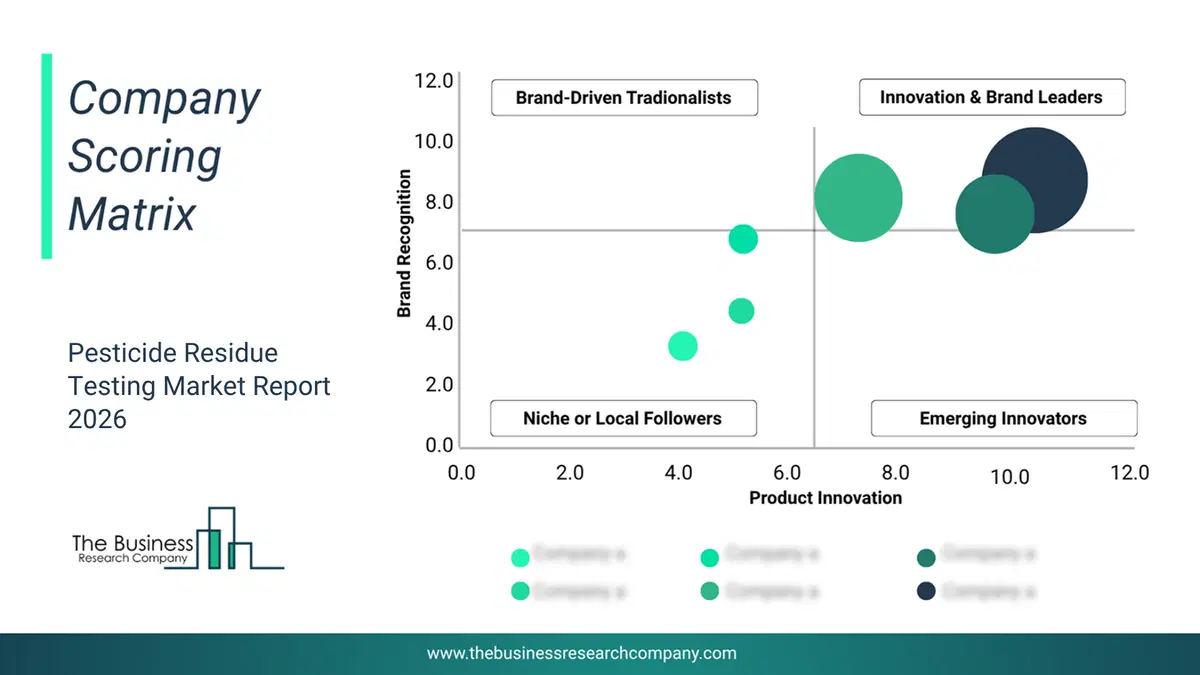
This chart maps companies by product innovation and brand strength, with bubble size indicating relative revenue, helping identify market leaders, challengers, and niche players. This is an illustrative chart; the full report provides a complete and accurate competitive analysis.
Global Pesticide Residue Testing Market Trends and Insights
Major companies operating in the pesticide residue testing market are focusing on developing an artificial intelligence kit to enhance the accuracy and efficiency of residue detection in agricultural products. An artificial intelligence kit refers to a portable device that uses artificial intelligence to quickly analyze samples (soil, water, or produce) and identify the presence and concentration of pesticide residues, offering real-time, accurate detection for agricultural or food safety purposes. For instance, in July 2024, the Tea Research Association, an India-based tea research institute, collaborated with Arogyam Medisoft, an India-based biotechnology research company, launched ACLIVIA for Tea, a rapid screening platform designed to detect pesticide residues in tea leaves. By leveraging artificial intelligence, it ensures faster and more accurate screening, helping tea producers comply with safety standards and minimize harmful chemical exposure. The platform aims to streamline testing, offering a cost-effective and efficient alternative to traditional residue detection methods.What Are Latest Mergers And Acquisitions In The Pesticide Residue Testing Market?
In June 2024, ALS Limited, an Australia-based testing, inspection, and certification company, acquired Wessling Group, for an undisclosed amount. With this acquisition, ALS aims to expand its industry expertise, strengthen its service offerings across multiple sectors, and enhance its capabilities in laboratory testing and consultancy solutions. Wessling Group is a Germany-based provider of analytical, testing, and consultancy services provides specialized analytical and testing services across industries including environmental, food, pharmaceutical, and chemical sectors.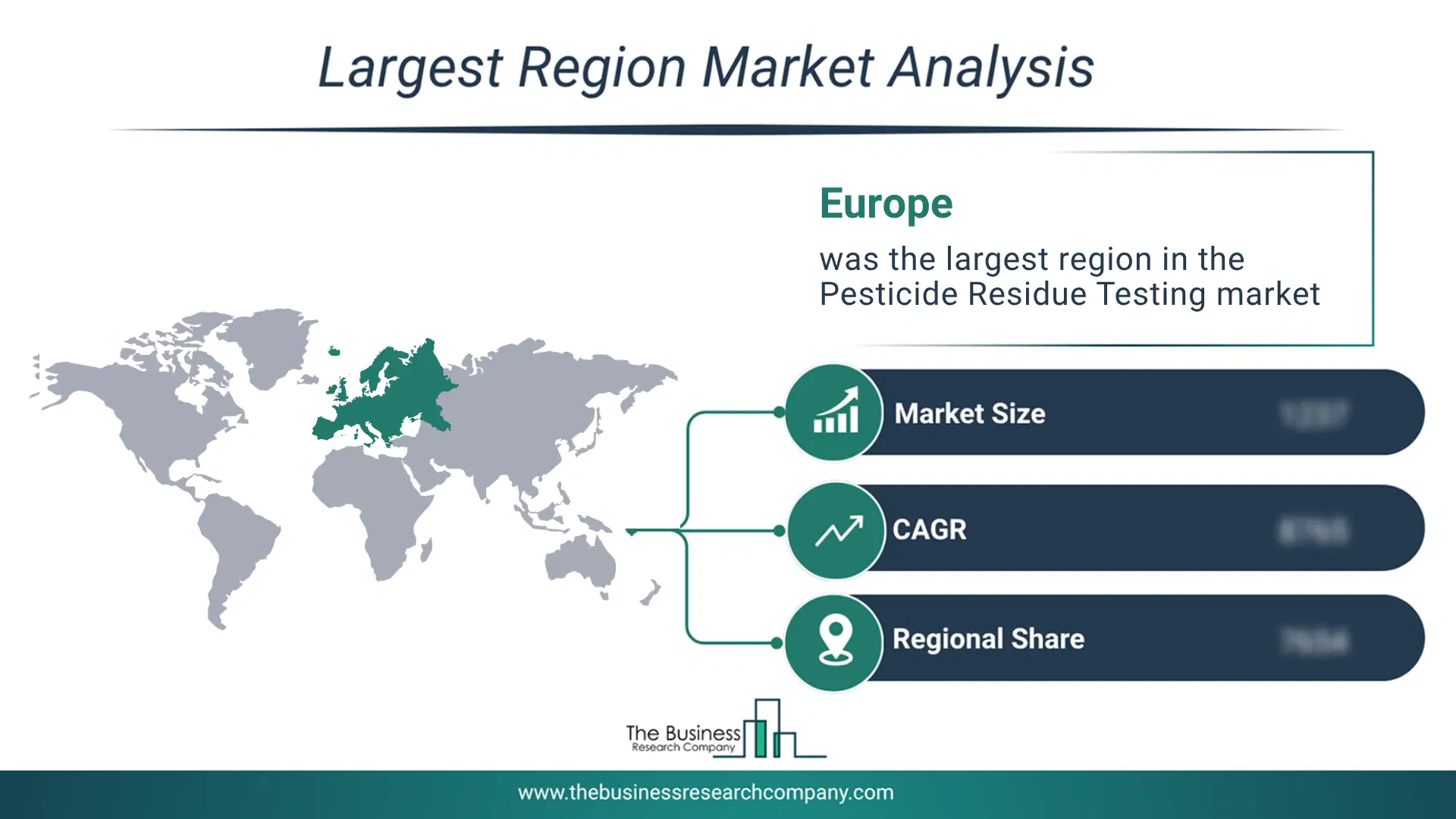
Regional Insights
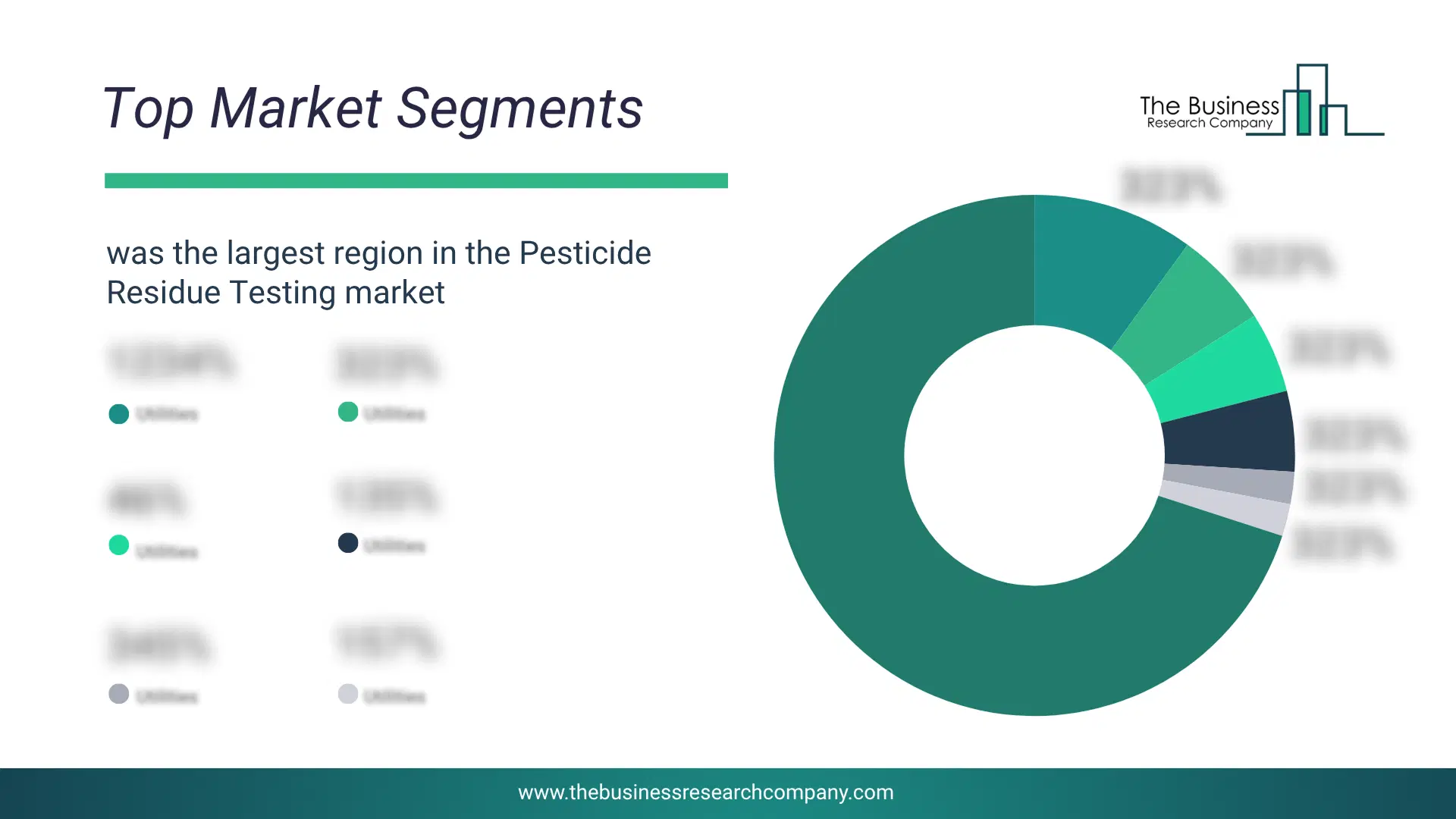
Europe was the largest region in the pesticide residue testing market in 2025. The regions covered in this market report are Asia-Pacific, South East Asia, Western Europe, Eastern Europe, North America, South America, Middle East, Africa The countries covered in this market report are Australia, Brazil, China, France, Germany, India, Indonesia, Japan, Taiwan, Russia, South Korea, UK, USA, Canada, Italy, SpainWhat Defines the Pesticide Residue Testing Market?
The pesticide residue testing market includes revenues earned by entities by chemical rapid detection methods, immunoassay methods, enzyme inhibition methods and vivo detection methods. The market value includes the value of related goods sold by the service provider or included within the service offering. Only goods and services traded between entities or sold to end consumers are included. The pesticide residue testing market consists of sales of Benchtop NIR analyzers, FTIR milk and beverage analyzers, glutomatic system, process NIR analyzers, and others. Values in this market are ‘factory gate’ values, that is the value of goods sold by the manufacturers or creators of the goods, whether to other entities (including downstream manufacturers, wholesalers, distributors and retailers) or directly to end customers. The value of goods in this market includes related services sold by the creators of the goods.How is Market Value Defined and Measured?
The market value is defined as the revenues that enterprises gain from the sale of goods and/or services within the specified market and geography through sales, grants, or donations in terms of the currency (in USD unless otherwise specified). The revenues for a specified geography are consumption values that are revenues generated by organizations in the specified geography within the market, irrespective of where they are produced. It does not include revenues from resales along the supply chain, either further along the supply chain or as part of other products.
This chart presents market attractiveness based on a quantitative evaluation of growth, competition, strategic alignment, and risk, offering a clear view of opportunity areas for decision-making. This chart is for illustrative purposes; the full report contains the complete analysis.

This chart highlights the Total Addressable Market (TAM) by estimating the maximum revenue opportunity using an assumption-driven approach, supporting strategic planning and opportunity sizing across markets. The chart is illustrative; the full report provides a more comprehensive analysis.
What Key Data and Analysis Are Included in the Pesticide Residue Testing Market Report 2026?
The pesticide residue testing market research report is one of a series of new reports from The Business Research Company that provides market statistics, including industry global market size, regional shares, competitors with the market share, detailed market segments, market trends and opportunities, and any further data you may need to thrive in the pesticide residue testing industry. The market research report delivers a complete perspective of everything you need, with an in-depth analysis of the current and future state of the industry.Pesticide Residue Testing Market Report Forecast Analysis
| Report Attribute | Details |
|---|---|
| Market Size Value In 2026 | $2.11 billion |
| Revenue Forecast In 2030 | $2.94 billion |
| Growth Rate | CAGR of 8.4% from 2026 to 2030 |
| Base Year For Estimation | 2025 |
| Actual Estimates/Historical Data | 2020-2025 |
| Forecast Period | 2026 - 2030 |
| Market Representation | Revenue in USD Billion and CAGR from 2026 to 2030 |
| Segments Covered | Type, Technology, Food Tested, Class |
| Regional Scope | Asia-Pacific, Western Europe, Eastern Europe, North America, South America, Middle East, Africa |
| Country Scope | The countries covered in this market report are Australia, Brazil, China, France, Germany, India, Indonesia, Japan, Taiwan, Russia, South Korea, UK, USA, Canada, Italy, Spain |
| Key Companies Profiled | SGS SA, Eurofins Scientific SE, Intertek Group plc, Bureau Veritas S.A., ALS Limited, TÜV SÜD AG, TÜV Rheinland AG, Mérieux NutriSciences Corporation, AsureQuality Limited, Neogen Corporation, Romer Labs Division Holding GmbH, Merck KGaA, Agilent Technologies, Inc., Thermo Fisher Scientific Inc., Shimadzu Corporation, Bruker Corporation, PerkinElmer, Inc., Waters Corporation, Danaher Corporation, Hitachi High-Tech Corporation |
| Customization Scope | Request for Customization |
| Pricing And Purchase Options | Explore Purchase Options |