
Petrochemical Feedstock Market Report 2026
Global Outlook – By Feedstock Type (Naphtha, Ethane, Propane, Butane, Liquefied Petroleum Gas, Natural Gas, Natural Gas Liquids, Condensates, Bio-Based Feedstocks, Recycled Feedstocks), By Source (Crude Oil-Based Feedstocks, Natural Gas-Based Feedstocks, Renewable Feedstocks), By Process Technology (Steam Cracking, Catalytic Cracking, Catalytic Reforming, Methanol-To-Olefins, Propane Dehydrogenation, Other Process Technologies), By Application (Olefins, Aromatics, Methanol, Other Applications), By End Use Industry (Packaging, Automotive, Construction, Electronics, Healthcare, Textiles, Agriculture, Consumer Goods, Industrial Manufacturing, Other End Use Industries) – Market Size, Trends, Strategies, and Forecast to 2030
Petrochemical Feedstock Market Overview
• Petrochemical Feedstock market size has reached to $413.28 billion in 2025 • Expected to grow to $520.14 billion in 2030 at a compound annual growth rate (CAGR) of 4.6% • Growth Driver: Growth In The Automotive Sector Fueling The Growth Of The Market Due To Rising Demand For Plastics, Synthetic Rubber, Resins, Adhesives, And Coatings In Vehicle Manufacturing • Market Trend: Refinery Ethane Integration Enhances Feedstock Efficiency And Optimizes Ethylene Production • North America was the largest region in 2025 and Asia-Pacific is the fastest growing region.What Is Covered Under Petrochemical Feedstock Market?
Petrochemical feedstock refers to raw hydrocarbon materials that are used as the primary inputs for producing petrochemicals. These feedstocks are processed through refining and cracking technologies to manufacture basic chemicals. Their primary purpose is to provide the essential building blocks for manufacturing numerous industrial and consumer products. The main feedstock types of petrochemical feedstock include naphtha, ethane, propane, butane, liquefied petroleum gas, natural gas, natural gas liquids, condensates, bio-based feedstocks, and recycled feedstocks. Naphtha refers to a light hydrocarbon mixture derived primarily from crude oil and used as a key feedstock for producing petrochemicals. These feedstocks are sourced from crude oil-based feedstocks, natural gas-based feedstocks, and renewable feedstocks and are processed through steam cracking, catalytic cracking, catalytic reforming, methanol-to-olefins, propane dehydrogenation, and other process technologies. The various applications involved are olefins, aromatics, methanol, and others and they are utilized by end use industries including packaging, automotive, construction, electronics, healthcare, textiles, agriculture, consumer goods, industrial manufacturing, and others.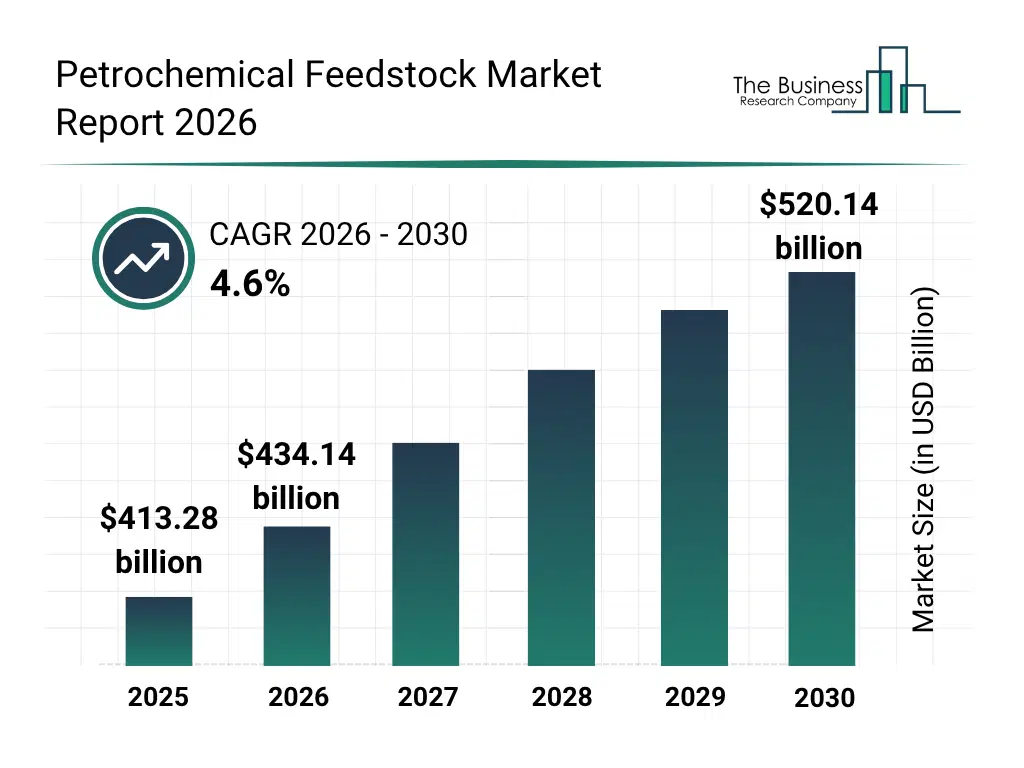
What Is The Petrochemical Feedstock Market Size and Share 2026?
The petrochemical feedstock market size has grown strongly in recent years. It will grow from $413.28 billion in 2025 to $434.14 billion in 2026 at a compound annual growth rate (CAGR) of 5.0%. The growth in the historic period can be attributed to growing petrochemical production capacity, increasing demand for basic chemicals, rising consumption of plastic products, expanding packaging manufacturing, increasing automotive production.What Is The Petrochemical Feedstock Market Growth Forecast?
The petrochemical feedstock market size is expected to see steady growth in the next few years. It will grow to $520.14 billion in 2030 at a compound annual growth rate (CAGR) of 4.6%. The growth in the forecast period can be attributed to rising demand for natural gas-based feedstocks, expanding adoption of renewable feedstocks, increasing demand for olefins and aromatics, growing petrochemical capacity in emerging economies, expanding demand from electronics and healthcare industries. Major trends in the forecast period include increasing feedstock flexibility across petrochemical production, rising demand for natural gas-based feedstocks, growing adoption of bio-based and renewable feedstocks, increasing use of recycled feedstocks, rising demand for olefin and aromatic production.Tariff Impact On Petrochemical Feedstock Market
Tariffs are impacting the Petrochemical feedstock market by increasing the cost of imported crude oil, natural gas, natural gas liquids, naphtha, and other hydrocarbon inputs required for petrochemical production. This is raising production costs across olefins, aromatics, methanol, and other applications, particularly in regions that rely heavily on imported feedstocks such as Asia-Pacific and Europe. Feedstock-intensive producers using imported crude oil-based and natural gas-based inputs are most affected by higher landed costs and supply chain disruptions. However, tariffs are also encouraging domestic feedstock sourcing, regional supplier diversification, and greater use of renewable and recycled feedstocks, supporting longer-term supply chain resilience.
Global Petrochemical Feedstock Market Segmentation
1) By Feedstock Type: Naphtha, Ethane, Propane, Butane, Liquefied Petroleum Gas, Natural Gas, Natural Gas Liquids, Condensates, Bio-Based Feedstocks, Recycled Feedstocks 2) By Source: Crude Oil-Based Feedstocks, Natural Gas-Based Feedstocks, Renewable Feedstocks 3) By Process Technology: Steam Cracking, Catalytic Cracking, Catalytic Reforming, Methanol-To-Olefins, Propane Dehydrogenation, Other Process Technologies 4) By Application: Olefins, Aromatics, Methanol, Other Applications 5) By End Use Industry: Packaging, Automotive, Construction, Electronics, Healthcare, Textiles, Agriculture, Consumer Goods, Industrial Manufacturing, Other End Use Industries Subsegments: 1) By Naphtha: Light Naphtha, Full Range Naphtha, Heavy Naphtha 2) By Ethane: Conventional Ethane, Shale-Derived Ethane, Bio-Based Ethane 3) By Propane: Refinery-Derived Propane, Natural Gas Processing Propane, Renewable Propane 4) By Butane: Normal Butane, Isobutane, Renewable Butane 5) By Liquefied Petroleum Gas: Propane-Rich Liquefied Petroleum Gas, Butane-Rich Liquefied Petroleum Gas, Mixed Liquefied Petroleum Gas 6) By Natural Gas: Associated Natural Gas, Non-Associated Natural Gas, Renewable Natural Gas 7) By Natural Gas Liquids: Pentanes Plus, Ethane-Rich Natural Gas Liquids, Mixed Natural Gas Liquids 8) By Condensates: Lease Condensate, Plant Condensate, Field Condensate 9) By Bio-Based Feedstocks: Bio-Ethanol, Bio-Naphtha, Bio-Propane, Bio-Butane 10) By Recycled Feedstocks: Recycled Plastic Feedstocks, Recycled Waste Oils, Recycled Biomass Feedstocks, Recycled Carbon FeedstocksWhat Is The Driver Of The Petrochemical Feedstock Market?
The growth in the automotive sector is expected to propel the growth of the petrochemical feedstock market going forward. The automotive sector refers to the industry involved in the design, manufacturing, assembly, and sale of motor vehicles and their components. The growth in the automotive sector is driven by rising consumer demand for passenger and commercial vehicles, fueled by increasing disposable incomes and improving living standards. The growth of the automotive sector supports the petrochemical feedstock market by increasing the demand for feedstocks used to produce plastics, synthetic rubber, resins, adhesives, coatings, and other materials required in vehicle manufacturing. For instance, in March 2026, according to the International Organization of Motor Vehicle Manufacturers (OICA), a France-based international trade association, in 2026, vehicle production in France reached 1.46 million units, marking an 8% increase compared to 2025. Therefore, the growth in the automotive sector is driving the growth of the petrochemical feedstock industry.Key Players In The Global Petrochemical Feedstock Market
Major companies operating in the petrochemical feedstock market are Saudi Arabian Oil Company, Exxon Mobil Corporation, China Petroleum & Chemical Corporation, TotalEnergies SE, Shell plc, China National Petroleum Corporation, BP p.l.c., BASF SE, Reliance Industries Limited, Saudi Basic Industries Corporation, Dow Inc., INEOS Group Holdings S.A., LyondellBasell Industries N.V., China National Offshore Oil Corporation, Formosa Plastics Corporation, Equinor ASA, Indian Oil Corporation Limited, Chevron Phillips Chemical Company LLC, Bharat Petroleum Corporation Limited, Oil and Natural Gas Corporation Limited, Westlake Corporation, Haldia Petrochemicals Limited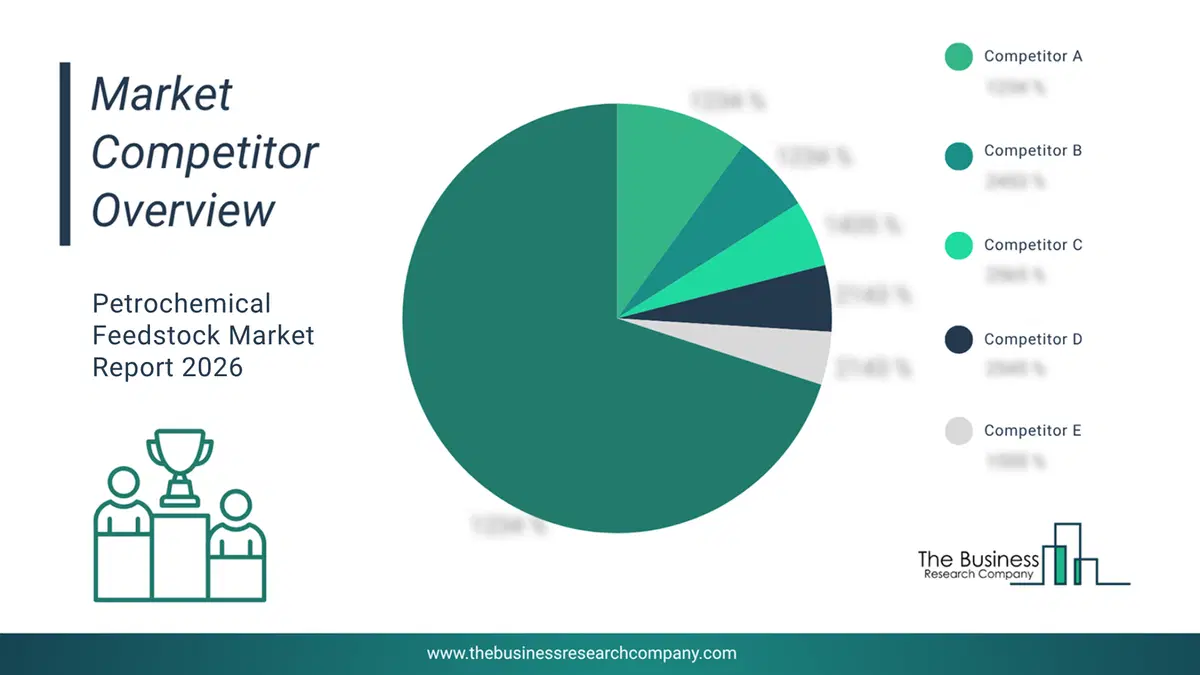
This chart is for illustrative purposes; the full report includes a detailed competitor analysis and comprehensive overview of the top 10 companies in the market.
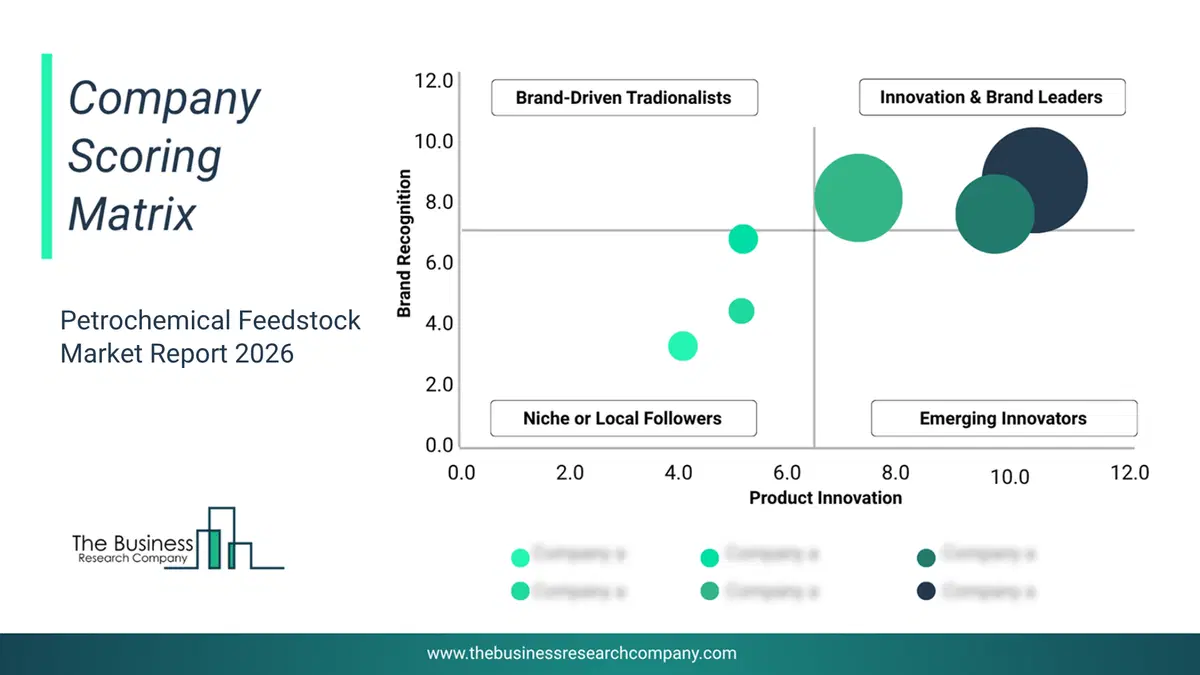
This chart maps companies by product innovation and brand strength, with bubble size indicating relative revenue, helping identify market leaders, challengers, and niche players. This is an illustrative chart; the full report provides a complete and accurate competitive analysis.
Global Petrochemical Feedstock Market Trends and Insights
Major companies operating in the petrochemical feedstock market are focusing on technological advancements in production, such as refinery ethane integration, to improve feedstock utilization, increase cracking efficiency, and reduce production costs. Refinery ethane integration is a production technology that recovers ethane from refinery off-gases and supplies it directly to ethylene crackers as a high-value petrochemical feedstock instead of using those gases as refinery fuel. For instance, in October 2025, Bright LyondellBasell Petrochemical Co., Limited (BLYB), a China-based petrochemical company, introduced the use of refinery ethane as a feedstock in its ethylene cracker unit. The initiative enables the production of approximately 330,000 tons of refinery ethane annually, transports the feedstock through a dedicated pipeline from the adjacent refinery, and improves ethylene yield while reducing transportation and storage costs through integrated operations.What Are Latest Mergers And Acquisitions In The Petrochemical Feedstock Market?
In January 2026, Oil and Natural Gas Corporation (ONGC), an India-based oil and gas exploration and production company, partnered with Mitsui O.S.K. Lines (MOL), to strengthen petrochemical feedstock logistics. Through this partnership, the companies will build two Very Large Ethane Carriers (VLECs) to transport imported ethane feedstock to ONGC Petro Additions Limited's (OPAL) petrochemical complex at Dahej, Gujarat. Mitsui O.S.K. Lines (MOL), a Japan-based global shipping company, provides specialized maritime transportation solutions for petrochemical feedstocks, including ethane and liquefied gas, through its fleet of Very Large Ethane Carriers (VLECs).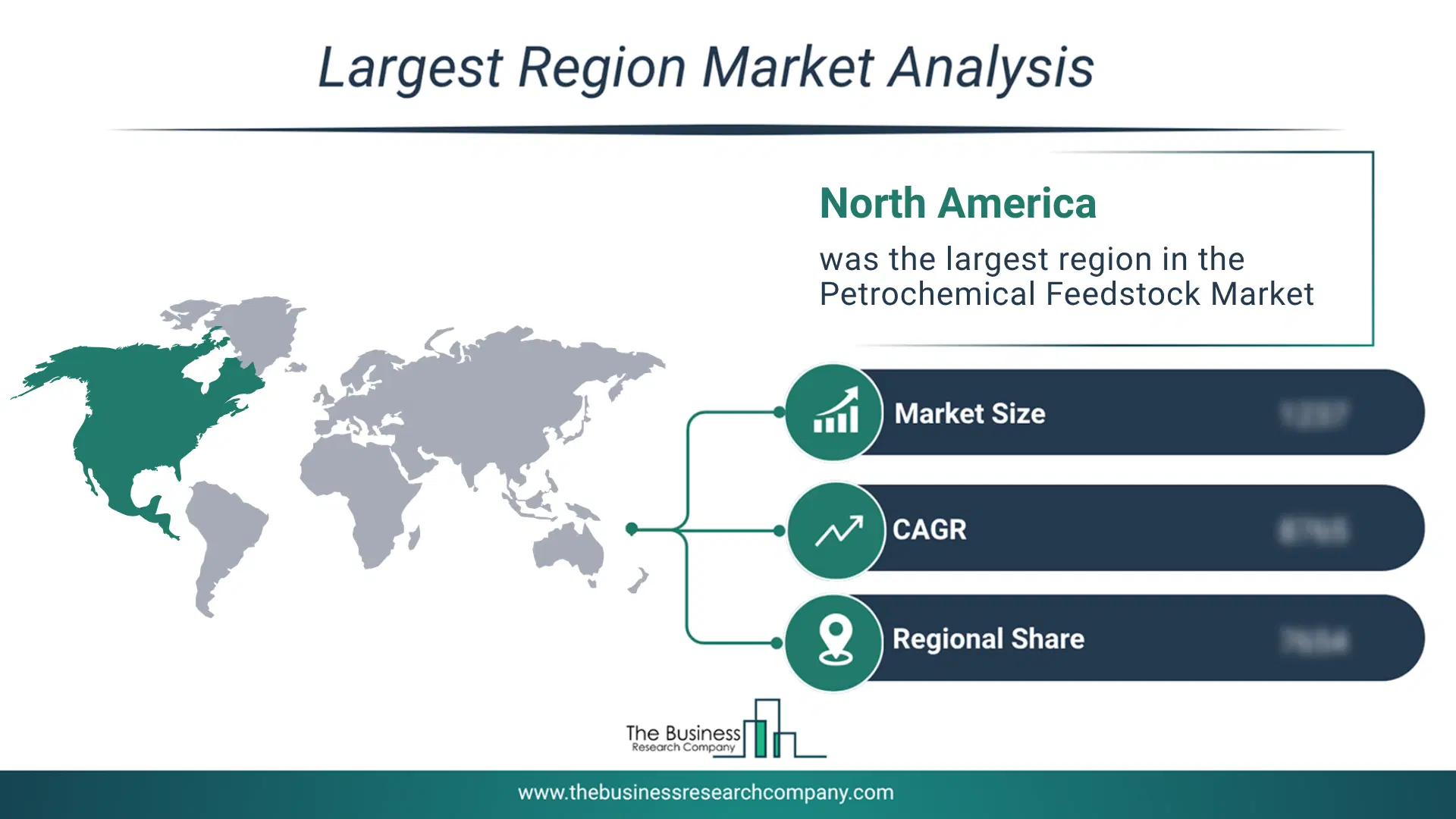
Regional Outlook
North America was the largest region in the petrochemical feedstock market in 2025. Asia-Pacific is expected to be the fastest-growing region in the forecast period. The regions covered in this market report are Asia-Pacific, South East Asia, Western Europe, Eastern Europe, North America, South America, Middle East, Africa. The countries covered in this market report are Australia, Brazil, China, France, Germany, India, Indonesia, Japan, Taiwan, Russia, South Korea, UK, USA, Canada, Italy, Spain.What Defines the Petrochemical Feedstock Market?
The petrochemical feedstock market consists of sales of refinery feedstocks, aromatic feedstocks, olefin feedstocks, synthesis gas, refinery off-gases, and other hydrocarbon raw materials. Values in this market are ‘factory gate’ values, that is the value of goods sold by the manufacturers or creators of the goods, whether to other entities (including downstream manufacturers, wholesalers, distributors and retailers) or directly to end customers. The value of goods in this market includes related services sold by the creators of the goods.How is Market Value Defined and Measured?
The market value is defined as the revenues that enterprises gain from the sale of goods and/or services within the specified market and geography through sales, grants, or donations in terms of the currency (in USD unless otherwise specified). The revenues for a specified geography are consumption values that are revenues generated by organizations in the specified geography within the market, irrespective of where they are produced. It does not include revenues from resales along the supply chain, either further along the supply chain or as part of other products.
This chart presents market attractiveness based on a quantitative evaluation of growth, competition, strategic alignment, and risk, offering a clear view of opportunity areas for decision-making. This chart is for illustrative purposes; the full report contains the complete analysis.

This chart highlights the Total Addressable Market (TAM) by estimating the maximum revenue opportunity using an assumption-driven approach, supporting strategic planning and opportunity sizing across markets. The chart is illustrative; the full report provides a more comprehensive analysis.
What Key Data and Analysis Are Included in the Petrochemical Feedstock Market Report 2026?
The petrochemical feedstock market research report is one of a series of new reports from The Business Research Company that provides market statistics, including industry global market size, regional shares, competitors with the market share, detailed market segments, market trends and opportunities, and any further data you may need to thrive in the petrochemical feedstock industry. The market research report delivers a complete perspective of everything you need, with an in-depth analysis of the current and future state of the industry.Petrochemical Feedstock Market Report Forecast Analysis
| Report Attribute | Details |
|---|---|
| Market Size Value In 2026 | $434.14 billion |
| Revenue Forecast In 2030 | $520.14 billion |
| Growth Rate | CAGR of 4.6% from 2026 to 2030 |
| Base Year For Estimation | 2025 |
| Actual Estimates/Historical Data | 2020-2025 |
| Forecast Period | 2026 - 2030 |
| Market Representation | Revenue in USD Billion and CAGR from 2026 to 2030 |
| Segments Covered | Feedstock Type, Source, Process Technology, Application, End Use Industry |
| Regional Scope | Asia-Pacific, Western Europe, Eastern Europe, North America, South America, Middle East, Africa |
| Country Scope | The countries covered in the report are Australia, Brazil, China, France, Germany, India, Indonesia, Japan, Taiwan, Russia, South Korea, UK, USA, Canada, Italy, Spain. |
| Key Companies Profiled | Saudi Arabian Oil Company, Exxon Mobil Corporation, China Petroleum & Chemical Corporation, TotalEnergies SE, Shell plc, China National Petroleum Corporation, BP p.l.c., BASF SE, Reliance Industries Limited, Saudi Basic Industries Corporation, Dow Inc., INEOS Group Holdings S.A., LyondellBasell Industries N.V., China National Offshore Oil Corporation, Formosa Plastics Corporation, Equinor ASA, Indian Oil Corporation Limited, Chevron Phillips Chemical Company LLC, Bharat Petroleum Corporation Limited, Oil and Natural Gas Corporation Limited, Westlake Corporation, Haldia Petrochemicals Limited |
| Customization Scope | Request for Customization |
| Pricing And Purchase Options | Explore Purchase Options |