
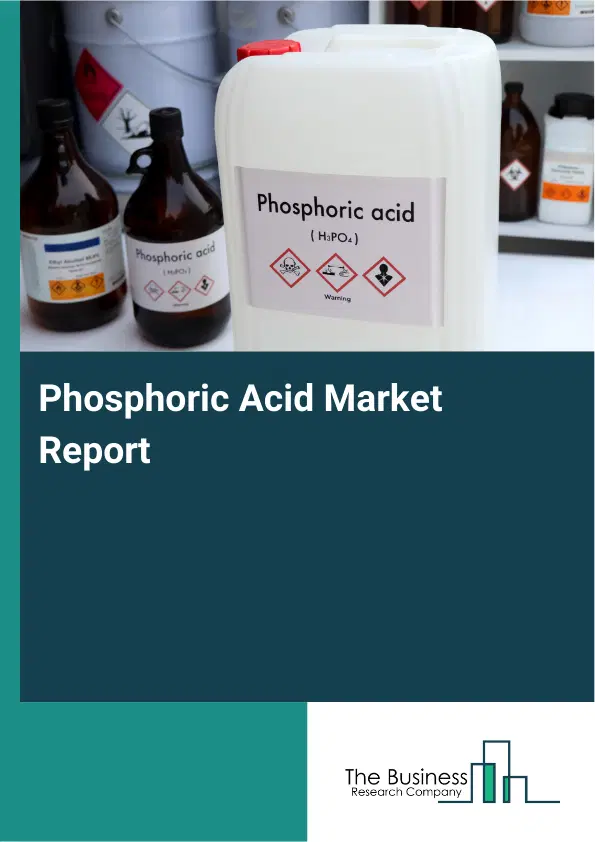
Phosphoric Acid Market Report 2026
Global Outlook – By Type (Food Grade, Agricultural Grade, Industrial Grade, Pharmaceutical Grade), By Form (Liquid Phosphoric Acid, Solid Phosphoric Acid), By Process Type (Wet Process Phosphoric Acid, Thermal Or Furnace Process Phosphoric Acid), By End-User (Fertilizer, Food and Beverages, Chemicals, Medicine, Metallurgy, Other End-Users ) – Market Size, Trends, Strategies, and Forecast to 2030
Phosphoric Acid Market Overview
• Phosphoric Acid market size has reached to $54.47 billion in 2025 • Expected to grow to $74.28 billion in 2030 at a compound annual growth rate (CAGR) of 6.3% • Growth Driver: Growing DI-Ammonium Phosphate (DAP) Fertilizer Demand Fuels Phosphoric Acid Market • Market Trend: Technological Advancements Reshaping The Phosphoric Acid Market • Asia-Pacific was the largest region and fastest growing region.What Is Covered Under Phosphoric Acid Market?
Phosphoric acid is a tricrotic acid that exists in the form of a dense liquid. It is corrosive to both human and laboratory animal skin, eyes, and mucous membranes. Dilute solutions of phosphoric acid have a pleasing acid taste. Thus, it is also used as a food additive, lending acidic properties to soft drinks and other prepared foods, and in water treatment products. Phosphoric acid is used as a component of fertilizers, detergents, and many household cleaning products. The main types of phosphoric acid are calcium phosphate, phosphoric acid, potassium phosphate, and sodium tripolyphosphate. Calcium phosphate is a calcium salt of phosphoric acid with a chemical formula of Ca3(PO4)2. It is also known as calcium phosphate tribasic or tricalcium phosphate and appears as a white amorphous or crystalline powder that is odorless and tasteless. The different process types include the furnace process, the dry kiln process, and others that have various grades such as food, agricultural, and industrial. The end-user industries using this acid are fertilizer, food and beverages, chemicals, medicine, metallurgy, and others.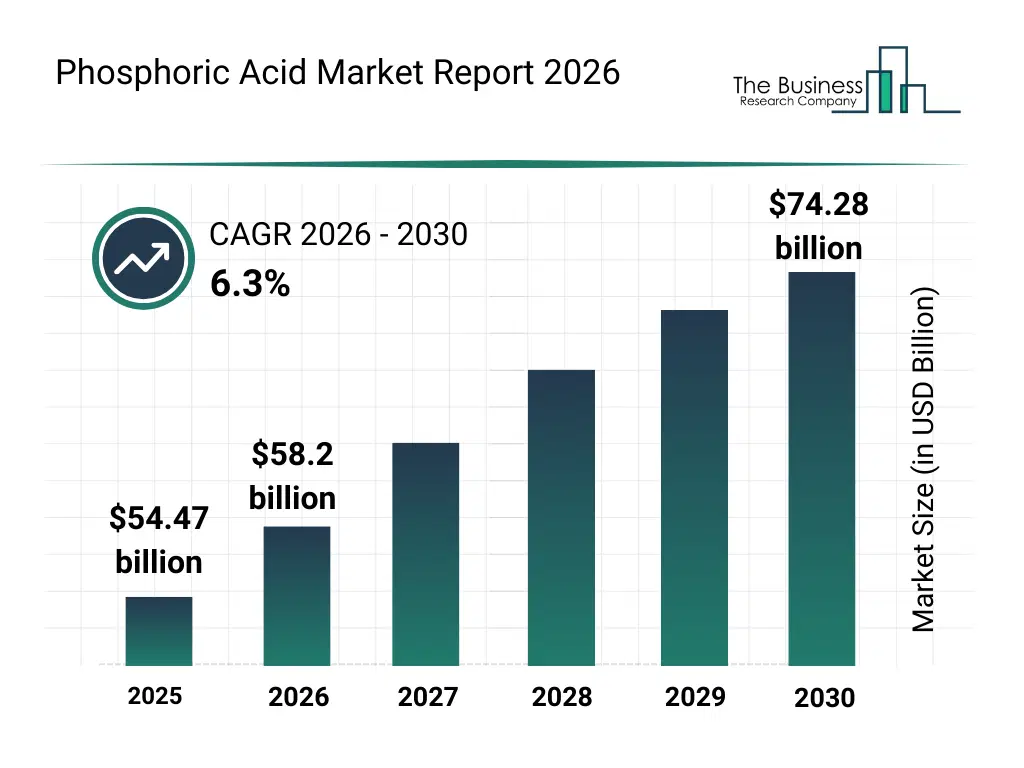
What Is The Phosphoric Acid Market Size and Share 2026?
The phosphoric acid market size has grown strongly in recent years. It will grow from $54.47 billion in 2025 to $58.2 billion in 2026 at a compound annual growth rate (CAGR) of 6.8%. The growth in the historic period can be attributed to expansion of global fertilizer consumption, growth of food and beverage manufacturing, rising demand for industrial cleaning agents, increasing use in water treatment chemicals, availability of phosphate rock reserves.What Is The Phosphoric Acid Market Growth Forecast?
The phosphoric acid market size is expected to see strong growth in the next few years. It will grow to $74.28 billion in 2030 at a compound annual growth rate (CAGR) of 6.3%. The growth in the forecast period can be attributed to increasing agricultural productivity requirements, rising demand for specialty phosphate chemicals, expansion of sustainable fertilizer solutions, growing focus on water quality management, increasing adoption in pharmaceutical formulations. Major trends in the forecast period include rising demand for high-purity phosphoric acid, increasing use in fertilizer production, growing application in food and beverage processing, expansion of water treatment applications, enhanced focus on efficient phosphate processing.
Global Phosphoric Acid Market Segmentation
1) By Type: Food Grade, Agricultural Grade, Industrial Grade, Pharmaceutical Grade 2) By Form: Liquid Phosphoric Acid, Solid Phosphoric Acid 3) By Process Type: Wet Process Phosphoric Acid, Thermal Or Furnace Process Phosphoric Acid 4) By End-User: Fertilizer, Food and Beverages, Chemicals, Medicine, Metallurgy, Other End-Users Subsegments: 1) By Food Grade: Beverage-Grade Phosphoric Acid, Processed Food-Grade Phosphoric Acid, High-Purity Food-Grade Phosphoric Acid 2) By Agricultural Grade: Fertilizer-Grade Phosphoric Acid, Technical-Grade Agricultural Phosphoric Acid 3) By Industrial Grade: Technical-Grade Phosphoric Acid, Metal Treatment-Grade Phosphoric Acid, Detergent and Cleaning-Grade Phosphoric Acid, Water Treatment-Grade Phosphoric Acid 4) By Pharmaceutical Grade: USP Or BP Or EP Grade Phosphoric Acid, High-Purity Pharmaceutical-Grade Phosphoric AcidWhat Is The Driver Of The Phosphoric Acid Market?
The increasing demand for di-ammonium phosphate (DAP) fertilizers is significantly contributing to the growth of the phosphoric acid market. Di-ammonium phosphate is one of a series of water-soluble ammonium phosphate salts that can be produced when ammonia reacts with phosphoric acid. Phosphoric acid is widely utilized in fertilizer production because its combination with finely ground phosphate produces triple superphosphate (TSP), monoammonium phosphate (MAP), and diammonium phosphate (DAP). For instance, according to the World Bank, a US-based international financial institution, phosphate DAP prices jumped 23% owing to increased demand by farmers across the world. Therefore, the increasing demand for DAP phosphate fertilizers is driving the demand for the phosphoric acid industry.Key Players In The Global Phosphoric Acid Market
Major companies operating in the phosphoric acid market are OCP Group, The Mosaic Company, Nutrien Ltd., PhosAgro (Public Joint Stock Company PhosAgro), EuroChem Group AG, ICL Group Ltd. (Israel Chemicals Ltd.), Yara International ASA, Prayon Group (Prayon S.A.), Jordan Phosphate Mines Company plc, Ma’aden (Saudi Arabian Mining Company), Lifosa (AB Lifosa, part of EuroChem Group AG), Gujarat Alkalies and Chemicals Ltd., Innophos Holdings, Inc., Wengfu Group Co., Ltd., Yuntianhua Group Co., Ltd., Grupa Azoty S.A., CF Industries Holdings, Inc., Hubei Xingfa Chemicals Group Co., Ltd., Chengxing Group Co., Ltd., Yunphos (Yunnan Phosphate Chemical Group Co., Ltd.), Tongling Nonferrous Metals Group Chemical Branch (Tongling Chemical Industry Group), Kailin Group Co., Ltd.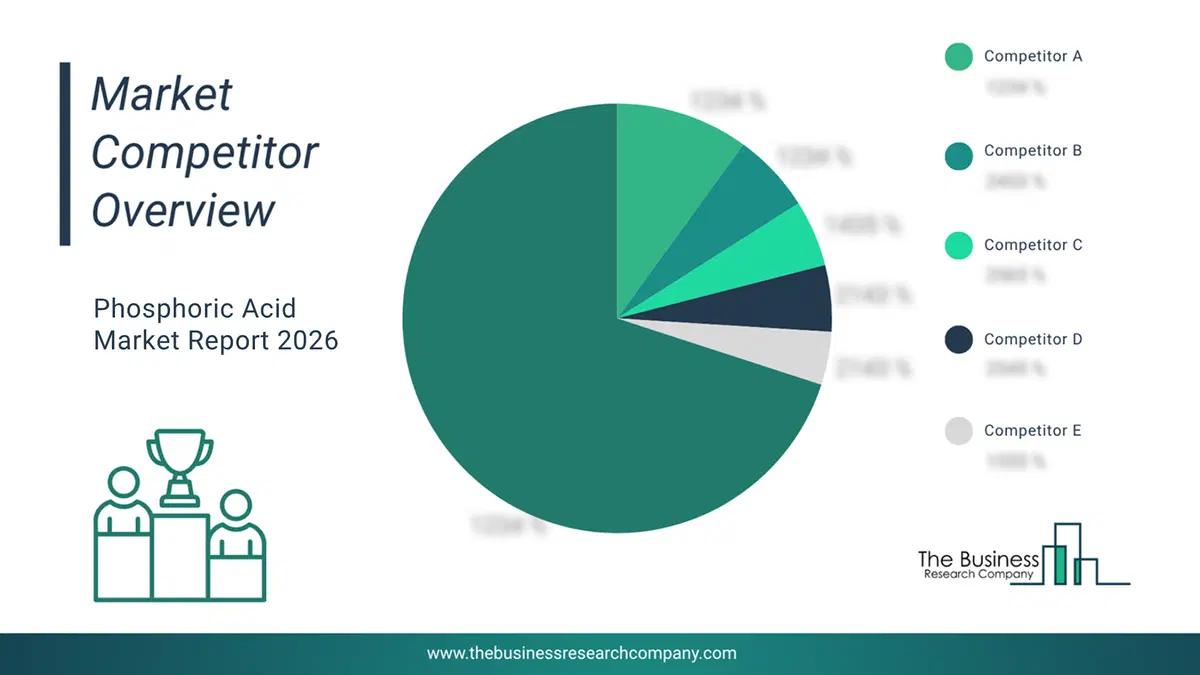
This chart is for illustrative purposes; the full report includes a detailed competitor analysis and comprehensive overview of the top 10 companies in the market.
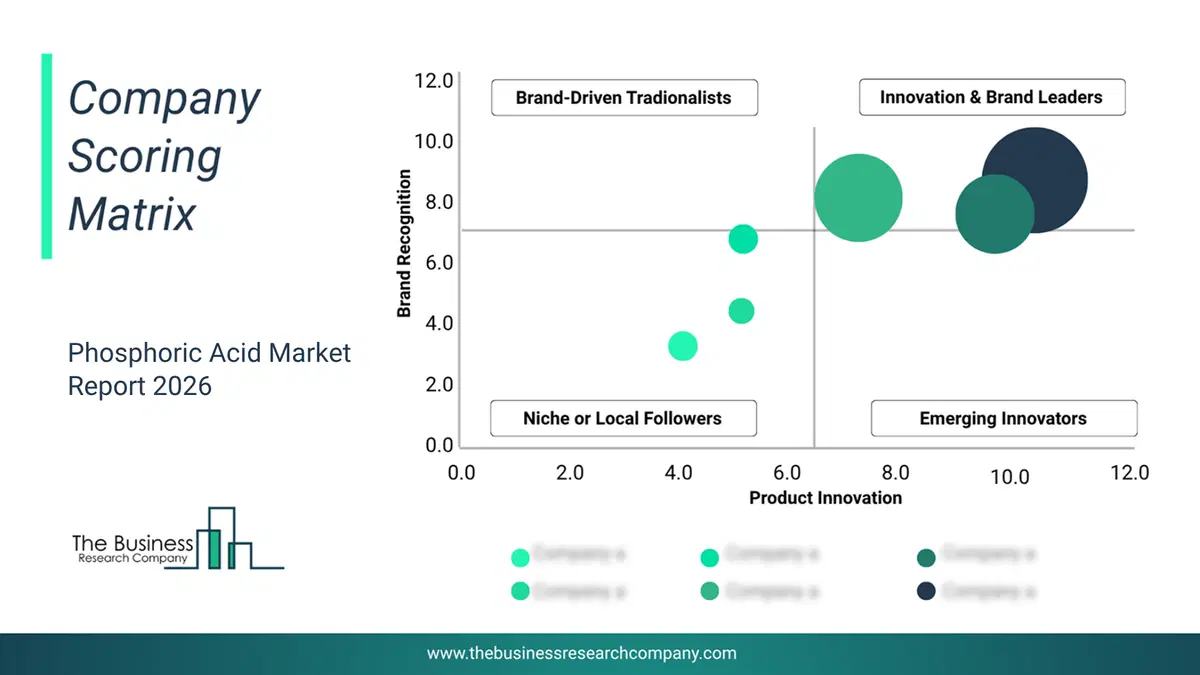
This chart maps companies by product innovation and brand strength, with bubble size indicating relative revenue, helping identify market leaders, challengers, and niche players. This is an illustrative chart; the full report provides a complete and accurate competitive analysis.
Global Phosphoric Acid Market Trends and Insights
Major companies operating in the phosphoric acid market are focusing on developing innovative advancements such as fluorinated phosphoric acid additives to enhance performance in high-efficiency photovoltaic and advanced material applications. Fluorinated phosphoric acid additives refer to specially engineered phosphoric acid derivatives designed to improve interfacial passivation, film quality, and overall device performance in next-generation solar and electronic technologies. For instance, in August 2024, researchers at Saitama University, a Japan-based national university, achieved a power conversion efficiency of 20.5% in a thin-film perovskite solar cell by incorporating fluorinated phosphoric acid (TPFP) into the absorber's precursor solution, enhancing passivation at the interface between the perovskite film and the hole transport layer. This innovative solar cell eliminates the need for traditional surface treatments and post-processing steps, showcasing improved efficiency, reduced hysteresis, and potential applicability in large-area deposition techniques.What Are Latest Mergers And Acquisitions In The Phosphoric Acid Market?
In April 2025, Jordan Phosphate Mines Company (JPMC), a Jordan-based provider of phosphate mining and phosphoric acid/raw phosphate, partnered with the government of Indonesia to establish a new phosphoric acid plant in Surabaya. With this partnership, the objective was to expand and secure long-term phosphoric acid production capacity to meet growing demand in Indonesia’s fertilizer market effectively doubling the existing joint venture capacity and strengthening JPMC’s export market footprint. The Indonesian government is Indonesia-based and serves as a strategic partner in expanding the nation’s domestic phosphoric acid production capabilities.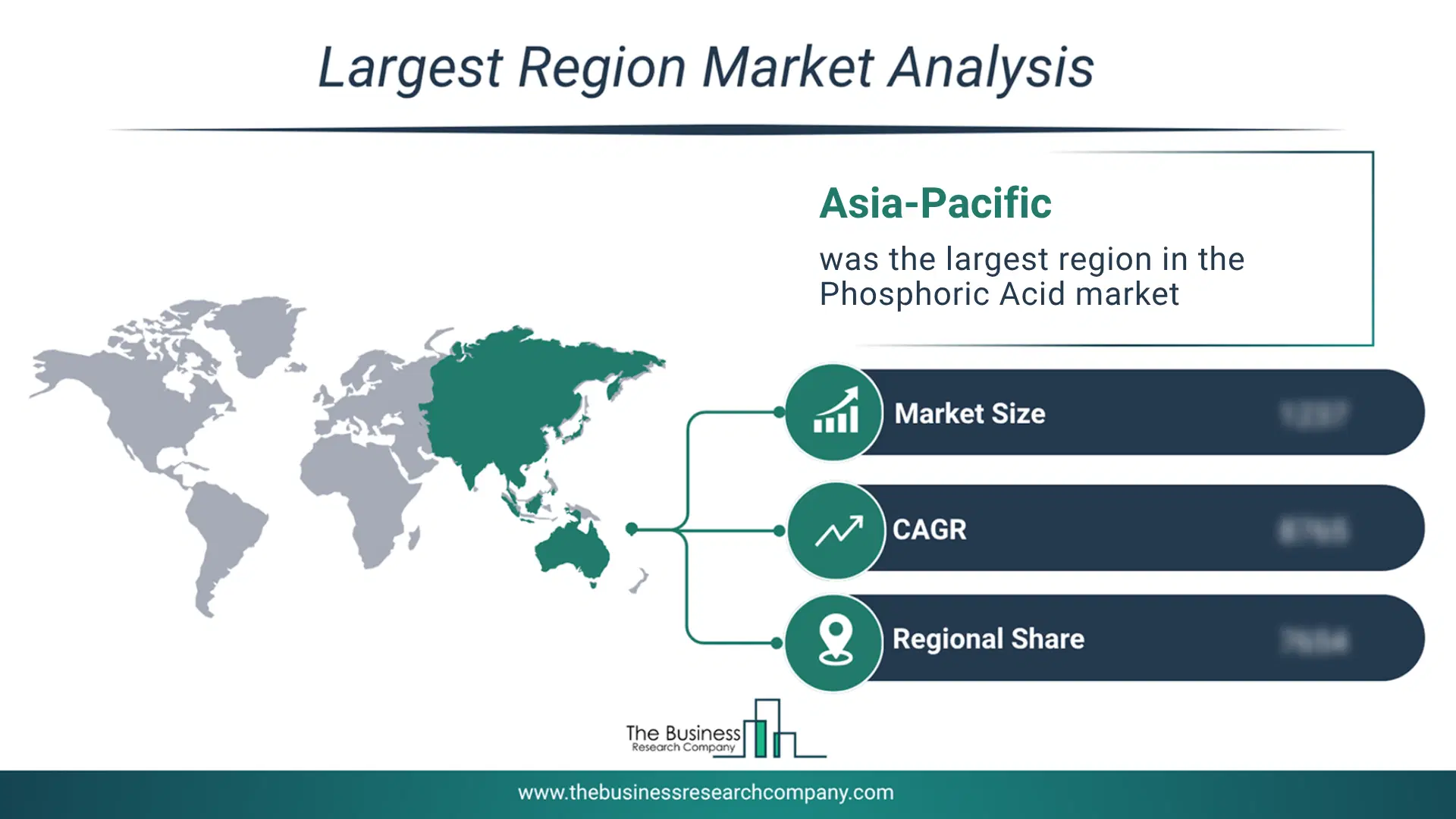
Regional Insights
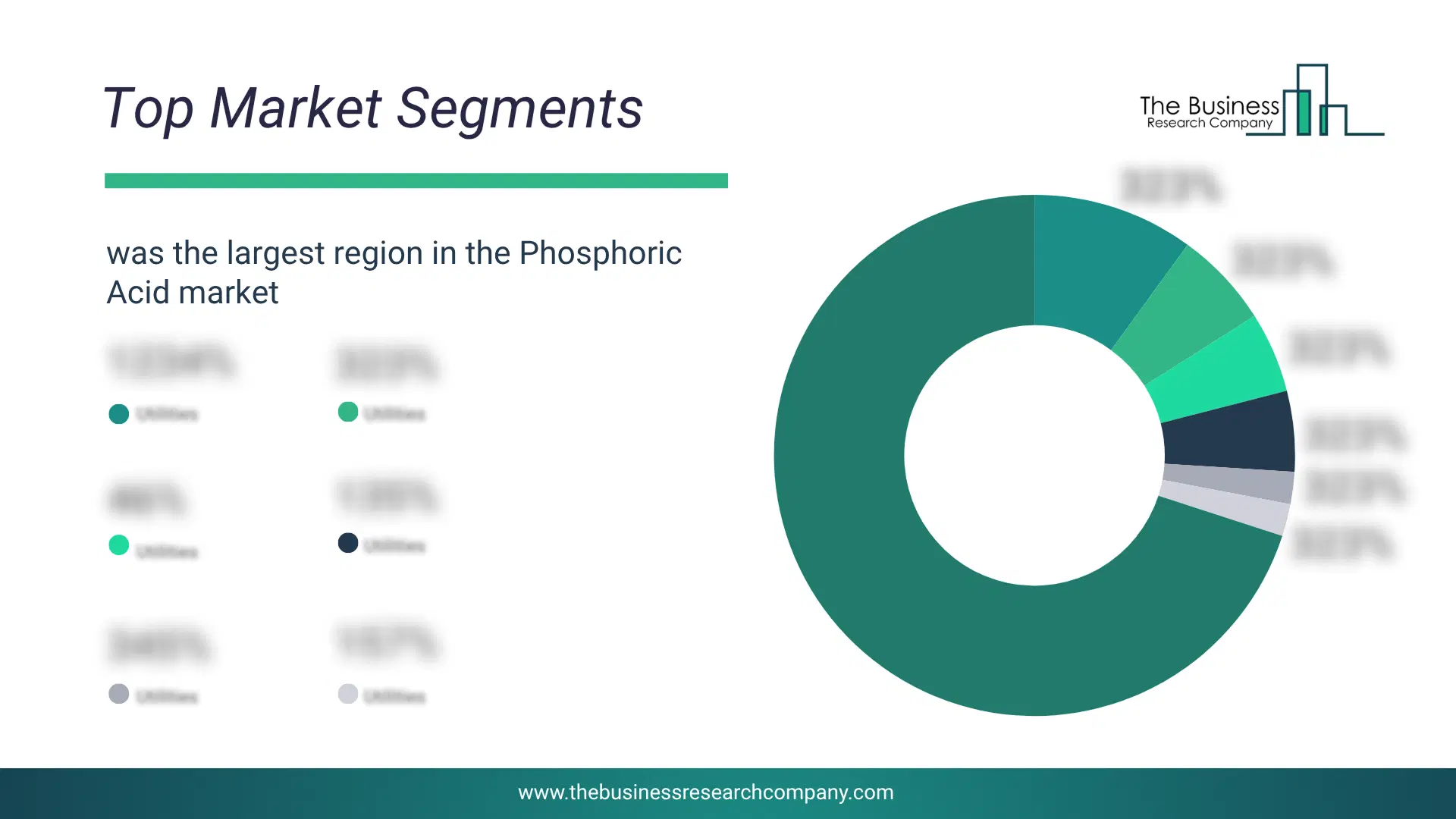
Asia-Pacific was the largest region in the phosphoric acid market in 2025. Asia-Pacific is expected to be the fastest-growing region in the forecast period. The regions covered in this market report are Asia-Pacific, South East Asia, Western Europe, Eastern Europe, North America, South America, Middle East, Africa The countries covered in this market report are Australia, Brazil, China, France, Germany, India, Indonesia, Japan, Taiwan, Russia, South Korea, UK, USA, Canada, Italy, SpainWhat Defines the Phosphoric Acid Market?
The phosphoric acid market consists of sales of hypophosphorous acid, orthophosphorous acid and pyrophosphoric acid. Values in this market are ‘factory gate’ values, that is the value of goods sold by the manufacturers or creators of the goods, whether to other entities (including downstream manufacturers, wholesalers, distributors, and retailers) or directly to end customers. The value of goods in this market includes related services sold by the creators of the goods.How is Market Value Defined and Measured?
The market value is defined as the revenues that enterprises gain from the sale of goods and/or services within the specified market and geography through sales, grants, or donations in terms of the currency (in USD unless otherwise specified). The revenues for a specified geography are consumption values that are revenues generated by organizations in the specified geography within the market, irrespective of where they are produced. It does not include revenues from resales along the supply chain, either further along the supply chain or as part of other products.
This chart presents market attractiveness based on a quantitative evaluation of growth, competition, strategic alignment, and risk, offering a clear view of opportunity areas for decision-making. This chart is for illustrative purposes; the full report contains the complete analysis.

This chart highlights the Total Addressable Market (TAM) by estimating the maximum revenue opportunity using an assumption-driven approach, supporting strategic planning and opportunity sizing across markets. The chart is illustrative; the full report provides a more comprehensive analysis.
What Key Data and Analysis Are Included in the Phosphoric Acid Market Report 2026?
The phosphoric acid market research report is one of a series of new reports from The Business Research Company that provides market statistics, including industry global market size, regional shares, competitors with the market share, detailed market segments, market trends and opportunities, and any further data you may need to thrive in the phosphoric acid industry. The market research report delivers a complete perspective of everything you need, with an in-depth analysis of the current and future state of the industry.Phosphoric Acid Market Report Forecast Analysis
| Report Attribute | Details |
|---|---|
| Market Size Value In 2026 | $58.2 billion |
| Revenue Forecast In 2030 | $74.28 billion |
| Growth Rate | CAGR of 6.8% from 2026 to 2030 |
| Base Year For Estimation | 2025 |
| Actual Estimates/Historical Data | 2020-2025 |
| Forecast Period | 2026 - 2030 |
| Market Representation | Revenue in USD Billion and CAGR from 2026 to 2030 |
| Segments Covered | Type, Form, Process Type, End-User |
| Regional Scope | Asia-Pacific, Western Europe, Eastern Europe, North America, South America, Middle East, Africa |
| Country Scope | The countries covered in this market report are Australia, Brazil, China, France, Germany, India, Indonesia, Japan, Taiwan, Russia, South Korea, UK, USA, Canada, Italy, Spain |
| Key Companies Profiled | OCP Group, The Mosaic Company, Nutrien Ltd., PhosAgro (Public Joint Stock Company PhosAgro), EuroChem Group AG, ICL Group Ltd. (Israel Chemicals Ltd.), Yara International ASA, Prayon Group (Prayon S.A.), Jordan Phosphate Mines Company plc, Ma’aden (Saudi Arabian Mining Company), Lifosa (AB Lifosa, part of EuroChem Group AG), Gujarat Alkalies and Chemicals Ltd., Innophos Holdings, Inc., Wengfu Group Co., Ltd., Yuntianhua Group Co., Ltd., Grupa Azoty S.A., CF Industries Holdings, Inc., Hubei Xingfa Chemicals Group Co., Ltd., Chengxing Group Co., Ltd., Yunphos (Yunnan Phosphate Chemical Group Co., Ltd.), Tongling Nonferrous Metals Group Chemical Branch (Tongling Chemical Industry Group), Kailin Group Co., Ltd. |
| Customization Scope | Request for Customization |
| Pricing And Purchase Options | Explore Purchase Options |