
Photochromic Lenses Market Report 2026
Global Outlook – By Material (Glass, Polycarbonate, Plastic, Other Materials), By Technology (Ultra-Violet (UV) And Visible Light, Imbibing And Trans-bonding, In Mass, Other Technologies), By Distribution Channel (Online, Optical Chains, Independent Eye Care Professionals (ECPs)), By Application (Corrective, Preventive) – Market Size, Trends, Strategies, and Forecast to 2030
Photochromic Lenses Market Overview
• Photochromic Lenses market size has reached to $6.98 billion in 2025 • Expected to grow to $9.48 billion in 2030 at a compound annual growth rate (CAGR) of 6.2% • Growth Driver: Rising Eye Disorders Propel Growth in the Photochromic Lenses Market • Market Trend: Advanced Solutions Enhanced The Photochromic Lenses Market • North America was the largest region in 2025 and Asia-Pacific is the fastest growing region.What Is Covered Under Photochromic Lenses Market?
Photochromic lenses refer to specialized optical lenses that darken in response to ultraviolet (UV) light exposure and light when UV light is reduced or absent. These lenses are utilized in eyewear to provide adaptive protection from sunlight, offering convenience by eliminating the need to switch between regular glasses and sunglasses. The main materials of photochromic lenses are glass, polycarbonate, plastic, and other materials. Glass photochromic lenses are made from high-quality glass that changes tint when exposed to sunlight. These lenses utilize various technologies, including ultra-violet (UV) and visible light, imbibing and trans-bonding, in mass, and others. They are distributed through online channels, optical chains, and independent eye care professionals (ECPs) for a variety of applications, such as corrective and preventive.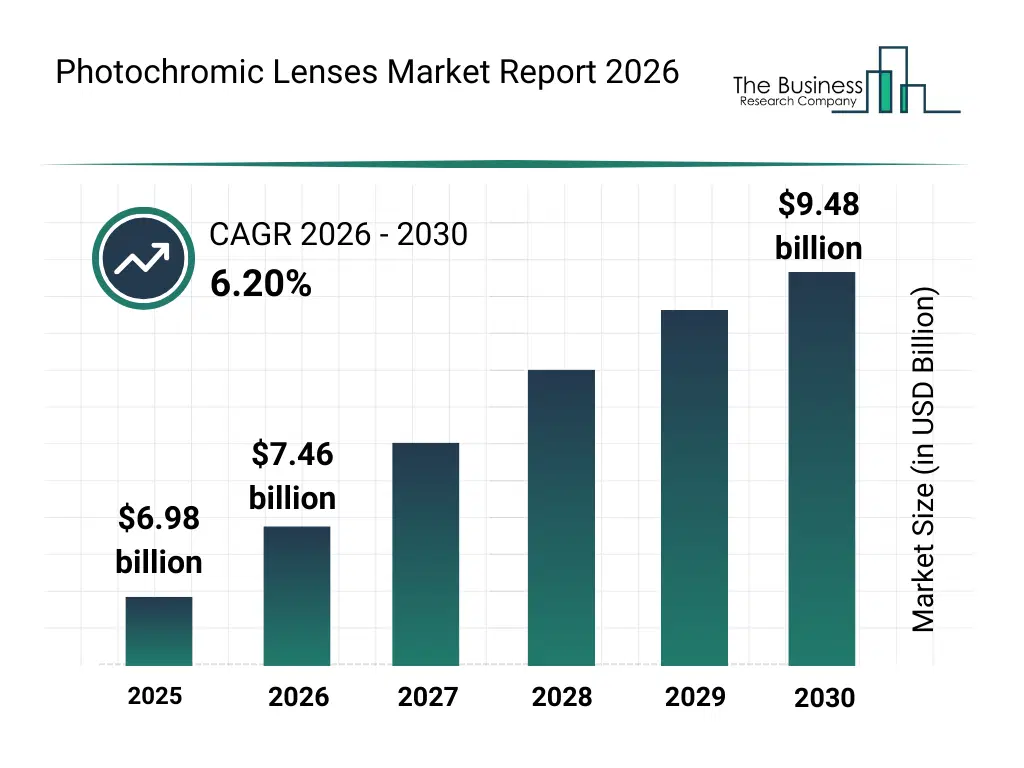
What Is The Photochromic Lenses Market Size and Share 2026?
The photochromic lenses market size has grown strongly in recent years. It will grow from $6.98 billion in 2025 to $7.46 billion in 2026 at a compound annual growth rate (CAGR) of 7.0%. The growth in the historic period can be attributed to rising prevalence of vision correction needs, increased consumer awareness of uv eye protection, expansion of optical retail networks, growth in prescription eyewear adoption, advancements in lens material science.What Is The Photochromic Lenses Market Growth Forecast?
The photochromic lenses market size is expected to see strong growth in the next few years. It will grow to $9.48 billion in 2030 at a compound annual growth rate (CAGR) of 6.2%. The growth in the forecast period can be attributed to growing demand for adaptive eyewear solutions, rising adoption of premium optical products, expansion of online eyewear distribution, increasing focus on sustainable lens materials, continuous innovation in photochromic technologies. Major trends in the forecast period include advancements in faster light-responsive lens materials, growing demand for scratch-resistant and durable coatings, rising adoption of lightweight high-index lenses, increased focus on aesthetic and fashion-oriented designs, expansion of uv-protection integrated eyewear.
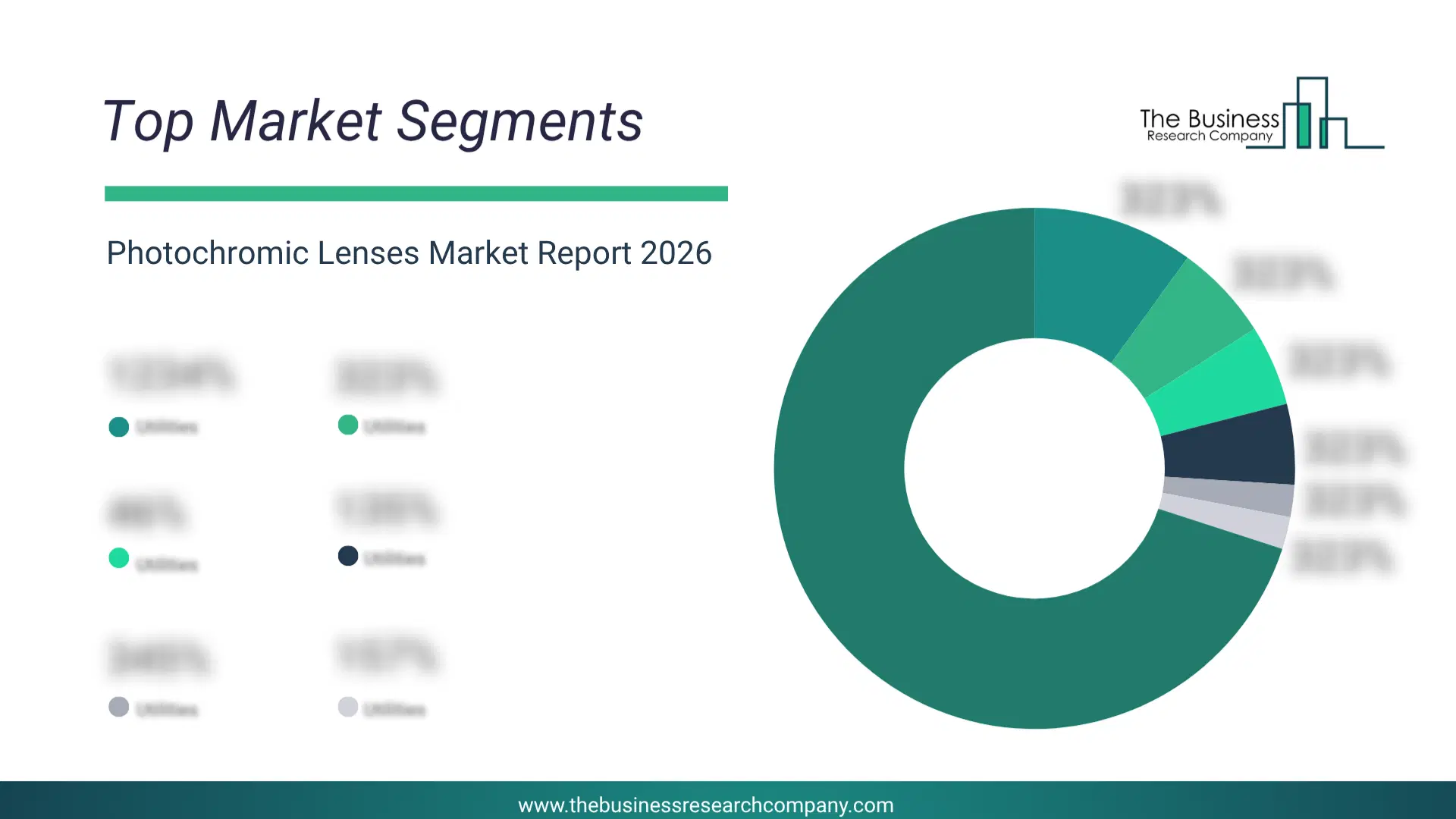
Global Photochromic Lenses Market Segmentation
1) By Material: Glass, Polycarbonate, Plastic, Other Materials 2) By Technology: Ultra-Violet (UV) And Visible Light, Imbibing And Trans-bonding, In Mass, Other Technologies 3) By Distribution Channel: Online, Optical Chains, Independent Eye Care Professionals (ECPs) 4) By Application: Corrective, Preventive Subsegments: 1) By Glass: Standard Glass Photochromic Lenses, High-Index Glass Photochromic Lenses, Ultra-Thin Glass Photochromic Lenses, Glass Lenses With Scratch-Resistant Coatings, Glass Lenses For Prescription Eyewear 2) By Polycarbonate: Standard Polycarbonate Photochromic Lenses, High-Impact Polycarbonate Photochromic Lenses, Polycarbonate Lenses For Sports Eyewear, Polycarbonate Lenses With UV Protection, Polycarbonate Lenses For Children’s Eyewear 3) By Plastic: Standard Plastic Photochromic Lenses (CR-39), High-Index Plastic Photochromic Lenses, Lightweight Plastic Photochromic Lenses, Plastic Lenses With Anti-Reflective Coatings, Plastic Lenses For Fashion Eyewear 4) By Other Materials: Trivex Photochromic Lenses, Acrylic Photochromic Lenses, Biodegradable Plastic Photochromic Lenses, Polyurethane Photochromic Lenses, Photochromic Lenses Made From Recycled MaterialsWhat Are The Drivers Of The Photochromic Lenses Market?
The increasing prevalence of eye-related disorders is expected to propel the growth of the photochromic lenses market moving forward. Eye-related disorders refer to a range of conditions affecting the eyes that can impair vision and overall eye health, such as myopia, cataracts, glaucoma, and age-related macular degeneration. The rising occurrence of eye-related disorders is fueled by aging populations, increased screen time, environmental pollution, poor diet, and higher rates of chronic conditions such as diabetes. Photochromic lenses help alleviate eye strain and provide UV protection, offering comfort and improved visual health for individuals with eye-related disorders. For instance, in July 2025, according to the UK government’s vision health profile, there were nearly 3.7 million people who attended 9.8 million hospital outpatient appointments for vision in England in the financial year ending 2024, and rates of cataract surgery and injection therapy significantly increased. Therefore, the rising demand for clinical eye-care services reinforces demand for adaptive optical solutions like photochromic lenses. The growing geriatric population is expected to propel the growth of the photochromic lenses market moving forward. The geriatric population refers to older adults, typically aged 65 years and above, who often require specialized healthcare and support due to age-related physiological changes. The growing geriatric population is primarily due to increasing life expectancy, which allows people to live longer, and declining birth rates, which reduce the proportion of younger individuals in the population. Photochromic lenses support the geriatric population by automatically adjusting to changing light conditions, reducing glare, enhancing visual comfort, and minimizing eye strain, which is particularly beneficial for age-related sensitivity to bright light. For instance, in July 2024, according to the UK Parliament's House of Commons Library, a UK-based government administration, in 2022, there were 12.7 million people aged 65 or older in the UK, representing 19% of the total population. This number is projected to rise to 22.1 million by 2072, accounting for 27% of the population. Therefore, the growing geriatric population is driving the growth of the photochromic lenses industry.Key Players In The Global Photochromic Lenses Market
Major companies operating in the photochromic lenses market are EssilorLuxottica SA, Mitsui Chemicals Inc., Carl Zeiss AG, HOYA Corporation, Rodenstock GmbH, Shanghai Conant Optics Co. Ltd., Younger Optics Inc., Vision Ease LP, Signet Armorlite Inc., SEIKO Optical Europe GmbH, S.T International Ltd, Optiswiss AG, GKB Optic Technologies Pvt. Ltd., Nikon Lenswear, BBGR Ltd, Norville Opticians Co, Tokai Optical Co. Ltd., Shamir Optical Industry Ltd., Indo Optical Company, Essilor India Pvt. Ltd.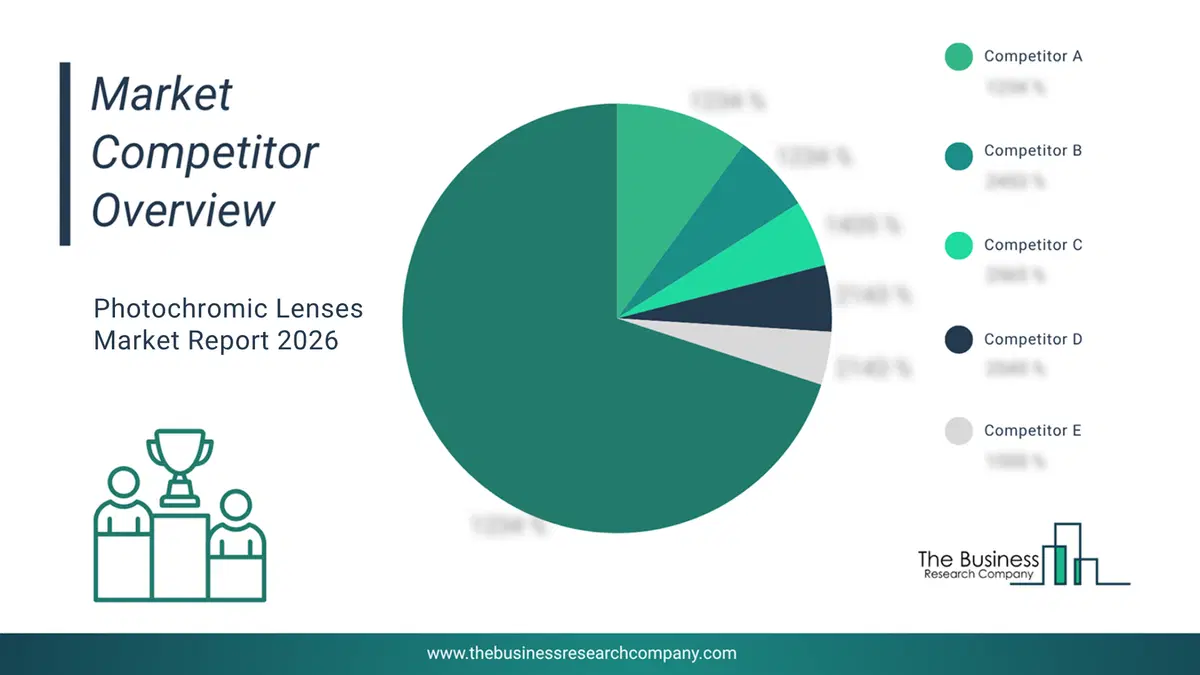
This chart is for illustrative purposes; the full report includes a detailed competitor analysis and comprehensive overview of the top 10 companies in the market.
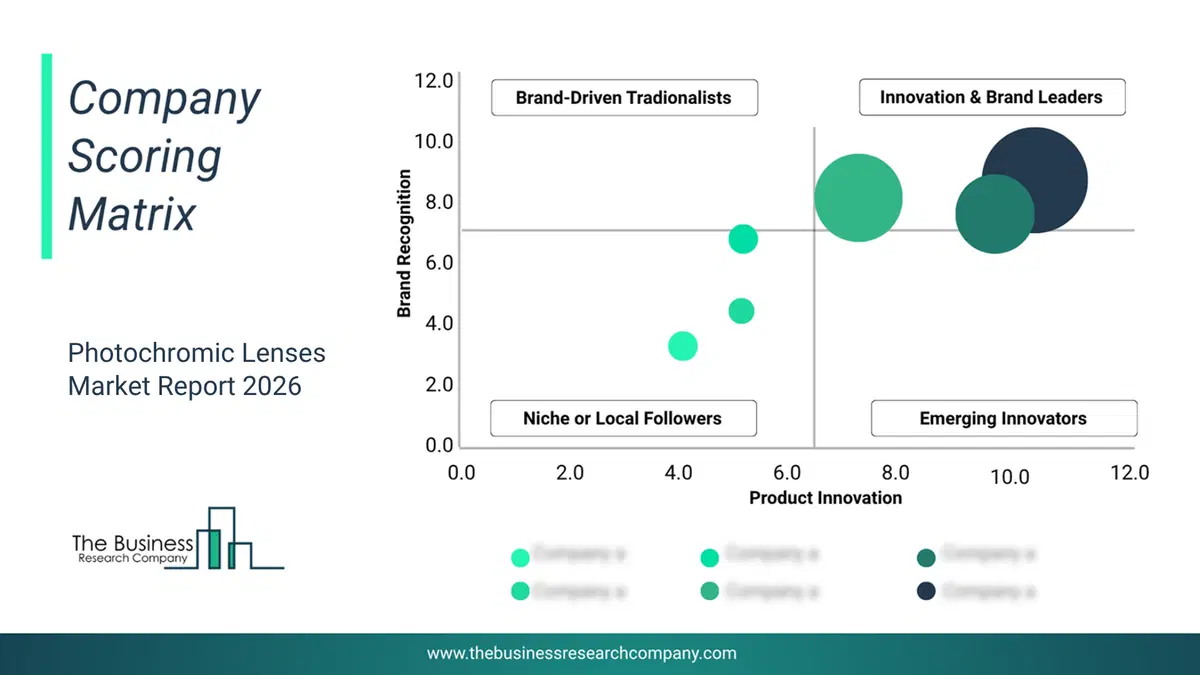
This chart maps companies by product innovation and brand strength, with bubble size indicating relative revenue, helping identify market leaders, challengers, and niche players. This is an illustrative chart; the full report provides a complete and accurate competitive analysis.
Global Photochromic Lenses Market Trends and Insights
Major companies operating in the photochromic lenses market are focusing on developing innovative photochromic lenses to enhance the user experience with improved clarity, faster transition times, and better UV protection. An innovative photochromic lens is an optical device that automatically adjusts its tint in response to varying light conditions, providing enhanced visual comfort and protection. For instance, in May 2024, LensCrafters, a US-based optical company, launched Transitions GEN S. This new product offers ultra-responsive light adaptation, a wide range of vibrant colors at different darkness levels, and improved UV and blue-violet light protection. These features address consumers' needs for smooth visual transitions and robust eye protection.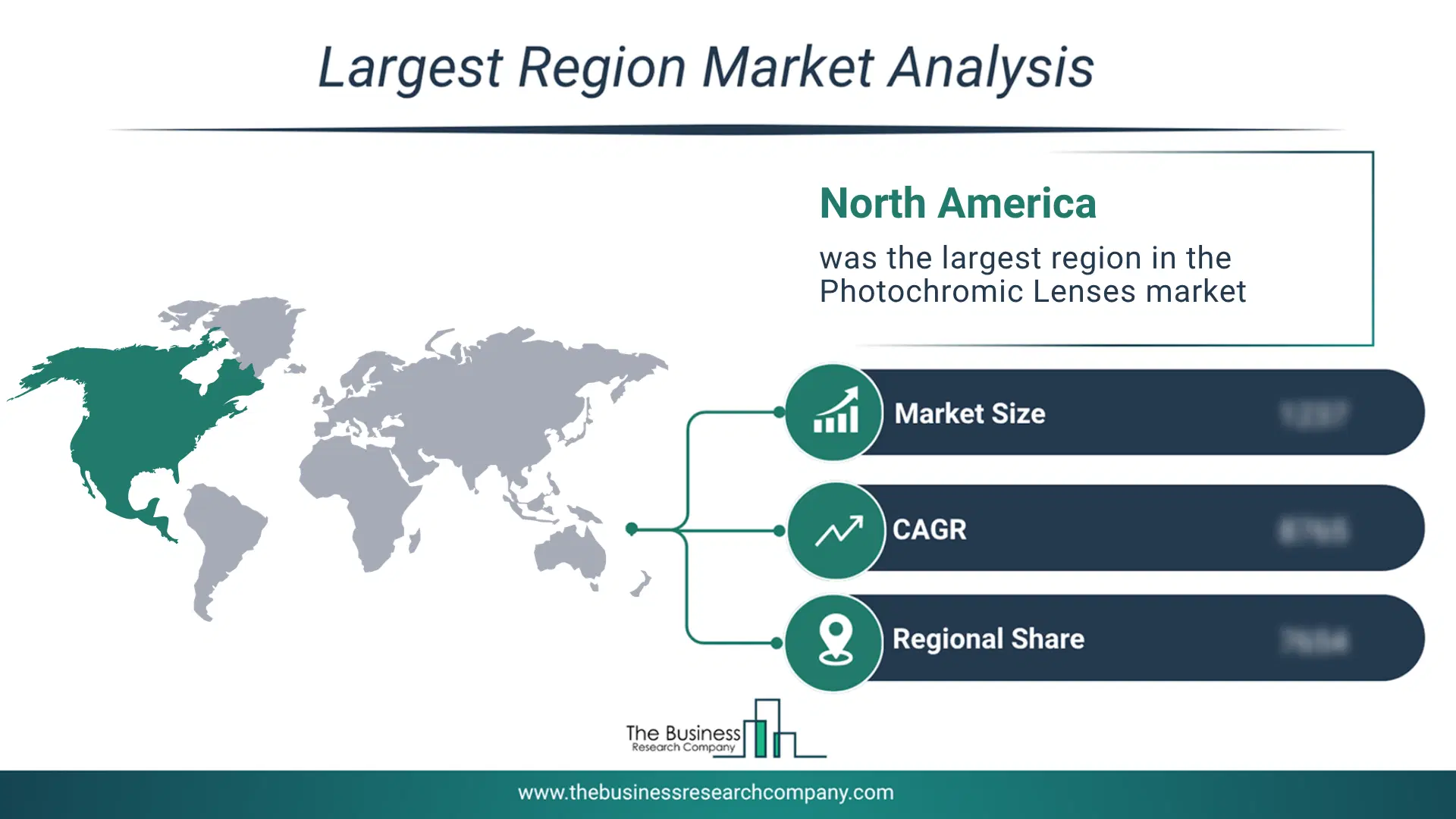
Regional Outlook
North America was the largest region in the photochromic lenses market in 2025. Asia-Pacific is expected to be the fastest-growing region in the forecast period. The regions covered in this market report are Asia-Pacific, South East Asia, Western Europe, Eastern Europe, North America, South America, Middle East, Africa. The countries covered in this market report are Australia, Brazil, China, France, Germany, India, Indonesia, Japan, Taiwan, Russia, South Korea, UK, USA, Canada, Italy, SpainWhat Defines the Photochromic Lenses Market?
The photochromic lenses market consists of sales of high-index lenses, blue-light filtering lenses, progressive lenses, mirrored lenses, polarized lenses, and anti-reflective coated lenses. Values in this market are ‘factory gate’ values, that is the value of goods sold by the manufacturers or creators of the goods, whether to other entities (including downstream manufacturers, wholesalers, distributors and retailers) or directly to end customers. The value of goods in this market includes related services sold by the creators of the goods.How is Market Value Defined and Measured?
The market value is defined as the revenues that enterprises gain from the sale of goods and/or services within the specified market and geography through sales, grants, or donations in terms of the currency (in USD unless otherwise specified). The revenues for a specified geography are consumption values that are revenues generated by organizations in the specified geography within the market, irrespective of where they are produced. It does not include revenues from resales along the supply chain, either further along the supply chain or as part of other products.
This chart presents market attractiveness based on a quantitative evaluation of growth, competition, strategic alignment, and risk, offering a clear view of opportunity areas for decision-making. This chart is for illustrative purposes; the full report contains the complete analysis.

This chart highlights the Total Addressable Market (TAM) by estimating the maximum revenue opportunity using an assumption-driven approach, supporting strategic planning and opportunity sizing across markets. The chart is illustrative; the full report provides a more comprehensive analysis.
What Key Data and Analysis Are Included in the Photochromic Lenses Market Report 2026?
The photochromic lenses market research report is one of a series of new reports from The Business Research Company that provides market statistics, including industry global market size, regional shares, competitors with the market share, detailed market segments, market trends and opportunities, and any further data you may need to thrive in the photochromic lenses industry. The market research report delivers a complete perspective of everything you need, with an in-depth analysis of the current and future state of the industry.Photochromic Lenses Market Report Forecast Analysis
| Report Attribute | Details |
|---|---|
| Market Size Value In 2026 | $7.46 billion |
| Revenue Forecast In 2030 | $9.48 billion |
| Growth Rate | CAGR of 6.2% from 2026 to 2030 |
| Base Year For Estimation | 2025 |
| Actual Estimates/Historical Data | 2020-2025 |
| Forecast Period | 2026 - 2030 |
| Market Representation | Revenue in USD Billion and CAGR from 2026 to 2030 |
| Segments Covered | Material, Technology, Distribution Channel, Application |
| Regional Scope | Asia-Pacific, Western Europe, Eastern Europe, North America, South America, Middle East, Africa |
| Country Scope | The countries covered in the report are Australia, Brazil, China, France, Germany, India, Indonesia, Japan, Taiwan, Russia, South Korea, UK, USA, Canada, Italy, Spain. |
| Key Companies Profiled | EssilorLuxottica SA, Mitsui Chemicals Inc., Carl Zeiss AG, HOYA Corporation, Rodenstock GmbH, Shanghai Conant Optics Co. Ltd., Younger Optics Inc., Vision Ease LP, Signet Armorlite Inc., SEIKO Optical Europe GmbH, S.T International Ltd, Optiswiss AG, GKB Optic Technologies Pvt. Ltd., Nikon Lenswear, BBGR Ltd, Norville Opticians Co, Tokai Optical Co. Ltd., Shamir Optical Industry Ltd., Indo Optical Company, Essilor India Pvt. Ltd. |
| Customization Scope | Request for Customization |
| Pricing And Purchase Options | Explore Purchase Options |