
Photonic Integrated Circuits Market Report 2026
Global Outlook – By Component (Lasers, Modulators, Detectors, Multiplexers, Optical Amplifiers, Other Components), By Material (Indium Phosphide, Silicon, Lithium Niobate, Gallium Arsenide, Other Materials), By Application (Optical Communication, Sensing, Biophotonics, Optical Signal Processing, Other Applications), By End-Users (Telecommunications, Healthcare, Data Centres, Defense And Security, Other End Users) – Market Size, Trends, Strategies, and Forecast to 2030
Photonic Integrated Circuits Market Overview
• Photonic Integrated Circuits market size has reached to $14.25 billion in 2025 • Expected to grow to $34.60 billion in 2030 at a compound annual growth rate (CAGR) of 19.3% • Growth Driver: Increasing Adoption Of High-Speed Optical Communication Systems Driving The Growth Of The Market Due To Rising Demand For Faster And More Efficient Digital Network Infrastructure • Market Trend: Accelerating Optical Connectivity With High-Bandwidth Silicon Photonics And Compact Photonic Integration • North America was the largest region in 2025 and Asia-Pacific is the fastest growing region.What Is Covered Under Photonic Integrated Circuits Market?
The photonic integrated circuits are compact devices that combine multiple optical components on a single chip to guide and control light. They enable high-speed data transmission and signal processing using optical pathways instead of electrical conduction. These circuits offer improved efficiency, reduced power usage, and enhanced performance for advanced optical systems. The main components of photonic integrated circuits include lasers, modulators, detectors, multiplexers, optical amplifiers, and other components. Lasers refer to devices that emit a concentrated and coherent beam of light used for communication, sensing, and signal processing in photonic circuits. The materials used include indium phosphide, silicon, lithium niobate, gallium arsenide, and others. The applications include optical communication, sensing, biophotonics, optical signal processing, and others, catering to key end users such as telecommunications companies, healthcare providers, data centres, defense and security organizations, and others.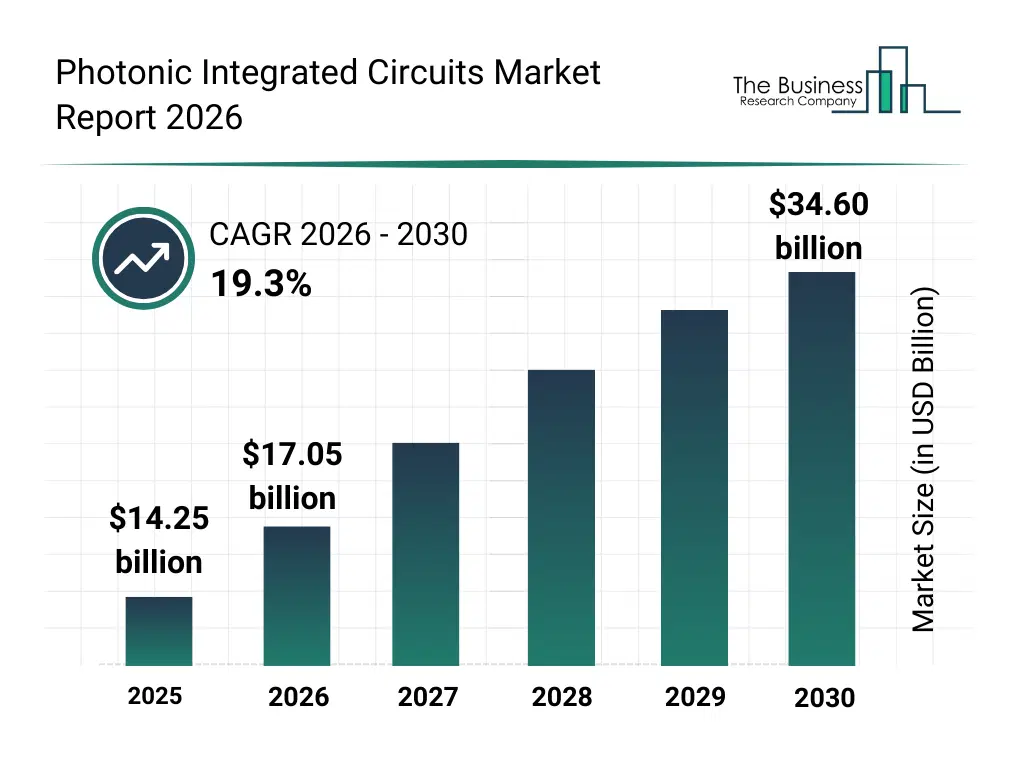
What Is The Photonic Integrated Circuits Market Size and Share 2026?
The photonic integrated circuits market size has grown rapidly in recent years. It will grow from $14.25 billion in 2025 to $17.05 billion in 2026 at a compound annual growth rate (CAGR) of 19.7%. The growth in the historic period can be attributed to growing demand for high-speed data transmission, increasing adoption of optical communication systems, expansion of telecommunication infrastructure, rising use of energy-efficient devices, and increasing integration of photonics in consumer electronics.What Is The Photonic Integrated Circuits Market Growth Forecast?
The photonic integrated circuits market size is expected to see rapid growth in the next few years. It will grow to $34.60 billion in 2030 at a compound annual growth rate (CAGR) of 19.3%. The growth in the forecast period can be attributed to rising deployment of silicon photonics, increasing need for compact optical components, growing investments in data centers, expansion of cloud computing infrastructure, and increasing demand for 5G and beyond networks. Major trends in the forecast period include technology advancements in photonic integration, innovations in optical chip design, developments in low-power photonic circuits, research and developments in advanced materials, and breakthroughs in miniaturized optical components.
Global Photonic Integrated Circuits Market Segmentation
1) By Component: Lasers, Modulators, Detectors, Multiplexers, Optical Amplifiers, Other Components 2) By Material: Indium Phosphide, Silicon, Lithium Niobate, Gallium Arsenide, Other Materials 3) By Application: Optical Communication, Sensing, Biophotonics, Optical Signal Processing, Other Applications 4) By End-Users: Telecommunications, Healthcare, Data Centres, Defense And Security, Other End Users Subsegments: 1) By Lasers: Distributed Feedback Laser, Vertical Cavity Surface Emitting Laser, Fabry Perot Laser, Quantum Cascade Laser 2) By Modulators: Electro Optic Modulator, Mach Zehnder Modulator, Microring Modulator, Phase Modulator 3) By Detectors: Photodiode, Avalanche Photodiode, PIN Photodetector, Quantum Dot Photodetector 4) By Multiplexers: Wavelength Division Multiplexer, Arrayed Waveguide Grating, Planar Lightwave Circuit Multiplexer, Optical Add Drop Multiplexer 5) By Optical Amplifiers: Semiconductor Optical Amplifier, Erbium Doped Waveguide Amplifier, Raman Amplifier, Optical Parametric Amplifier 6) By Other Components: Optical Switch, Optical Coupler, Waveguide, Optical FilterWhat Is The Driver Of The Photonic Integrated Circuits Market?
The increasing adoption of high speed optical communication systems is expected to propel the growth of the photonic integrated circuits market going forward. High speed optical communication systems use light to transmit large volumes of data rapidly over optical fiber or through optical networks, and they are essential for modern digital infrastructure. Demand for high speed optical communication systems is rising because global internet usage and fixed broadband expectations are increasing, pushing network operators and service providers to upgrade from legacy technologies to fiber based high speed connectivity. The photonic integrated circuits supports high speed optical communication systems by enabling more compact, energy efficient, and higher capacity photonic components that improve signal transmission performance and reduce costs for network deployments. For instance, in May 2025, according to the Federal Communications Commission, a US-based government agency, as of June 30, 2024, there were 133 million fixed broadband connections in the United States, up 2.3% from June 2023, with 24.5% being optical carrier connections and 26.0% of fixed connections delivering at least 940 megabits per second, indicative of full-fiber gigabit-class services. Therefore, the increasing adoption of high speed optical communication systems is driving the growth of the photonic integrated circuits industry.Key Players In The Global Photonic Integrated Circuits Market
Major companies operating in the photonic integrated circuits market are STMicroelectronics N.V., GlobalFoundries Inc., Coherent Inc., MACOM Technology Solutions Holdings Inc., PsiQuantum Corporation, Ayar Labs Inc., Smart Photonics B.V., DustPhotonics Ltd., Lightmatter Inc., Sivers Semiconductors AB, LioniX International B.V., PHIX Photonics Assembly B.V., LIGENTEC SA, QuiX Quantum B.V., Lightelligence Inc., Pilot Photonics Inc., HyperLight Corporation, Scintil Photonics B.V., VLC Photonics S.L., Applied Nanotools Inc.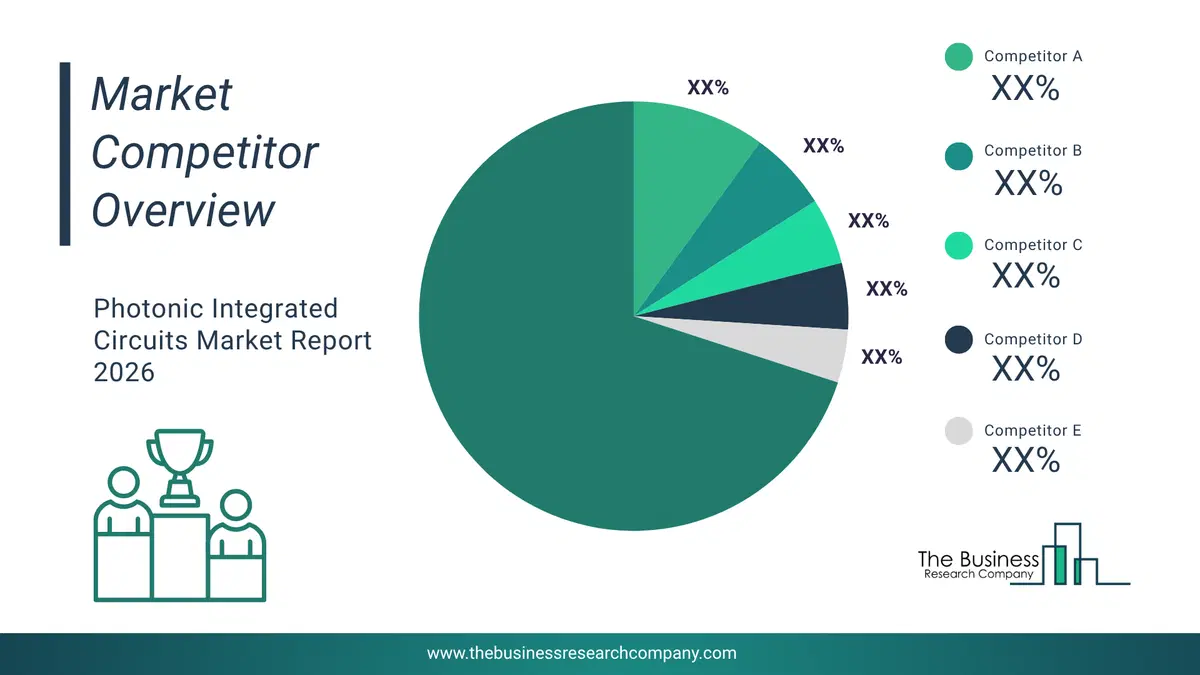
This chart is for illustrative purposes; the full report includes a detailed competitor analysis and comprehensive overview of the top 10 companies in the market.
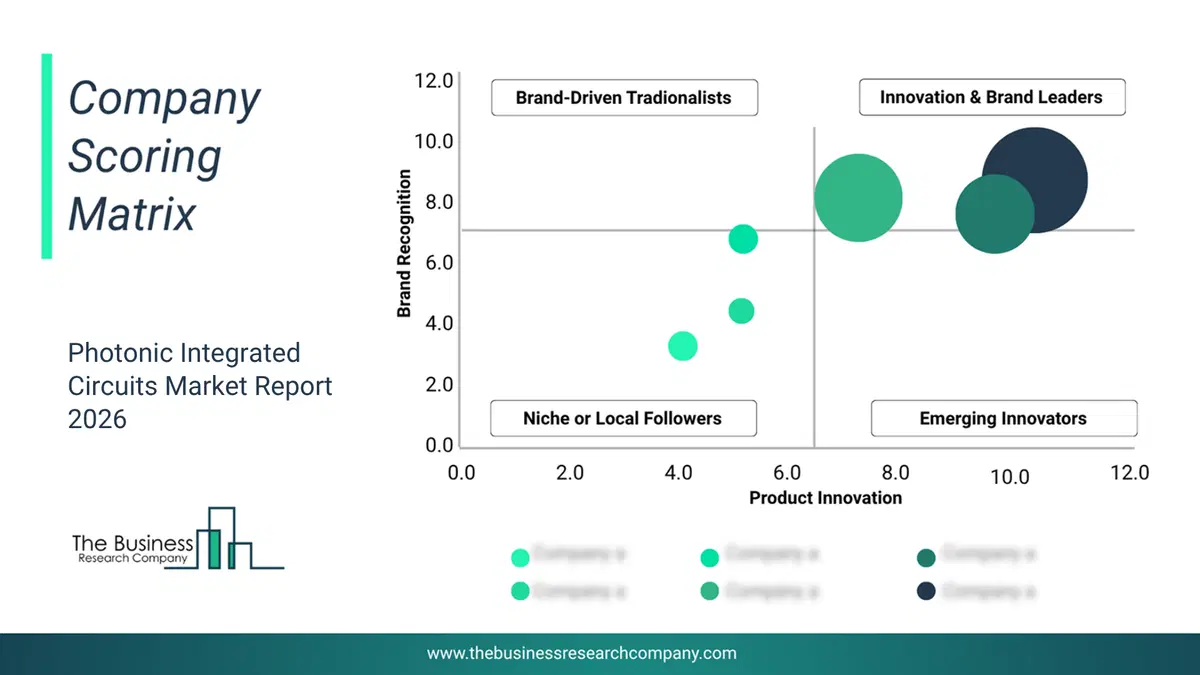
This chart maps companies by product innovation and brand strength, with bubble size indicating relative revenue, helping identify market leaders, challengers, and niche players. This is an illustrative chart; the full report provides a complete and accurate competitive analysis.
Global Photonic Integrated Circuits Market Trends and Insights
Major companies operating in the photonic integrated circuits (PICs) market are focusing on developing advanced optical components, such as high-bandwidth silicon photonics chips, to meet skyrocketing bandwidth, density, and power efficiency demands across data centers, AI infrastructure, and hyperscale networking. High-bandwidth silicon photonics chips refer to photonic integrated circuits that leverage silicon-based optical components to support very high data rates (e.g., 800 Gb/s), enabling low-power, compact, and scalable optical interconnects for next-generation communication systems. For instance, in October 2023, DustPhotonics Ltd., an Israel-based developer of silicon photonics solutions, launched its Carmel-8 800G silicon photonics chip, the industry’s first merchant 800 Gb/s silicon photonics PIC suitable for DR8 and DR8+ optical transmit applications up to 2 km. This high-bandwidth silicon photonics chip integrates eight optical channels at 100 Gb/s each in a compact package suitable for industry-standard form factors, supports on-board lasers using low-loss laser coupling, and enables flexible deployment across a range of transceiver applications.What Are Latest Mergers And Acquisitions In The Photonic Integrated Circuits Market?
In June 2025, Pasqal SAS, a France‑based leader in neutral‑atom quantum computing, acquired AEPONYX Inc. for an undisclosed amount. With this acquisition, Pasqal intends to accelerate its roadmap toward fault‑tolerant quantum computing by integrating AEPONYX’s photonic integrated circuits into its quantum processor platforms, enhancing precision, stability, and scalability. AEPONYX Inc. is a Canada‑based company focused on designing and developing photonic integrated circuits (PICs), microchip-scale photonics products for quantum atom control and entanglement.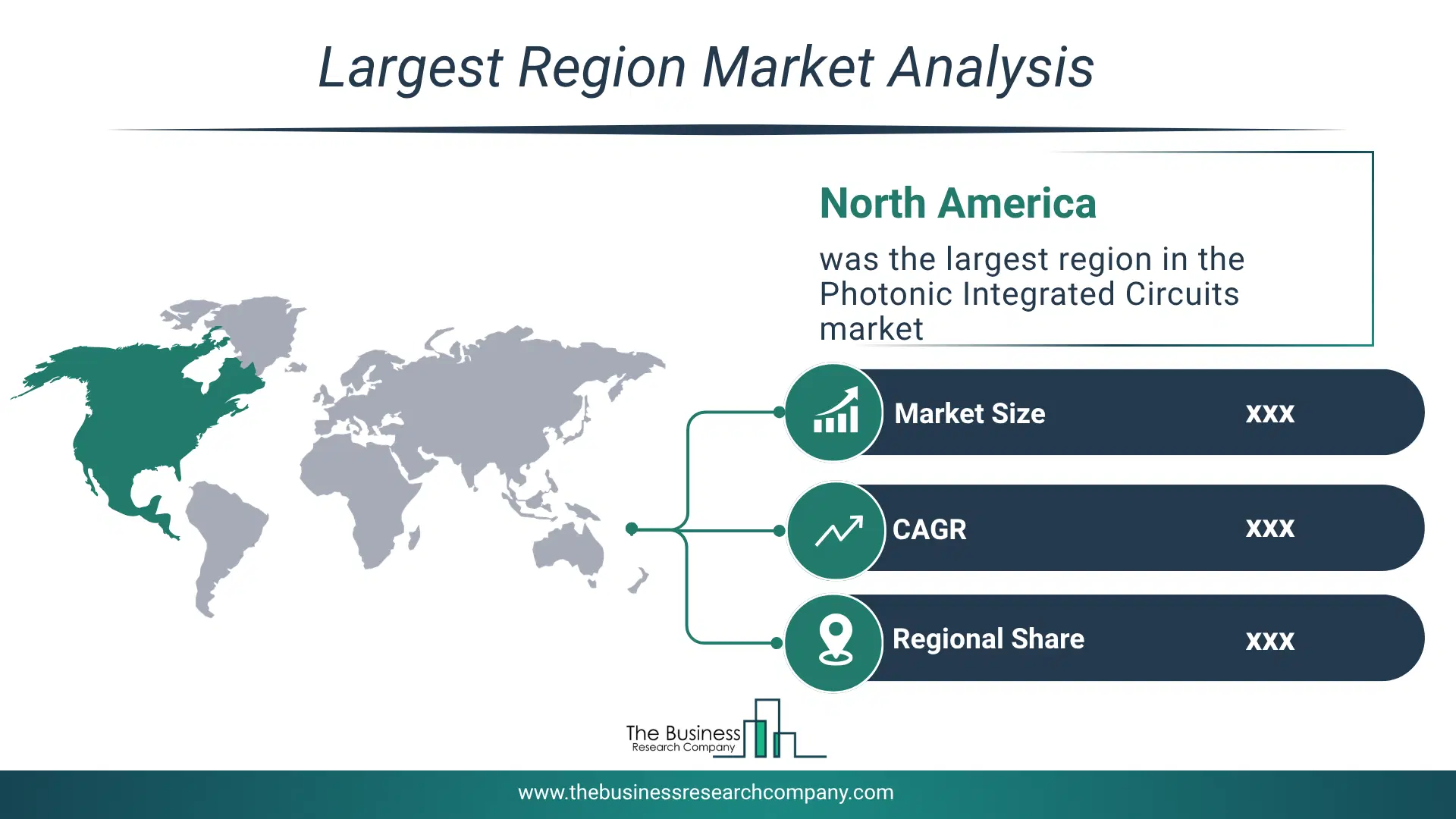
Regional Insights
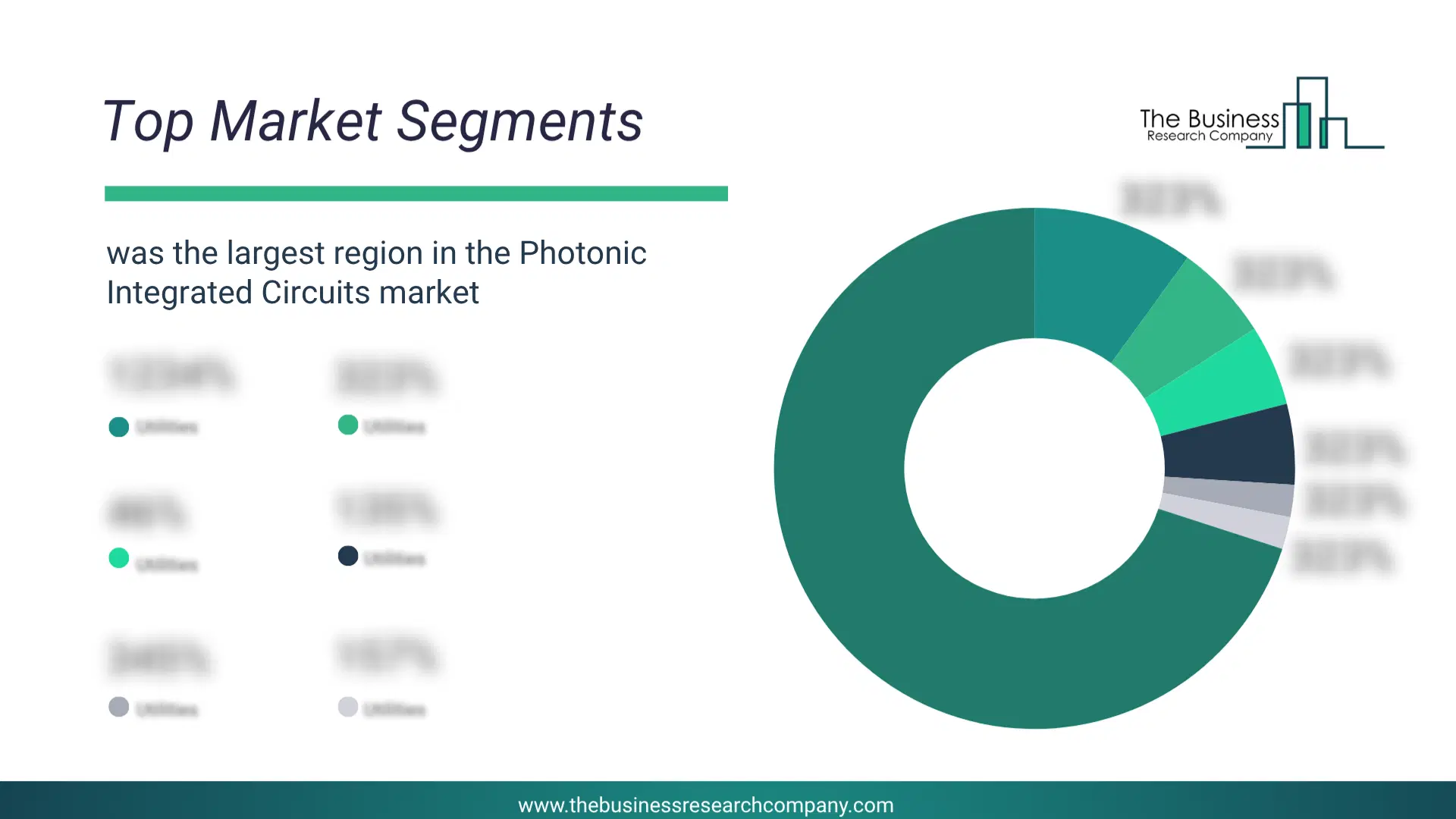
North America was the largest region in the photonic integrated circuits market in 2025. Asia-Pacific is expected to be the fastest-growing region in the forecast period. The regions covered in this market report are Asia-Pacific, South East Asia, Western Europe, Eastern Europe, North America, South America, Middle East, Africa. The countries covered in this market report are Australia, Brazil, China, France, Germany, India, Indonesia, Japan, Taiwan, Russia, South Korea, UK, USA, Canada, Italy, Spain.What Defines the Photonic Integrated Circuits Market?
The photonic integrated circuits market consists of revenues earned by entities by providing services such as improved efficiency, reduced power usage, and enhanced performance for advanced optical systems by enabling high-speed data transmission and signal processing through compact, on-chip optical pathways. The market value includes the value of related goods sold by the service provider or included within the service offering. The photonic integrated circuits market includes sales of products such as photonic chips, optical modulators, waveguides, photodetectors, lasers, optical amplifiers, multiplexers and demultiplexers, optical switches, and transceivers used for high-speed data transmission, signal processing, and communication applications. Values in this market are ‘factory gate’ values, that is, the value of goods sold by the manufacturers or creators of the goods, whether to other entities (including downstream manufacturers, wholesalers, distributors, and retailers) or directly to end customers. The value of goods in this market includes related services sold by the creators of the goods.How is Market Value Defined and Measured?
The market value is defined as the revenues that enterprises gain from the sale of goods and/or services within the specified market and geography through sales, grants, or donations in terms of the currency (in USD unless otherwise specified). The revenues for a specified geography are consumption values that are revenues generated by organizations in the specified geography within the market, irrespective of where they are produced. It does not include revenues from resales along the supply chain, either further along the supply chain or as part of other products.
This chart presents market attractiveness based on a quantitative evaluation of growth, competition, strategic alignment, and risk, offering a clear view of opportunity areas for decision-making. This chart is for illustrative purposes; the full report contains the complete analysis.

This chart highlights the Total Addressable Market (TAM) by estimating the maximum revenue opportunity using an assumption-driven approach, supporting strategic planning and opportunity sizing across markets. The chart is illustrative; the full report provides a more comprehensive analysis.
What Key Data and Analysis Are Included in the Photonic Integrated Circuits Market Report 2026?
The photonic integrated circuits market research report is one of a series of new reports from The Business Research Company that provides market statistics, including industry global market size, regional shares, competitors with the market share, detailed market segments, market trends and opportunities, and any further data you may need to thrive in the photonic integrated circuits industry. The market research report delivers a complete perspective of everything you need, with an in-depth analysis of the current and future state of the industry.Photonic Integrated Circuits Market Report Forecast Analysis
| Report Attribute | Details |
|---|---|
| Market Size Value In 2026 | $17.05 billion |
| Revenue Forecast In 2030 | $34.60 billion |
| Growth Rate | CAGR of 19.7% from 2026 to 2030 |
| Base Year For Estimation | 2025 |
| Actual Estimates/Historical Data | 2020-2025 |
| Forecast Period | 2026 - 2030 |
| Market Representation | Revenue in USD Billion and CAGR from 2026 to 2030 |
| Segments Covered | Component, Material, Application, End-Users |
| Regional Scope | Asia-Pacific, Western Europe, Eastern Europe, North America, South America, Middle East, Africa |
| Country Scope | The countries covered in the report are Australia, Brazil, China, France, Germany, India, Indonesia, Japan, Taiwan, Russia, South Korea, UK, USA, Canada, Italy, Spain. |
| Key Companies Profiled | STMicroelectronics N.V., GlobalFoundries Inc., Coherent Inc., MACOM Technology Solutions Holdings Inc., PsiQuantum Corporation, Ayar Labs Inc., Smart Photonics B.V., DustPhotonics Ltd., Lightmatter Inc., Sivers Semiconductors AB, LioniX International B.V., PHIX Photonics Assembly B.V., LIGENTEC SA, QuiX Quantum B.V., Lightelligence Inc., Pilot Photonics Inc., HyperLight Corporation, Scintil Photonics B.V., VLC Photonics S.L., Applied Nanotools Inc. |
| Customization Scope | Request for Customization |
| Pricing And Purchase Options | Explore Purchase Options |