
Photoresist Electronic Chemical Market Report 2026
Global Outlook – By Type (Positive, Negative), By Substrate (Silicon, Glass, Metal, Other Substrates), By Application (Semiconductor Manufacturing, Printed Circuit Boards (PCBs), Liquid Crystal Displays(LCD), Micro-Electro-Mechanical Systems (MEMS), Other Applications), By End User (Semiconductor Industry, Electronics Industry, Display Industry, MEMS Industry, Other Industries) – Market Size, Trends, Strategies, and Forecast to 2030
Photoresist Electronic Chemical Market Overview
• Photoresist Electronic Chemical market size has reached to $12.01 billion in 2025 • Expected to grow to $16.82 billion in 2030 at a compound annual growth rate (CAGR) of 6.9% • Growth Driver: Rapid Expansion Of The Internet of Things (IoT) Fuels Growth In The Photoresist Electronic Chemical Market • Market Trend: Advancements In DRAM Technology Through Collaborative Efforts • North America was the largest region in 2025 and Asia-Pacific is the fastest growing region.What Is Covered Under Photoresist Electronic Chemical Market?
Photoresist electronic chemicals are a specialized class of chemicals specifically designed for the application of photoresists in the creation of patterns and features on semiconductor wafers or substrates during the manufacturing of electronic components and integrated circuits. These chemicals play a crucial role in the process of photolithography, which is fundamental to the fabrication of integrated circuits (ICs) and other microelectronic devices. The main types of photoresist electronic chemicals are positive and negative. A positive photoresist is a light-sensitive material that becomes more soluble or undergoes a chemical change when exposed to light, allowing for the selective patterning of semiconductor wafers or substrates. The various substrates include silicon, glass, metal, and others. These are used in various applications such as semiconductor manufacturing, printed circuit boards (PCBs), liquid crystal displays(LCD), micro-electro-mechanical systems (mems), and also by various end users such as the semiconductor industry, electronics industry, display industry, mems industry, and others.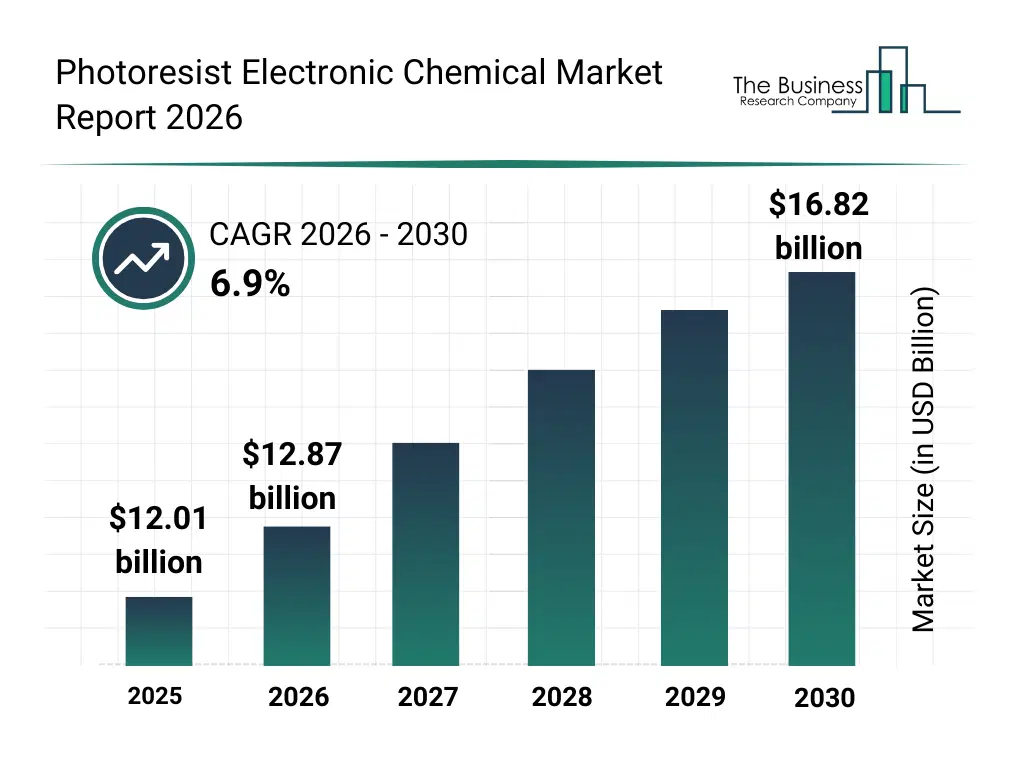
What Is The Photoresist Electronic Chemical Market Size and Share 2026?
The photoresist electronic chemical market size has grown strongly in recent years. It will grow from $12.01 billion in 2025 to $12.87 billion in 2026 at a compound annual growth rate (CAGR) of 7.1%. The growth in the historic period can be attributed to growth of semiconductor manufacturing, expansion of consumer electronics, rising PCB production, demand for miniaturized electronics, development of photolithography techniques.What Is The Photoresist Electronic Chemical Market Growth Forecast?
The photoresist electronic chemical market size is expected to see strong growth in the next few years. It will grow to $16.82 billion in 2030 at a compound annual growth rate (CAGR) of 6.9%. The growth in the forecast period can be attributed to advanced node semiconductor development, expansion of EV electronics, growth of display technologies, rising MEMS applications, increased chip fabrication investments. Major trends in the forecast period include rising demand for advanced semiconductor fabrication, increasing use of high resolution photoresists, growing adoption in MEMS manufacturing, expansion of display and PCB production, higher focus on process precision and yield.
Global Photoresist Electronic Chemical Market Segmentation
1) By Type: Positive, Negative 2) By Substrate: Silicon, Glass, Metal, Other Substrates 3) By Application: Semiconductor Manufacturing, Printed Circuit Boards (PCBs), Liquid Crystal Displays(LCD), Micro-Electro-Mechanical Systems (MEMS), Other Applications 4) By End User: Semiconductor Industry, Electronics Industry, Display Industry, MEMS Industry, Other Industries Subsegments: 1) By Positive: Positive Photoresists For Semiconductor Manufacturing, Positive Photoresists For Printed Circuit Boards (Pcbs) 2) By Negative: Negative Photoresists For Semiconductor Manufacturing, Negative Photoresists For PCB And MicroelectronicsWhat Is The Driver Of The Photoresist Electronic Chemical Market?
The increasing Internet of Things (IoT) adoption is expected to propel the growth of the photoresist electronic chemical market going forward. The Internet of Things (IoT) is a networked system of interconnected computing devices, mechanical and electronic machinery with unique identities (UIDs), and the capacity to transfer data without needing human-to-human or human-to-computer contact. Specialized photoresist electronic chemicals are used in Internet of Things (IoT) for miniaturization, layer-to-layer alignment and adhesion for IoT devices require stacking. For instance, in October 2025, according to IoT Analytics, a Germany-based research firm, the number of connected IoT devices worldwide increased by 14% in 2025, reaching 21.1 billion, up from 18.5 billion in 2024. Therefore, the increasing Internet of Things (IoT) adoption drives the photoresist electronic chemical industry.Key Players In The Global Photoresist Electronic Chemical Market
Major companies operating in the photoresist electronic chemical market are BASF SE, Honeywell International Inc., Merck KGaA, Mitsui Chemicals Inc., Hitachi Chemicals Co. Ltd., The Dow Chemical Company, LG Chem Ltd., Fujifilm Corporation, Sumitomo Chemical Co. Ltd., Shin-Etsu Chemical Co. Ltd., E.I. DuPont, Air Products And Chemicals Inc., Kolon Industries Inc., PhiChem Corporation, Eternal Chemical Co. Ltd., JSR Corporation, Tokyo Ohka Kogyo Co. Ltd., Electra Polymers Ltd., Ikonics Corp., Micro Resist Technology GmbH, Photo Sciences Inc., Jiangsu Kuangshun Photosensitivity New-Material Stock Co. Ltd., DJ Microlaminates Inc., Allresist GmbH, AZ Electronic Materials, Hitech Photopolymere AG, KemLab Inc., Kanto Chemical Co. Inc.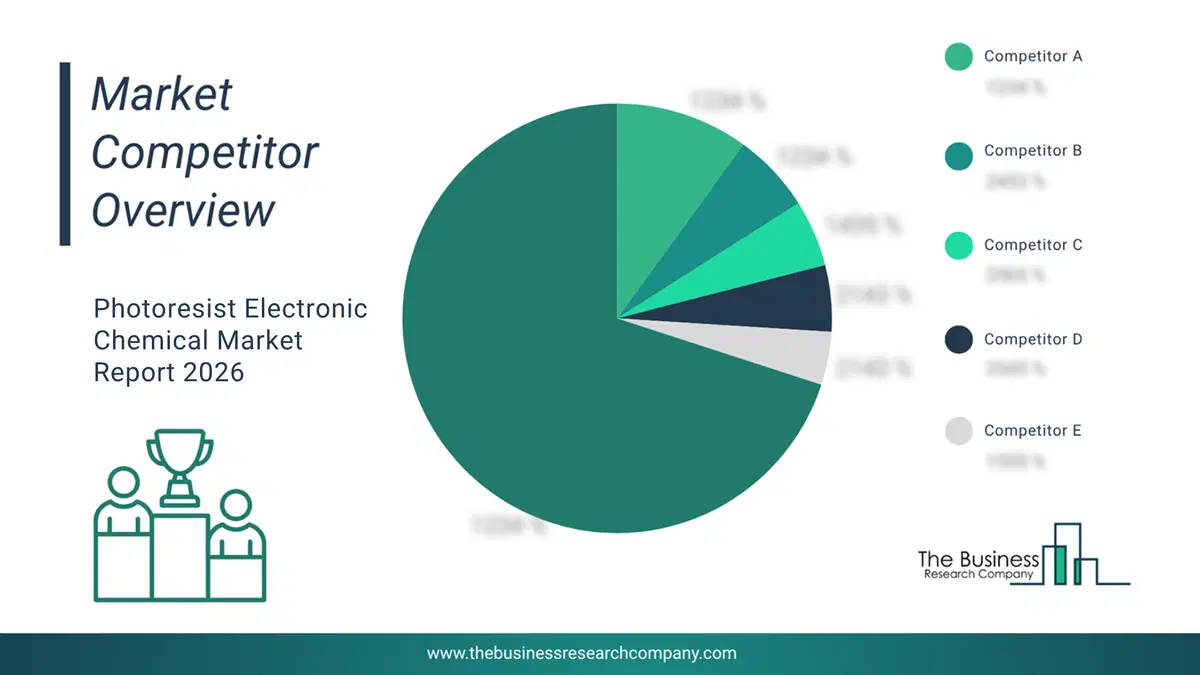
This chart is for illustrative purposes; the full report includes a detailed competitor analysis and comprehensive overview of the top 10 companies in the market.
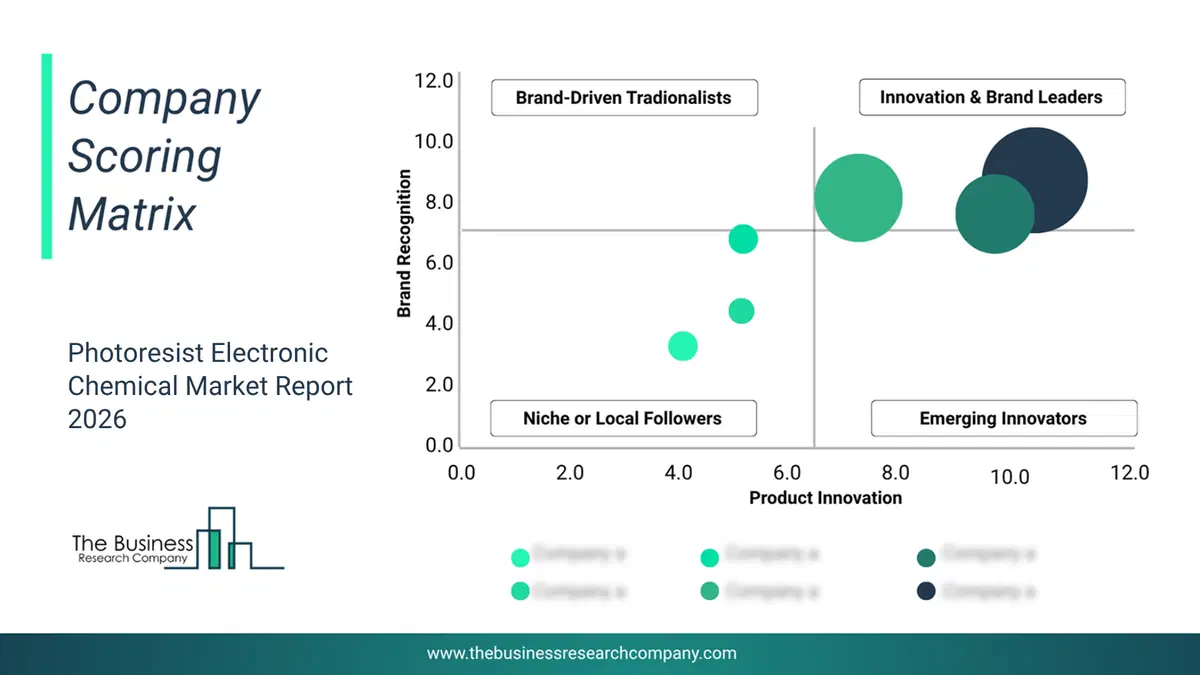
This chart maps companies by product innovation and brand strength, with bubble size indicating relative revenue, helping identify market leaders, challengers, and niche players. This is an illustrative chart; the full report provides a complete and accurate competitive analysis.
Global Photoresist Electronic Chemical Market Trends and Insights
Major companies operating in the photoresist electronic chemicals market are developing advancements in dynamic random-access memory (DRAM) technology through collaborative efforts. This will improve the performance of the photoresist utilized in this technology, thereby optimizing the overall manufacturing process. For instance, in October 2024, Lam Research Corp., a US-based manufacturer of wafer fabrication equipment, and Entegris Inc., a US-based provider of electronic materials, partnered with Gelest, Inc. to advance semiconductor manufacturing. The partnership concentrates on creating precursor chemicals for Lam's advanced dry photoresist technology, utilized in extreme ultraviolet (EUV) lithography. This partnership will prioritize research and development for next-generation logic and dynamic random-access memory (DRAM) devices, critical for driving innovations in artificial intelligence and mobile technologies. Gelest Inc. is a US-based company specializing in photoresist electronic chemicals.What Are Latest Mergers And Acquisitions In The Photoresist Electronic Chemical Market?
In June 2023, DIC Corporation, a Japan-based chemical company acquired PCAS Canada Inc. for an undisclosed amount. With this acquisition, DIC aims to accelerate its product development for advanced processes, make capital expenditures to boost its supply capabilities, and establish a corporate structure. PCAS Canada Inc. is a Canada-based company that specializes in the synthesis, development, and customization of photoresist electronic chemicals.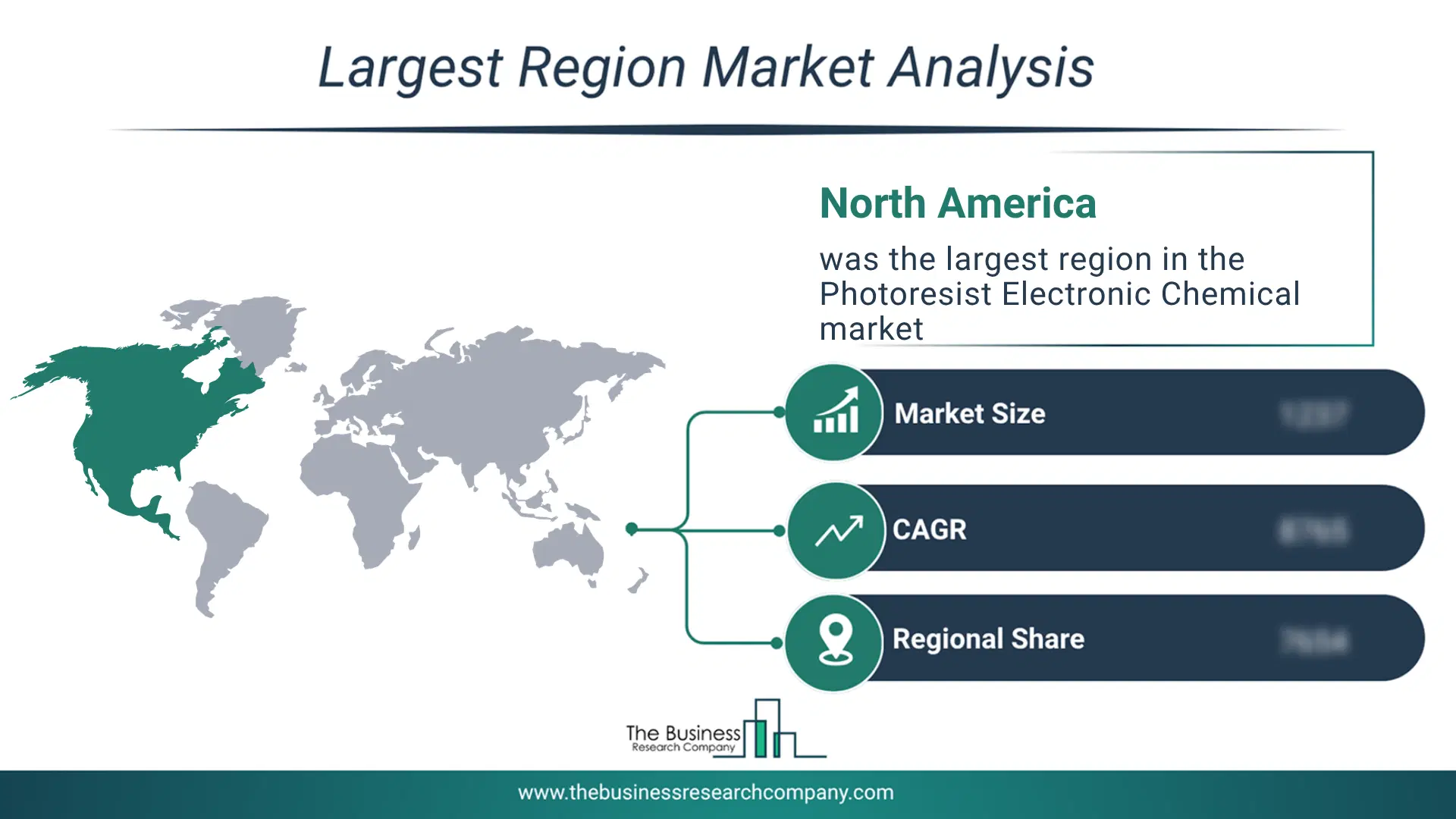
Regional Insights
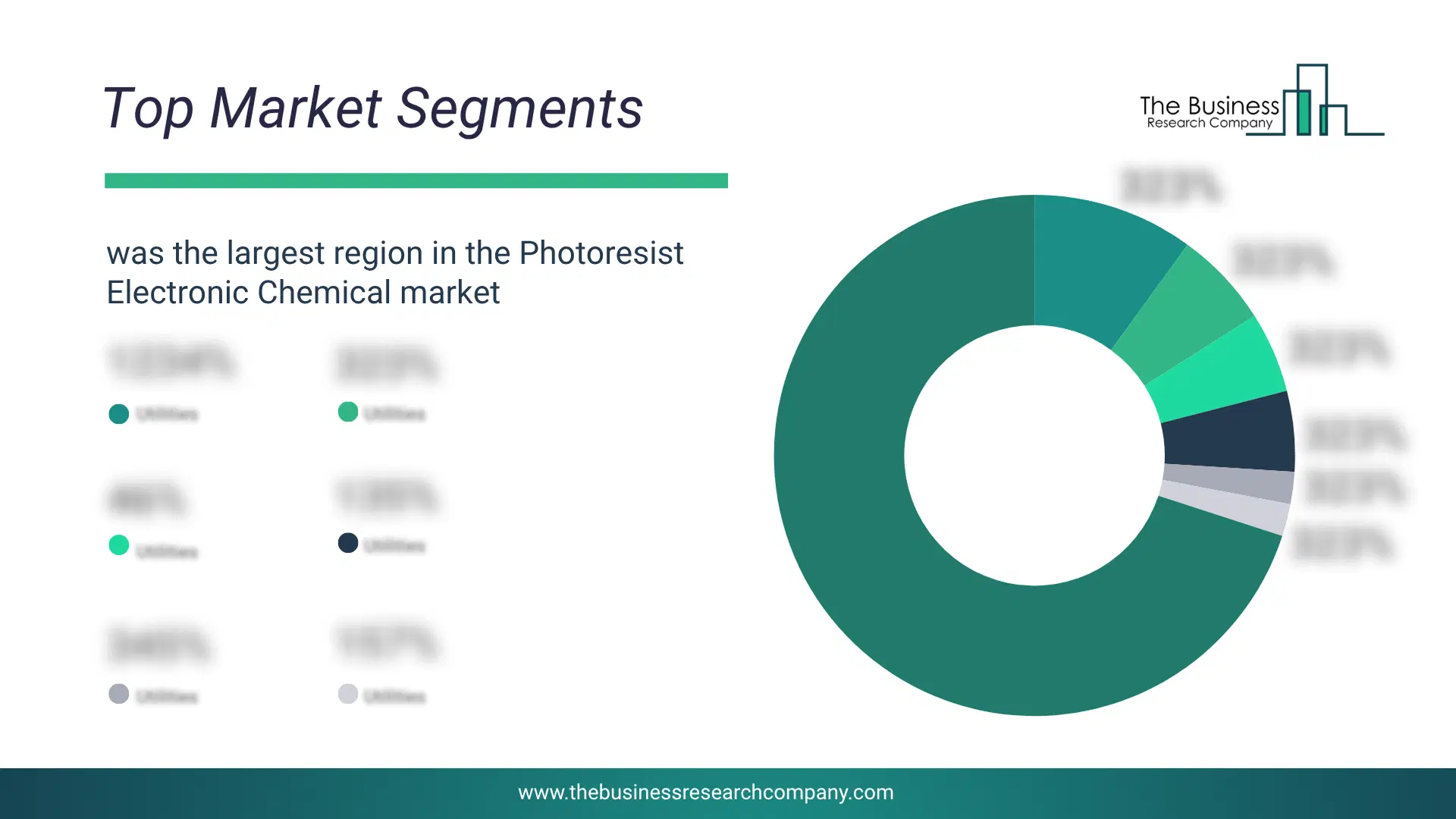
North America was the largest region in the photoresist electronic chemical market in 2025. The regions covered in this market report are Asia-Pacific, South East Asia, Western Europe, Eastern Europe, North America, South America, Middle East, Africa The countries covered in this market report are Australia, Brazil, China, France, Germany, India, Indonesia, Japan, Taiwan, Russia, South Korea, UK, USA, Canada, Italy, SpainWhat Defines the Photoresist Electronic Chemical Market?
The photoresist electronic chemicals market consists of sales of ceramic, quartz, and copper substrates. Values in this market are ‘factory gate’ values, that is the value of goods sold by the manufacturers or creators of the goods, whether to other entities (including downstream manufacturers, wholesalers, distributors, and retailers) or directly to end customers. The value of goods in this market includes related services sold by the creators of the goods.How is Market Value Defined and Measured?
The market value is defined as the revenues that enterprises gain from the sale of goods and/or services within the specified market and geography through sales, grants, or donations in terms of the currency (in USD unless otherwise specified). The revenues for a specified geography are consumption values that are revenues generated by organizations in the specified geography within the market, irrespective of where they are produced. It does not include revenues from resales along the supply chain, either further along the supply chain or as part of other products.
This chart presents market attractiveness based on a quantitative evaluation of growth, competition, strategic alignment, and risk, offering a clear view of opportunity areas for decision-making. This chart is for illustrative purposes; the full report contains the complete analysis.

This chart highlights the Total Addressable Market (TAM) by estimating the maximum revenue opportunity using an assumption-driven approach, supporting strategic planning and opportunity sizing across markets. The chart is illustrative; the full report provides a more comprehensive analysis.
What Key Data and Analysis Are Included in the Photoresist Electronic Chemical Market Report 2026?
The photoresist electronic chemical market research report is one of a series of new reports from The Business Research Company that provides market statistics, including industry global market size, regional shares, competitors with the market share, detailed market segments, market trends and opportunities, and any further data you may need to thrive in the photoresist electronic chemical industry. The market research report delivers a complete perspective of everything you need, with an in-depth analysis of the current and future state of the industry.Photoresist Electronic Chemical Market Report Forecast Analysis
| Report Attribute | Details |
|---|---|
| Market Size Value In 2026 | $12.87 billion |
| Revenue Forecast In 2030 | $16.82 billion |
| Growth Rate | CAGR of 7.1% from 2026 to 2030 |
| Base Year For Estimation | 2025 |
| Actual Estimates/Historical Data | 2020-2025 |
| Forecast Period | 2026 - 2030 |
| Market Representation | Revenue in USD Billion and CAGR from 2026 to 2030 |
| Segments Covered | Type, Substrate, Application, End User |
| Regional Scope | Asia-Pacific, Western Europe, Eastern Europe, North America, South America, Middle East, Africa |
| Country Scope | The countries covered in this market report are Australia, Brazil, China, France, Germany, India, Indonesia, Japan, Taiwan, Russia, South Korea, UK, USA, Canada, Italy, Spain |
| Key Companies Profiled | BASF SE, Honeywell International Inc., Merck KGaA, Mitsui Chemicals Inc., Hitachi Chemicals Co. Ltd., The Dow Chemical Company, LG Chem Ltd., Fujifilm Corporation, Sumitomo Chemical Co. Ltd., Shin-Etsu Chemical Co. Ltd., E.I. DuPont, Air Products And Chemicals Inc., Kolon Industries Inc., PhiChem Corporation, Eternal Chemical Co. Ltd., JSR Corporation, Tokyo Ohka Kogyo Co. Ltd., Electra Polymers Ltd., Ikonics Corp., Micro Resist Technology GmbH, Photo Sciences Inc., Jiangsu Kuangshun Photosensitivity New-Material Stock Co. Ltd., DJ Microlaminates Inc., Allresist GmbH, AZ Electronic Materials, Hitech Photopolymere AG, KemLab Inc., Kanto Chemical Co. Inc. |
| Customization Scope | Request for Customization |
| Pricing And Purchase Options | Explore Purchase Options |