
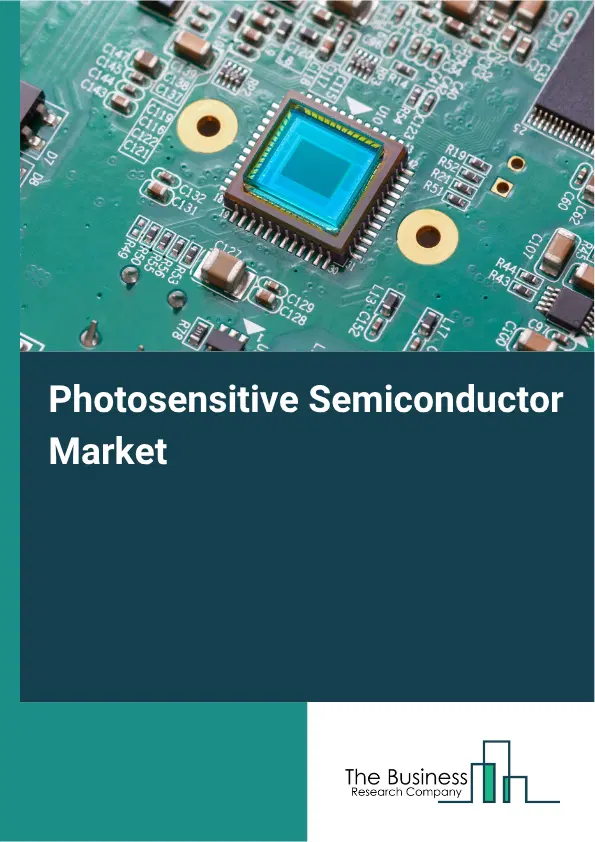
Photosensitive Semiconductor Market Report 2026
Global Outlook – By Device Type (Photodiodes, Phototransistors, Complementary Metal Oxide Semiconductor Image Sensors, Charge Coupled Device Image Sensors, Photoresistors, Optical Integrated Circuits, Other Device Types), By Form Factor (Chips, Packaged Sensors, Modules, Other Form Factors), By Operating Wavelength Range (Ultraviolet, Visible Light, Infrared, Near Infrared, Short Wave Infrared), By Material Type (Silicon, Germanium, Compound Semiconductors, Emerging Materials), By End Use Industry (Consumer Electronics, Automotive, Industrial Manufacturing, Healthcare, Telecommunications, Aerospace And Defense, Energy And Utilities, Research Institutions) – Market Size, Trends, Strategies, and Forecast to 2030
Photosensitive Semiconductor Market Overview
• Photosensitive Semiconductor market size has reached to $4.16 billion in 2025 • Expected to grow to $5.22 billion in 2030 at a compound annual growth rate (CAGR) of 4.6% • Growth Driver: Surge In Consumer Electronics Applications Fueling The Growth Of The Market Due To Increasing Smartphone And Wearable Device Adoption • Market Trend: Innovations In Image Sensor Technology Enhance High Dynamic Range Performance In Smartphone Cameras • North America was the largest region in 2025 and Asia-Pacific is the fastest growing region.What Is Covered Under Photosensitive Semiconductor Market?
Photosensitive semiconductors are materials that respond to light by altering their electrical conductivity. When exposed to light, they absorb photons and generate charge carriers, allowing light energy to be converted into electrical signals. Photosensitive semiconductors play a vital role in sensing, detecting, and converting light for applications such as image sensors, photodetectors, solar cells, optical communication networks, and automated lighting systems. The main device types of photosensitive semiconductors include photodiodes, phototransistors, complementary metal oxide semiconductor image sensors, charge coupled device image sensors, photoresistors, optical integrated circuits, and other device types. Photodiodes refer to semiconductor devices that convert incident light into electrical current or voltage, enabling light detection and optical sensing across a wide range of electronic applications. These devices are available in chips, packaged sensors, modules, and other form factors and operate across ultraviolet, visible light, infrared, near infrared, and short wave infrared wavelength ranges. They are manufactured using silicon, germanium, compound semiconductors, and emerging materials and are utilized by end-use industries including consumer electronics, automotive, industrial manufacturing, healthcare, telecommunications, aerospace and defense, energy and utilities, and research institutions.
What Is The Photosensitive Semiconductor Market Size and Share 2026?
The photosensitive semiconductor market size has grown steadily in recent years. It will grow from $4.16 billion in 2025 to $4.37 billion in 2026 at a compound annual growth rate (CAGR) of 5.0%. The growth in the historic period can be attributed to growing demand for image sensing technologies, increasing adoption of optical communication systems, rising use of semiconductor based photodetectors, expanding consumer electronics manufacturing, growing investments in optoelectronic device development.What Is The Photosensitive Semiconductor Market Growth Forecast?
The photosensitive semiconductor market size is expected to see steady growth in the next few years. It will grow to $5.22 billion in 2030 at a compound annual growth rate (CAGR) of 4.6%. The growth in the forecast period can be attributed to increasing demand for autonomous sensing systems, growing deployment of advanced optical communication networks, rising investments in silicon photonics, expanding adoption of smart industrial sensing solutions, increasing demand for high efficiency imaging technologies. Major trends in the forecast period include growing adoption of high sensitivity image sensors, increasing demand for advanced photodetector technologies, rising development of wide spectrum photosensitive semiconductor materials, expanding integration of silicon photonic devices, increasing commercialization of quantum dot photodetectors.

Global Photosensitive Semiconductor Market Segmentation
2) By Form Factor: Chips, Packaged Sensors, Modules, Other Form Factors 3) By Operating Wavelength Range: Ultraviolet, Visible Light, Infrared, Near Infrared, Short Wave Infrared 4) By Material Type: Silicon, Germanium, Compound Semiconductors, Emerging Materials 5) By End Use Industry: Consumer Electronics, Automotive, Industrial Manufacturing, Healthcare, Telecommunications, Aerospace And Defense, Energy And Utilities, Research Institutions Subsegments: 1) By Photodiodes: P-N Photodiodes, P-I-N Photodiodes, Avalanche Photodiodes, Schottky Photodiodes, Metal Semiconductor Metal Photodiodes 2) By Phototransistors: Bipolar Phototransistors, Darlington Phototransistors, Field Effect Phototransistors 3) By Complementary Metal Oxide Semiconductor Image Sensors: Front Side Illuminated Image Sensors, Back Side Illuminated Image Sensors, Stacked Image Sensors, Global Shutter Image Sensors, Rolling Shutter Image Sensors 4) By Charge Coupled Device Image Sensors: Full Frame Charge Coupled Device Image Sensors, Frame Transfer Charge Coupled Device Image Sensors, Interline Transfer Charge Coupled Device Image Sensors, Electron Multiplying Charge Coupled Device Image Sensors 5) By Photoresistors: Cadmium Sulfide Photoresistors, Cadmium Selenide Photoresistors, Lead Sulfide Photoresistors, Indium Antimonide Photoresistors 6) By Optical Integrated Circuits: Monolithic Optical Integrated Circuits, Hybrid Optical Integrated Circuits, Planar Lightwave Circuits, Silicon Photonic Integrated Circuits 7) By Other Device Types: Photothyristors, Phototriacs, Photoconductive Detectors, Quantum Dot PhotodetectorsWhat Is The Driver Of The Photosensitive Semiconductor Market?
The rising demand from consumer electronics applications is expected to propel the growth of the photosensitive semiconductor market going forward. Consumer electronics applications refer to the use of electronic devices and technologies designed for personal, household, entertainment, communication, and everyday consumer needs. The rising demand from consumer electronics applications is driven by increasing smartphone and wearable device adoption, as these products require advanced electronic components to deliver enhanced performance, connectivity, and energy efficiency. Photosensitive semiconductors support consumer electronics by converting light into electrical signals, enabling image sensing, facial recognition, ambient light adjustment, gesture detection, and optical communication in smartphones, cameras, and wearable devices. For instance, in May 2023, according to the Japan Electronics and Information Technology Industries Association, a Japan-based trade association, the total consumer electronic equipment production in Japan reached $209.16 million (¥32,099 million), compared to $164.65 million (¥25,268 million) in May 2022. Therefore, the rising demand from consumer electronics applications is driving the growth of the photosensitive semiconductor industry.Key Players In The Global Photosensitive Semiconductor Market
Major companies operating in the photosensitive semiconductor market are ams OSRAM AG, Analog Devices Inc., Broadcom Inc., Canon Inc., Everlight Electronics Co. Ltd., GalaxyCore Inc., Gpixel Inc., Hamamatsu Photonics K.K., Infineon Technologies AG, Laser Components GmbH, ON Semiconductor Corporation, OmniVision Integrated Circuits Group Inc., Panasonic Holdings Corporation, PixArt Imaging Inc., Renesas Electronics Corporation, ROHM Co. Ltd., Samsung Electronics Co. Ltd., Silicon Optronics Inc., SmartSens Technology Co. Ltd., Sony Semiconductor Solutions Corporation, STMicroelectronics N.V., Teledyne Technologies Incorporated, Thorlabs Inc., Vishay Intertechnology Inc.
This chart is for illustrative purposes; the full report includes a detailed competitor analysis and comprehensive overview of the top 10 companies in the market.

This chart maps companies by product innovation and brand strength, with bubble size indicating relative revenue, helping identify market leaders, challengers, and niche players. This is an illustrative chart; the full report provides a complete and accurate competitive analysis.
Global Photosensitive Semiconductor Market Trends and Insights
Major companies operating in the photosensitive semiconductor market are focusing on developing advanced image sensing solutions, such as single-exposure high dynamic range (HDR) image sensors, to improve image quality, enhance low-light performance, and deliver more accurate scene reproduction under varying lighting conditions. Single-exposure HDR image sensors are photosensitive semiconductor devices that capture a wide dynamic range of light in a single exposure, enabling clearer and more detailed images without motion artifacts. For instance, in March 2024, OMNIVISION, a US-based semiconductor solutions provider, launched the OV50K40, the industry's first smartphone image sensor featuring TheiaCel technology. The 50-megapixel image sensor utilizes lateral overflow integration capacitor (LOFIC)-based HDR technology to achieve human eye-level dynamic range with a single exposure while delivering superior low-light performance. It is designed for flagship smartphone rear cameras. The sensor enhances image clarity, color accuracy, and overall photography performance across diverse lighting environments.What Are Latest Mergers And Acquisitions In The Photosensitive Semiconductor Market?
In November 2024, Hamamatsu Photonics K.K., a Japan-based photonics and semiconductor technology company, acquired BAE Systems Imaging Solutions, Inc. for an undisclosed amount. Through this acquisition, Hamamatsu aimed to strengthen its opto-semiconductor business and accelerate value-added growth by expanding its capabilities in high-performance CMOS image sensors. BAE Systems Imaging Solutions, Inc. is a US-based developer and manufacturer of high-performance photosensitive semiconductor devices.
Regional Outlook/Insights
North America was the largest region in the photosensitive semiconductor market in 2025. Asia-Pacific is expected to be the fastest-growing region in the forecast period. The regions covered in this market report are Asia-Pacific, South East Asia, Western Europe, Eastern Europe, North America, South America, Middle East, Africa. The countries covered in this market report are Australia, Brazil, China, France, Germany, India, Indonesia, Japan, Taiwan, Russia, South Korea, UK, USA, Canada, Italy, Spain.What Defines the Photosensitive Semiconductor Market?
The photosensitive semiconductors market consists of sales of light measurement instruments, optical proximity sensors, and flame detection sensors. Values in this market are ‘factory gate’ values, that is, the value of goods sold by the manufacturers or creators of the goods, whether to other entities (including downstream manufacturers, wholesalers, distributors, and retailers) or directly to end customers. The value of goods in this market includes related services sold by the creators of the goods.How is Market Value Defined and Measured?
The market value is defined as the revenues that enterprises gain from the sale of goods and/or services within the specified market and geography through sales, grants, or donations in terms of the currency (in USD unless otherwise specified). The revenues for a specified geography are consumption values that are revenues generated by organizations in the specified geography within the market, irrespective of where they are produced. It does not include revenues from resales along the supply chain, either further along the supply chain or as part of other products.
This chart presents market attractiveness based on a quantitative evaluation of growth, competition, strategic alignment, and risk, offering a clear view of opportunity areas for decision-making. This chart is for illustrative purposes; the full report contains the complete analysis.

This chart highlights the Total Addressable Market (TAM) by estimating the maximum revenue opportunity using an assumption-driven approach, supporting strategic planning and opportunity sizing across markets. The chart is illustrative; the full report provides a more comprehensive analysis.
What Key Data and Analysis Are Included in the Photosensitive Semiconductor Market Report 2026?
The photosensitive semiconductor market research report is one of a series of new reports from The Business Research Company that provides photosensitive semiconductor market statistics, including photosensitive semiconductor industry global market size, regional shares, competitors with a photosensitive semiconductor market share, detailed photosensitive semiconductor market segments, market trends and opportunities, and any further data you may need to thrive in the photosensitive semiconductor industry. This photosensitive semiconductor market research report delivers a complete perspective of everything you need, with an in-depth analysis of the current and future scenario of the industry.Photosensitive Semiconductor Market Report Forecast Analysis
| Report Attribute | Details |
|---|---|
| Market Size Value In 2026 | $4.37 billion |
| Revenue Forecast In 2030 | $5.22 billion |
| Growth Rate | CAGR of 4.6% from 2026 to 2030 |
| Base Year For Estimation | 2025 |
| Actual Estimates/Historical Data | 2020-2025 |
| Forecast Period | 2026 - 2030 |
| Market Representation | Revenue in USD Billion and CAGR from 2026 to 2030 |
| Segments Covered | Device Type, Form Factor, Operating Wavelength Range, Material Type, End Use Industry |
| Regional Scope | Asia-Pacific, Western Europe, Eastern Europe, North America, South America, Middle East, Africa |
| Country Scope | The countries covered in the report are Australia, Brazil, China, France, Germany, India, Indonesia, Japan, Taiwan, Russia, South Korea, UK, USA, Canada, Italy, Spain. |
| Key Companies Profiled | ams OSRAM AG, Analog Devices Inc., Broadcom Inc., Canon Inc., Everlight Electronics Co. Ltd., GalaxyCore Inc., Gpixel Inc., Hamamatsu Photonics K.K., Infineon Technologies AG, Laser Components GmbH, ON Semiconductor Corporation, OmniVision Integrated Circuits Group Inc., Panasonic Holdings Corporation, PixArt Imaging Inc., Renesas Electronics Corporation, ROHM Co. Ltd., Samsung Electronics Co. Ltd., Silicon Optronics Inc., SmartSens Technology Co. Ltd., Sony Semiconductor Solutions Corporation, STMicroelectronics N.V., Teledyne Technologies Incorporated, Thorlabs Inc., Vishay Intertechnology Inc. |
| Customization Scope | Request for Customization |
| Pricing And Purchase Options | Explore Purchase Options |