
Photovoltaic Wet Electronic Chemicals Market Report 2026
Global Outlook – By Chemical Type ( Hydrofluoric Acid, Nitric Acid, Hydrochloric Acid, Sulfuric Acid, Phosphoric Acid, Ammonium Hydroxide, Hydrogen Peroxide, Photoresists, Other Wet Electronic Chemicals), By Purity Level ( Ultra High Purity Chemicals, High Purity Chemicals, Electronic Grade Chemicals, Standard Purity Chemicals), By Distribution Channel ( Direct Sales, Distributors, Specialty Chemical Suppliers), By Application ( Solar Cell Manufacturing, Wafer Processing, Surface Cleaning, Etching And Texturing, Photolithography, Solar Module Production) – Market Size, Trends, Strategies, and Forecast to 2030
Photovoltaic Wet Electronic Chemicals Market Report 2026 Market Overview
• Photovoltaic Wet Electronic Chemicals Market Report 2026 market size has reached to $3.09 billion in 2025 • Expected to grow to $4.73 billion in 2030 at a compound annual growth rate (CAGR) of 8.8% • Growth Driver: The Growing Installation Of Photovoltaic (PV) Systems Driving The Growth Of The Market Due To Increasing Demand For Renewable Energy • Asia-Pacific was the largest region and fastest growing region.What Is Covered Under Photovoltaic Wet Electronic Chemicals Market?
Photovoltaic wet electronic chemicals are high-purity liquid chemicals used in the manufacturing and processing of photovoltaic (solar) cells and modules, including cleaning, etching, texturing, and surface treatment applications. These chemicals help remove impurities, enhance wafer surface characteristics, and improve the efficiency, performance, and reliability of solar energy devices. The main chemical types of photovoltaic wet electronic chemicals include hydrofluoric acid, nitric acid, hydrochloric acid, sulfuric acid, phosphoric acid, ammonium hydroxide, hydrogen peroxide, photoresists, and other wet electronic chemicals. Hydrofluoric acid refers to a highly reactive chemical used in photovoltaic manufacturing processes for etching and cleaning semiconductor materials. These chemicals are available in purity levels including ultra high purity chemicals, high purity chemicals, electronic grade chemicals, and standard purity chemicals. They are distributed through direct sales, distributors, and specialty chemical suppliers for applications such as solar cell manufacturing, wafer processing, surface cleaning, etching and texturing, photolithography, and solar module production.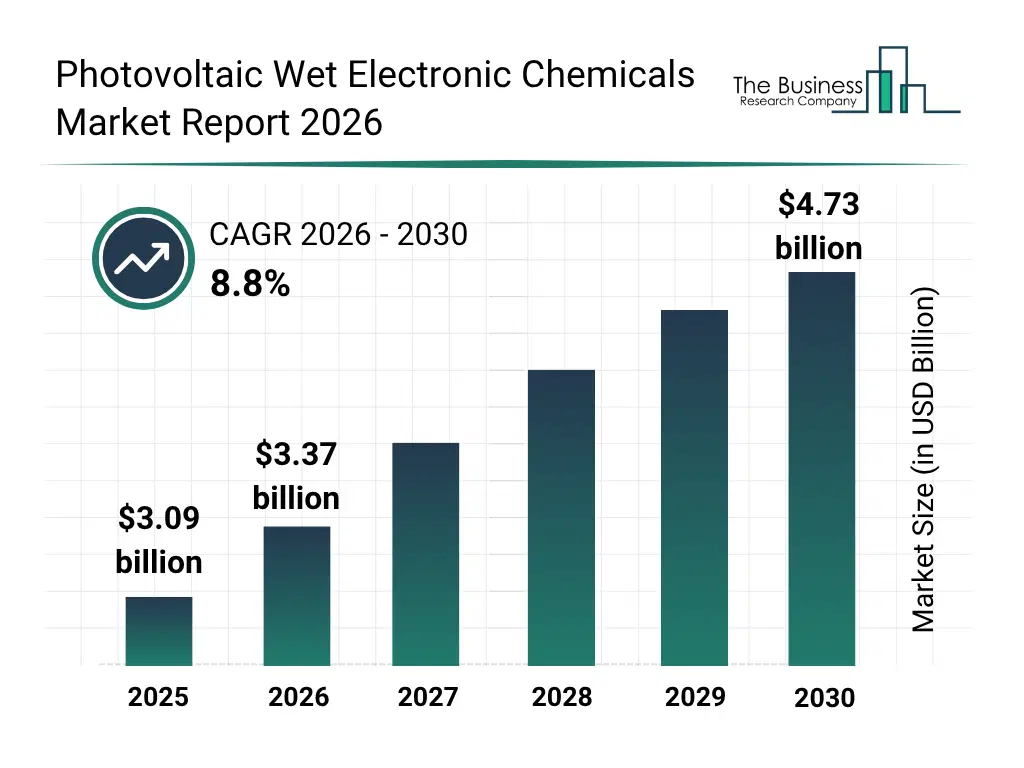
What Is The Photovoltaic Wet Electronic Chemicals Market Size and Share 2026?
The photovoltaic wet electronic chemicals market size has grown strongly in recent years. It will grow from $3.09 billion in 2025 to $3.37 billion in 2026 at a compound annual growth rate (CAGR) of 9.3%. The growth in the historic period can be attributed to expansion of global solar photovoltaic installations, growth in crystalline silicon wafer manufacturing, increasing government subsidies for renewable energy adoption, development of large scale solar panel production facilities, rising demand for cost-efficient solar energy generation,.What Is The Photovoltaic Wet Electronic Chemicals Market Growth Forecast?
The photovoltaic wet electronic chemicals market size is expected to see strong growth in the next few years. It will grow to $4.73 billion in 2030 at a compound annual growth rate (CAGR) of 8.8%. The growth in the forecast period can be attributed to acceleration of next generation high-efficiency solar cell technologies, increasing demand for ultra pure and specialty wet electronic chemicals, expansion of renewable energy capacity targets globally, adoption of sustainable and green chemical processing in solar manufacturing, growth in integrated solar supply chain ecosystems and localized production. Major trends in the forecast period include rising demand for ultra-high purity wet electronic chemicals in advanced photovoltaic cell manufacturing processes, increasing adoption of precision surface treatment and wafer etching solutions to improve solar cell efficiency, expansion of high-efficiency n-type and tandem solar cell production requiring specialized chemical formulations, growing focus on environmentally sustainable and low-toxicity photovoltaic processing chemicals, rising integration of advanced chemical recycling and waste reduction systems in solar manufacturing processes.
Global Photovoltaic Wet Electronic Chemicals Market Segmentation
1) By Chemical Type: Hydrofluoric Acid, Nitric Acid, Hydrochloric Acid, Sulfuric Acid, Phosphoric Acid, Ammonium Hydroxide, Hydrogen Peroxide, Photoresists, Other Wet Electronic Chemicals 2) By Purity Level: Ultra High Purity Chemicals, High Purity Chemicals, Electronic Grade Chemicals, Standard Purity Chemicals 3) By Distribution Channel: Direct Sales, Distributors, Specialty Chemical Suppliers 4) By Application: Solar Cell Manufacturing, Wafer Processing, Surface Cleaning, Etching And Texturing, Photolithography, Solar Module Production Subsegments: 1) By Hydrofluoric Acid: Electronic Grade Hydrofluoric Acid, Semiconductor Grade Hydrofluoric Acid, Ultra High Purity Hydrofluoric Acid, Buffered Hydrofluoric Acid, Diluted Hydrofluoric Acid 2) By Nitric Acid: Electronic Grade Nitric Acid, Ultra High Purity Nitric Acid, Concentrated Nitric Acid, Diluted Nitric Acid, Semiconductor Grade Nitric Acid 3) By Hydrochloric Acid: Electronic Grade Hydrochloric Acid, Ultra High Purity Hydrochloric Acid, Concentrated Hydrochloric Acid, Diluted Hydrochloric Acid, Semiconductor Grade Hydrochloric Acid 4) By Sulfuric Acid: Electronic Grade Sulfuric Acid, Ultra High Purity Sulfuric Acid, Concentrated Sulfuric Acid, Diluted Sulfuric Acid, Semiconductor Grade Sulfuric Acid 5) By Phosphoric Acid: Electronic Grade Phosphoric Acid, Ultra High Purity Phosphoric Acid, Concentrated Phosphoric Acid, Diluted Phosphoric Acid, Semiconductor Grade Phosphoric Acid 6) By Ammonium Hydroxide: Electronic Grade Ammonium Hydroxide, Ultra High Purity Ammonium Hydroxide, Concentrated Ammonium Hydroxide, Diluted Ammonium Hydroxide, Semiconductor Grade Ammonium Hydroxide 7) By Hydrogen Peroxide: Electronic Grade Hydrogen Peroxide, Ultra High Purity Hydrogen Peroxide, Stabilized Hydrogen Peroxide, High Concentration Hydrogen Peroxide, Low Concentration Hydrogen Peroxide 8) By Photoresists: Positive Photoresists, Negative Photoresists, Chemically Amplified Photoresists, Dry Film Photoresists, Liquid Photoresists 9) By Other Wet Electronic Chemicals: Cleaning Chemicals, Etching Chemicals, Texturing Chemicals, Surface Passivation Chemicals, Wafer Polishing Chemicals, Anti Reflection Coating Chemicals, Wet Process Additives, Specialty Process ChemicalsWhat Are The Drivers Of The Photovoltaic Wet Electronic Chemicals Market?
The growing installation of photovoltaic (PV) systems is expected to propel the growth of the photovoltaic wet electronic chemicals market going forward. Photovoltaic (PV) systems refer to solar energy systems that convert sunlight directly into electricity using semiconductor-based solar cells. The growing installation of photovoltaic (PV) systems is due to the increasing demand for renewable energy, as governments, businesses, and consumers seek cleaner and more sustainable alternatives to fossil fuels while reducing carbon emissions and enhancing energy security. Growing installation of photovoltaic (PV) systems is driving demand for photovoltaic wet electronic chemicals, as these chemicals are essential for wafer cleaning, texturing, etching, and surface treatment processes used in solar cell manufacturing. For instance, in February 2026, according to the Energy Market Authority (EMA), a Singapore-based statutory board As of the end of third quarter of 2025, the total installed capacity of grid-connected solar PV systems reached 1,932 MWp, marking a 6% increase or an additional 100.4 MWp compared to the previous quarter. Therefore, the growing installation of photovoltaic (PV) systems is driving the growth of the photovoltaic wet electronic chemicals industry. The increasing demand for clean energy solutions is expected to propel the growth of the photovoltaic wet electronic chemicals market going forward. Clean energy solutions refer to technologies and systems that generate, store, or manage energy using renewable or low-emission sources such as solar, wind, hydrogen, and fuel cells to reduce environmental impact and greenhouse gas emissions. Increasing demand for clean energy solutions is due to growing concerns over climate change and greenhouse gas emissions, which are pushing governments, industries, and consumers to shift away from fossil fuels toward low-carbon and sustainable energy sources. Photovoltaic wet electronic chemicals help advance clean energy by enabling the precise cleaning, etching, and surface treatment processes required to manufacture high-efficiency solar cells, thereby improving solar panel performance and supporting the wider adoption of renewable energy. For instance, in March 2024, according to the International Energy Agency (IEA), a France-based autonomous intergovernmental organization, the expansion of clean energy has helped limit the growth of global emissions, which increased by only 1.1% in 2023. Therefore, the increasing demand for clean energy solutions is driving the growth of the photovoltaic wet electronic chemicals industry.Key Players In The Global Photovoltaic Wet Electronic Chemicals Market
Major companies operating in the photovoltaic wet electronic chemicals market report are BASF SE, Linde plc, Merck KGaA, Sumitomo Chemical Co. Ltd., Avantor Inc., Solvay SA, OCI Holdings Company Ltd., Do-Fluoride New Materials Co. Ltd., Dongjin Semichem Co. Ltd., Soulbrain Co. Ltd., Technic Inc, Suzhou Crystal Clear Chemical Co. Ltd., Jiangyin Jianghua Microelectronics Materials Co. Ltd., TNC Industrial Co. Ltd., SACHEM Inc., Columbus Chemical Industries Inc., Zhejiang Kaisn Fluorochemical Co. Ltd., Alfa Chemistry Inc., Kanto Chemical Co. Inc., Mitsubishi Chemical Corporation, Hubei Jingxing Science and Technology Co. Ltd., Moses Lake Industries, Transene Company Inc.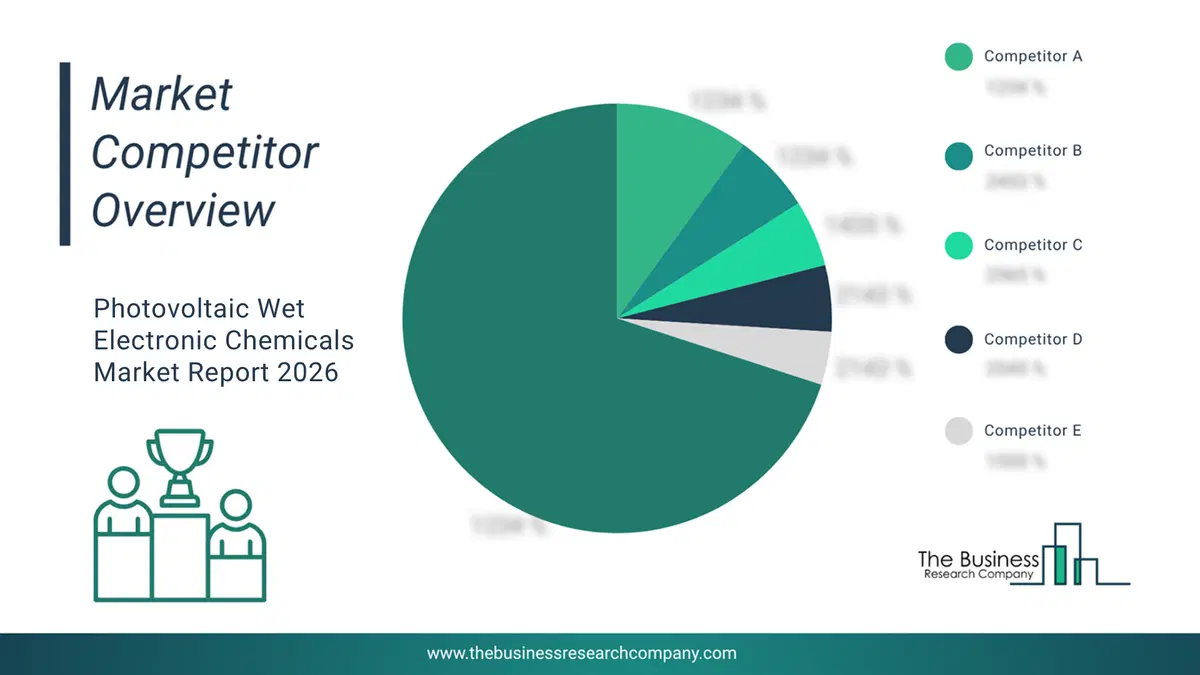
This chart is for illustrative purposes; the full report includes a detailed competitor analysis and comprehensive overview of the top 10 companies in the market.
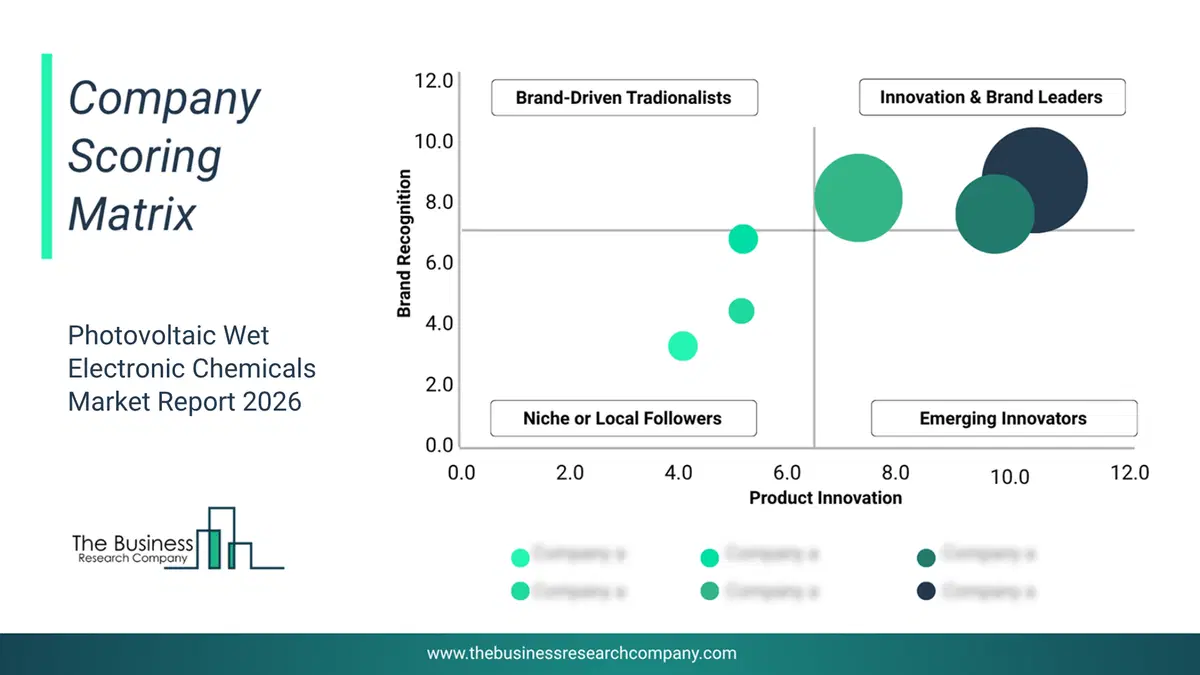
This chart maps companies by product innovation and brand strength, with bubble size indicating relative revenue, helping identify market leaders, challengers, and niche players. This is an illustrative chart; the full report provides a complete and accurate competitive analysis.
What Are Latest Mergers And Acquisitions In The Photovoltaic Wet Electronic Chemicals Market?
In May 2025, RENA Technologies GmbH, a Germany-based provider of wet chemical processing equipment and surface treatment solutions for the photovoltaic and semiconductor industries, partnered with Premier Energies Limited to advance next-generation solar cell technologies. With this partnership, RENA Technologies GmbH and Premier Energies Limited aim to optimize wet chemical processes for N-type solar cells, accelerate the development of TOPCon and silicon-perovskite tandem solar cell technologies, improve manufacturing efficiency, and support the production of higher-performance solar cells through innovative wet chemistry solutions. Premier Energies Limited is an India-based company specializing in the manufacturing of photovoltaic solar cells and solar modules.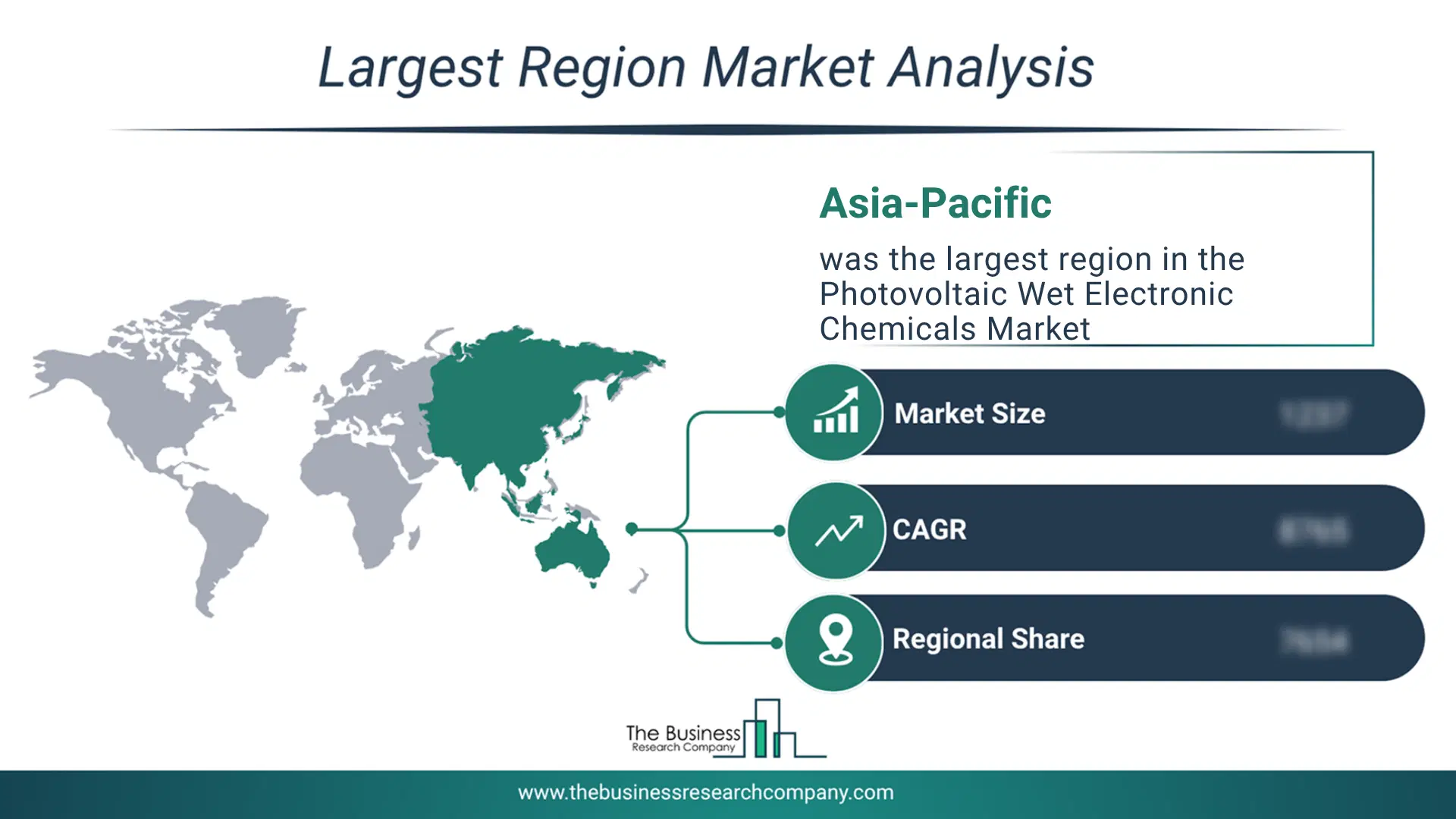
Regional Outlook
Asia-Pacific was the largest region in the photovoltaic wet electronic chemicals market in 2025. Asia-Pacific is expected to be the fastest-growing region in the forecast period. The regions covered in this market report are Asia-Pacific, South East Asia, Western Europe, Eastern Europe, North America, South America, Middle East, Africa. The countries covered in this market report are Australia, Brazil, China, France, Germany, India, Indonesia, Japan, Taiwan, Russia, South Korea, UK, USA, Canada, Italy, Spain.What Defines the Photovoltaic Wet Electronic Chemicals Market?
The photovoltaic wet electronic chemicals market consists of sales of general-purpose wet electronic chemicals, functional wet electronic chemicals, photovoltaic wet process additives, and doping chemicals. Values in this market are ‘factory gate’ values, that is, the value of goods sold by the manufacturers or creators of the goods, whether to other entities (including photovoltaic cell manufacturers, solar module manufacturers, distributors, chemical suppliers, and research institutions) or directly to end customers. The value of goods in this market includes related services sold by the creators of the goods.How is Market Value Defined and Measured?
The market value is defined as the revenues that enterprises gain from the sale of goods and/or services within the specified market and geography through sales, grants, or donations in terms of the currency (in USD unless otherwise specified). The revenues for a specified geography are consumption values that are revenues generated by organizations in the specified geography within the market, irrespective of where they are produced. It does not include revenues from resales along the supply chain, either further along the supply chain or as part of other products.
This chart presents market attractiveness based on a quantitative evaluation of growth, competition, strategic alignment, and risk, offering a clear view of opportunity areas for decision-making. This chart is for illustrative purposes; the full report contains the complete analysis.

This chart highlights the Total Addressable Market (TAM) by estimating the maximum revenue opportunity using an assumption-driven approach, supporting strategic planning and opportunity sizing across markets. The chart is illustrative; the full report provides a more comprehensive analysis.
What Key Data and Analysis Are Included in the Photovoltaic Wet Electronic Chemicals Market Report 2026?
The photovoltaic wet electronic chemicals market research report is one of a series of new reports from The Business Research Company that provides market statistics, including industry global market size, regional shares, competitors with the market share, detailed market segments, market trends and opportunities, and any further data you may need to thrive in the photovoltaic wet electronic chemicals industry. The market research report delivers a complete perspective of everything you need, with an in-depth analysis of the current and future state of the industry.Photovoltaic Wet Electronic Chemicals Market Report Forecast Analysis
| Report Attribute | Details |
|---|---|
| Market Size Value In 2026 | $3.37 billion |
| Revenue Forecast In 2030 | $4.73 billion |
| Growth Rate | CAGR of 8.8% from 2026 to 2030 |
| Base Year For Estimation | 2025 |
| Actual Estimates/Historical Data | 2020-2025 |
| Forecast Period | 2026 - 2030 |
| Market Representation | Revenue in USD Billion and CAGR from 2026 to 2030 |
| Segments Covered | Chemical Type, Purity Level, Distribution Channel, Application |
| Regional Scope | Asia-Pacific, Western Europe, Eastern Europe, North America, South America, Middle East, Africa |
| Country Scope | The countries covered in the report are Australia, Brazil, China, France, Germany, India, Indonesia, Japan, Taiwan, Russia, South Korea, UK, USA, Canada, Italy, Spain. |
| Key Companies Profiled | BASF SE, Linde plc, Merck KGaA, Sumitomo Chemical Co. Ltd., Avantor Inc., Solvay SA, OCI Holdings Company Ltd., Do-Fluoride New Materials Co. Ltd., Dongjin Semichem Co. Ltd., Soulbrain Co. Ltd., Technic Inc, Suzhou Crystal Clear Chemical Co. Ltd., Jiangyin Jianghua Microelectronics Materials Co. Ltd., TNC Industrial Co. Ltd., SACHEM Inc., Columbus Chemical Industries Inc., Zhejiang Kaisn Fluorochemical Co. Ltd., Alfa Chemistry Inc., Kanto Chemical Co. Inc., Mitsubishi Chemical Corporation, Hubei Jingxing Science and Technology Co. Ltd., Moses Lake Industries, Transene Company Inc. |
| Customization Scope | Request for Customization |
| Pricing And Purchase Options | Explore Purchase Options |