

Physical Vapor Deposition Market Report 2026
Global Outlook – By Type (PVD Equipment, PVD Materials, PVD Services ), By Process (Thermal Evaporation, Sputter Deposition), By Application (Microelectronics, Data Storage, Solar products, Cutting Tools, Medical Equipment, Other Applications) – Market Size, Trends, Strategies, and Forecast to 2030
Physical Vapor Deposition Market Overview
• Physical Vapor Deposition market size has reached to $24.67 billion in 2025 • Expected to grow to $36.95 billion in 2030 at a compound annual growth rate (CAGR) of 8.5% • Growth Driver: Surging Semiconductor Demand Fuels Physical Vapor Deposition Market Growth • Market Trend: Innovative Inline Sputtering Systems Advance Efficiency • Asia-Pacific was the largest region in 2025 and North America is the fastest growing region.What Is Covered Under Physical Vapor Deposition Market?
Physical vapor deposition refers to several different vacuum deposition techniques that can be used to create thin films and coatings. Physical vapor deposition is described as a method in which a material transforms from a condensed to a vapor phase before returning to a thin-film condensed phase. The main types of physical vapor deposition (PVD) are PVD equipment, PVD materials, and PVD services. PVD equipment refers to devices designed for the application of physical vapor deposition (PVD) coatings. PVD materials that are deposited on the material to be coated include titanium, aluminum, chromium, and nitrogen. PVD services include the use of technologies such as evaporation, vacuum, and sputtering systems to produce affordable, wear-resistant, and superior-quality coatings. The different processes include thermal evaporation and sputtering deposition and are used in microelectronics, data storage, solar products, cutting tools, medical equipment, and others.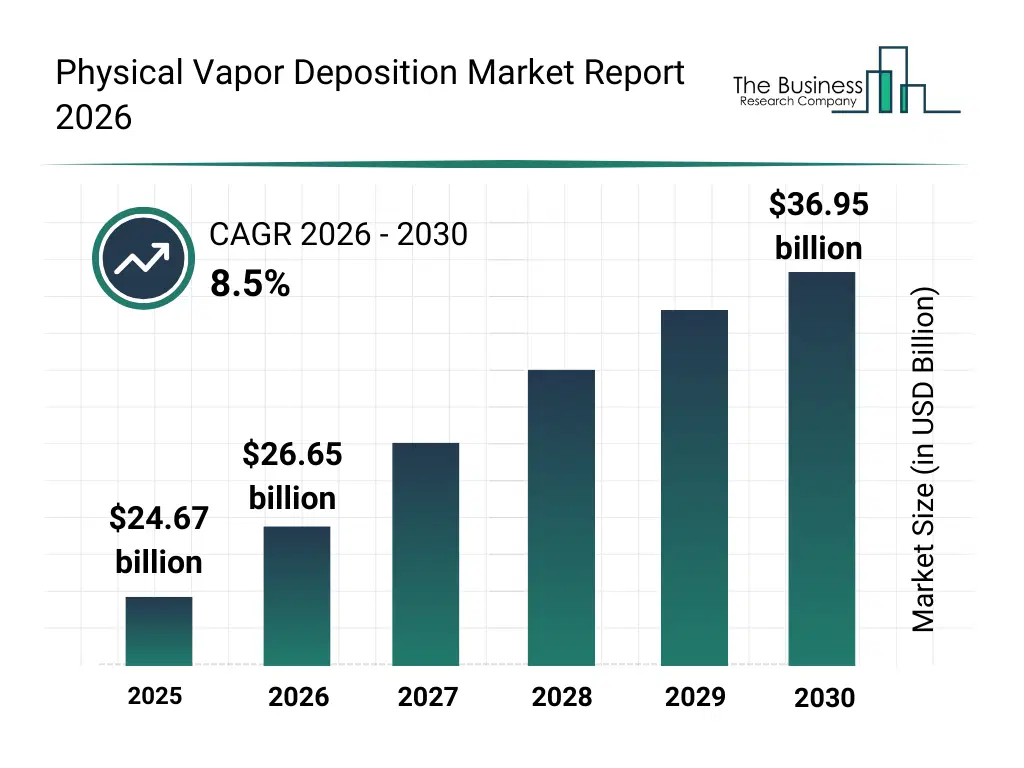
What Is The Physical Vapor Deposition Market Size and Share 2026?
The physical vapor deposition market size has grown strongly in recent years. It will grow from $24.67 billion in 2025 to $26.65 billion in 2026 at a compound annual growth rate (CAGR) of 8.0%. The growth in the historic period can be attributed to advancements in vacuum coating technologies, growth of cutting tool manufacturing, increasing demand for durable surface coatings, rising adoption in electronics production, availability of high-performance coating materials.What Is The Physical Vapor Deposition Market Growth Forecast?
The physical vapor deposition market size is expected to see strong growth in the next few years. It will grow to $36.95 billion in 2030 at a compound annual growth rate (CAGR) of 8.5%. The growth in the forecast period can be attributed to increasing semiconductor fabrication investments, rising demand for advanced medical coatings, expansion of renewable energy applications, growing focus on sustainable coating processes, increasing integration of automated coating systems. Major trends in the forecast period include increasing adoption of advanced thin-film coatings, rising demand for wear-resistant surfaces, growing use in semiconductor manufacturing, expansion of pvd in medical devices, enhanced focus on high-precision coating processes.
Global Physical Vapor Deposition Market Segmentation
1) By Type: PVD Equipment, PVD Materials, PVD Services 2) By Process: Thermal Evaporation, Sputter Deposition 3) By Application: Microelectronics, Data Storage, Solar products, Cutting Tools, Medical Equipment, Other Applications Subsegments: 1) By PVD Equipment: Evaporation Systems, Sputtering Systems, Cathodic Arc Deposition Systems, Ion Beam Deposition Systems 2) By PVD Materials: Metallic Materials, Ceramic Materials, Alloy Materials, Target Materials 3) By PVD Services: Coating Services, Maintenance and Repair Services, Consulting And Support ServicesWhat Is The Driver Of The Physical Vapor Deposition Market?
The increasing demand in the semiconductor industry is expected to propel the growth of the physical vapor deposition market going forward. The semiconductor industry refers to the designing, manufacturing, and distribution of semiconductor devices such as integrated circuits or microchips. Physical vapor deposition is used for creating the thin metal wiring that connects various components and transistors on the semiconductor. For instance, in July 2025, according to the Semiconductor Industry Association (SIA), a US-based trade group, global semiconductor sales reached $630.5 billion in 2024, surpassing earlier projections and exceeding $600 billion for the first time, with regional growth observed in the Americas, China, and Asia Pacific/All Others, contrasted by slight declines in Japan and Europe. Therefore, the increasing demand in the semiconductor industry is driving the growth of the physical vapor deposition industry going forward.Key Players In The Global Physical Vapor Deposition Market
Major companies operating in the physical vapor deposition market are Applied Materials, Inc., ULVAC, Inc., Tokyo Electron Limited, Veeco Instruments Inc., Singulus Technologies AG, Angstrom Engineering Inc., AJA International, Inc., Buhler AG, IHI Corporation, Oerlikon Balzers Coating AG, Platit AG, Intevac, Inc., Kurt J. Lesker Company, Semicore Equipment, Inc., Mustang Vacuum Systems Inc., HEF Group, NAURA Technology Group Co., Ltd., Impact Coatings AB, Shincron Co., Ltd., CemeCon AG, Intlvac Thin Film Corporation, CHA Industries, Inc., Pfeiffer Vacuum GmbH, Advanced Energy Industries, Inc.,
This chart is for illustrative purposes; the full report includes a detailed competitor analysis and comprehensive overview of the top 10 companies in the market.
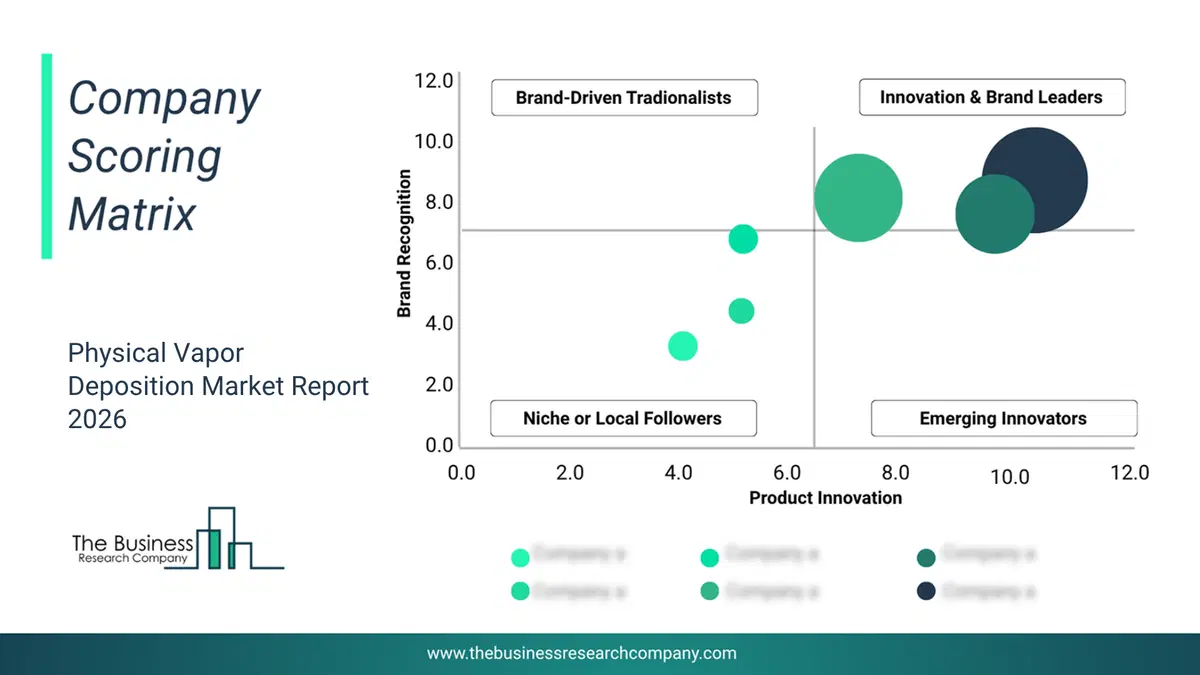
This chart maps companies by product innovation and brand strength, with bubble size indicating relative revenue, helping identify market leaders, challengers, and niche players. This is an illustrative chart; the full report provides a complete and accurate competitive analysis.
Global Physical Vapor Deposition Market Trends and Insights
Major companies operating in the physical vapor deposition (PVD) market are focusing on developing advanced solutions such as inline sputtering systems to enhance efficiency and cost-effectiveness. Inline sputtering systems are deposition technologies that allow precise application of thin films on substrates, enabling uniform coating, reduced material consumption, and high adhesion, which is especially important when using precious metals. For instance, in April 2024, SINGULUS TECHNOLOGIES, a Germany-based company providing machines for thin-film coating and surface treatment, launched the GENERIS PVD inline sputtering system for the production of bipolar plates for fuel cells and PEM electrolyzers. The system features a modular design for flexible adaptation to various substrate sizes and requirements, upstream substrate cleaning for optimal surface preparation, and rotating magnetron cathodes to ensure double-sided coating with excellent adhesion. Controlled thin-layer deposition reduces material usage, while the system supports intelligent manufacturing practices and scalable production. The GENERIS PVD range includes coating areas from 510 x 1,500 mm up to 1,400 x 1,600 mm and allows cost-effective series production, offering a highly efficient and sustainable solution for the growing hydrogen technology market.What Are Latest Mergers And Acquisitions In The Physical Vapor Deposition Market?
In March 2025, HEF Groupe, a France-based provider of surface treatment and tribology solutions, acquired Vergason Technology, Inc. for an undisclosed amount. With this acquisition, HEF Groupe aimed to broaden and deepen its global footprint in high-performance coating technologies by integrating Vergason’s advanced physical vapor deposition (PVD) equipment and services enhancing HEF’s technological capabilities and market reach across automotive, aerospace, medical, and electronics sectors. Vergason Technology Inc. is a US-based provider of PVD coating equipment and services, offering sputtering, thermal evaporation, and cathodic arc deposition technologies for metallizing and hard coating applications.
Regional Insights
Asia-Pacific was the largest region in the physical vapor deposition market in 2025. North America was the fastest-growing region in the physical vapor deposition market share. The regions covered in this market report are Asia-Pacific, South East Asia, Western Europe, Eastern Europe, North America, South America, Middle East, Africa The countries covered in this market report are Australia, Brazil, China, France, Germany, India, Indonesia, Japan, Taiwan, Russia, South Korea, UK, USA, Canada, Italy, SpainWhat Defines the Physical Vapor Deposition Market?
The physical vapor deposition market consists of revenues earned by entities by providing ion plating, electron beam sputtering, and magnetron sputtering. Values in this market are ‘factory gate’ values, that is, the value of goods sold by the manufacturers or creators of the goods, whether to other entities (including downstream manufacturers, wholesalers, distributors, and retailers) or directly to end customers. The value of goods in this market includes related services sold by the creators of the goods.How is Market Value Defined and Measured?
The market value is defined as the revenues that enterprises gain from the sale of goods and/or services within the specified market and geography through sales, grants, or donations in terms of the currency (in USD unless otherwise specified). The revenues for a specified geography are consumption values that are revenues generated by organizations in the specified geography within the market, irrespective of where they are produced. It does not include revenues from resales along the supply chain, either further along the supply chain or as part of other products.
This chart presents market attractiveness based on a quantitative evaluation of growth, competition, strategic alignment, and risk, offering a clear view of opportunity areas for decision-making. This chart is for illustrative purposes; the full report contains the complete analysis.

This chart highlights the Total Addressable Market (TAM) by estimating the maximum revenue opportunity using an assumption-driven approach, supporting strategic planning and opportunity sizing across markets. The chart is illustrative; the full report provides a more comprehensive analysis.
What Key Data and Analysis Are Included in the Physical Vapor Deposition Market Report 2026?
The physical vapor deposition market research report is one of a series of new reports from The Business Research Company that provides market statistics, including industry global market size, regional shares, competitors with the market share, detailed market segments, market trends and opportunities, and any further data you may need to thrive in the physical vapor deposition industry. The market research report delivers a complete perspective of everything you need, with an in-depth analysis of the current and future state of the industry.Physical Vapor Deposition Market Report Forecast Analysis
| Report Attribute | Details |
|---|---|
| Market Size Value In 2026 | $26.65 billion |
| Revenue Forecast In 2030 | $36.95 billion |
| Growth Rate | CAGR of 8.0% from 2026 to 2030 |
| Base Year For Estimation | 2025 |
| Actual Estimates/Historical Data | 2020-2025 |
| Forecast Period | 2026 - 2030 |
| Market Representation | Revenue in USD Billion and CAGR from 2026 to 2030 |
| Segments Covered | Type, Process, Application |
| Regional Scope | Asia-Pacific, Western Europe, Eastern Europe, North America, South America, Middle East, Africa |
| Country Scope | The countries covered in this market report are Australia, Brazil, China, France, Germany, India, Indonesia, Japan, Taiwan, Russia, South Korea, UK, USA, Canada, Italy, Spain |
| Key Companies Profiled | Applied Materials, Inc., ULVAC, Inc., Tokyo Electron Limited, Veeco Instruments Inc., Singulus Technologies AG, Angstrom Engineering Inc., AJA International, Inc., Buhler AG, IHI Corporation, Oerlikon Balzers Coating AG, Platit AG, Intevac, Inc., Kurt J. Lesker Company, Semicore Equipment, Inc., Mustang Vacuum Systems Inc., HEF Group, NAURA Technology Group Co., Ltd., Impact Coatings AB, Shincron Co., Ltd., CemeCon AG, Intlvac Thin Film Corporation, CHA Industries, Inc., Pfeiffer Vacuum GmbH, Advanced Energy Industries, Inc., |
| Customization Scope | Request for Customization |
| Pricing And Purchase Options | Explore Purchase Options |