

Pipeline Construction Market Report 2026
Global Outlook – By Pipe Type (Metallic, Non-Metallic ), By Equipment (Valves, Pipeline, Metering Skids, Compressor stations ), By Operation (Transmission, Distribution), By Application (Liquid Pipeline, Gas Pipeline ), By End User (Oil and Gas, Chemical, Water and Wastewater, Energy, Other End Users ) – Market Size, Trends, Strategies, and Forecast to 2030
Pipeline Construction Market Overview
• Pipeline Construction market size has reached to $52.35 billion in 2025 • Expected to grow to $69.92 billion in 2030 at a compound annual growth rate (CAGR) of 5.9% • Growth Driver: Increasing Demand For Oil And Gas Production In The Pipeline Construction Market • Market Trend: Launch Of Advanced Inter-Oceanic Energy Corridor Pipelines To Boost Global Energy Transport Efficiency • North America was the largest region and fastest growing region.Market Gains By 2030 – Top Opportunities By Segment
Market Gain identifies the most promising market opportunities by highlighting the segments or products expected to generate the highest incremental revenue growth over the next five years.
What Is Covered Under Pipeline Construction Market?
Pipeline construction refers to the commencement of any excavation or other property disturbance for the purpose of installing, building, maintaining, repairing, replacing, modifying, or removing a pipeline. Pipelines are used to transport materials like sewage, gas, and water from one location to another. The main types of pipeline construction are metallic and non-metallic pipelines. Metallic character is an element's propensity to lose electrons and produce positive ions or cations. Metal pipelines are the most often used pipes in water delivery systems. They are also used in natural gas pipes and wastewater systems. Various equipment involved are valves, pipeline, metering skids, and compressor stations. It is used for transmission and distribution operations. It is used in several applications, such as liquid pipeline and gas pipeline, by various end users, such as oil and gas, chemical, water and wastewater, energy, and others.
What Is The Pipeline Construction Market Size and Share 2026?
The pipeline construction market size has grown strongly in recent years. It will grow from $52.35 billion in 2025 to $55.52 billion in 2026 at a compound annual growth rate (CAGR) of 6.1%. The growth in the historic period can be attributed to expansion of oil and gas exploration activities, adoption of durable metallic pipeline materials, development of municipal water infrastructure, reliance on traditional pipeline construction practices, availability of low-cost imported steel.What Is The Pipeline Construction Market Growth Forecast?
The pipeline construction market size is expected to see strong growth in the next few years. It will grow to $69.92 billion in 2030 at a compound annual growth rate (CAGR) of 5.9%. The growth in the forecast period can be attributed to growing demand for sustainable pipeline materials, rising investments in cross-border energy transport, increased use of trenchless construction technology, expansion of smart pipeline monitoring, regulatory push for safer and resilient pipeline systems. Major trends in the forecast period include growing demand for corrosion-resistant pipeline materials, expansion of long-distance oil, gas, and water transmission projects, increased focus on pipeline safety upgrades and integrity management, rising adoption of trenchless construction and replacement methods, higher investment in large-scale cross-border pipeline infrastructure.
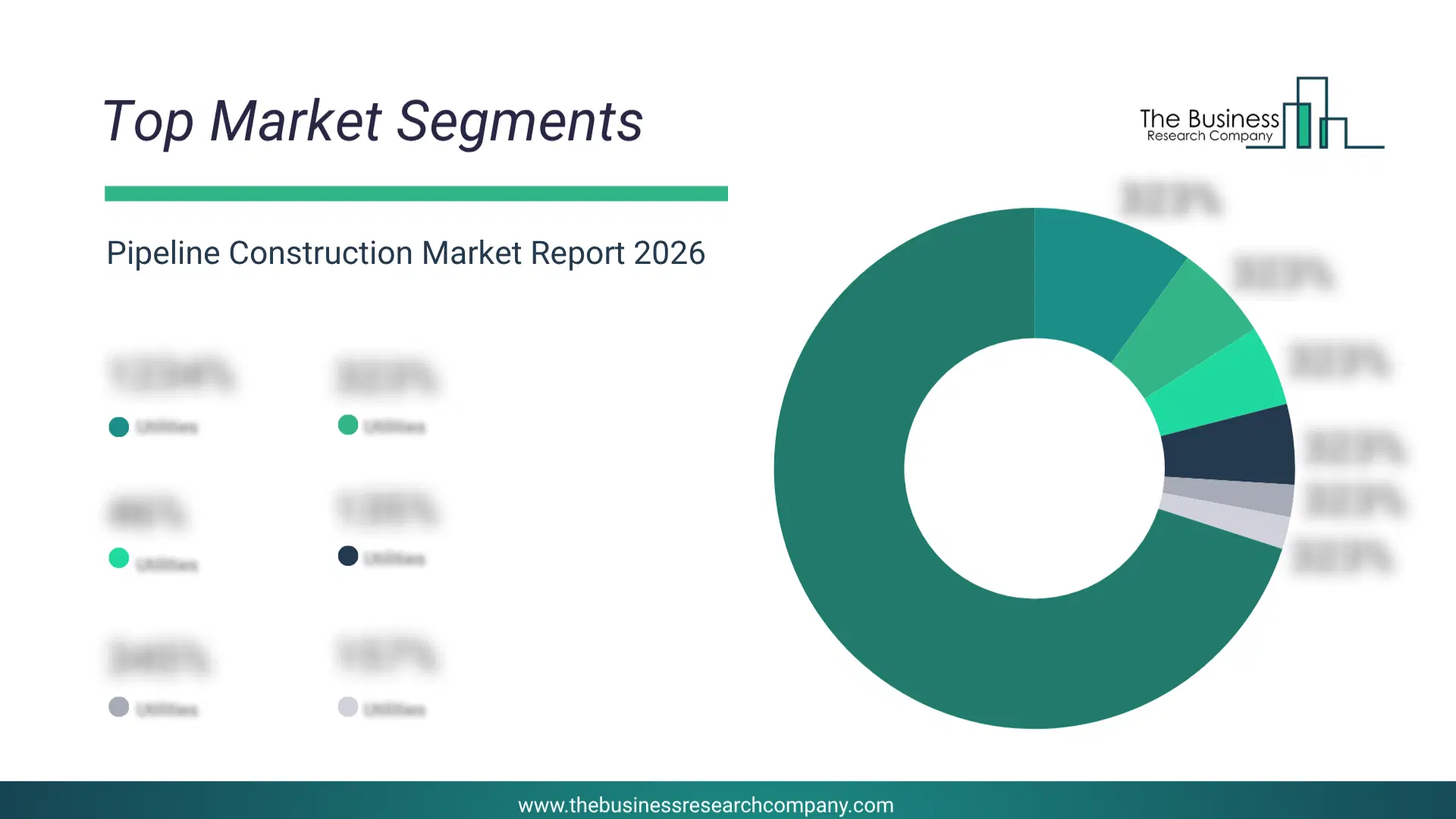
Global Pipeline Construction Market Segmentation
1) By Pipe Type: Metallic, Non-Metallic 2) By Equipment: Valves, Pipeline, Metering Skids, Compressor stations 3) By Operation: Transmission, Distribution 4) By Application: Liquid Pipeline, Gas Pipeline 5) By End User: Oil and Gas, Chemical, Water and Wastewater, Energy, Other End Users Subsegments: 1) By Metallic: Steel Pipes, Copper Pipes, Aluminum Pipes, Other Metallic Pipes 2) By Non-Metallic: PVC Pipes, HDPE Pipes, FRP Pipes, Other Non-Metallic Pipes The top segments in the pipeline construction market will be: • Metallic will reach $46 Billion by 2030. • Non-Metallic will reach $24 Billion by 2030.What Is The Driver Of The Pipeline Construction Market?
The increasing demand for oil and gas production is expected to propel the pipeline construction market going forward. Oil and gas production refer to the basic process of converting crude oil and natural gas from wells into finished petroleum products that may be used by consumers. Pipeline constructions are used in oil and gas production for the transportation of hydrocarbons from extraction sites to processing facilities, refineries, and distribution points, and for supplying natural gas to industries, power plants, and households. For instance, in March 2023, according to the US Energy Information Administration, a US-based government agency, there was crude oil output of 12.4 million b/d in 2023 from 11.7 million b/d in 2022 in the US. Therefore, the increasing demand for oil and gas production is driving the growth of the pipeline construction industry.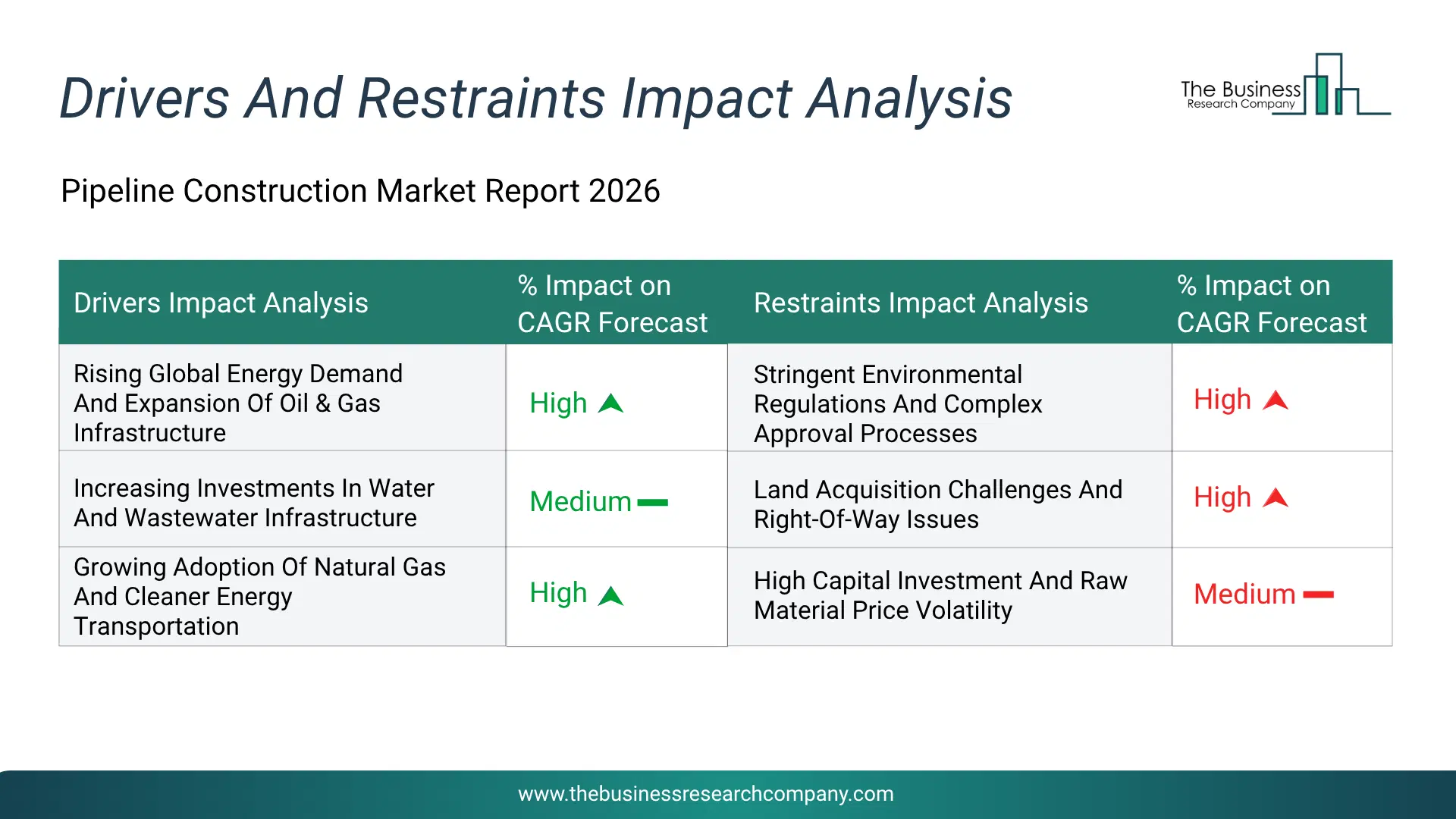
Infographic Chart Showing Key Market Drivers Analysis And Restraints For Pipeline Construction Market
The chart presents an impact analysis of key drivers and restraints, quantifying their relative influence on the market's growth rate and helping assess the balance between growth enablers and limiting factors. This chart offers a high-level perspective; the full report contains more detailed insights.
How Will The Drivers Impact Growth In The Global Pipeline Construction Market?
• Rising Global Energy Demand And Expansion Of Oil & Gas Infrastructure (High) – During the forecast period, the rising global energy demand and expansion of oil & gas infrastructure are expected to emerge as a major factor driving the expansion of the pipeline construction market by 2030. Growing industrialization, urbanization, and increasing energy consumption are encouraging governments and energy companies to invest in new transmission pipelines connecting production fields, refineries, LNG terminals, and distribution networks. In addition, cross-border pipeline projects and the replacement of aging pipeline infrastructure with modern systems are creating significant construction opportunities. • Increasing Investments In Water And Wastewater Infrastructure (Medium) – During the forecast period, increasing investments in water and wastewater infrastructure are expected to emerge as a major factor driving the expansion of the pipeline construction market by 2030. This is because governments and municipalities are expanding drinking water supply systems, wastewater collection networks, irrigation projects, desalination facilities, and water recycling infrastructure to meet growing population needs and improve water resource management. The replacement of aging underground pipelines and stricter environmental regulations are further increasing demand for modern pipeline construction services. • Growing Adoption Of Natural Gas And Cleaner Energy Transportation (High) – During the forecast period, the growing adoption of natural gas and cleaner energy transportation is expected to act as a key growth catalyst for the pipeline construction market by 2030. This is supporting market growth as countries expand natural gas transmission and distribution networks while investing in hydrogen pipelines, renewable natural gas infrastructure, and carbon capture transportation systems to support energy transition goals. Continuous development of city gas distribution projects and industrial gas supply networks is further strengthening pipeline construction activities.How Will The Restraints Impact Growth In The Global Pipeline Construction Market?
• Stringent Environmental Regulations And Complex Approval Processes (High) – During the forecast period, the stringent environmental regulations and complex approval processes remain one of the biggest restraints affecting the pipeline construction market. Pipeline projects typically pass through environmentally sensitive regions, forests, agricultural land, wetlands, and residential communities, requiring developers to comply with extensive environmental regulations before construction begins. Obtaining environmental clearances involves comprehensive impact assessments, biodiversity studies, public consultations, safety evaluations, and multiple regulatory approvals, often extending project timelines by several years. In many regions, legal challenges from environmental organizations, indigenous communities, and local residents further delay or halt construction activities. Increasing regulatory scrutiny related to greenhouse gas emissions, ecosystem preservation, and land restoration also raises project compliance costs significantly. These lengthy approval procedures increase investment risks, delay project commissioning, and discourage private investors from undertaking new large-scale pipeline developments, thereby limiting overall market expansion. • Land Acquisition Challenges And Right-Of-Way Issues (Medium) – During the forecast period, the land acquisition challenges and right-of-way issues continue to create major obstacles for pipeline construction projects globally. Long-distance pipelines often cross privately owned properties, agricultural land, forests, protected ecosystems, urban areas, and multiple administrative jurisdictions, making land acquisition highly complex and time-consuming. Negotiations with landowners regarding compensation, rehabilitation, and easement rights frequently result in legal disputes and project delays. In addition, local communities may oppose pipeline construction due to environmental concerns, displacement risks, or perceived safety hazards, leading to protests and litigation. Cross-border pipeline projects face even greater complexity because developers must coordinate with multiple governments, regulatory agencies, and international agreements. Delays associated with securing land access increase construction costs, extend project schedules, and reduce overall project profitability, making right-of-way acquisition one of the industry's most persistent challenges. • High Capital Investment And Raw Material Price Volatility (High) – During the forecast period, the high capital investment and raw material price volatility significantly restrain the growth of the pipeline construction market. Developing pipeline infrastructure requires enormous upfront investments in steel pipes, protective coatings, valves, compressors, pumping stations, heavy construction equipment, advanced monitoring systems, and skilled engineering labor. Fluctuations in steel prices, fuel costs, cement, construction materials, and transportation expenses directly affect project budgets and profitability. Inflation, higher borrowing costs, and global supply chain disruptions further increase procurement expenses and delay equipment deliveries. Large infrastructure projects also require long investment recovery periods, making financing more difficult during periods of economic uncertainty. These financial challenges are particularly severe in developing economies where government budgets and private investment are limited. Consequently, many planned pipeline projects experience delays, cost overruns, downsizing, or cancellation, restricting the overall growth potential of the pipeline construction market.Key Players In The Global Pipeline Construction Market
Major companies operating in the pipeline construction market are Energy Transfer LP, Nippon Steel Corporation, Enterprise Products Partners L.P., Enbridge lnc., Larsen & Toubro Ltd., Kinder Morgan Inc., Joint Stock Company Transneft, Tenaris S.A, Pembina Pipeline Corporation, TechnipFMC plc, TMK Group, Primoris Services Corporation, Enka İnşaat ve Sanayi A.Ş., Ledcor Group, Mott Macdonald Group Ltd., McDermott International Inc., Bonatti S.p.A., Spiecapag, CRC-Evans Pipeline International Inc., Prosaic Steel & Alloys, Gateway Pipeline LLC, Pumpco Inc., Cogbill Construction LLC, Sung IL Sim Co Ltd., Cecon Group, Barnard Construction Company Inc., Metal Forge India, CCI Leidingsystemen B.V., Yena Engineering B.V., Seonghwa Industrial Co Ltd., ChelPipe Group, Shengli Oil & Gas Pipe Holdings Limited, Sunland Construction Inc., Bechtel Corporation, Snelson Companies Inc., TC Energy Corporation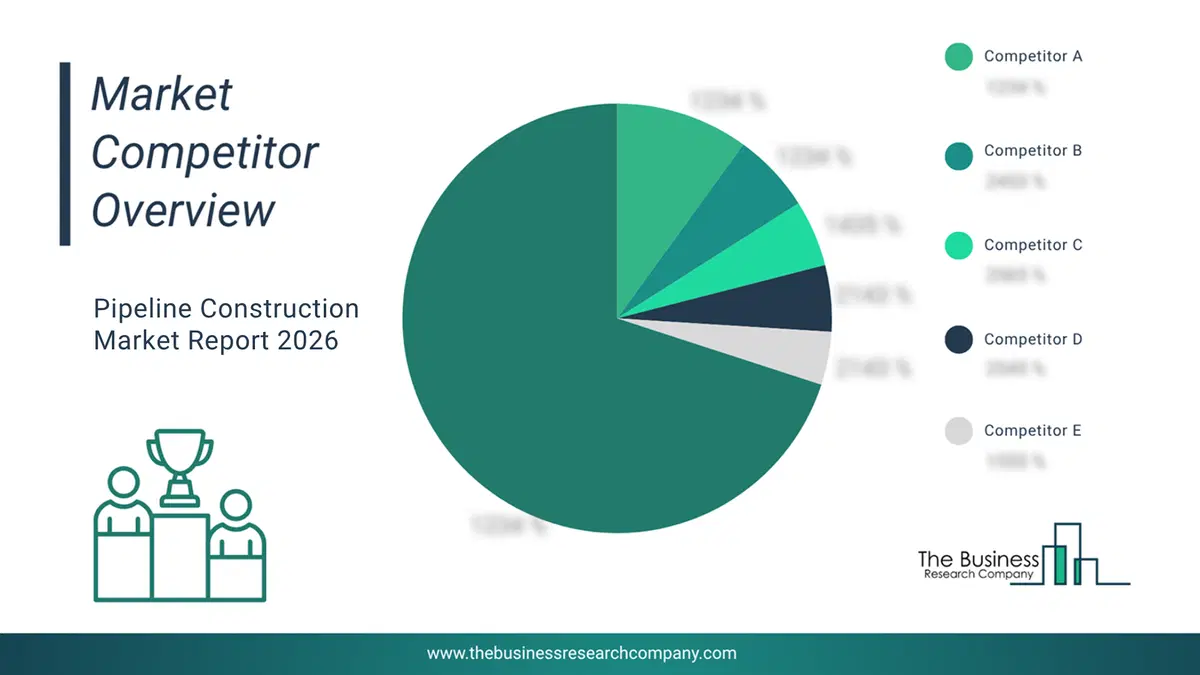
This chart is for illustrative purposes; the full report includes a detailed competitor analysis and comprehensive overview of the top 10 companies in the market.
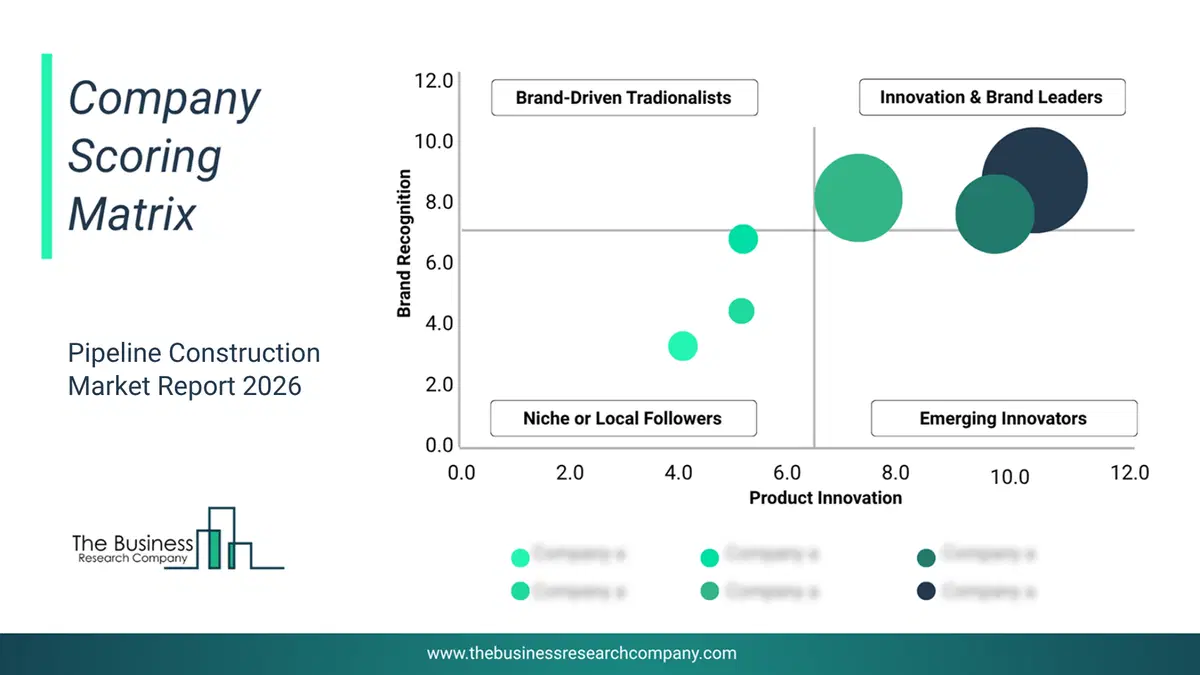
This chart maps companies by product innovation and brand strength, with bubble size indicating relative revenue, helping identify market leaders, challengers, and niche players. This is an illustrative chart; the full report provides a complete and accurate competitive analysis.
Global Pipeline Construction Market Trends and Insights
Major companies operating in the pipeline construction market are focusing on developing advanced solutions, such as inter-oceanic energy corridor pipelines, to enhance operational efficiency and capacity utilization. An inter-oceanic energy corridor pipeline is a dedicated pipeline system that enables bulk transport of energy products from one ocean to another, bypassing conventional maritime transit bottlenecks, thereby freeing up existing waterways and reducing vessel wait times. For instance, in September 2025, the Panama Canal Authority (ACP), a Panama-based government authority, launched a concession process for a new energy pipeline project featuring a 76-kilometer pipeline capable of transferring up to 2.5 million barrels per day. Its key features include the pipeline’s routing across the isthmus to link Atlantic and Pacific maritime terminals, capacity to transport propane, butane, and ethane, support for maritime terminals on both coasts to integrate with sea logistics, and compliance with international standards for safety, environmental protection, and operational excellence.What Are Latest Mergers And Acquisitions In The Pipeline Construction Market?
In October 2024, Indian Oil Corporation Limited, an India-based company, partnered with Nepal Oil Corporation Limited. With this partnership, Indian Oil aims to expand its portfolio by incorporating Nepal Oil's expertise in providing pipeline construction projects. Nepal Oil Corporation Limited is a Nepal-based company that offers pipeline construction projects.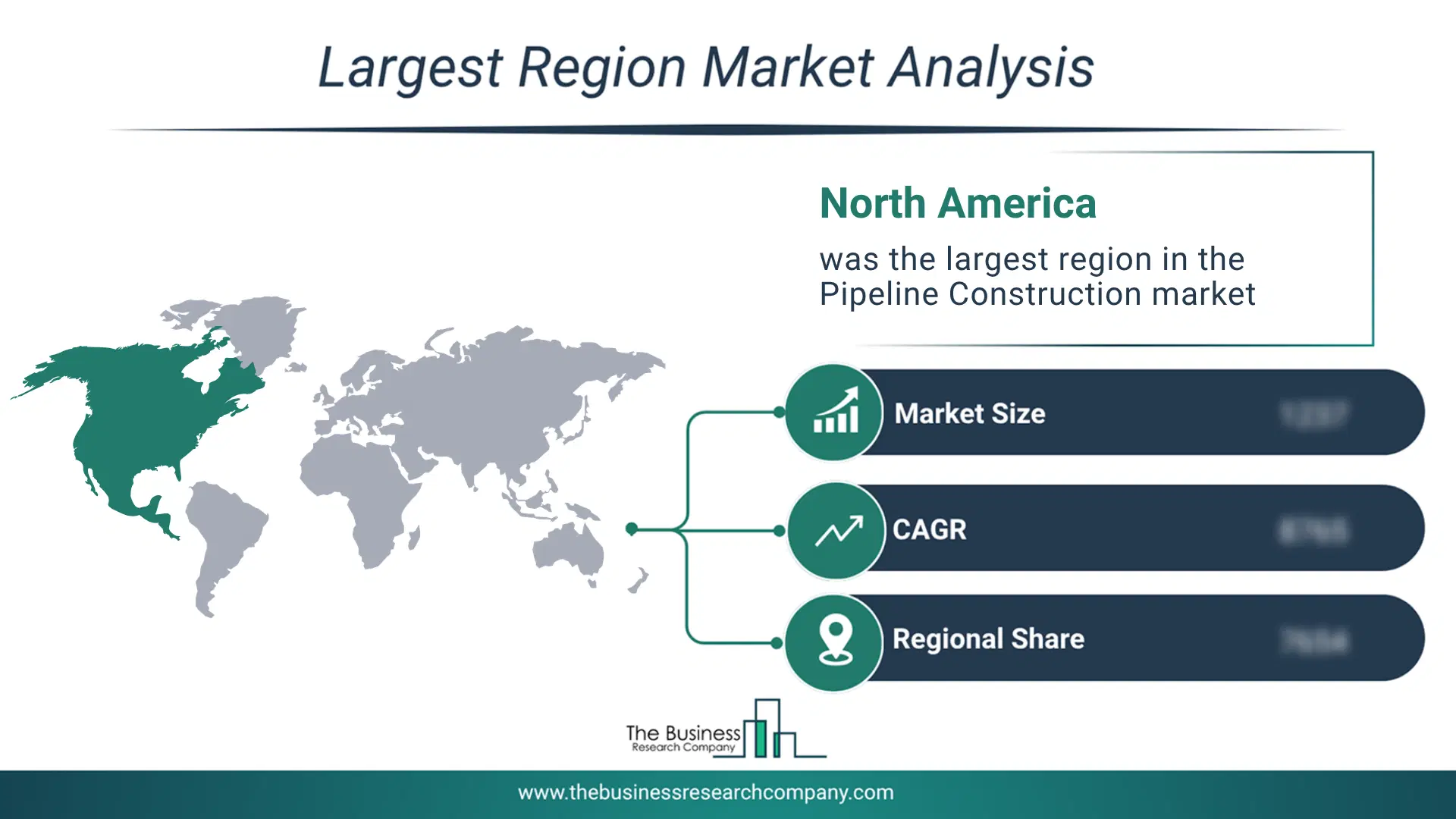
Regional Insights
North America was the largest region in the pipeline construction market share in 2025. The regions covered in this market report are Asia-Pacific, South East Asia, Western Europe, Eastern Europe, North America, South America, Middle East, Africa. The countries covered in this market report are Australia, Brazil, China, France, Germany, India, Indonesia, Japan, Taiwan, Russia, South Korea, UK, USA, Canada, Italy, Spain.What Defines the Pipeline Construction Market?
The pipeline construction market includes revenue earned by entities by constructing cast iron pipes, petroleum oil pipelines, gas pipelines, slurry pipelines, and oily sewers. The market value includes the value of related goods sold by the service provider or included within the service offering. Only goods and services traded between entities or sold to end consumers are included.How is Market Value Defined and Measured?
The market value is defined as the revenues that enterprises gain from the sale of goods and/or services within the specified market and geography through sales, grants, or donations in terms of the currency (in USD unless otherwise specified). The revenues for a specified geography are consumption values that are revenues generated by organizations in the specified geography within the market, irrespective of where they are produced. It does not include revenues from resales along the supply chain, either further along the supply chain or as part of other products.
This chart presents market attractiveness based on a quantitative evaluation of growth, competition, strategic alignment, and risk, offering a clear view of opportunity areas for decision-making. This chart is for illustrative purposes; the full report contains the complete analysis.

This chart highlights the Total Addressable Market (TAM) by estimating the maximum revenue opportunity using an assumption-driven approach, supporting strategic planning and opportunity sizing across markets. The chart is illustrative; the full report provides a more comprehensive analysis.
What Key Data and Analysis Are Included in thePipeline Construction Market Report 2026?
The pipeline construction market research report is one of a series of new reports from The Business Research Company that provides market statistics, including industry global market size, regional shares, competitors with the market share, detailed market segments, market trends and opportunities, and any further data you may need to thrive in the pipeline construction industry. The market research report delivers a complete perspective of everything you need, with an in-depth analysis of the current and future state of the industry.Pipeline Construction Market Report Forecast Analysis
| Report Attribute | Details |
|---|---|
| Market Size Value In 2026 | $55.52 billion |
| Revenue Forecast In 2030 | $69.92 billion |
| Growth Rate | CAGR of 5.9% from 2026 to 2030 |
| Base Year For Estimation | 2025 |
| Actual Estimates/Historical Data | 2020-2025 |
| Forecast Period | 2026 - 2030 |
| Market Representation | Revenue in USD Billion and CAGR from 2026 to 2030 |
| Segments Covered | Pipe Type, Equipment, Operation, Application, End User |
| Regional Scope | Asia-Pacific, Western Europe, Eastern Europe, North America, South America, Middle East, Africa |
| Country Scope | The countries covered in the report are Australia, Brazil, China, France, Germany, India, Indonesia, Japan, Taiwan, Russia, South Korea, UK, USA, Canada, Italy, Spain. |
| Key Companies Profiled | Energy Transfer LP, Nippon Steel Corporation, Enterprise Products Partners L.P., Enbridge lnc., Larsen & Toubro Ltd., Kinder Morgan Inc., Joint Stock Company Transneft, Tenaris S.A, Pembina Pipeline Corporation, TechnipFMC plc, TMK Group, Primoris Services Corporation, Enka İnşaat ve Sanayi A.Ş., Ledcor Group, Mott Macdonald Group Ltd., McDermott International Inc., Bonatti S.p.A., Spiecapag, CRC-Evans Pipeline International Inc., Prosaic Steel & Alloys, Gateway Pipeline LLC, Pumpco Inc., Cogbill Construction LLC, Sung IL Sim Co Ltd., Cecon Group, Barnard Construction Company Inc., Metal Forge India, CCI Leidingsystemen B.V., Yena Engineering B.V., Seonghwa Industrial Co Ltd., ChelPipe Group, Shengli Oil & Gas Pipe Holdings Limited, Sunland Construction Inc., Bechtel Corporation, Snelson Companies Inc., TC Energy Corporation |
| Customization Scope | Request for Customization |
| Pricing And Purchase Options | Explore Purchase Options |