
Planetary Geology Market Report 2026
Global Outlook – By Component (Instruments, Software, Services), By Application (Space Exploration, Research And Development, Academic Institutions, Government Agencies, Other Applications), By End-User (Aerospace, Defense, Research Institutes, Other End-Users) – Market Size, Trends, Strategies, and Forecast to 2030
Planetary Geology Market Overview
• Planetary Geology market size has reached to $2 billion in 2025 • Expected to grow to $3.51 billion in 2030 at a compound annual growth rate (CAGR) of 11.8% • Growth Driver: Increasing Investment In Space Exploration Fueling The Growth Of The Market Due To Rising Demand For Celestial Body Analysis • Market Trend: Technological Advancements In Interplanetary Spacecraft Fuels The Market Due To Rising Demand For Detailed Planetary Geology Insights • North America was the largest region in 2025 and Asia-Pacific is the fastest growing region.What Is Covered Under Planetary Geology Market?
Planetary geology is the scientific study of celestial bodies' composition, structure, and surface processes, such as planets, moons, asteroids, and comets. It focuses on understanding features such as craters, volcanoes, tectonic activity, and erosion to uncover these bodies' geological history and evolution. This field is critical in supporting space missions, guiding exploration strategies, and identifying potential extraterrestrial resources. The main components involved in planetary geology are instruments, software, and services. Instruments refer to physical devices such as cameras, spectrometers, laser altimeters, and radars that are deployed on spacecraft, landers, or rovers to measure and study the surfaces and internal structures of planets, moons, asteroids, and comets. These serve various applications, including space exploration, research and development, academic institutions, government agencies, and others, and are utilized by multiple end-users such as aerospace, defense, research institutes, and others.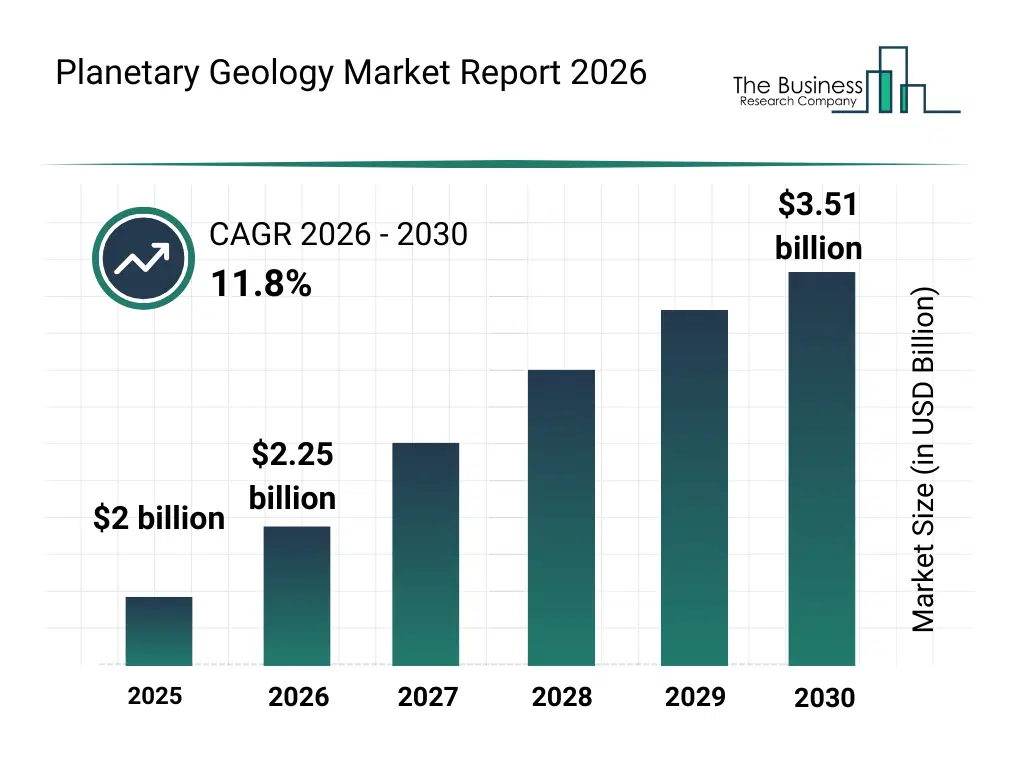
What Is The Planetary Geology Market Size and Share 2026?
The planetary geology market size has grown rapidly in recent years. It will grow from $2 billion in 2025 to $2.25 billion in 2026 at a compound annual growth rate (CAGR) of 12.5%. The growth in the historic period can be attributed to increasing government-funded planetary exploration missions generating demand for geological mapping services, rising use of remote sensing instruments and spectrometers for analyzing planetary surfaces, early development of planetary rovers and landers enabling in-situ geological studies, growth in scientific data interpretation services driven by expanding deep-space missions, greater reliance on mineral and chemical composition assessment for mission planning.What Is The Planetary Geology Market Growth Forecast?
The planetary geology market size is expected to see rapid growth in the next few years. It will grow to $3.51 billion in 2030 at a compound annual growth rate (CAGR) of 11.8%. The growth in the forecast period can be attributed to expanding commercial participation in lunar and asteroid exploration requiring advanced geological analysis, increasing adoption of high-resolution imaging and autonomous mapping technologies, rising demand for data analytics tools to process large volumes of planetary research data, growing focus on extraterrestrial resource identification supporting future mining feasibility studies, development of next-generation planetary rovers and landers enhancing precision geological investigations. Major trends in the forecast period include growing demand for high-resolution multispectral planetary imaging, rising use of in-situ geological analysis tools for extraterrestrial missions, increasing adoption of advanced geological mapping for lunar and martian colonization planning, expansion of contract-based planetary data interpretation services, integration of miniaturized scientific instruments in compact planetary rovers.
Global Planetary Geology Market Segmentation
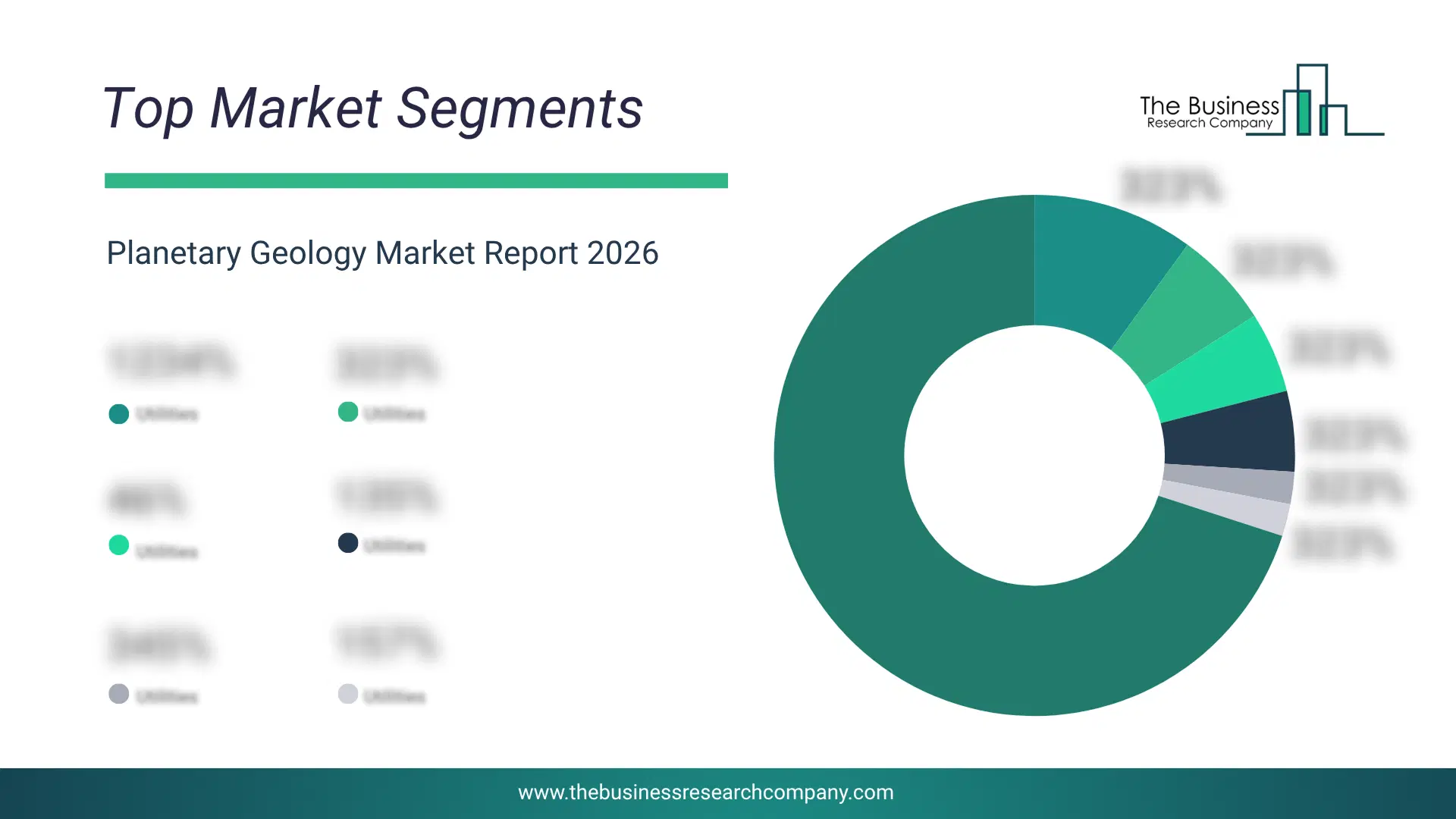
1) By Component: Instruments, Software, Services 2) By Application: Space Exploration, Research And Development, Academic Institutions, Government Agencies, Other Applications 3) By End-User: Aerospace, Defense, Research Institutes, Other End-Users Subsegments: 1) By Instruments: Spectrometers, Seismometers, Ground Penetrating Radar (GPR), Gravimeters, Magnetometers, Cameras, Sample Collection Tools, Drill Systems, Inertial Measurement Units (IMUs), Robotic Arms And Mobility Systems 2) By Software: Geospatial Mapping Software, 3Dimensional Geological Modeling Tools, Remote Sensing Data Processing, Planetary Simulation Software, Mission Planning And Navigation Systems, Spectral Analysis Tools, Data Visualization Platforms, Artificial Intelligence Or Machine Learning-Based Geological Interpretation Tools 3) By Services: Geological Survey And Data Interpretation, Calibration And Maintenance Services, Mission Design And Support Services, Data Analytics And Consulting, Software Integration And Customization, Training And Education, Remote Operation And Monitoring, Sample Return And Analysis ServicesWhat Is Driver Of The Planetary Geology Market?
The increasing investment in space exploration is expected to propel the growth of the planetary geology market going forward. Space exploration investments refer to the financial support directed toward developing and advancing technologies, infrastructure, and services related to space exploration and operations. The space exploration investments are growing primarily due to rising interest from private companies seeking commercial opportunities in satellite deployment, space tourism, and data services. Investment in space exploration supports planetary geology by funding missions that study the composition, structure, and history of planets, moons, and asteroids. For instance, in December 2024, according to the European Space Agency, a France-based intergovernmental organization, in 2024, global space budgets rose to €121 billion ($138.75 billion), marking a 7% increase from 2023. Of this total, 47% was allocated to civil space programs, representing a 5% increase compared to the previous year. Therefore, the increasing investment in space exploration is driving the growth of the planetary geology industry.Key Players In The Global Planetary Geology Market
Major companies operating in the planetary geology market are Lockheed Martin Corporation, Airbus SE, Thales SA, Ball Aerospace & Technologies Corp, Carl Zeiss Microscopy GmbH, Bruker Corporation, Maxar Technologies Inc, Leica Geosystems AG, Earth Science Systems Inc, Sensors & Software Inc, Sercel SAS, ESG Solutions Ltd, GEOSPACE Technologies Corporation, Honeybee Robotics Ltd, Güralp Systems Ltd, Malin Space Science Systems Inc, Scintrex Limited, Officina Stellare, RMS Instruments Inc, Radar Systems Inc., Geonics Ltd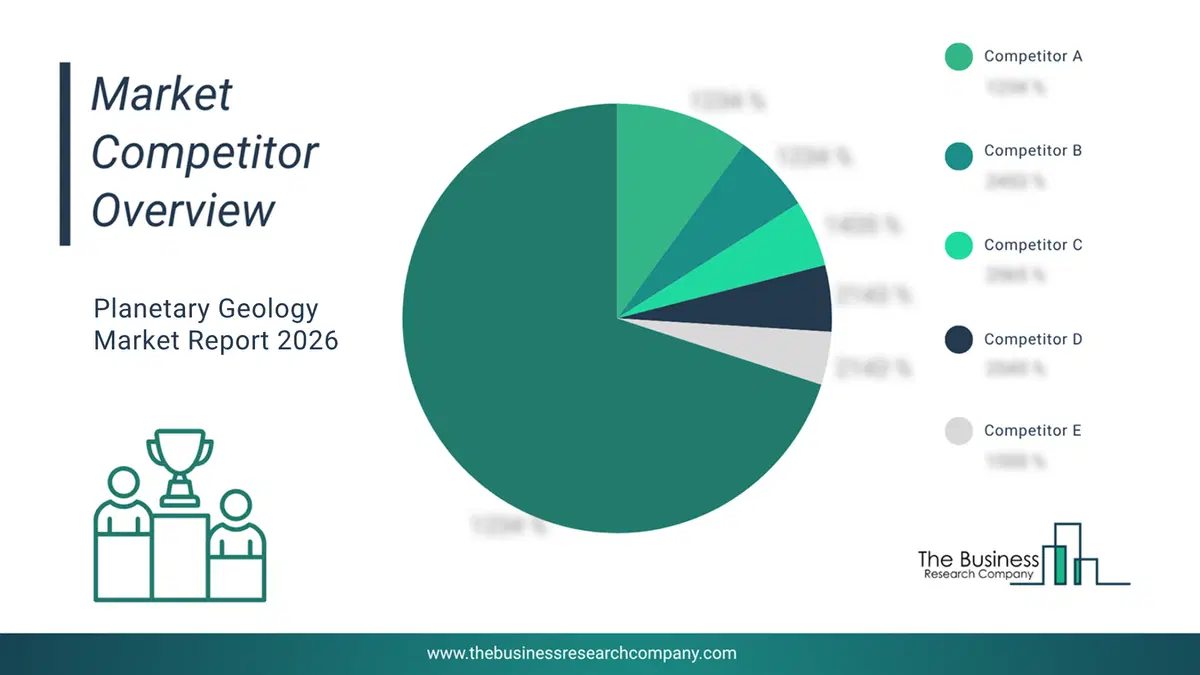
This chart is for illustrative purposes; the full report includes a detailed competitor analysis and comprehensive overview of the top 10 companies in the market.
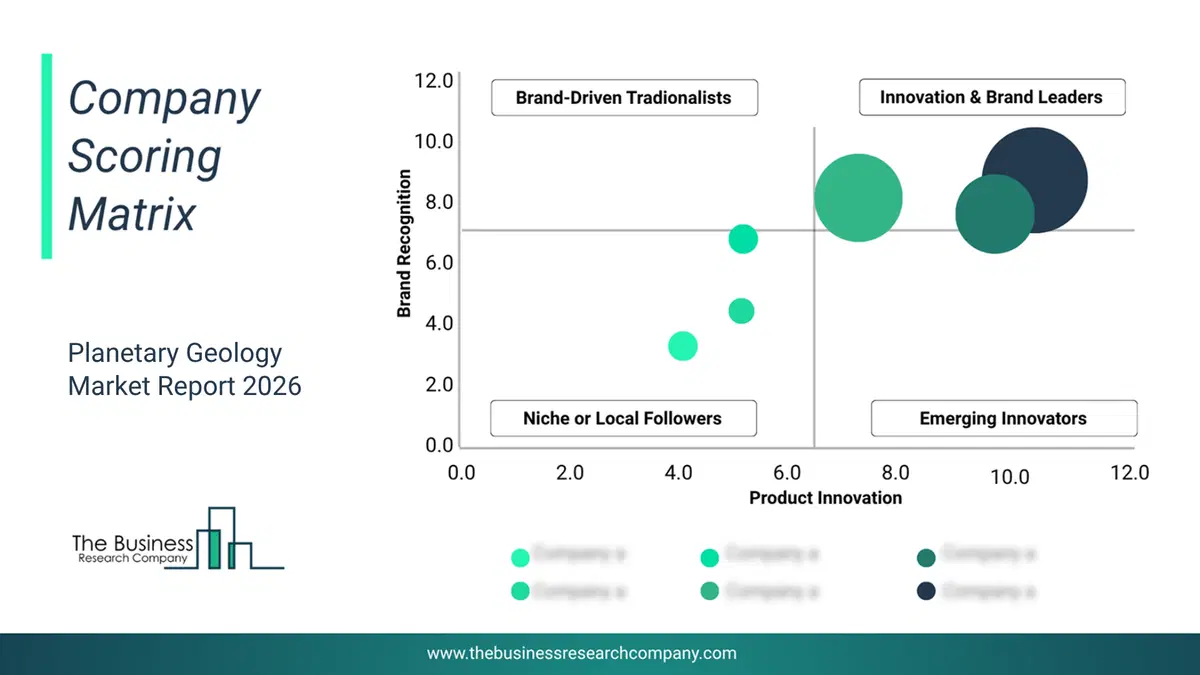
This chart maps companies by product innovation and brand strength, with bubble size indicating relative revenue, helping identify market leaders, challengers, and niche players. This is an illustrative chart; the full report provides a complete and accurate competitive analysis.
Global Planetary Geology Market Trends and Insights
Major companies operating in the planetary geology market are focusing on technological advancements, such as interplanetary spacecraft, to enhance the exploration and analysis of extraterrestrial surfaces. An interplanetary spacecraft is a space vehicle designed to travel between planets within a solar system, operating beyond Earth's orbit to explore other planetary bodies such as Mars, Venus, Jupiter, or asteroids and comets. For instance, in October 2024, the National Aeronautics and Space Administration (NASA), a US-based independent space agency, launched the Europa Clipper mission, an interplanetary spacecraft designed to investigate Jupiter's icy moon, Europa. The spacecraft is equipped with high-resolution cameras, ice-penetrating radar, thermal instruments, and a magnetometer to study the moon's surface, subsurface ocean, and potential habitability. It has a mass of about 6,000 kg and is powered by solar arrays over 30 meters. Europa Clipper aims to make nearly 50 flybys of Europa. Its data will help determine if conditions exist to support life beneath the moon's icy crust.What Are Latest Mergers And Acquisitions In The Planetary Geology Market? Ispace Partnered With SpaceData To Advance Lunar Exploration And Resource Mapping
In March 2025, ispace Inc., a Japan-based lunar robotic exploration company, partnered with SpaceData Inc. With this partnership, ispace aims to combine its lunar lander technology with SpaceData’s advanced geological analysis to enhance lunar surface exploration and resource mapping capabilities. SpaceData Inc. is a Japan-based technology company specializing in planetary geology and space-based data analytics.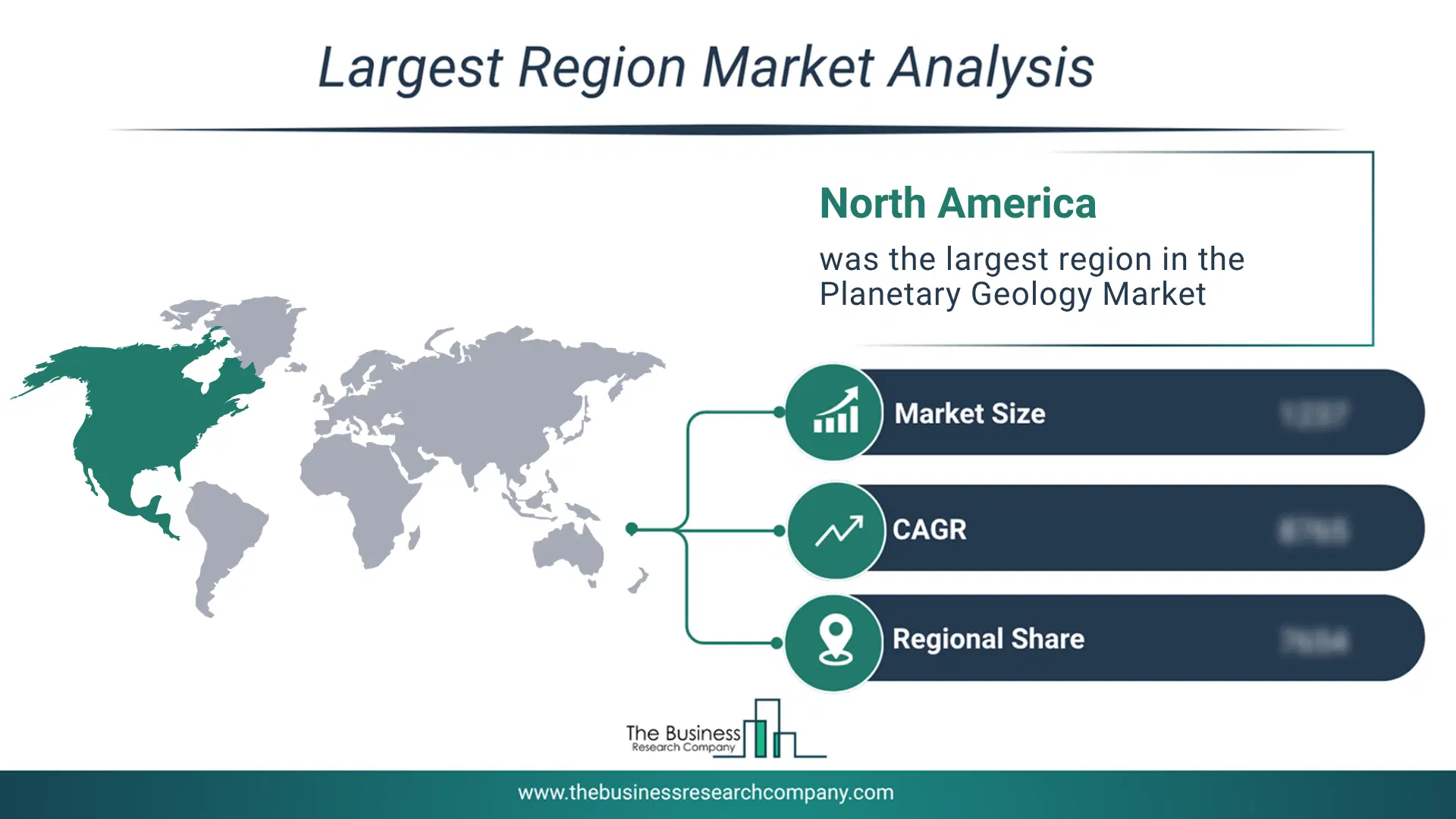
Regional Insights
North America was the largest region in the planetary geology market in 2025. Asia-Pacific is expected to be the fastest-growing region in the forecast period. The regions covered in this market report are Asia-Pacific, South East Asia, Western Europe, Eastern Europe, North America, South America, Middle East, Africa. The countries covered in this market report are Australia, Brazil, China, France, Germany, India, Indonesia, Japan, Taiwan, Russia, South Korea, UK, USA, Canada, Italy, SpainWhat Defines the Planetary Geology Market?
The planetary geology market consists of revenues earned by entities by providing services such as planetary surface analysis, geological mapping of celestial bodies, remote sensing and imaging, mineral and chemical composition assessment, and data interpretation for space missions. The market value includes the value of related goods sold by the service provider or included within the service offering. The planetary geology market includes sales of energy-efficient components and smart grid integrate geological mapping software, remote sensing instruments, spectrometers, planetary rovers and landers, data analytics tools, and other scientific equipment. Values in this market are ‘factory gate’ values, that is, the value of goods sold by the manufacturers or creators of the goods, whether to other entities (including downstream manufacturers, wholesalers, distributors, and retailers) or directly to end customers. The value of goods in this market includes related services sold by the creators of the goods.How is Market Value Defined and Measured?
The market value is defined as the revenues that enterprises gain from the sale of goods and/or services within the specified market and geography through sales, grants, or donations in terms of the currency (in USD unless otherwise specified). The revenues for a specified geography are consumption values that are revenues generated by organizations in the specified geography within the market, irrespective of where they are produced. It does not include revenues from resales along the supply chain, either further along the supply chain or as part of other products.
This chart presents market attractiveness based on a quantitative evaluation of growth, competition, strategic alignment, and risk, offering a clear view of opportunity areas for decision-making. This chart is for illustrative purposes; the full report contains the complete analysis.

This chart highlights the Total Addressable Market (TAM) by estimating the maximum revenue opportunity using an assumption-driven approach, supporting strategic planning and opportunity sizing across markets. The chart is illustrative; the full report provides a more comprehensive analysis.
What Key Data and Analysis Are Included in the Planetary Geology Market Report 2026?
The planetary geology market research report is one of a series of new reports from The Business Research Company that provides market statistics, including industry global market size, regional shares, competitors with the market share, detailed market segments, market trends and opportunities, and any further data you may need to thrive in the planetary geology industry. The market research report delivers a complete perspective of everything you need, with an in-depth analysis of the current and future state of the industry.Planetary Geology Market Report Forecast Analysis
| Report Attribute | Details |
|---|---|
| Market Size Value In 2026 | $2.25 billion |
| Revenue Forecast In 2030 | $3.51 billion |
| Growth Rate | CAGR of 11.8% from 2026 to 2030 |
| Base Year For Estimation | 2025 |
| Actual Estimates/Historical Data | 2020-2025 |
| Forecast Period | 2026 - 2030 |
| Market Representation | Revenue in USD Billion and CAGR from 2026 to 2030 |
| Segments Covered | Component, Application, End-User |
| Regional Scope | Asia-Pacific, Western Europe, Eastern Europe, North America, South America, Middle East, Africa |
| Country Scope | The countries covered in the planetary geology market report are Australia, Brazil, China, France, Germany, India, Indonesia, Japan, Taiwan, Russia, South Korea, UK, USA, Canada, Italy, Spain |
| Key Companies Profiled | Lockheed Martin Corporation, Airbus SE, Thales SA, Ball Aerospace & Technologies Corp, Carl Zeiss Microscopy GmbH, Bruker Corporation, Maxar Technologies Inc, Leica Geosystems AG, Earth Science Systems Inc, Sensors & Software Inc, Sercel SAS, ESG Solutions Ltd, GEOSPACE Technologies Corporation, Honeybee Robotics Ltd, Güralp Systems Ltd, Malin Space Science Systems Inc, Scintrex Limited, Officina Stellare, RMS Instruments Inc, Radar Systems Inc., Geonics Ltd |
| Customization Scope | Request for Customization |
| Pricing And Purchase Options | Explore Purchase Options |