
Plant-Based Texturizers Market Report 2026
Global Outlook – By Product Type (Hydrocolloids, Plant Proteins (Texturized), Starches, Cellulose Derivatives, Other Plant-Based Texturizers), By Technology Method (Extrusion Technology, Fermentation-Based Production, Extraction And Fractionation, Novel Texturization Technologies, Chemical Or Physical Modification), By End-User (Food And Beverage Manufacturing, Grain And Oilseed Processing, Dairy Alternative Manufacturers, Bakery And Confectionery, Foodservice And Institutional, Retail And Consumer Packaged Goods) – Market Size, Trends, Strategies, and Forecast to 2035
Plant-Based Texturizers Market Overview
• Plant-Based Texturizers market size has reached to $3.81 billion in 2025 • Expected to grow to $5.02 billion in 2030 at a compound annual growth rate (CAGR) of 5.7% • Growth Driver: Rising Demand For Plant-Based Foods Fueling The Growth Of The Market Due To Increasing Health Awareness And Shift Toward Sustainable Diets • Market Trend: Pea Protein Functional Solutions Enhancing Texture And Stability In Bakery Applications Amid Egg Price Volatility • North America was the largest region in 2025 and Asia-Pacific is the fastest growing region.What Is Covered Under Plant-Based Texturizers Market?
Plant-based texturizers refer to naturally derived ingredients obtained from plants that are used to enhance the texture, viscosity, stability, and sensory experience of food and beverage products. They help improve product consistency, binding, thickening, and mouthfeel while serving as sustainable and clean-label alternatives to synthetic or animal-derived texturizing agents. The main product types of plant-based texturizers include hydrocolloids, plant proteins (texturized), starches, cellulose derivatives, and other plant-based texturizers. Hydrocolloids refer to plant-derived functional ingredients used to improve viscosity, stability, and texture in food formulations. These products are produced using technology methods such as extrusion technology, fermentation-based production, extraction and fractionation, novel texturization technologies, and chemical or physical modification, and they are used by several end users such as food and beverage manufacturing, grain and oilseed processing, dairy alternative manufacturers, bakery and confectionery, foodservice and institutional, and retail and consumer packaged goods.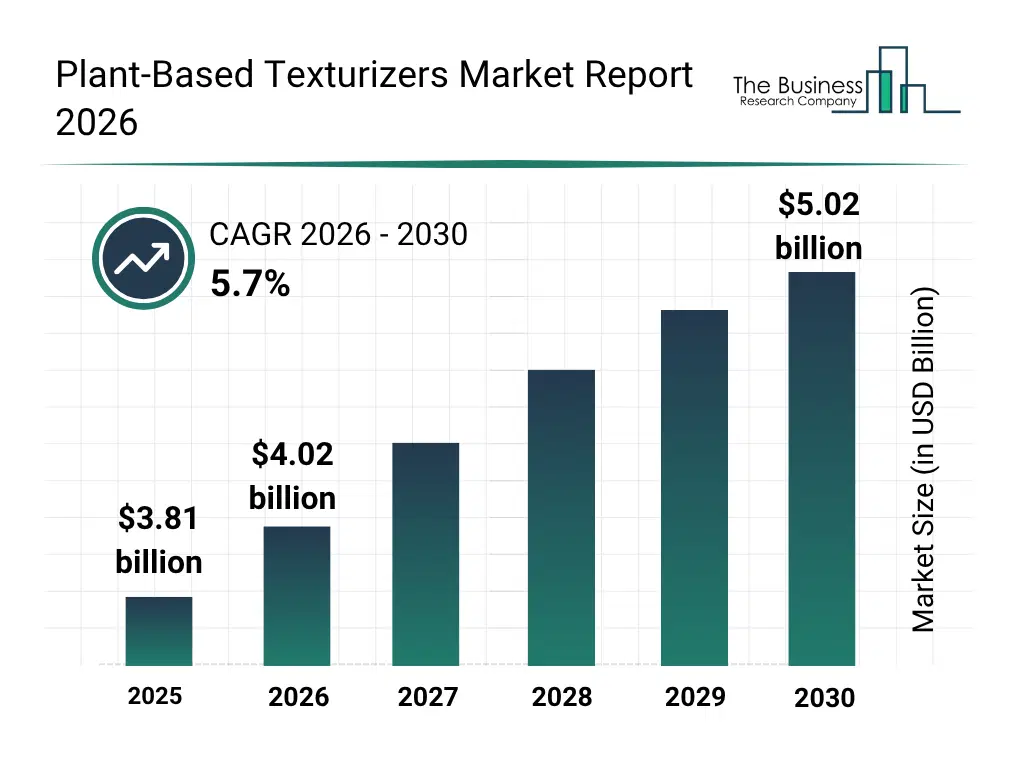
What Is The Plant-Based Texturizers Market Size and Share 2026?
The plant-based texturizers market size has grown strongly in recent years. It will grow from $3.81 billion in 2025 to $4.02 billion in 2026 at a compound annual growth rate (CAGR) of 5.5%. The growth in the historic period can be attributed to rising vegan and vegetarian dietary adoption, expansion of processed and packaged food consumption, growing concerns over synthetic food additives, globalization of food supply chains, early adoption of clean label food movement.What Is The Plant-Based Texturizers Market Growth Forecast?
The plant-based texturizers market size is expected to see strong growth in the next few years. It will grow to $5.02 billion in 2030 at a compound annual growth rate (CAGR) of 5.7%. The growth in the forecast period can be attributed to increasing demand for functional and fortified foods, rapid growth of alternative protein ecosystems, rising preference for personalized nutrition solutions, stricter global food safety and labeling regulations, expansion of ready-to-eat and convenience food formats. Major trends in the forecast period include clean label plant-based ingredient adoption, hydrocolloid-driven texture optimization in food systems, advanced plant protein structuring for improved mouthfeel, sugar and fat reduction using plant-derived fibers, multifunctional texturizers for improved product stability and shelf-life.
Global Plant-Based Texturizers Market Segmentation
1) By Product Type: Hydrocolloids, Plant Proteins (Texturized), Starches, Cellulose Derivatives, Other Plant-Based Texturizers 2) By Technology Method: Extrusion Technology, Fermentation-Based Production, Extraction And Fractionation, Novel Texturization Technologies, Chemical Or Physical Modification 3) By End-User: Food And Beverage Manufacturing, Grain And Oilseed Processing, Dairy Alternative Manufacturers, Bakery And Confectionery, Foodservice And Institutional, Retail And Consumer Packaged Goods Subsegments: 1) By Hydrocolloids: Pectin, Agar, Carrageenan, Guar Gum, Xanthan Gum, Locust Bean Gum, Gellan Gum 2) By Plant Proteins (Texturized): Soy Protein, Pea Protein, Wheat Protein (Gluten), Rice Protein, Faba Bean Protein, Chickpea Protein 3) By Starches: Native Starch, Modified Starch, Tapioca Starch, Corn Starch, Potato Starch, Rice Starch 4) By Cellulose Derivatives: Carboxymethyl Cellulose, Methyl Cellulose, Hydroxypropyl Methylcellulose, Microcrystalline Cellulose 5) By Other Plant-Based Texturizers: Inulin, Dietary Fibers, Plant-Based Emulsifiers, Resistant Starch, Algal ExtractsWhat Is The Driver Of The Plant-Based Texturizers Market?
The rising demand for plant-based foods is expected to propel the growth of the plant-based texturizers market going forward. Plant-based foods are food products derived entirely or primarily from plant sources such as fruits, vegetables, grains, legumes, nuts, milk and seeds. Plant-based foods are increasing due to rising health awareness, as consumers are actively choosing diets associated with lower risks of chronic diseases and improved overall well-being. Plant-based texturizers support plant-based foods by improving texture, consistency, and mouthfeel, allowing products to closely mimic the sensory experience of meat and dairy. For instance, in June 2025, according to the Good Food Institute Europe, a Belgium-based nonprofit organization, the sales value of plant-based milk in discounter stores increased by 45% between 2022 and 2024, significantly outpacing the 11% growth recorded in other supermarkets over the same period. Therefore, the rising demand for plant-based foods is driving the growth of the plant-based texturizers industry.Key Players In The Global Plant-Based Texturizers Market
Major companies operating in the plant-based texturizers market are Cargill Incorporated, Archer Daniels Midland Company, International Flavors And Fragrances Inc., Ingredion Incorporated, Kerry Group Public Limited Company, ICL Group Ltd., Roquette Frères, Tate And Lyle Public Limited Company, Ashland Global Holdings Inc., Palsgaard A/S, PURIS Holdings LLC, Cosucra Groupe Warcoing SA, Lasenor Emul S.L., Alland And Robert S.A.S., Fiberstar Inc., Axiom Foods Inc., Burcon NutraScience Corporation, Socius Ingredients LLC, Marine Hydrocolloids, Evopulse Industries Pvt. Ltd.Global Plant-Based Texturizers Market Trends and Insights
Major companies operating in the plant-based texturizers market are focusing on developing innovative solutions, such as pea protein-based functional texturizers, to improve texture, stability, and egg- or dairy-replacement performance in food applications amid rising demand for plant-based and cost-stable formulations. Pea protein-based functional texturizers are plant-derived ingredients made from processed pea proteins that improve the texture, structure, and stability of food products by mimicking the binding, gelling, and emulsifying properties of animal-based ingredients like eggs and dairy. For instance, in December 2025, Lasenor Emul, S.L., a Spain-based bakery ingredient solutions provider, launched VP-100 pea protein texturizer to address egg price volatility by enabling partial to full egg replacement in bakery formulations while maintaining texture, structure, and moisture in products such as cakes and muffins. These protein texturizers offer strong egg-replacement functionality (up to 100%), delivering comparable aeration, binding, and moisture retention in bakery products. It is specifically designed to stabilize formulations amid egg price volatility while supporting clean-label, plant-based bakery innovation.What Are Latest Mergers And Acquisitions In The Plant-Based Texturizers Market?
In July 2024, Tate and Lyle PLC, a UK-based food and beverage company, acquired CP Kelco US Inc. for an undisclosed amount. With this acquisition, Tate and Lyle PLC aims to strengthen its position in specialty ingredients by expanding its hydrocolloids portfolio, enhancing product diversification, and accelerating growth in food and beverage solutions across global markets. CP Kelco US Inc. is a US-based company that offers a broad portfolio of nature-derived, plant-based texturizers, stabilizers, and emulsifiers used in plant-based meat and dairy alternative products.Regional Outlook/Insights
North America was the largest region in the plant-based texturizers market in 2025. Asia-Pacific is expected to be the fastest-growing region in the forecast period. The regions covered in this market report are Asia-Pacific, South East Asia, Western Europe, Eastern Europe, North America, South America, Middle East, Africa. The countries covered in this market report are Australia, Brazil, China, France, Germany, India, Indonesia, Japan, Taiwan, Russia, South Korea, UK, USA, Canada, Italy, Spain.What Defines the Plant-Based Texturizers Market?
The plant-based texturizers market consists of sales of pectin-based texturizers, agar-based gelling agents, guar gum formulations, and xanthan gum stabilizers. Values in this market are ‘factory gate’ values, that is, the value of goods sold by the manufacturers or creators of the goods, whether to other entities (including downstream manufacturers, wholesalers, distributors, and retailers) or directly to end customers. The value of goods in this market includes related services sold by the creators of the goods.How is Market Value Defined and Measured?
The market value is defined as the revenues that enterprises gain from the sale of goods and/or services within the specified market and geography through sales, grants, or donations in terms of the currency (in USD unless otherwise specified). The revenues for a specified geography are consumption values that are revenues generated by organizations in the specified geography within the market, irrespective of where they are produced. It does not include revenues from resales along the supply chain, either further along the supply chain or as part of other products.What Key Data and Analysis Are Included in the Plant-Based Texturizers Market Report 2026?
The plant-based texturizers market research report is one of a series of new reports from The Business Research Company that provides market statistics, including industry global market size, regional shares, competitors with the market share, detailed market segments, market trends and opportunities, and any further data you may need to thrive in the plant-based texturizers industry. The market research report delivers a complete perspective of everything you need, with an in-depth analysis of the current and future state of the industry.Plant-Based Texturizers Market Report Forecast Analysis
| Report Attribute | Details |
|---|---|
| Market Size Value In 2026 | $4.02 billion |
| Revenue Forecast In 2035 | $5.02 billion |
| Growth Rate | CAGR of 5.7% from 2026 to 2035 |
| Base Year For Estimation | 2025 |
| Actual Estimates/Historical Data | 2020-2025 |
| Forecast Period | 2026 - 2030 - 2035 |
| Market Representation | Revenue in USD Billion and CAGR from 2026 to 2035 |
| Segments Covered | Product Type, Technology Method, End-User |
| Regional Scope | Asia-Pacific, Western Europe, Eastern Europe, North America, South America, Middle East, Africa |
| Country Scope | The countries covered in the report are Australia, Brazil, China, France, Germany, India, Indonesia, Japan, Taiwan, Russia, South Korea, UK, USA, Canada, Italy, Spain. |
| Key Companies Profiled | Cargill Incorporated, Archer Daniels Midland Company, International Flavors And Fragrances Inc., Ingredion Incorporated, Kerry Group Public Limited Company, ICL Group Ltd., Roquette Frères, Tate And Lyle Public Limited Company, Ashland Global Holdings Inc., Palsgaard A/S, PURIS Holdings LLC, Cosucra Groupe Warcoing SA, Lasenor Emul S.L., Alland And Robert S.A.S., Fiberstar Inc., Axiom Foods Inc., Burcon NutraScience Corporation, Socius Ingredients LLC, Marine Hydrocolloids, Evopulse Industries Pvt. Ltd. |
| Customization Scope | Request for Customization |
| Pricing And Purchase Options | Explore Purchase Options |