
Plant Sterol Drinks Market Report 2026
Global Outlook – By Product Type (Dairy-Based Plant Sterol Drinks, Fruit And Vegetable Juices, Smoothies And Wellness Shots, Plant-Based Milk Alternatives, Drinkable Grains And Nut Based Beverages), By Sterol Type (Beta-Sitosterol, Campesterol, Stigmasterol, Brassicasterol), By Form (Ready To Drink Liquid, Liquid Concentrates, Powdered Drink Mixes), By Distribution Channel (Supermarkets And Hypermarkets, Convenience Stores, Online Retail, Pharmacies And Health Stores, Specialty Food Stores), By End User (Adults With Elevated Cholesterol, Health Conscious Consumers, Geriatric Population, Athletes And Fitness Enthusiasts, Preventive Healthcare Consumers) – Market Size, Trends, Strategies, and Forecast to 2035
Plant Sterol Drinks Market Overview
• Plant Sterol Drinks market size has reached to $1.28 billion in 2025 • Expected to grow to $1.9 billion in 2030 at a compound annual growth rate (CAGR) of 8.3% • Growth Driver: The Rising Prevalence Of Cardiovascular Diseases Is Fueling The Market Growth Due To Increasing Demand For Cholesterol-Lowering • Market Trend: Functional Plant-Based Beverages Advancing Cholesterol Management Through Fortified Nutrition Solutions • Europe was the largest region in 2025 and Asia-Pacific is the fastest growing region.What Is Covered Under Plant Sterol Drinks Market?
Plant sterol drinks are functional beverages formulated with added plant sterols, which are naturally occurring compounds found in small amounts in fruits, vegetables, nuts, seeds, and plant oils. These drinks are designed to help lower low-density lipoprotein (LDL) cholesterol levels by reducing cholesterol absorption in the digestive system. Plant sterol drinks are often enriched in dairy-based beverages, juices, or fortified wellness drinks to improve cardiovascular health. The main product types of plant sterol drinks include dairy-based plant sterol drinks, fruit and vegetable juices, smoothies and wellness shots, plant-based milk alternatives, and drinkable grains and nut based beverages. Dairy-based plant sterol drinks refer to functional beverages enriched with plant sterols that help support cholesterol management and overall heart health. These products are made using sterol types such as beta-sitosterol, campesterol, stigmasterol, and brassicasterol and are available in forms including ready to drink liquid, liquid concentrates, and powdered drink mixes. They are distributed through supermarkets and hypermarkets, convenience stores, online retail, pharmacies and health stores, and specialty food stores, serving end users including adults with elevated cholesterol, health conscious consumers, geriatric population, athletes and fitness enthusiasts, and preventive healthcare consumers.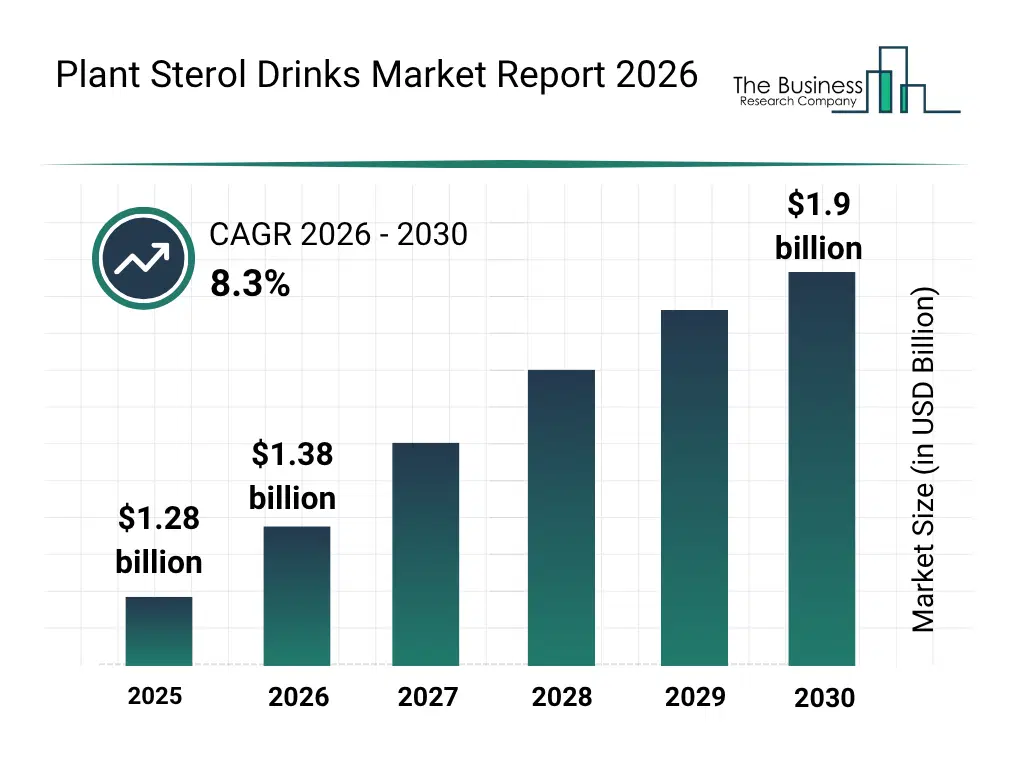
What Is The Plant Sterol Drinks Market Size and Share 2026?
The plant sterol drinks market size has grown strongly in recent years. It will grow from $1.28 billion in 2025 to $1.38 billion in 2026 at a compound annual growth rate (CAGR) of 8.0%. The growth in the historic period can be attributed to rising prevalence of cardiovascular diseases, increasing consumer awareness of cholesterol management, growth in functional beverage consumption, expansion of fortified dairy product offerings, rising adoption of preventive healthcare nutrition.What Is The Plant Sterol Drinks Market Growth Forecast?
The plant sterol drinks market size is expected to see strong growth in the next few years. It will grow to $1.9 billion in 2030 at a compound annual growth rate (CAGR) of 8.3%. The growth in the forecast period can be attributed to increasing aging population driving heart health demand, growth in personalized nutrition and functional foods, expansion of online health and wellness retail channels, rising investment in plant-based beverage innovation, increasing clinical validation of plant sterol efficacy. Major trends in the forecast period include functional cardiovascular wellness beverage innovation, rising demand for cholesterol management nutraceutical drinks, expansion of plant-based dairy alternative sterol fortification, growth of clean label and natural ingredient functional beverages, increasing adoption of preventive healthcare nutrition solutions.
Global Plant Sterol Drinks Market Segmentation
1) By Product Type: Dairy-Based Plant Sterol Drinks, Fruit And Vegetable Juices, Smoothies And Wellness Shots, Plant-Based Milk Alternatives, Drinkable Grains And Nut Based Beverages 2) By Sterol Type: Beta-Sitosterol, Campesterol, Stigmasterol, Brassicasterol 3) By Form: Ready To Drink Liquid, Liquid Concentrates, Powdered Drink Mixes 4) By Distribution Channel: Supermarkets And Hypermarkets, Convenience Stores, Online Retail, Pharmacies And Health Stores, Specialty Food Stores 5) By End User: Adults With Elevated Cholesterol, Health Conscious Consumers, Geriatric Population, Athletes And Fitness Enthusiasts, Preventive Healthcare Consumers Subsegments: 1) By Dairy-Based Plant Sterol Drinks: Flavored Yogurt Drinks, Probiotic Yogurt Drinks, High Protein Yogurt Drinks, Calcium Fortified Milk Beverages, Vitamin Enriched Milkshakes, Protein Rich Dairy Beverages 2) By Fruit And Vegetable Juices: Citrus Fruit Juices, Mixed Fruit Juices, Single Fruit Juices, Vegetable Blend Juices, Cold Pressed Juices, Functional Fortified Juices 3) By Smoothies And Wellness Shots: Fruit Based Smoothies, Green Vegetable Smoothies, Protein Smoothies, Detox Wellness Shots, Immunity Boosting Shots, Energy Enhancing Smoothies 4) By Plant-Based Milk Alternatives: Soy Milk Beverages, Oat Milk Beverages, Almond Milk Beverages, Flavored Plant Based Milk Drinks, Barista Style Plant Milks, Fortified Plant Based Milk Alternatives 5) By Drinkable Grains And Nut Based Beverages: Oat Grain Based Drinks, Rice Based Beverages, Barley Grain Drinks, Almond Nut Beverages, Cashew Nut Drinks, Mixed Grain Nut BeveragesWhat Is The Driver Of The Plant Sterol Drinks Market?
The rising prevalence of cardiovascular diseases is expected to propel the growth of the plant sterol drinks market going forward. Cardiovascular diseases are a group of disorders affecting the heart and blood vessels, including conditions such as coronary artery disease, heart failure, and stroke. The prevalence of cardiovascular diseases is growing due to factors such as increasingly sedentary lifestyles, aging populations, and unhealthy dietary habits, which contribute to obesity, high blood pressure, and poor heart health. Plant sterol drinks help reduce the risk of cardiovascular diseases by lowering LDL cholesterol through reducing its absorption in the intestine, which decreases plaque buildup in arteries and supports overall heart health when consumed regularly as part of a balanced diet and healthy lifestyle. For instance, in August 2025, according to the report published by the National Center for Biotechnology Information (NCBI), a division of the US-based National Library of Medicine (NLM), cardiovascular disease prevalence is projected to rise by 90.0% between 2025 and 2050, with crude mortality increasing by 73.4% and crude disability-adjusted life years (DALYs) by 54.7%, while total deaths are expected to grow from 20.5 million in 2025 to 35.6 million by 2050. Therefore, the rising prevalence of cardiovascular diseases is driving the growth of the plant sterol drinks industry.Key Players In The Global Plant Sterol Drinks Market
Major companies operating in the plant sterol drinks market are Nestlé Health Science S.A., The Coca-Cola Company, Unilever PLC, General Mills Inc., Danone S.A., Arla Foods amba, Koninklijke FrieslandCampina N.V., DSM-Firmenich AG, IOI Corporation Berhad, Meiji Holdings Co. Ltd., Glanbia plc, Herbalife Ltd., Megmilk Snow Brand Co. Ltd., Yakult Honsha Co. Ltd., Valio Ltd., The Hain Celestial Group Inc., Raisio plc, Sanitarium Health and Wellbeing CompanyGlobal Plant Sterol Drinks Market Trends and Insights
Major companies operating in the plant sterol drinks market are focusing on developing innovative products such as, functional plant-based milks enriched with plant sterols to help lower cholesterol levels and improve heart health. Functional plant-based milks enriched with plant sterols are dairy-free beverages (such as oat, soy, or almond milk) fortified with plant-derived compounds that help block the absorption of cholesterol in the intestines, lowering LDL (bad) cholesterol levels and supporting overall heart health when consumed regularly as part of a balanced diet. For instance, in July 2024, Sanitarium Health Food Company, an Australia-based health food and beverage company, launched PLANTWELL Cholesterol Lowering oat milk, an innovative plant sterol–fortified beverage as part of its next-generation functional plant milk range. The product is a creamy oat-based milk enriched with 1g of plant sterols per serve, scientifically associated with reducing LDL cholesterol by up to 9% within three weeks when consumed at recommended levels. It also contains added nutrients such as vitamin D, calcium (300mg per serve), and B vitamins, and is formulated to be high in fibre, low in sugar, and suitable for vegan and dairy-free diets, positioning it as a multifunctional daily-use beverage for heart health and general wellness.What Are Latest Mergers And Acquisitions In The Plant Sterol Drinks Market?
In September 2025, BASF SE, a Germany-based chemical company, completed the sale of its Food and Health Performance Ingredients business to Louis Dreyfus Company. Through this divestment, BASF SE aims to streamline its portfolio by shedding non-core nutrition assets, while enabling LDC to strengthen and expand its global food and health ingredients business, enhance its value-added product offerings, and reinforce its position in the growing health, wellness, and functional food markets, including key health ingredients such as plant sterol esters. Louis Dreyfus Company (LDC) is a Netherlands-based merchant and processor of agricultural goods and food ingredients.Regional Outlook/Insights
Europe was the largest region in the plant sterol drinks market in 2025. Asia-Pacific is expected to be the fastest-growing region in the forecast period. The regions covered in this market report are Asia-Pacific, South East Asia, Western Europe, Eastern Europe, North America, South America, Middle East, Africa. The countries covered in this market report are Australia, Brazil, China, France, Germany, India, Indonesia, Japan, Taiwan, Russia, South Korea, UK, USA, Canada, Italy, Spain.What Defines the Plant Sterol Drinks Market?
The plant sterol drinks market consists of sales of fermented and probiotic drinks, protein and nutritional beverages, botanical and adaptogenic beverages, concentrates, syrups and drink mixes, and functional mocktails and ready-to-drink mixes. Values in this market are ‘factory gate’ values, that is, the value of goods sold by the manufacturers or creators of the goods, whether to other entities (including downstream manufacturers, wholesalers, distributors, and retailers) or directly to end customers. The value of goods in this market includes related services sold by the creators of the goods.How is Market Value Defined and Measured?
The market value is defined as the revenues that enterprises gain from the sale of goods and/or services within the specified market and geography through sales, grants, or donations in terms of the currency (in USD unless otherwise specified). The revenues for a specified geography are consumption values that are revenues generated by organizations in the specified geography within the market, irrespective of where they are produced. It does not include revenues from resales along the supply chain, either further along the supply chain or as part of other products.What Key Data and Analysis Are Included in the Plant Sterol Drinks Market Report 2026?
The plant sterol drinks market research report is one of a series of new reports from The Business Research Company that provides market statistics, including industry global market size, regional shares, competitors with the market share, detailed market segments, market trends and opportunities, and any further data you may need to thrive in the plant sterol drinks industry. The market research report delivers a complete perspective of everything you need, with an in-depth analysis of the current and future state of the industry.Plant Sterol Drinks Market Report Forecast Analysis
| Report Attribute | Details |
|---|---|
| Market Size Value In 2026 | $1.38 billion |
| Revenue Forecast In 2035 | $1.9 billion |
| Growth Rate | CAGR of 8.3% from 2026 to 2035 |
| Base Year For Estimation | 2025 |
| Actual Estimates/Historical Data | 2020-2025 |
| Forecast Period | 2026 - 2030 - 2035 |
| Market Representation | Revenue in USD Billion and CAGR from 2026 to 2035 |
| Segments Covered | Product Type, Sterol Type, Form, Distribution Channel, End User |
| Regional Scope | Asia-Pacific, Western Europe, Eastern Europe, North America, South America, Middle East, Africa |
| Country Scope | The countries covered in the report are Australia, Brazil, China, France, Germany, India, Indonesia, Japan, Taiwan, Russia, South Korea, UK, USA, Canada, Italy, Spain. |
| Key Companies Profiled | Nestlé Health Science S.A., The Coca-Cola Company, Unilever PLC, General Mills Inc., Danone S.A., Arla Foods amba, Koninklijke FrieslandCampina N.V., DSM-Firmenich AG, IOI Corporation Berhad, Meiji Holdings Co. Ltd., Glanbia plc, Herbalife Ltd., Megmilk Snow Brand Co. Ltd., Yakult Honsha Co. Ltd., Valio Ltd., The Hain Celestial Group Inc., Raisio plc, Sanitarium Health and Wellbeing Company |
| Customization Scope | Request for Customization |
| Pricing And Purchase Options | Explore Purchase Options |