
Plasmid DNA Manufacturing Market Report 2026
Global Outlook – By Grade (Research And Development Grade, Good Manufacturing Practice (GMP) Grade), By Development Phase (Pre-Clinical Therapeutics, Clinical Therapeutics, Marketed Therapeutics), By Disease (Infectious Disease, Cancer, Genetic Disorder, Other Diseases), By Application (Deoxyribonucleic Acid (DNA) Vaccines, Cell And Gene Therapy, Immunotherapy, Other Applications) - Market Size, Trends, Strategies, and Forecast to 2030
Plasmid DNA Manufacturing Market Overview
• Plasmid DNA Manufacturing market size has reached to $2.89 billion in 2025 • Expected to grow to $7.64 billion in 2030 at a compound annual growth rate (CAGR) of 20.9% • Growth Driver: Gene Therapy Fueling Growth in Plasmid DNA Manufacturing Market • Market Trend: Innovations In Plasmid DNA Production For Advanced Therapies • North America was the largest region in 2025 and Asia-Pacific is the fastest growing region.What Is Covered Under Plasmid DNA Manufacturing Market?
Plasmid deoxyribonucleic acid (DNA) manufacturing refers to the process of producing large quantities of plasmid DNA molecules for use in various biotechnological applications, including gene therapy, molecular cloning, and the production of recombinant proteins. This process involves the growth of bacterial cells containing the desired plasmid DNA, followed by purification to isolate the plasmid DNA from other cellular components. The main grades of plasmid DNA manufacturing are research and development grade, and good manufacturing practice (GMP) grade. Research and Development grade plasmid DNA is produced primarily for use in laboratory research and early-stage development processes. They are used in various development phases such as pre-clinical therapeutics, clinical therapeutics, and marketed therapeutics for the treatment of infectious disease, cancer, genetic disorder, and other diseases. They are integral to various applications such as deoxyribonucleic acid (DNA) vaccines, cell and gene therapy, immunotherapy, and others.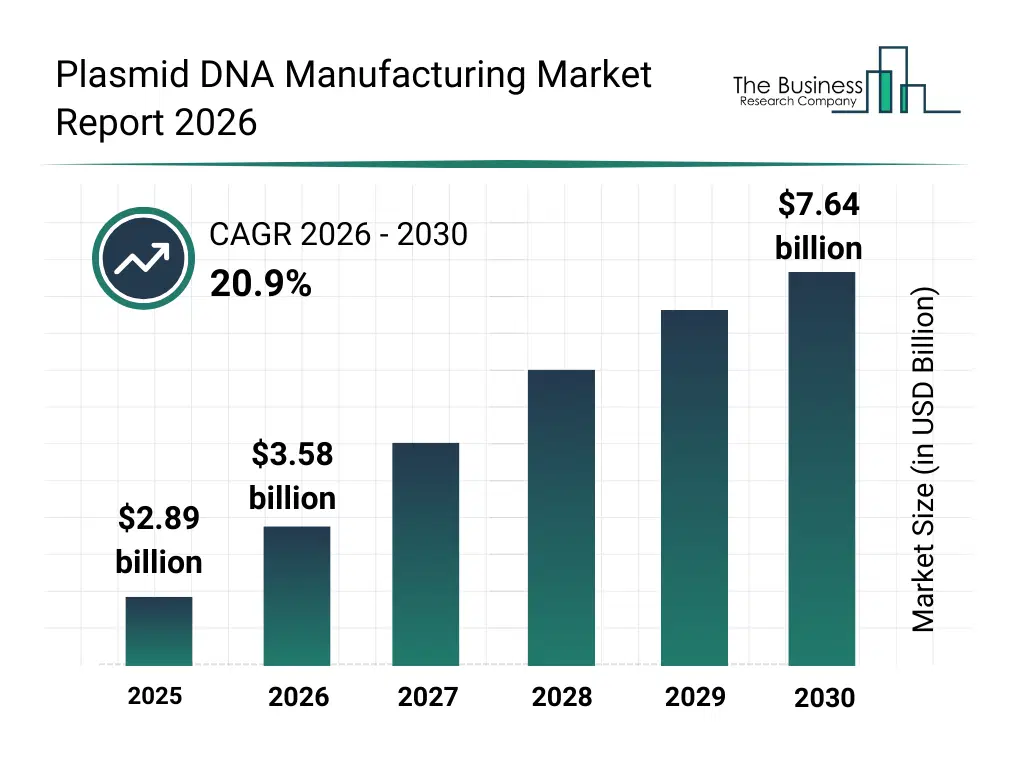
What Is The Plasmid DNA Manufacturing Market Size and Share 2026?
The plasmid dna manufacturing market size has grown exponentially in recent years. It will grow from $2.89 billion in 2025 to $3.58 billion in 2026 at a compound annual growth rate (CAGR) of 23.6%. The growth in the historic period can be attributed to increasing use of plasmid dna in research applications, expansion of molecular cloning activities, growth of preclinical therapeutic development, rising investments in biotechnology research, improved bacterial fermentation techniques.What Is The Plasmid DNA Manufacturing Market Growth Forecast?
The plasmid dna manufacturing market size is expected to see exponential growth in the next few years. It will grow to $7.64 billion in 2030 at a compound annual growth rate (CAGR) of 20.9%. The growth in the forecast period can be attributed to increasing demand for dna-based vaccines, rising investments in gene and cell therapy pipelines, expansion of commercial-scale plasmid manufacturing, growing focus on regulatory-compliant production, increasing adoption of advanced purification technologies. Major trends in the forecast period include increasing demand for gmp-grade plasmid dna production, rising adoption of automated bioprocessing systems, growing use of plasmid dna in gene therapy applications, expansion of large-scale manufacturing capacities, enhanced focus on high-purity dna production.
Global Plasmid DNA Manufacturing Market Segmentation
1) By Grade: Research And Development Grade, Good Manufacturing Practice (GMP) Grade 2) By Development Phase: Pre-Clinical Therapeutics, Clinical Therapeutics, Marketed Therapeutics 3) By Disease: Infectious Disease, Cancer, Genetic Disorder, Other Diseases 4) By Application: Deoxyribonucleic Acid (DNA) Vaccines, Cell And Gene Therapy, Immunotherapy, Other Applications Subsegments: 1) By Research And Development Grade: Small-scale Plasmid DNA Production, Preclinical Research Plasmid DNA 2) By Good Manufacturing Practice (GMP) Grade: Clinical Trial Material Production, Commercial-Scale Plasmid DNA ProductionWhat Is The Driver Of The Plasmid DNA Manufacturing Market?
The growing acceptance of gene therapy is expected to propel the growth of the plasmid DNA manufacturing market going forward. Gene therapy refers to a medical treatment that involves modifying or manipulating a person's genes to treat or prevent disease. Gene therapy is on the rise due to advancements in genetic engineering technologies, increasing investment in research and development, successful clinical trials, and the growing prevalence of genetic disorders, which together highlight its potential for providing long-term or permanent cures. Plasmid DNA manufacturing is essential for gene therapy, as it produces the vectors needed to deliver therapeutic genes into cells, facilitating the treatment of genetic disorders. For instance, according to the American Society of Gene & Cell Therapy, a US-based non-profit medical and scientific organization, the number of gene therapies in Phase III clinical trials grew by 10% in Q3 2023, the first quarterly increase since Q3 2022. Therefore, the growing acceptance of gene therapy is driving the growth of the plasmid DNA manufacturing industry.Key Players In The Global Plasmid DNA Manufacturing Market
Major companies operating in the plasmid dna manufacturing market are Thermo Fisher Scientific Inc., Eurofins Genomics LLC, Catalent Inc., Charles River Laboratories, Recipharm AB, Kaneka Corp., Genscript Biotech Corporation, Aldevron LLC, Genewiz, OriGene Technologies, Celonic AG, Creative Biogene, Cellectis, Synbio Technologies, VectorBuilder Inc., Altogen Biosystems, Andelyn Biosciences, AGC Biologics, VGXI, GeneCopoeia, PlasmidFactory GmbH & Co. KG, Akron Biotech, PackGene Biotech Inc.
This chart is for illustrative purposes; the full report includes a detailed competitor analysis and comprehensive overview of the top 10 companies in the market.
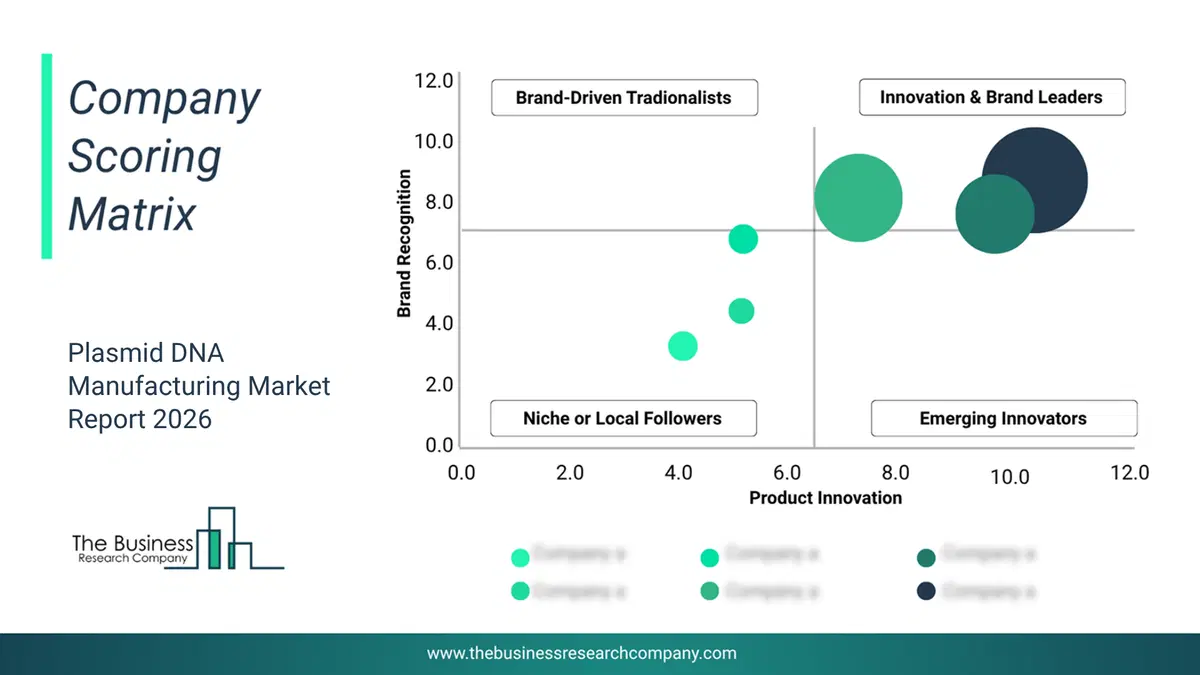
This chart maps companies by product innovation and brand strength, with bubble size indicating relative revenue, helping identify market leaders, challengers, and niche players. This is an illustrative chart; the full report provides a complete and accurate competitive analysis.
Global Plasmid DNA Manufacturing Market Trends and Insights
Major companies operating in the plasmid DNA manufacturing market are developing advanced bioprocessing technologies to enhance the efficiency, scalability, and quality of plasmid DNA production. These innovations aim to streamline the manufacturing process, reduce production costs, and ensure that the plasmid DNA meets stringent regulatory standards for therapeutic applications. For instance, in January 2023, Charles River Laboratories, a US-based pharmaceutical company, launched the eXpDNA platform, designed for the efficient production and purification of high-quality plasmid DNA. This platform integrates advanced bioprocessing technologies, scalable production methods, and rigorous quality control measures to produce plasmid DNA that meets the stringent requirements for therapeutic and clinical applications. The eXpDNA platform is used extensively in gene therapy, DNA vaccine development, and other biopharmaceutical applications that demand high yield, purity, and consistency.What Are Latest Mergers And Acquisitions In The Plasmid DNA Manufacturing Market?
In March 2023, Sartorius Stedim Biotech, a Germany-based provider of bioprocess solutions for the life sciences industry, acquired Polyplus for approximately US$2.6 billion (€2.4 billion). Through this acquisition, Sartorius aims to strengthen its plasmid DNA manufacturing capabilities by integrating Polyplus’ GMP-grade plasmid DNA and transfection reagents, enhancing its portfolio for viral vector and gene therapy production. Polyplus is a France-based company that provides GMP-grade plasmid DNA and nucleic-acid delivery reagents for gene and cell therapy applications.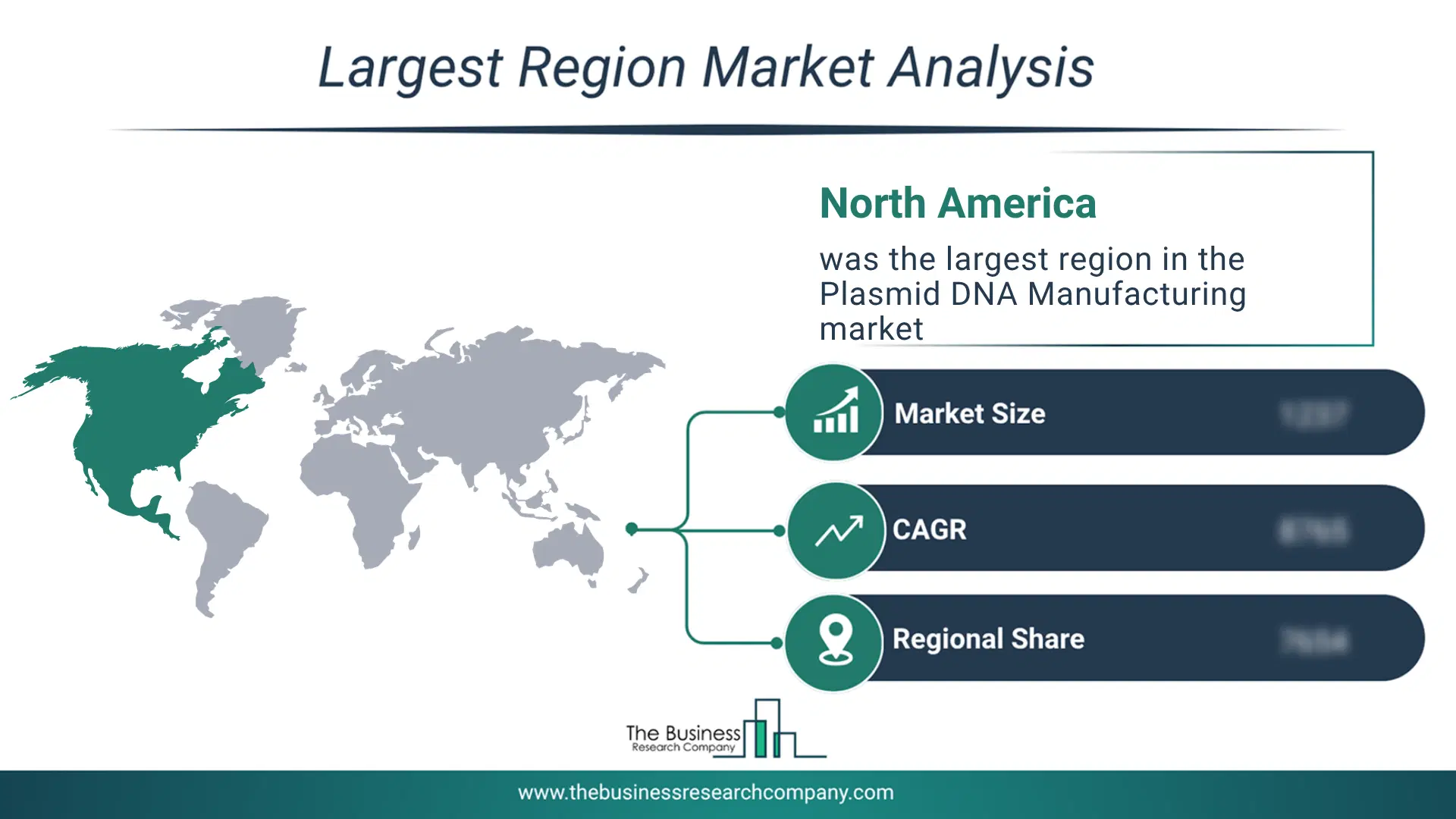
Regional Outlook
North America was the largest region in the plasmid DNA manufacturing market in 2025. Asia-Pacific is expected to be the fastest-growing region in the forecast period. The regions covered in this market report are Asia-Pacific, South East Asia, Western Europe, Eastern Europe, North America, South America, Middle East, Africa. The countries covered in this market report are Australia, Brazil, China, France, Germany, India, Indonesia, Japan, Taiwan, Russia, South Korea, UK, USA, Canada, Italy, Spain.What Defines the Plasmid DNA Manufacturing Market?
The plasmid DNA manufacturing market consists of revenues earned by entities by providing services such as plasmid design, construction, production, purification, quality control, customization, storage, shipping, and regulatory support. The market value includes the value of related goods sold by the service provider or included within the service offering. The plasmid DNA manufacturing market also includes sales of bioreactors, centrifuges, incubators, chromatography systems, freeze dryers, electrophoresis systems, and microscopes. Values in this market are ‘factory gate’ values, that is the value of goods sold by the manufacturers or creators of the goods, whether to other entities (including downstream manufacturers, wholesalers, distributors and retailers) or directly to end customers. The value of goods in this market includes related services sold by the creators of the goods.How is Market Value Defined and Measured?
The market value is defined as the revenues that enterprises gain from the sale of goods and/or services within the specified market and geography through sales, grants, or donations in terms of the currency (in USD unless otherwise specified). The revenues for a specified geography are consumption values that are revenues generated by organizations in the specified geography within the market, irrespective of where they are produced. It does not include revenues from resales along the supply chain, either further along the supply chain or as part of other products.
This chart presents market attractiveness based on a quantitative evaluation of growth, competition, strategic alignment, and risk, offering a clear view of opportunity areas for decision-making. This chart is for illustrative purposes; the full report contains the complete analysis.

This chart highlights the Total Addressable Market (TAM) by estimating the maximum revenue opportunity using an assumption-driven approach, supporting strategic planning and opportunity sizing across markets. The chart is illustrative; the full report provides a more comprehensive analysis.
What Key Data and Analysis Are Included in the Plasmid DNA Manufacturing Market Report 2026?
The plasmid dna manufacturing market research report is one of a series of new reports from The Business Research Company that provides market statistics, including industry global market size, regional shares, competitors with the market share, detailed market segments, market trends and opportunities, and any further data you may need to thrive in the plasmid dna manufacturing industry. The market research report delivers a complete perspective of everything you need, with an in-depth analysis of the current and future state of the industry.Plasmid DNA Manufacturing Market Report Forecast Analysis
| Report Attribute | Details |
|---|---|
| Market Size Value In 2026 | $3.58 billion |
| Revenue Forecast In 2030 | $7.64 billion |
| Growth Rate | CAGR of 20.9% from 2026 to 2030 |
| Base Year For Estimation | 2025 |
| Actual Estimates/Historical Data | 2020-2025 |
| Forecast Period | 2026 - 2030 |
| Market Representation | Revenue in USD Billion and CAGR from 2026 to 2030 |
| Segments Covered | Grade, Development Phase, Disease, Application |
| Regional Scope | Asia-Pacific, Western Europe, Eastern Europe, North America, South America, Middle East, Africa |
| Country Scope | The countries covered in the report are Australia, Brazil, China, France, Germany, India, Indonesia, Japan, Taiwan, Russia, South Korea, UK, USA, Canada, Italy, Spain |
| Key Companies Profiled | Thermo Fisher Scientific Inc., Eurofins Genomics LLC, Catalent Inc., Charles River Laboratories, Recipharm AB, Kaneka Corp., Genscript Biotech Corporation, Aldevron LLC, Genewiz, OriGene Technologies, Celonic AG, Creative Biogene, Cellectis, Synbio Technologies, VectorBuilder Inc., Altogen Biosystems, Andelyn Biosciences, AGC Biologics, VGXI, GeneCopoeia, PlasmidFactory GmbH & Co. KG, Akron Biotech, PackGene Biotech Inc. |
| Customization Scope | Request for Customization |
| Pricing And Purchase Options | Explore Purchase Options |