
Plastic Lens Market Report 2026
Global Outlook – By Type (Aspheric Lens, Spherical Lens, Light-Emitting Diode (LED) Lens, Sensor Lens, Diffractive Lens, Collimating Lens, Cylindrical Lens, Other Types), By Application (Safety Equipment, Sensing, Imaging, Projection Display, Flight Simulators, Detecting, Telecom Optics, Scanning, Barcode Scanner Optics), By End User (Medical Equipment, Scientific Equipment, Military Equipment, Consumer Electronics) – Market Size, Trends, Strategies, and Forecast to 2030
Plastic Lens Market Overview
• Plastic Lens market size has reached to $5.67 billion in 2025 • Expected to grow to $8.02 billion in 2030 at a compound annual growth rate (CAGR) of 7.1% • Growth Driver: Rising Demand For Consumer Electronics Fuels Growth In The Plastic Lens Market • Market Trend: Advancements In Vision Care Lenses For Outdoor Eye Protection And Myopia Control • North America was the largest region in 2025 and Asia-Pacific is the fastest growing region.What Is Covered Under Plastic Lens Market?
A plastic lens is a type of optical lens made from synthetic polymer materials rather than traditional glass. These lenses are used in various applications, including eyeglasses, cameras, microscopes, and more. Plastic lenses offer a combination of durability, lightweight properties, and affordability, making them a popular choice for many optical applications. The main types of plastic lens are aspheric lens, spherical lens, LED lens, sensor lens, diffractive lens, collimating lens, cylindrical lens, and others. Aspheric lenses are optical lenses with a non-spherical surface profile designed to reduce optical aberrations and improve image quality. The various applications involved are safety equipment, sensing, imaging, projection display, flight simulators, detecting, telecom optics, scanning, and barcode scanner optics and are used in several end users such as medical equipment, scientific equipment, military equipment, and consumer electronics.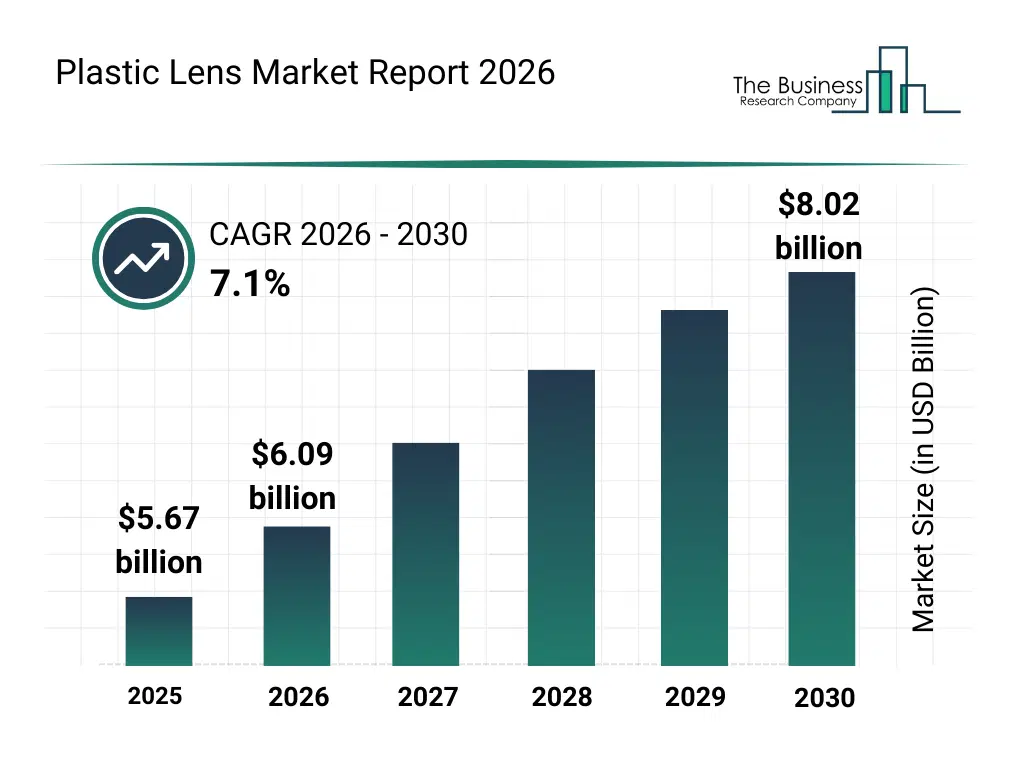
What Is The Plastic Lens Market Size and Share 2026?
The plastic lens market size has grown strongly in recent years. It will grow from $5.67 billion in 2025 to $6.09 billion in 2026 at a compound annual growth rate (CAGR) of 7.5%. The growth in the historic period can be attributed to growth in consumer electronics manufacturing, expansion of optical sensing applications, rising demand for lightweight lenses, advancements in injection molding technologies, increased use of plastics in optical systems.What Is The Plastic Lens Market Growth Forecast?
The plastic lens market size is expected to see strong growth in the next few years. It will grow to $8.02 billion in 2030 at a compound annual growth rate (CAGR) of 7.1%. The growth in the forecast period can be attributed to increasing adoption of advanced imaging systems, rising demand for smart sensors and cameras, expansion of autonomous and ADAS technologies, growing focus on miniaturized optical components, increasing use of plastic optics in medical devices. Major trends in the forecast period include increasing adoption of lightweight optical components, rising use of plastic lenses in consumer electronics, growing demand for high-precision molded optics, expansion of led and sensor lens applications, enhanced focus on cost-effective optical solutions.
Global Plastic Lens Market Segmentation
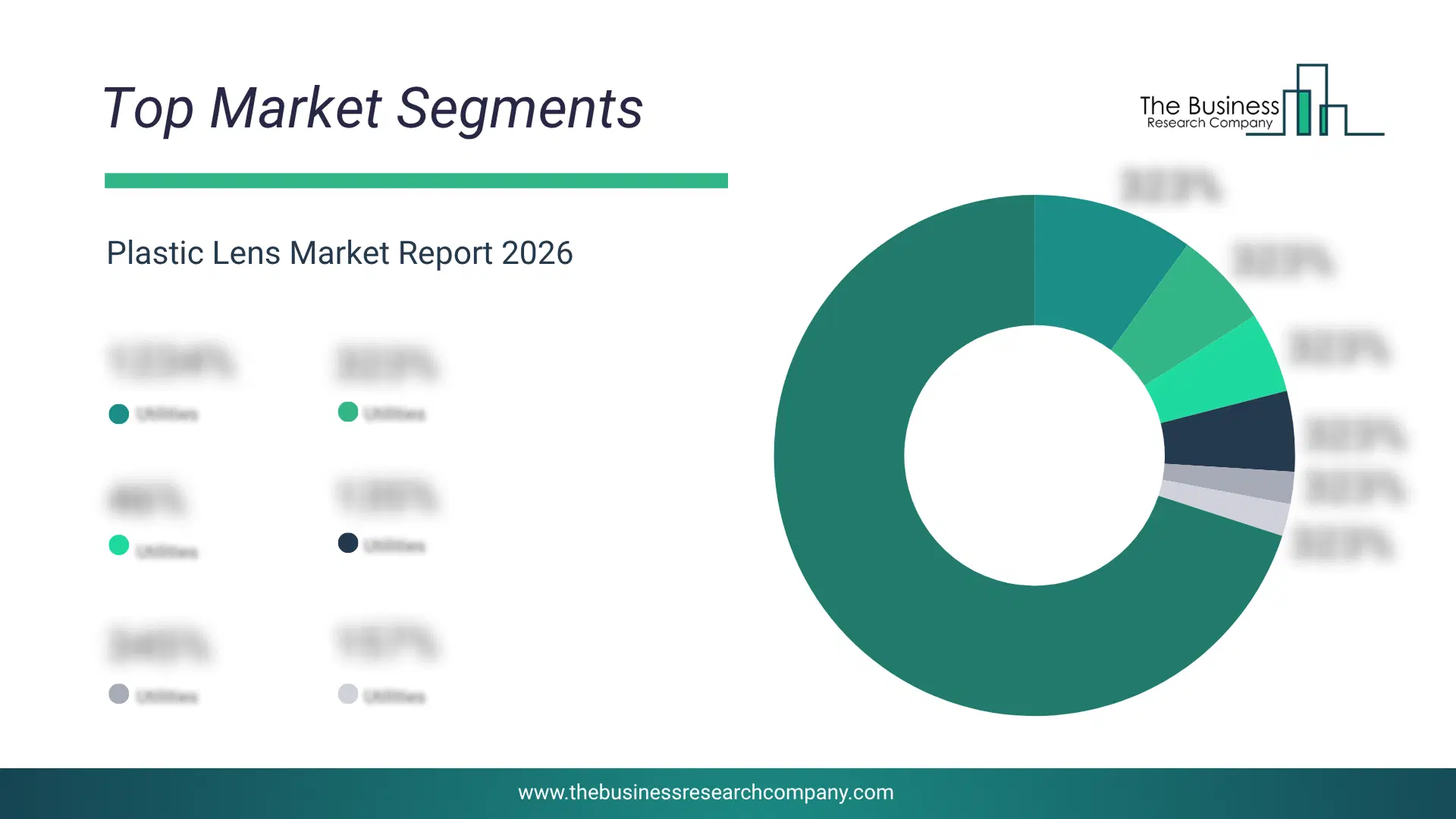
1) By Type: Aspheric Lens, Spherical Lens, Light-Emitting Diode (LED) Lens, Sensor Lens, Diffractive Lens, Collimating Lens, Cylindrical Lens, Other Types 2) By Application: Safety Equipment, Sensing, Imaging, Projection Display, Flight Simulators, Detecting, Telecom Optics, Scanning, Barcode Scanner Optics 3) By End User: Medical Equipment, Scientific Equipment, Military Equipment, Consumer Electronics Subsegments: 1) By Aspheric Lens: Single Aspheric Lenses, Multi-Focal Aspheric Lenses, Custom Aspheric Lenses 2) By Spherical Lens: Convex Lenses, Concave Lenses, Double-Convex Lenses 3) By Light-Emitting Diode (LED) Lens: Primary Light-Emitting Diode (LED) Lenses, Secondary Light-Emitting Diode (LED) Lenses, Optical Light-Emitting Diode (LED) Lenses 4) By Sensor Lens: Camera Sensor Lenses, Image Sensor Lenses, Proximity Sensor Lenses 5) By Diffractive Lens: Phase-Controlled Diffractive Lenses, Diffractive Optical Elements (DOE), Micro-Diffractive Lenses 6) By Collimating Lens: Circular Collimators, Square Collimators, Multi-Element Collimators 7) By Cylindrical Lens: Positive Cylindrical Lenses, Negative Cylindrical Lenses, Cylindrical Lens Arrays 8) By Other Types: Specialty Lenses, Customized Optical Lenses, Hybrid LensesWhat Is The Driver Of The Plastic Lens Market?
The increasing demand for consumer electronics is expected to propel the growth of the plastic lens market going forward. Consumer electronics refers to electronic devices and appliances designed for personal use by individuals. These products are typically used for entertainment, communication, and convenience in everyday life. The demand for consumer electronics is due to technological advancements, rising disposable incomes, and growing demand for smart, connected devices, which drive the expansion of innovative and multifunctional electronic products in the market. Plastic lenses are used in consumer electronics primarily for their lightweight and impact-resistant properties, enhancing the performance and durability of devices such as smartphone cameras, digital cameras, and tablets by providing clear and efficient optical functions while contributing to the overall sleek design of these gadgets. For instance, in May 2023, according to Japan Electronics and Information Technology Industries Association, a Japan-based industry association, cumulative consumer electronic equipment production from January to May 2023 reached USD 1.15 billion (¥161, 541 million), representing an 11.2% increase compared with January–May 2022. Therefore, the increasing demand for consumer electronics is driving the growth of the plastic lens industry.Key Players In The Global Plastic Lens Market
Major companies operating in the plastic lens market are Johnson & Johnson Vision Care Inc., Panasonic Holding Corporation, Canon Inc., EssilorLuxottica S.A., Luxottica Group S.p.A., Bausch + Lomb Corporation, CooperVision Inc., Carl Zeiss AG, Largan Precision Co. Ltd., Vision Express (UK) Limited, Sekonix Co. Ltd., Rodenstock GmbH, Bluebell Industries Ltd., Rayner Intraocular Lenses Limited, Calin Technology Co. Ltd., Hinode Co. Ltd., Lensel Optics Pvt. Ltd., Tokai Optical Co. Ltd., Kantatsu Co. Ltd., Sunny Optical Technology (Group) Company Limited, Nikon Corporation, AAC Technologies Holdings Inc.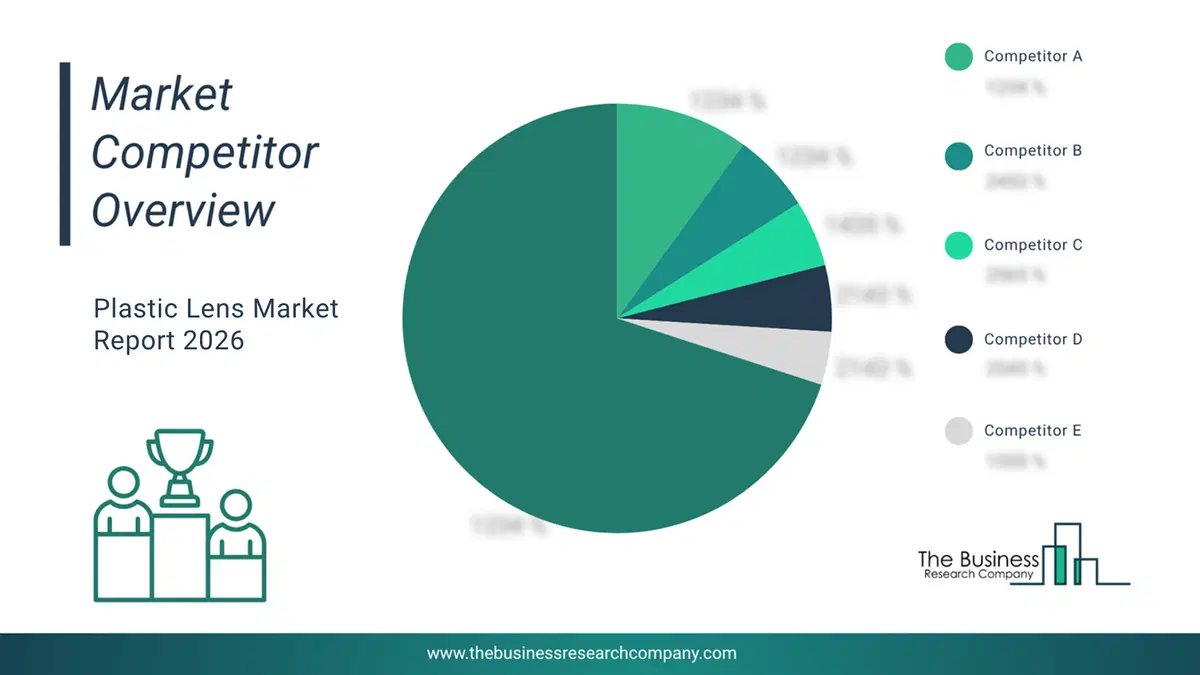
This chart is for illustrative purposes; the full report includes a detailed competitor analysis and comprehensive overview of the top 10 companies in the market.
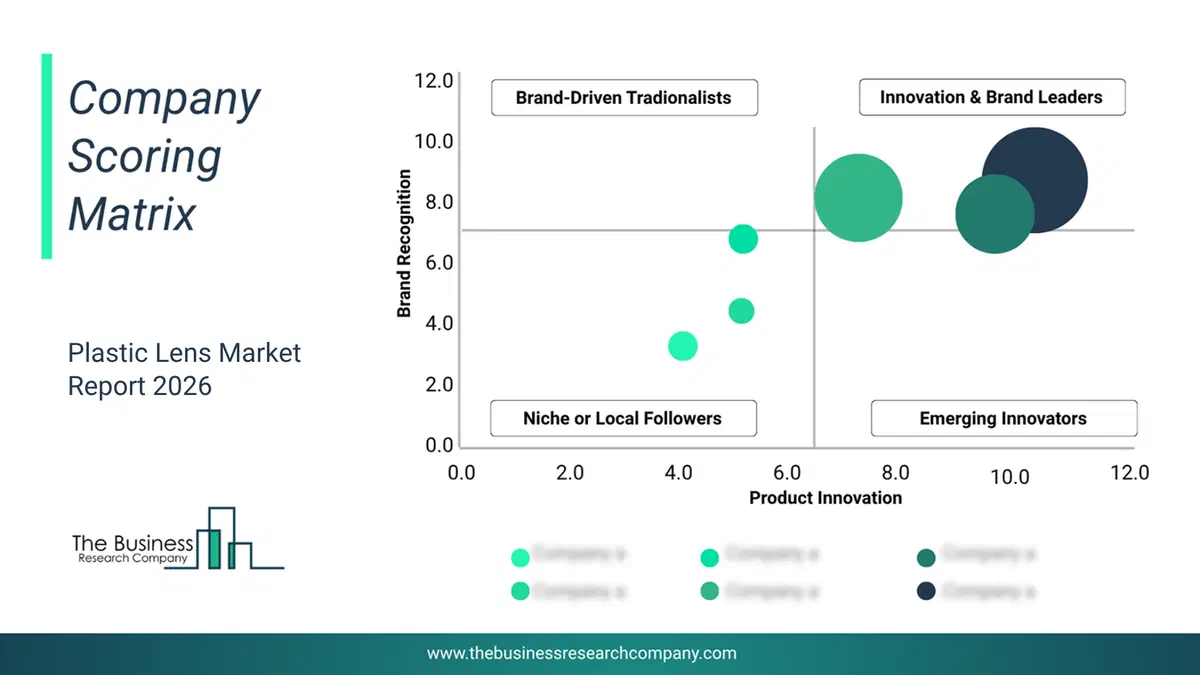
This chart maps companies by product innovation and brand strength, with bubble size indicating relative revenue, helping identify market leaders, challengers, and niche players. This is an illustrative chart; the full report provides a complete and accurate competitive analysis.
Global Plastic Lens Market Trends and Insights
Major companies operating in the plastic lens market are focusing on developing specialty optical solutions such as myopia management sun spectacle lenses to enhance vision correction, eye health protection, and outdoor usability. Myopia management sun spectacle lenses are advanced plastic ophthalmic lenses that incorporate optical defocus technology while integrating sun protection features, enabling capabilities such as myopia progression control, ultraviolet protection, and glare reduction in outdoor conditions. For instance, in April 2023, HOYA Vision Care, a Japan-based optical technology and vision care company, launched MiYOSMART Sun spectacle lenses, a myopia management lens solution designed to support myopia control while protecting eyes from intense sunlight, featuring Defocus Incorporated Multiple Segments technology, ultraviolet protection, and polarized or photochromic options. MiYOSMART Sun spectacle lenses improve long-term visual health outcomes for children by combining effective myopia management with enhanced comfort and protection during outdoor activities.What Are Latest Mergers And Acquisitions In The Plastic Lens Market?
In June 2023, Gooch & Housego PLC, a UK-based manufacturer of optical products, acquired GS Plastic Optics for an undisclosed amount. With this acquisition, G&H aims to enhance its optical component offerings and broaden its manufacturing capabilities by integrating GS Optics' expertise in plastic lens production, strengthening its position in the optical and imaging markets. GS Plastic Optics is a US-based manufacturer of precision polymer optics, including plastic lenses.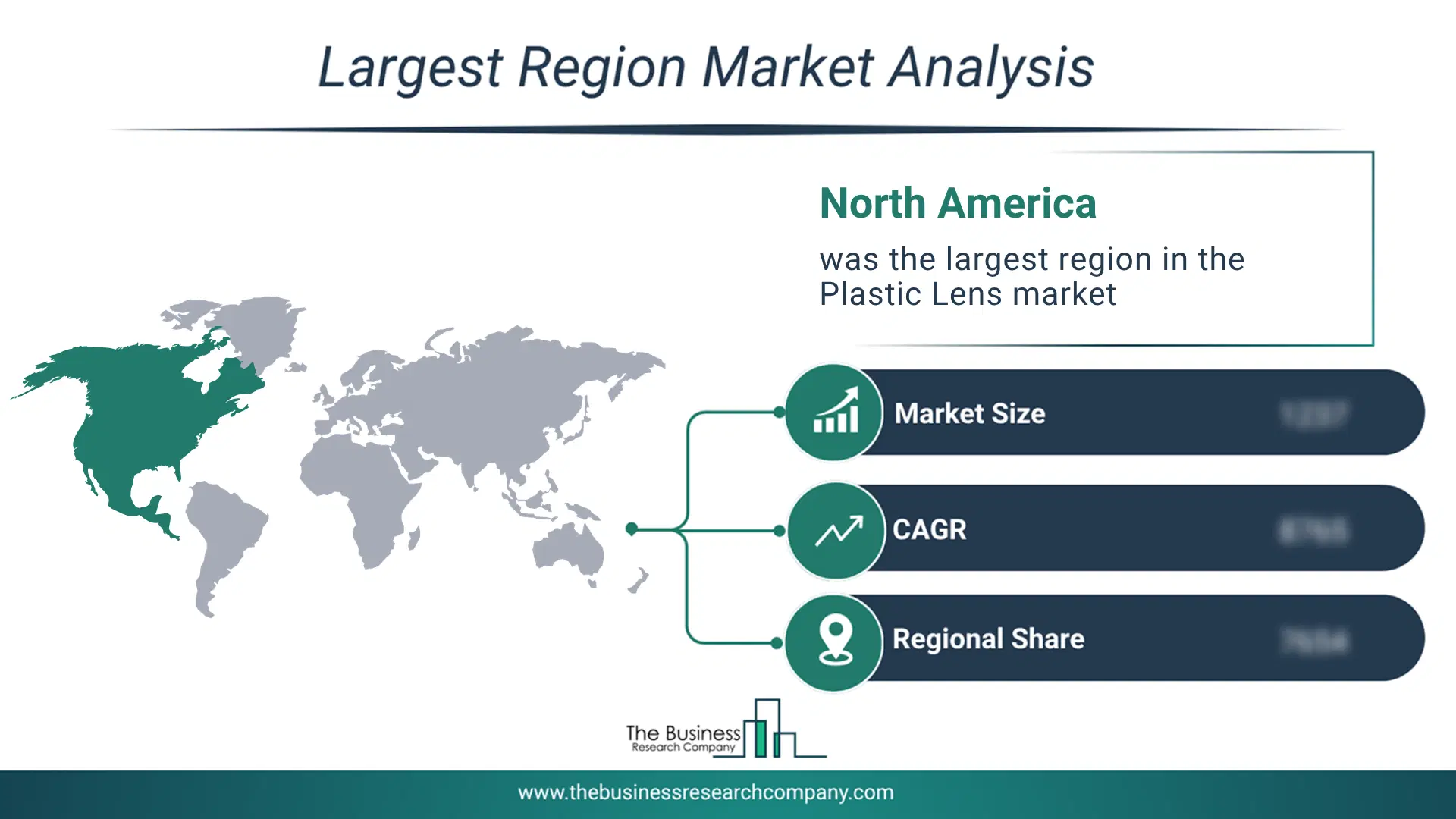
Regional Outlook
North America was the largest region in the plastic lens market in 2025. Asia-Pacific is expected to be the fastest-growing region in the forecast period. The regions covered in this market report are Asia-Pacific, South East Asia, Western Europe, Eastern Europe, North America, South America, Middle East, Africa. The countries covered in this market report are Australia, Brazil, China, France, Germany, India, Indonesia, Japan, Taiwan, Russia, South Korea, UK, USA, Canada, Italy, Spain.What Defines the Plastic Lens Market?
The plastic lens market consists of sales of camera lenses, eyeglass lenses, magnifying lenses, and contact lenses. Values in this market are ‘factory gate’ values, that is the value of goods sold by the manufacturers or creators of the goods, whether to other entities (including downstream manufacturers, wholesalers, distributors, and retailers) or directly to end customers. The value of goods in this market includes related services sold by the creators of the goods.How is Market Value Defined and Measured?
The market value is defined as the revenues that enterprises gain from the sale of goods and/or services within the specified market and geography through sales, grants, or donations in terms of the currency (in USD unless otherwise specified). The revenues for a specified geography are consumption values that are revenues generated by organizations in the specified geography within the market, irrespective of where they are produced. It does not include revenues from resales along the supply chain, either further along the supply chain or as part of other products.
This chart presents market attractiveness based on a quantitative evaluation of growth, competition, strategic alignment, and risk, offering a clear view of opportunity areas for decision-making. This chart is for illustrative purposes; the full report contains the complete analysis.

This chart highlights the Total Addressable Market (TAM) by estimating the maximum revenue opportunity using an assumption-driven approach, supporting strategic planning and opportunity sizing across markets. The chart is illustrative; the full report provides a more comprehensive analysis.
What Key Data and Analysis Are Included in the Plastic Lens Market Report 2026?
The plastic lens market research report is one of a series of new reports from The Business Research Company that provides market statistics, including Market Report 2026?global market size, regional shares, competitors with the market share, detailed market segments, market trends and opportunities, and any further data you may need to thrive in the plastic lens Market Report 2026? The market research report delivers a complete perspective of everything you need, with an in-depth analysis of the current and future state of the Market Report 2026?Plastic Lens Market Report Forecast Analysis
| Report Attribute | Details |
|---|---|
| Market Size Value In 2026 | $6.09 billion |
| Revenue Forecast In 2030 | $8.02 billion |
| Growth Rate | CAGR of 7.5% from 2026 to 2030 |
| Base Year For Estimation | 2025 |
| Actual Estimates/Historical Data | 2020-2025 |
| Forecast Period | 2026 - 2030 |
| Market Representation | Revenue in USD Billion and CAGR from 2026 to 2030 |
| Segments Covered | Type, Application, End User |
| Regional Scope | Asia-Pacific, Western Europe, Eastern Europe, North America, South America, Middle East, Africa |
| Country Scope | The countries covered in the report are Australia, Brazil, China, France, Germany, India, Indonesia, Japan, Taiwan, Russia, South Korea, UK, USA, Canada, Italy, Spain. |
| Key Companies Profiled | Johnson & Johnson Vision Care Inc., Panasonic Holding Corporation, Canon Inc., EssilorLuxottica S.A., Luxottica Group S.p.A., Bausch + Lomb Corporation, CooperVision Inc., Carl Zeiss AG, Largan Precision Co. Ltd., Vision Express (UK) Limited, Sekonix Co. Ltd., Rodenstock GmbH, Bluebell Industries Ltd., Rayner Intraocular Lenses Limited, Calin Technology Co. Ltd., Hinode Co. Ltd., Lensel Optics Pvt. Ltd., Tokai Optical Co. Ltd., Kantatsu Co. Ltd., Sunny Optical Technology (Group) Company Limited, Nikon Corporation, AAC Technologies Holdings Inc. |
| Customization Scope | Request for Customization |
| Pricing And Purchase Options | Explore Purchase Options |