
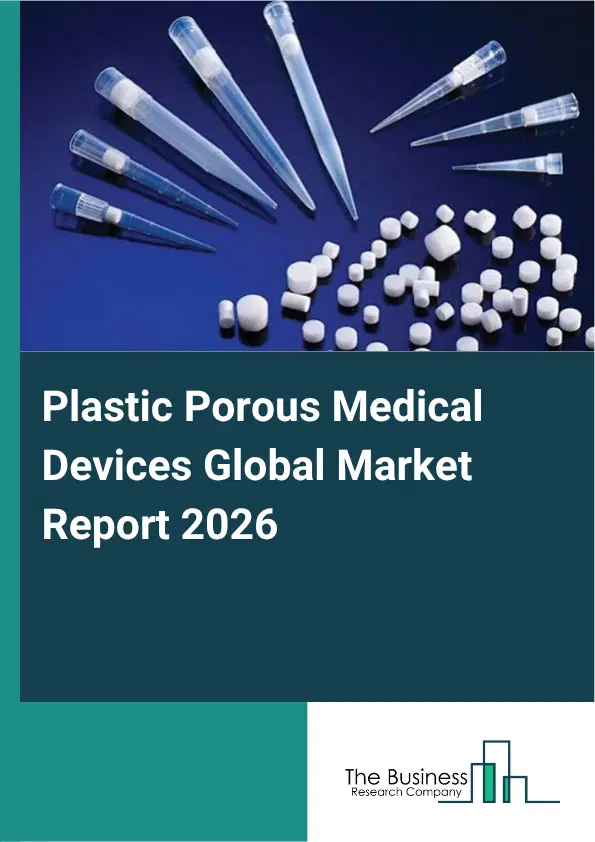
Plastic Porous Medical Devices Market Report 2026
Global Outlook – By Product Type (Porous Plastic Filters, Porous Plastic Vents, Porous Catheter Components, Porous Drug Delivery Components), By Functionality (Fluid Filtration And Separation, Venting And Pressure Equalization, Diagnostic Wicking And Capillary Flow, Tissue Ingrowth And Scaffolding), By Material (Ultra High Molecular Weight Polyethylene, Polyether Ether Ketone, Polytetrafluoroethylene, Other Biocompatible Thermoplastics), By Application (Orthopedic, Cardiovascular, Drug Delivery And Diagnostics, Wound Management), By End User (Medical Device Manufacturers, Hospitals, Diagnostic Laboratories, Ambulatory Surgical Centers) – Market Size, Trends, Strategies, and Forecast to 2030
Plastic Porous Medical Devices Market Report 2026 Market Overview
• Plastic Porous Medical Devices Market Report 2026 market size has reached to $0.71 billion in 2025 • Expected to grow to $0.96 billion in 2030 at a compound annual growth rate (CAGR) of 6.3% • Growth Driver: Increasing Focus On Infection Control Measures Fueling The Growth Of The Market Due To Rising Incidence Of Healthcare-Associated Infections • Market Trend: Innovations In Three-Dimensional Printed Porous Polymer Implant Technology Enhance Bone Integration And Spinal Fusion Outcomes • North America was the largest region in 2025 and Asia-Pacific is the fastest growing region.What Is Covered Under Plastic Porous Medical Devices Market?
Plastic porous medical devices are specialized medical-grade polymer components engineered with a controlled, interconnected porous structure that enables the selective passage of gases and liquids while preventing the migration of particulate contaminants. These devices offer tunable pore size, chemical resistance, and biocompatibility, providing reliable fluid management, contamination control, and enhanced performance across various medical and healthcare applications. The main product types of plastic porous medical devices include porous plastic filters, porous plastic vents, porous catheter components, and porous drug delivery components. Porous plastic filters refer to medical-grade filtration components designed to enable controlled fluid passage, particle retention, and separation in various diagnostic and therapeutic applications. These devices are manufactured using materials such as ultra high molecular weight polyethylene, polyether ether ketone, polytetrafluoroethylene, and other biocompatible thermoplastics and support functionalities including fluid filtration and separation, venting and pressure equalization, diagnostic wicking and capillary flow, and tissue ingrowth and scaffolding. The various applications involved are orthopedic, cardiovascular, drug delivery and diagnostics, and wound management and they are utilized by end users including medical device manufacturers, hospitals, diagnostic laboratories, and ambulatory surgical centers.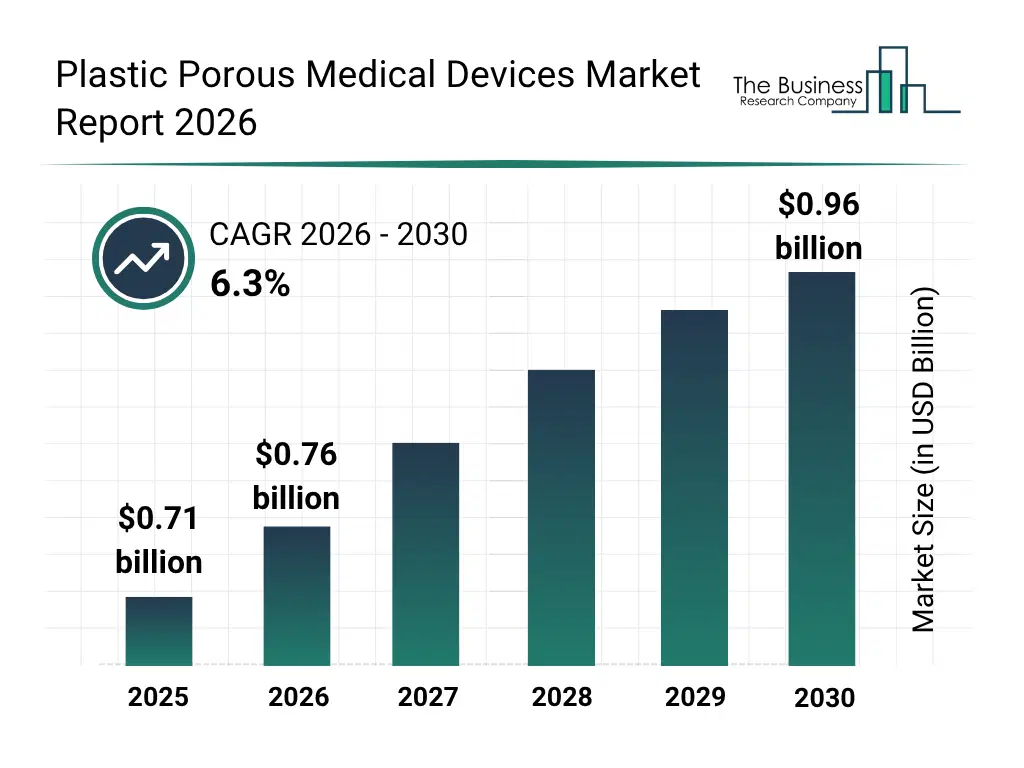
What Is The Plastic Porous Medical Devices Market Size and Share 2026?
The plastic porous medical devices market size has grown strongly in recent years. It will grow from $0.71 billion in 2025 to $0.76 billion in 2026 at a compound annual growth rate (CAGR) of 6.1%. The growth in the historic period can be attributed to growing demand for minimally invasive medical devices, increasing prevalence of chronic diseases, rising adoption of advanced wound management products, expanding use of diagnostic devices, increasing focus on infection prevention.What Is The Plastic Porous Medical Devices Market Growth Forecast?
The plastic porous medical devices market size is expected to see strong growth in the next few years. It will grow to $0.96 billion in 2030 at a compound annual growth rate (CAGR) of 6.3%. The growth in the forecast period can be attributed to growing demand for implantable medical components, increasing investment in advanced biomaterials, rising adoption of precision drug delivery systems, expanding demand for high-performance filtration technologies, increasing healthcare infrastructure development. Major trends in the forecast period include increasing adoption of high-porosity medical components, growing demand for advanced fluid management solutions, rising use of biocompatible porous polymer materials, expansion of contamination control technologies in medical devices, increasing development of customized porous medical components.
Global Plastic Porous Medical Devices Market Segmentation
1) By Product Type: Porous Plastic Filters, Porous Plastic Vents, Porous Catheter Components, Porous Drug Delivery Components 2) By Functionality: Fluid Filtration And Separation, Venting And Pressure Equalization, Diagnostic Wicking And Capillary Flow, Tissue Ingrowth And Scaffolding 3) By Material: Ultra High Molecular Weight Polyethylene, Polyether Ether Ketone, Polytetrafluoroethylene, Other Biocompatible Thermoplastics 4) By Application: Orthopedic, Cardiovascular, Drug Delivery And Diagnostics, Wound Management 5) By End User: Medical Device Manufacturers, Hospitals, Diagnostic Laboratories, Ambulatory Surgical Centers Subsegments: 1) By Porous Plastic Filters: Sintered Polyethylene Filters, Sintered Polytetrafluoroethylene Filters, Hydrophobic Filters, Hydrophilic Filters, Depth Filtration Filters 2) By Porous Plastic Vents: Hydrophobic Membrane Vents, Pressure Equalization Vents, Sterile Barrier Vents, Protective Vent Plugs, Air Flow Vents 3) By Porous Catheter Components: Catheter Vent Plugs, Porous Catheter Tips, Flow Control Inserts, Fluid Distribution Components, Catheter Filter Elements 4) By Porous Drug Delivery Components: Controlled Release Reservoirs, Porous Drug Diffusion Components, Implantable Drug Delivery Components, Transdermal Drug Delivery Components, Injectable Drug Delivery ComponentsWhat Is The Driver Of The Plastic Porous Medical Devices Market?
The increasing focus on infection control measures is expected to propel the growth of the plastic porous medical devices market going forward. Infection control measures are practices healthcare facilities use to prevent pathogen transmission among patients and staff. Hospitals and clinics are increasingly focusing on these measures as the rising incidence of healthcare-associated infections drives up patient morbidity, mortality, and treatment costs. Plastic porous medical devices support infection control by enabling controlled fluid drainage, promoting tissue breathability, and reducing bacterial colonization on device surfaces. For instance, in January 2026, according to the Centers for Disease Control and Prevention, a US-based service organization that protects the public's health, approximately 1 in 31 hospital patients in the United States has at least one healthcare-associated infection on any given day. Therefore, the increasing focus on infection control measures is driving the growth of the plastic porous medical devices industry.Key Players In The Global Plastic Porous Medical Devices Market
Major companies operating in the plastic porous medical devices market report are Porex Corporation, Saint-Gobain Life Sciences, Wilbert Lee Gore & Associates Inc., Freudenberg Medical, Medtronic plc, Porvair Filtration Group, Cobetter Filtration Equipment Co. Ltd., Ahlstrom, Teleflex Incorporated, GenPore, Atex Technologies Inc., Interstate Specialty Products Inc., Poriferous LLC, Pore Technology Inc., Sansuk Industries
This chart is for illustrative purposes; the full report includes a detailed competitor analysis and comprehensive overview of the top 10 companies in the market.
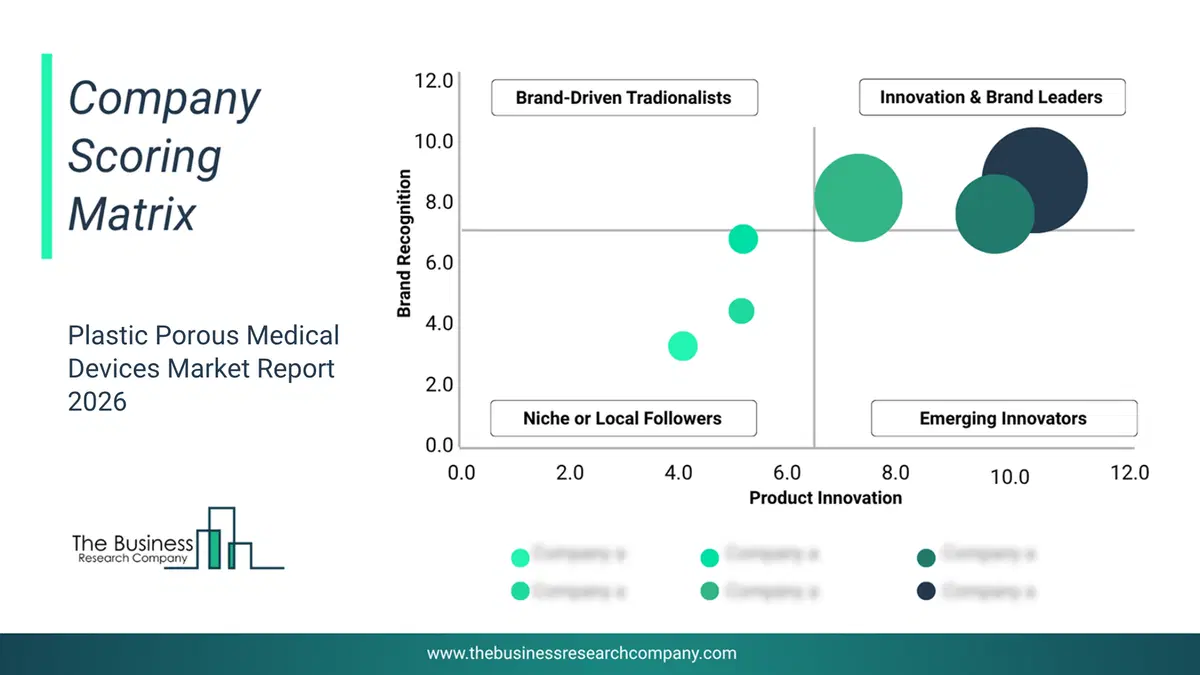
This chart maps companies by product innovation and brand strength, with bubble size indicating relative revenue, helping identify market leaders, challengers, and niche players. This is an illustrative chart; the full report provides a complete and accurate competitive analysis.
Global Plastic Porous Medical Devices Market Trends and Insights
Major companies operating in the plastic porous medical devices market are focusing on developing advanced technologies, such as 3D-printed porous PEEK (Polyether Ether Ketone) interbody technology, to enhance implant performance, improve biological integration, and develop next-generation polymer-based medical solutions. 3D-printed porous PEEK interbody technology is an advanced additive manufacturing approach that creates patient-specific polymer implants with controlled, interconnected porous structures designed to support bone ingrowth, improve implant stability, and replicate natural bone-like mechanical properties. For instance, in June 2025, Curiteva, a US-based medical device company, launched the Inspire Trabecular PEEK Standalone ALIF System, the first 3D-printed standalone PEEK implant featuring HAFUSE surface technology to promote cell attachment and bone integration. The implant incorporates a fully interconnected porous lattice structure that enhances biological performance and enables improved biomechanical load sharing compared with traditional titanium implants.What Are Latest Mergers And Acquisitions In The Plastic Porous Medical Devices Market?
In December 2023, EQT AB, a Sweden-based provider of private equity investment and growth capital focused on healthcare, technology, and industrial sectors, acquired Zeus Company LLC for $3.4 billion. With this acquisition, EQT aims to accelerate Zeus's global manufacturing expansion, strengthen its research and product innovation capabilities, and support growing demand for advanced porous polymer components used in catheter-based and structural heart procedures. Zeus Company LLC is a US-based provider of extruded and expanded fluoropolymer tubing, including its Aeos microporous expanded PTFE (ePTFE) membranes, ribbons, and tubing, along with other plastic porous components used in cardiovascular, neurovascular, and structural heart medical devices.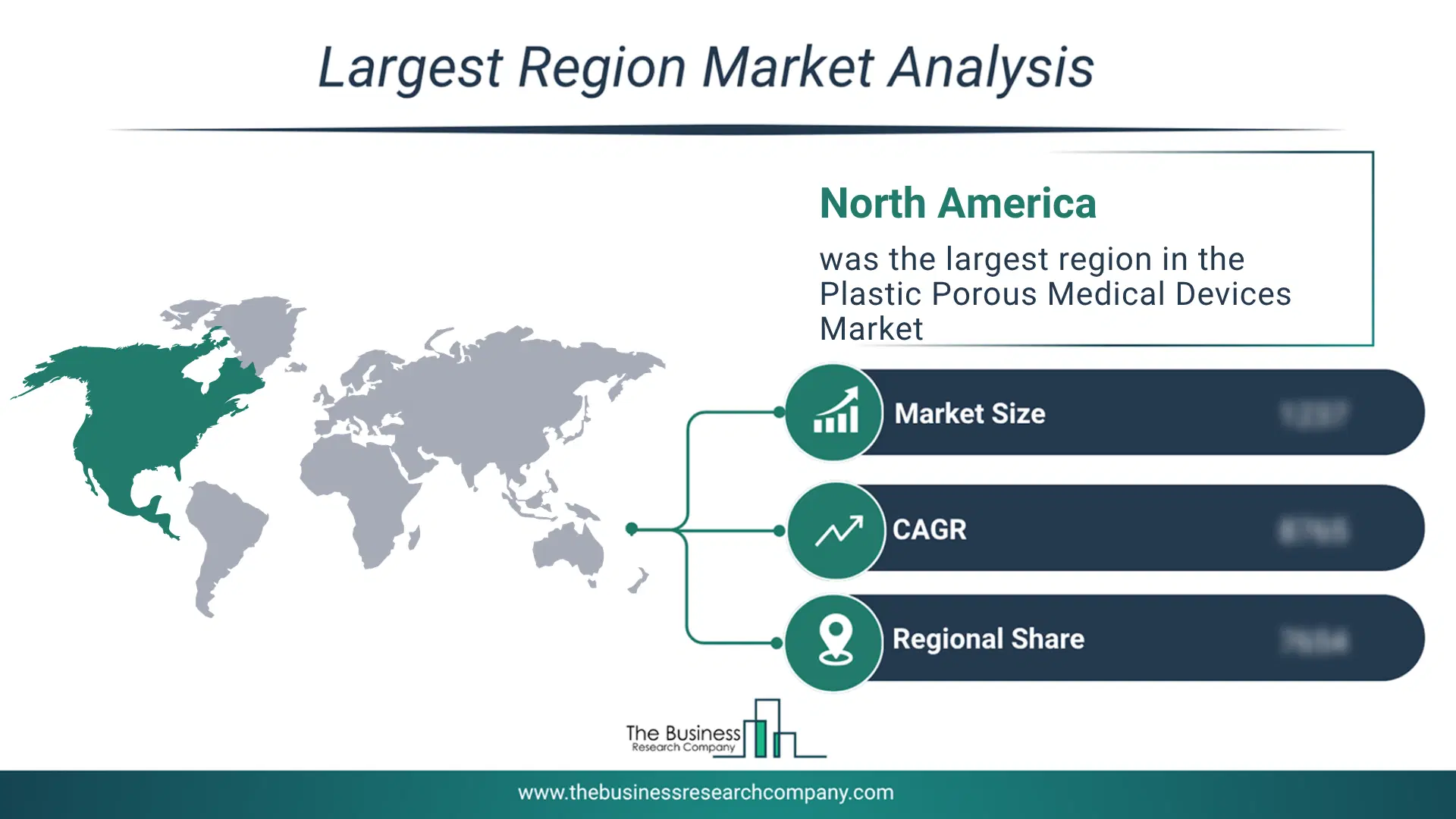
Regional Outlook
North America was the largest region in the plastic porous medical devices market in 2025. Asia-Pacific is expected to be the fastest-growing region in the forecast period. The regions covered in this market report are Asia-Pacific, South East Asia, Western Europe, Eastern Europe, North America, South America, Middle East, Africa. The countries covered in this market report are Australia, Brazil, China, France, Germany, India, Indonesia, Japan, Taiwan, Russia, South Korea, UK, USA, Canada, Italy, Spain.What Defines the Plastic Porous Medical Devices Market?
The plastic porous medical devices market consists of sales of porous diagnostic wicks, porous wound care components, porous membrane separators, porous fluid management components and porous implantable components. Values in this market are ‘factory gate’ values, that is, the value of goods sold by the manufacturers or creators of the goods, whether to other entities (including downstream manufacturers, wholesalers, distributors, and retailers) or directly to end customers. The value of goods in this market includes related services sold by the creators of the goods.How is Market Value Defined and Measured?
The market value is defined as the revenues that enterprises gain from the sale of goods and/or services within the specified market and geography through sales, grants, or donations in terms of the currency (in USD unless otherwise specified). The revenues for a specified geography are consumption values that are revenues generated by organizations in the specified geography within the market, irrespective of where they are produced. It does not include revenues from resales along the supply chain, either further along the supply chain or as part of other products.
This chart presents market attractiveness based on a quantitative evaluation of growth, competition, strategic alignment, and risk, offering a clear view of opportunity areas for decision-making. This chart is for illustrative purposes; the full report contains the complete analysis.

This chart highlights the Total Addressable Market (TAM) by estimating the maximum revenue opportunity using an assumption-driven approach, supporting strategic planning and opportunity sizing across markets. The chart is illustrative; the full report provides a more comprehensive analysis.
What Key Data and Analysis Are Included in the Plastic Porous Medical Devices Market Report 2026?
The plastic porous medical devices market research report is one of a series of new reports from The Business Research Company that provides market statistics, including industry global market size, regional shares, competitors with the market share, detailed market segments, market trends and opportunities, and any further data you may need to thrive in the plastic porous medical devices industry. The market research report delivers a complete perspective of everything you need, with an in-depth analysis of the current and future state of the industry.Plastic Porous Medical Devices Market Report Forecast Analysis
| Report Attribute | Details |
|---|---|
| Market Size Value In 2026 | $0.76 billion |
| Revenue Forecast In 2030 | $0.96 billion |
| Growth Rate | CAGR of 6.3% from 2026 to 2030 |
| Base Year For Estimation | 2025 |
| Actual Estimates/Historical Data | 2020-2025 |
| Forecast Period | 2026 - 2030 |
| Market Representation | Revenue in USD Billion and CAGR from 2026 to 2030 |
| Segments Covered | Product Type, Functionality, Material, Application, End User |
| Regional Scope | Asia-Pacific, Western Europe, Eastern Europe, North America, South America, Middle East, Africa |
| Country Scope | The countries covered in the report are Australia, Brazil, China, France, Germany, India, Indonesia, Japan, Taiwan, Russia, South Korea, UK, USA, Canada, Italy, Spain. |
| Key Companies Profiled | Porex Corporation, Saint-Gobain Life Sciences, Wilbert Lee Gore & Associates Inc., Freudenberg Medical, Medtronic plc, Porvair Filtration Group, Cobetter Filtration Equipment Co. Ltd., Ahlstrom, Teleflex Incorporated, GenPore, Atex Technologies Inc., Interstate Specialty Products Inc., Poriferous LLC, Pore Technology Inc., Sansuk Industries |
| Customization Scope | Request for Customization |
| Pricing And Purchase Options | Explore Purchase Options |