
Plastic To Fuel Market Report 2026
Global Outlook – By Technology (Pyrolysis, Gasification, Depolymerization), By Plant Capacity (Small Scale, Medium Scale, Large Scale), By Plastic Type (Polyethylene, Polyethylene Terephthalate, Polypropylene, Polyvinyl Chloride, Polystyrene, Other Plastic Types), By Application (Transportation Fuels, Industrial Energy, Chemical Feedstock, Power Generation), By End Product (Crude Oil, Hydrogen) – Market Size, Trends, Strategies, and Forecast to 2030
Plastic To Fuel Market Overview
• Plastic To Fuel market size has reached to $0.88 billion in 2025 • Expected to grow to $2.67 billion in 2030 at a compound annual growth rate (CAGR) of 24.8% • Growth Driver: Increasing Plastic Waste Generation Drives Growth Of The Market Due To The Growing Consumption Of Single-Use Plastic Packaging • Market Trend: Advanced Plastic Recycling Technologies Innovations Driving Sustainable Waste Valorization • Asia-Pacific was the largest region and fastest growing region.What Is Covered Under Plastic To Fuel Market?
Plastic to fuel is a waste conversion process that transforms plastic waste into fuel-grade hydrocarbons through thermochemical technologies such as pyrolysis, gasification, or catalytic depolymerization. It supports resource recovery and circular economy objectives by reducing plastic waste and converting it into valuable energy resources. The main technologies used for plastic to fuel include pyrolysis, gasification, and depolymerization. Pyrolysis is a thermal conversion process that breaks down plastic materials into smaller hydrocarbon molecules in the absence of oxygen. The plant capacities include small scale, medium scale, and large scale, while the plastic types processed include polyethylene, polyethylene terephthalate, polypropylene, polyvinyl chloride, polystyrene, and other plastic types. The various applications involved are transportation fuels, industrial energy, chemical feedstock, and power generation, and they are used to produce end products such as crude oil and hydrogen.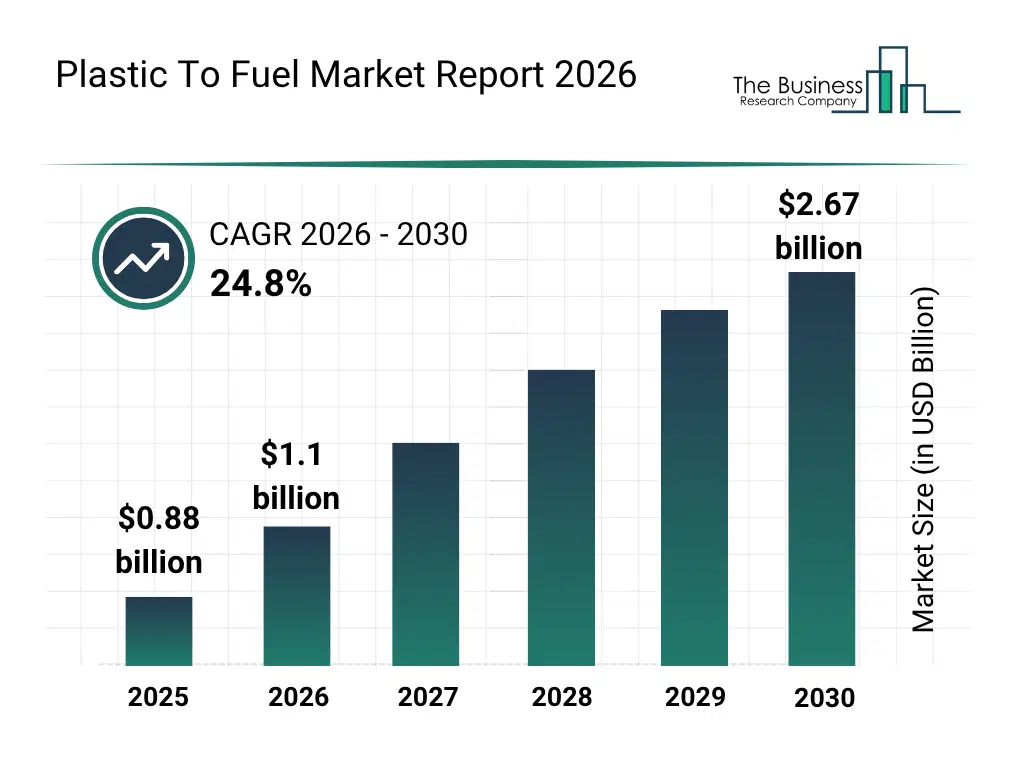
What Is The Plastic To Fuel Market Size and Share 2026?
The plastic to fuel market size has grown exponentially in recent years. It will grow from $0.88 billion in 2025 to $1.1 billion in 2026 at a compound annual growth rate (CAGR) of 25.2%. The growth in the historic period can be attributed to increasing plastic waste generation, rising demand for waste-to-energy solutions, growing landfill diversion requirements, increasing demand for alternative fuel sources, expanding plastic waste collection and recovery.What Is The Plastic To Fuel Market Growth Forecast?
The plastic to fuel market size is expected to see exponential growth in the next few years. It will grow to $2.67 billion in 2030 at a compound annual growth rate (CAGR) of 24.8%. The growth in the forecast period can be attributed to stricter plastic waste management regulations, rising demand for circular feedstock recovery, increasing need for low-carbon fuel alternatives, growing adoption of advanced chemical recycling, expanding demand for recovered hydrocarbons in industrial applications. Major trends in the forecast period include growing adoption of plastic waste pyrolysis for fuel production, increasing use of catalytic processes for higher-quality fuel outputs, rising demand for advanced plastic waste sorting and feedstock preparation, expanding development of modular and distributed plastic-to-fuel plants, increasing upgrading of pyrolysis oil into transportation-grade fuels.Tariff Impact On Plastic To Fuel Market
Tariffs are impacting the plastic to fuel market by increasing the cost of imported pyrolysis reactors, gasification equipment, catalysts, sensors, and specialized process-control systems required for plastic waste conversion. This is increasing project costs and potentially delaying the development and expansion of plastic-to-fuel facilities, particularly in regions dependent on imported equipment and technologies. Equipment-intensive segments such as pyrolysis and gasification are most affected due to their reliance on specialized machinery and imported components. However, tariffs are also encouraging local equipment manufacturing, regional supplier diversification, and greater investment in domestic plastic waste conversion infrastructure, creating long-term supply-chain resilience in the market.
Global Plastic To Fuel Market Segmentation
1) By Technology: Pyrolysis, Gasification, Depolymerization 2) By Plant Capacity: Small Scale, Medium Scale, Large Scale 3) By Plastic Type: Polyethylene, Polyethylene Terephthalate, Polypropylene, Polyvinyl Chloride, Polystyrene, Other Plastic Types 4) By Application: Transportation Fuels, Industrial Energy, Chemical Feedstock, Power Generation 5) By End Product: Crude Oil, Hydrogen Subsegments: 1) By Pyrolysis: Slow Pyrolysis, Fast Pyrolysis, Flash Pyrolysis, Catalytic Pyrolysis, Microwave Assisted Pyrolysis 2) By Gasification: Air Gasification, Oxygen Gasification, Steam Gasification, Plasma Gasification, Supercritical Water Gasification 3) By Depolymerization: Thermal Depolymerization, Catalytic Depolymerization, Solvolysis, Hydrothermal Liquefaction, HydrogenolysisWhat Is The Driver Of The Plastic To Fuel Market?
The increasing plastic waste generation is expected to propel the growth of the plastic-to-fuel market going forward. Plastic waste generation is the production and disposal of discarded plastic materials from households, industries, and commercial activities after they reach the end of their useful life. Plastic waste generation is increasing due to the growing consumption of single-use plastic packaging, driven by expanding e-commerce and food delivery services that generate large volumes of disposable plastic materials. Increasing plastic waste generation drives the growth of the plastic-to-fuel market by providing a larger and more consistent supply of feedstock for conversion into liquid fuels through thermochemical recycling processes. For instance, in December 2025, according to the Pew Research Center organization, a US-based organization, approximately 130 million metric tons (Mt) of plastic enter the environment each year, polluting land, air, and water, and this volume is projected to increase to 280 million Mt annually by 2040. Therefore, the increasing plastic waste generation is driving the growth of the plastic-to-fuel market.Key Players In The Global Plastic To Fuel Market
Major companies operating in the plastic to fuel market are Exxon Mobil Corporation, SABIC, LyondellBasell Industries N.V., Eastman Chemical Company, Chevron Phillips Chemical Company LLC, Brightmark LLC, Nexus Circular LLC, Agilyx Corporation, New Hope Energy LLC, Alterra Energy LLC, Renewlogy Technologies Inc., Klean Industries Inc., Niutech Environment Technology Corporation, Beston Group Co. Ltd., Pyrowave Inc., Resynergi Inc., Vow ASA, MK Aromatics Limited, Rudra Environmental Solutions (India) Limited, PolyCycl Private Limited, Pyrocrat Systems LLP, Shangqiu Sihai Machinery Equipment Manufacturing Co. Ltd., Green EnviroTech Holdings Corp., Waste Energy Corp.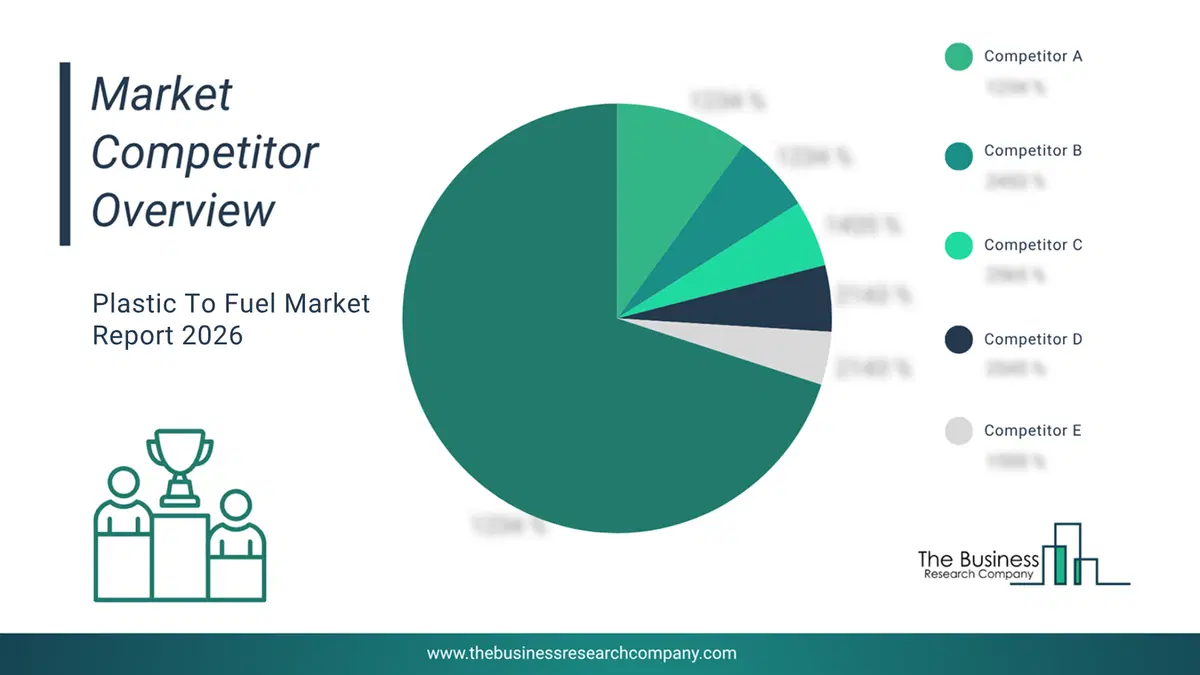
This chart is for illustrative purposes; the full report includes a detailed competitor analysis and comprehensive overview of the top 10 companies in the market.
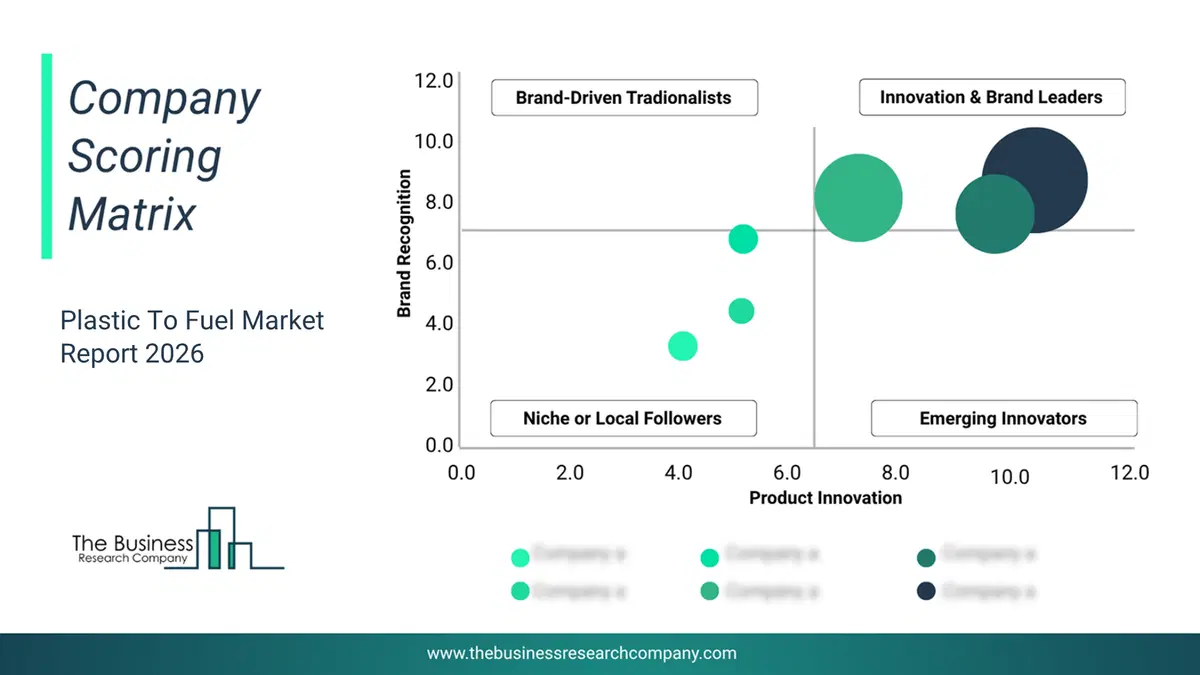
This chart maps companies by product innovation and brand strength, with bubble size indicating relative revenue, helping identify market leaders, challengers, and niche players. This is an illustrative chart; the full report provides a complete and accurate competitive analysis.
Global Plastic To Fuel Market Trends and Insights
Major companies operating in the plastic to fuel market are focusing on developing innovative solutions such as advanced plastic recycling technologies to improve plastic waste conversion efficiency, reduce landfill disposal, and support circular economy goals. Advanced plastic recycling technologies refer to processes that convert non-recyclable or mixed plastic waste into valuable products such as fuels, chemicals, or feedstocks through thermochemical or catalytic conversion methods. For instance, in March 2026, CSIR–Indian Institute of Chemical Technology (CSIR-IICT), an India-based research organisation, partnered with 2 Degrees Clicon Pvt. Ltd., an India-based clean technology company, to launch a plastic waste-to-fuel conversion technology, an advanced plastic recycling technology designed to convert mixed plastic waste into liquid fuels through a thermochemical process. It offers benefits such as reducing plastic waste accumulation, recovering valuable fuel resources, and supporting environmentally sustainable waste management. The launch aims to help customers transform low-value plastic waste into commercially useful fuels while supporting the transition towards a circular economy and sustainable resource recovery.What Are Latest Mergers And Acquisitions In The Plastic To Fuel Market?
In June 2026, Pacific Northwest National Laboratory (PNNL), a US-based national research laboratory, partnered with Refinity to commercialize a licensed catalytic process that converts mixed plastic waste into valuable industrial products, including chemicals, plastics, fuels, and circular hydrocarbon liquids derived from waste plastic-based olefins. Through this partnership, the companies aim to accelerate the commercialization of advanced plastic recycling technologies, support circular economy initiatives, and reduce reliance on virgin fossil-based feedstocks. Refinity is a US-based chemical recycling company that provides plastic waste conversion technologies, producing circular olefins, hydrocarbon intermediates, and feedstocks for sustainable aviation fuel and renewable diesel.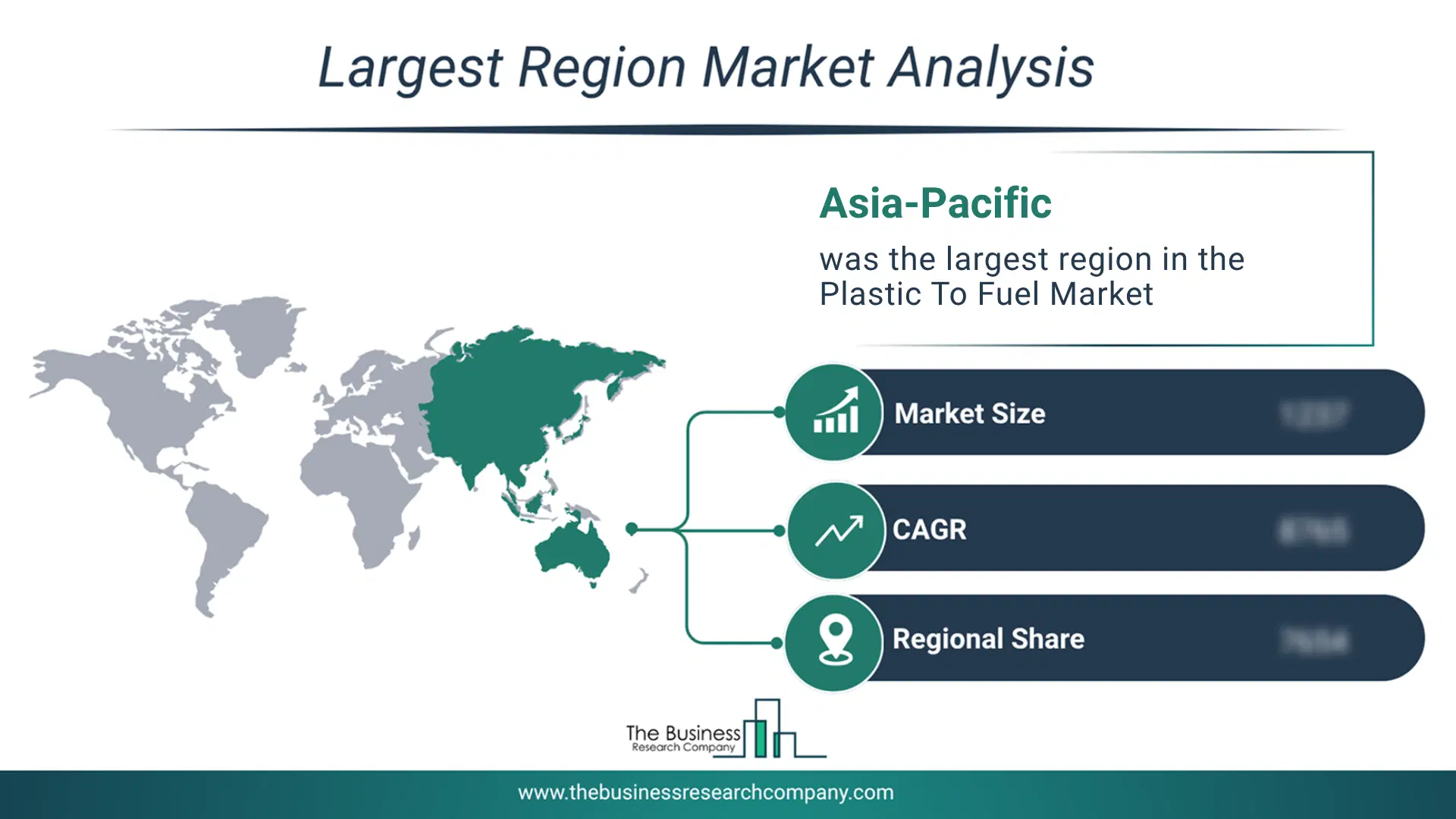
Regional Outlook
Asia-Pacific was the largest region in the plastic to fuel market in 2025. Asia-Pacific is expected to be the fastest-growing region in the forecast period. The regions covered in this market report are Asia-Pacific, South East Asia, Western Europe, Eastern Europe, North America, South America, Middle East, Africa. The countries covered in this market report are Australia, Brazil, China, France, Germany, India, Indonesia, Japan, Taiwan, Russia, South Korea, UK, USA, Canada, Italy, Spain.What Defines the Plastic To Fuel Market?
The plastic-to-fuel market includes sales of synthetic crude oil, pyrolysis oil, and diesel fuel. Values in this market are ‘factory gate’ values, that is, the value of goods sold by the manufacturers or creators of the goods, whether to other entities (including downstream manufacturers, wholesalers, distributors, and retailers) or directly to end customers. The value of goods in this market includes related services sold by the creators of the goods.How is Market Value Defined and Measured?
The market value is defined as the revenues that enterprises gain from the sale of goods and/or services within the specified market and geography through sales, grants, or donations in terms of the currency (in USD unless otherwise specified). The revenues for a specified geography are consumption values that are revenues generated by organizations in the specified geography within the market, irrespective of where they are produced. It does not include revenues from resales along the supply chain, either further along the supply chain or as part of other products.
This chart presents market attractiveness based on a quantitative evaluation of growth, competition, strategic alignment, and risk, offering a clear view of opportunity areas for decision-making. This chart is for illustrative purposes; the full report contains the complete analysis.

This chart highlights the Total Addressable Market (TAM) by estimating the maximum revenue opportunity using an assumption-driven approach, supporting strategic planning and opportunity sizing across markets. The chart is illustrative; the full report provides a more comprehensive analysis.
What Key Data and Analysis Are Included in the Plastic To Fuel Market Report 2026?
The plastic to fuel market research report is one of a series of new reports from The Business Research Company that provides market statistics, including industry global market size, regional shares, competitors with the market share, detailed market segments, market trends and opportunities, and any further data you may need to thrive in the plastic to fuel industry. The market research report delivers a complete perspective of everything you need, with an in-depth analysis of the current and future state of the industry.Plastic To Fuel Market Report Forecast Analysis
| Report Attribute | Details |
|---|---|
| Market Size Value In 2026 | $1.1 billion |
| Revenue Forecast In 2030 | $2.67 billion |
| Growth Rate | CAGR of 24.8% from 2026 to 2030 |
| Base Year For Estimation | 2025 |
| Actual Estimates/Historical Data | 2020-2025 |
| Forecast Period | 2026 - 2030 |
| Market Representation | Revenue in USD Billion and CAGR from 2026 to 2030 |
| Segments Covered | Technology, Plant Capacity, Plastic Type, Application, End Product |
| Regional Scope | Asia-Pacific, Western Europe, Eastern Europe, North America, South America, Middle East, Africa |
| Country Scope | The countries covered in the report are Australia, Brazil, China, France, Germany, India, Indonesia, Japan, Taiwan, Russia, South Korea, UK, USA, Canada, Italy, Spain. |
| Key Companies Profiled | Exxon Mobil Corporation, SABIC, LyondellBasell Industries N.V., Eastman Chemical Company, Chevron Phillips Chemical Company LLC, Brightmark LLC, Nexus Circular LLC, Agilyx Corporation, New Hope Energy LLC, Alterra Energy LLC, Renewlogy Technologies Inc., Klean Industries Inc., Niutech Environment Technology Corporation, Beston Group Co. Ltd., Pyrowave Inc., Resynergi Inc., Vow ASA, MK Aromatics Limited, Rudra Environmental Solutions (India) Limited, PolyCycl Private Limited, Pyrocrat Systems LLP, Shangqiu Sihai Machinery Equipment Manufacturing Co. Ltd., Green EnviroTech Holdings Corp., Waste Energy Corp. |
| Customization Scope | Request for Customization |
| Pricing And Purchase Options | Explore Purchase Options |