
Contact Us
  Search
The Business Research Company Logo
Plastics In Electronics Global Market Opportunities And Strategies To 2035
Published :July 2026
Pages :449
Format :PDF
Delivery Time :2-3 Business Days
Why 2-3 days? We update the report with the latest data and news before delivery. Let us know if you need us to expedite.
Report Price :$4,490.00

Plastics In Electronics Global Market Opportunities And Strategies To 2035

By Product Type (Thermoplastics, Thermosets), By Application (Consumer Electronics, Automotive Electronics, Industrial Electronics, Medical Devices, Other Applications), And By Region, Opportunities And Strategies – Global Forecast To 2035

Plastics In Electronics Market Definition

Plastics in electronics refers to the use of polymer-based materials in the manufacturing and assembly of electronic components and devices. These materials are engineered to provide insulation, structural integrity, lightweight properties, thermal resistance, and, in some cases, electrical conductivity. The market encompasses a wide range of plastic materials used in devices such as smartphones, computers, televisions, automotive electronics, industrial control systems, and medical electronic equipment. The plastics in electronics market consists of sales of plastics in electronics by entities (organizations, sole traders and partnerships) that are utilized by original equipment manufacturers (OEMs), contract manufacturers, and component suppliers across various industries. They are used throughout the lifecycle of electronic devices from internal components such as connectors, circuit board housings, and insulation layers to external casings and enclosures.
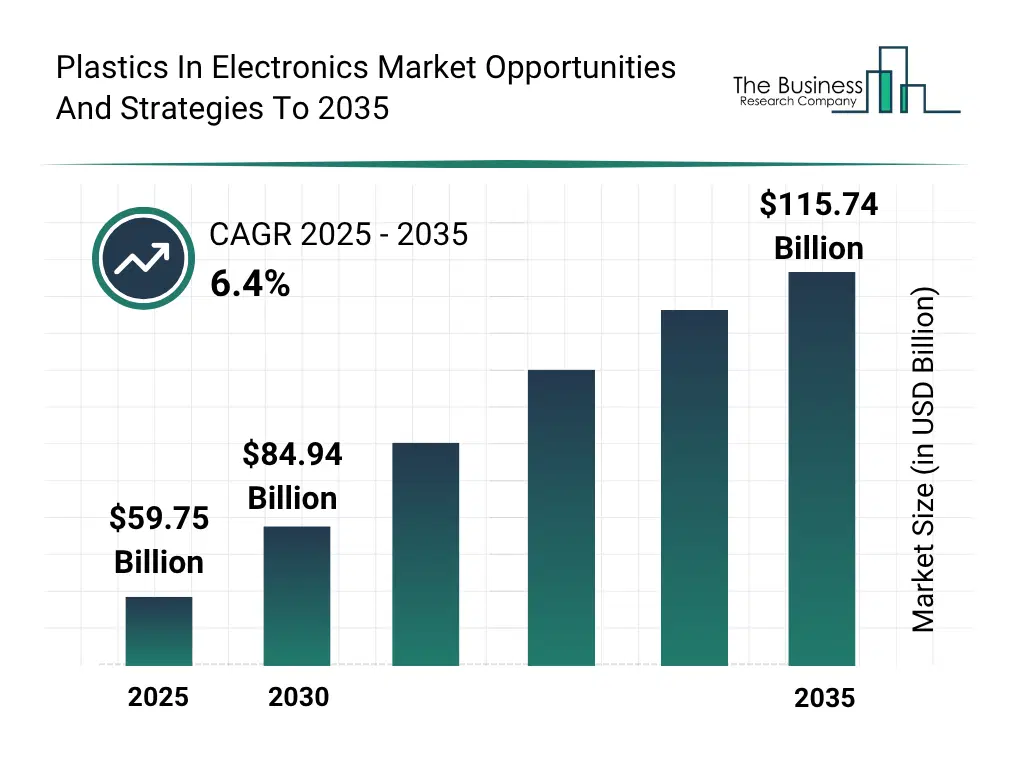
Plastics In Electronics Global Market Opportunities And Strategies To 2035 Market Size and growth rate 2026 to 2030: Graph

Plastics In Electronics Market Size

The global plastics in electronics market reached a value of nearly $59,754.3 million in 2025, having grown at a compound annual growth rate (CAGR) of 8.0% since 2020. The market is expected to grow from $59,754.3 million in 2025 to $84,935.9 million in 2030 at a rate of 7.3%. The market is then expected to grow at a CAGR of 6.4% from 2030 and reach $115,739.3 million in 2035. Growth in the historic period resulted from expansion of global consumer electronics demand, growth in miniaturization of electronic components and devices, growth in automotive electronics and electric vehicles and rising healthcare electronics and medical devices demand. Factors that negatively affected growth in the historic period were stringent environmental regulations on plastic usage and growing concerns over plastic waste and pollution. Going forward, increasing adoption of smart homes, IoT devices, and connected devices, increasing demand for flame-retardant and heat-resistant plastics, increasing penetration of wearable electronics and compact devices and lightweight material preference in electronics manufacturing will drive the growth. Factors that could hinder the growth of the plastics in electronics market in the future include growing e-waste management challenges, rising costs of recycled and bio-based plastics and impact of trade war and tariffs.
Research Expert

Book your 30 minutes free consultation with our research experts

Plastics In Electronics Market Segmentation

The plastics in electronics market is segmented by product type and by application.

By Product Type –
The plastics in electronics market is segmented by product type into:
    • a) Thermoplastics
    • b) Thermosets
The thermoplastics market was the largest segment of the plastics in electronics market segmented by product type, accounting for 69.6% or $41,612.7 million of the total in 2025. Going forward, the thermoplastics segment is expected to be the fastest-growing segment in the plastics in electronics market segmented by product type, at a CAGR of 7.9% during 2025-2030.

By Application –
The plastics in electronics market is segmented by application into:
    • a) Consumer Electronics
    • b) Automotive Electronics
    • c) Industrial Electronics
    • d) Medical Devices
    • e) Other Applications
The consumer electronics was the largest segment of the plastics in electronics market segmented by application, accounting for 32.2% or $19,225.0 million of the total in 2025. Going forward, the automotive electronics segment is expected to be the fastest-growing segment in the plastics in electronics market segmented by application, at a CAGR of 8.2% during 2025-2030.

By Geography - The plastics in electronics market is segmented by geography into:
      o Asia Pacific
      • China
      • India
      • Japan
      • Australia
      • Taiwan
      • South Korea
      o South East Asia
      • Indonesia
      • Thailand
      • Vietnam
      o North America
      • USA
      • Canada
      o South America
      • Brazil
      o Western Europe
      • France
      • Germany
      • UK
      • Italy
      • Spain
      o Eastern Europe
      • Russia
      o Middle East
      o Africa
Asia Pacific was the largest region in the plastics in electronics market, accounting for 42.6% or $25,476.2 million of the total in 2025. It was followed by North America, Western Europe and then the other regions. Going forward, the fastest-growing regions in the plastics in electronics market will be Asia Pacific and South America where growth will be at CAGRs of 7.9% and 7.3% respectively. These will be followed by Middle East and Eastern Europe where the markets are expected to grow at CAGRs of 6.91% and 6.87% respectively.

Plastics In Electronics Market Drivers

The key drivers of the plastics in electronics market include: Increasing Adoption Of Smart Homes, IoT Devices, And Connected Devices During the forecast period, increasing adoption of smart homes, IoT devices, and connected devices is expected to be a key driver propelling expansion in the plastics in electronics market. As connected devices such as smart thermostats, wearables, security systems, and voice assistants proliferate, manufacturers are under pressure to produce compact, energy-efficient, and aesthetically appealing products at scale. Advanced engineering plastics, such as polycarbonate, ABS, and high-performance thermoplastics offer critical advantages including electrical insulation, heat resistance, impact strength, and ease of mass production through injection molding. Additionally, the integration of sensors, wireless modules, and embedded systems requires materials that can accommodate complex geometries while maintaining structural integrity and signal transparency. The increasing adoption of smart homes, IoT devices, and connected devices growth contribution during the forecast period in 2026 is 1.3%.

Plastics In Electronics Market Restraints

The key restraints on the plastics in electronics market include: Growing E-Waste Management Challenges During the historic period, growing e-waste management challenges restricted the growth of the plastics in electronics market. Electronic products contain a high proportion of complex, multi-layered plastic components, often blended with additives, flame retardants, and mixed polymers which are difficult and costly to recycle at scale. As global volumes of discarded devices rise, governments are tightening regulations around waste collection, recycling targets, and the use of hazardous substances, compelling manufacturers to rethink material choices and product design. Compliance with extended producer responsibility (EPR) frameworks and recycling mandates can elevate costs across the value chain, while inadequate recycling infrastructure in many regions further limits efficient material recovery. Additionally, growing consumer and investor focus on sustainability is pressuring companies to reduce reliance on virgin plastics and improve circularity, potentially slowing demand for conventional plastic materials in electronics. Growth affected by the growing e-waste management challenges during the forecast period in 2026 is -2.0%.

Plastics In Electronics Market Competitive Landscape

Major Competitors are:

  • BASF SE
  • Covestro AG
  • SABIC (Saudi Basic Industries Corporation)
  • LG Chem Ltd.
  • Toray Industries, Inc
  • Other Competitors Include:

  • Mitsubishi Chemical Corporation
  • Celanese Corporation
  • Sumitomo Chemical Co., Ltd.
  • LyondellBasell Industries N.V.
  • Formosa Plastics Group
  • Arkema SA
  • Solvay S.A.
  • INEOS Group
  • Dow Inc.
  • LANXESS AG
  • Eastman Chemical Company
  • Asahi Kasei Corporation
  • Chi Mei Corporation
  • Indorama Ventures Public Company Limited
  • PTT Global Chemical Public Company Limited
  • IRPC Public Company Limited
  • SCG Chemicals
  • MBA Polymers
  • Röchling SE & Co. KG
  • RadiciGroup
  • Versalis S.p.A
  • Evonik Industries AG
  • Talisman
  • KAPLAST (Poland)
  • LyondellBasell Industries Holdings BV
  • TotalEnergies Petrochemicals
  • Alpek S.A.B. de C.V.
  • Orbia Advance Corporation
  • POLNAC (Polímeros Nacionales)
  • Lavergne
  • DuPont de Nemours, Inc.
  • Avient Corporation
  • Ensinger Inc.
  • Envision Plastics and Design
  • Braskem S.A.
  • Need data on a specific region in this market?

    Opportunities And Recommendations In The Plastics In Electronics Market

    Opportunities – The top opportunities in the plastics in electronics market segmented by product type will arise in the thermoplastics segment, which will gain $19,270.5 million of global annual sales by 2030. The top opportunities in the plastics in electronics market segmented by application will arise in the automotive electronics segment, which will gain $8,269.3 million of global annual sales by 2030. The plastics in electronics market size will gain the most in China at $6,096.4 million. Recommendations- To take advantage of the opportunities, The Business Research Company recommends the plastics in electronics companies to focus on bio-based and recycled material integration for sustainable electronics manufacturing, focus on lightweight high performance polymer innovation for advanced consumer electronics design, focus on recycled plastic integration for low carbon consumer electronics growth, focus on high performance recycled ABS adoption for circular electronics manufacturing growth, focus on thermoplastics expansion for high growth electronics applications, expand in emerging markets, continue to focus on developed markets, focus on value based tiered pricing to capture premium and mass electronics demand, OEM and engineer-focused technical promotion strategy, account-based digital and lifecycle marketing strategy and focus on automotive electronics plastics for high-growth performance applications.
    Chat with us