
Polar Region Satellite Communications Market Report 2026
Global Outlook – By Component (Hardware, Software, Services), By Platform (Ground Stations, Airborne, Maritime, Spaceborne), By Frequency Band (L-Band, S-Band, C-Band, X-Band, Ku-Band, Ka-Band, Other Frequency Bands), By Application (Defense And Military, Scientific Research, Oil And Gas, Maritime, Aviation, Other Applications), By End-User (Government, Commercial, Research Institutions, Other End-Users) – Market Size, Trends, Strategies, and Forecast to 2030
Polar Region Satellite Communications Market Overview
• Polar Region Satellite Communications market size has reached to $2.49 billion in 2025 • Expected to grow to $4.25 billion in 2030 at a compound annual growth rate (CAGR) of 11.3% • Growth Driver: High-Throughput And Low Earth Orbit (LEO) Satellite Deployment Is Fueling The Growth Of The Market Due To Rising Demand For Reliable Polar Connectivity • Market Trend: Advanced Technological Innovations Are Driving Enhanced Connectivity And Real-Time Monitoring In Remote And High-Latitude Regions • North America was the largest region in 2025 and Asia-Pacific is the fastest growing region.What Is Covered Under Polar Region Satellite Communications Market?
Polar region satellite communications refers to the use of satellites positioned in or passing over high-latitude areas near the Arctic and Antarctic to provide reliable connectivity. These communications enable continuous data transmission, tracking, and monitoring in regions where traditional geostationary satellites have limited coverage. They are critical for maintaining communication links in extreme and remote environments with challenging atmospheric and geographic conditions. The main components of polar region satellite communications are hardware, software, and services. Hardware refers to the physical components of a computer or electronic system, such as processors, memory, storage devices, and peripheral equipment, that can be physically touched and interacted with. The multiple platforms are ground stations, airborne, maritime, and spaceborne. The different frequency bands are L-Band, S-Band, C-Band, X-Band, Ku-Band, Ka-Band, and others. The various applications involved are defense and military, scientific research, oil and gas, maritime, aviation, and others, and they are used by several end-users such as government, commercial, and research institutions, and others.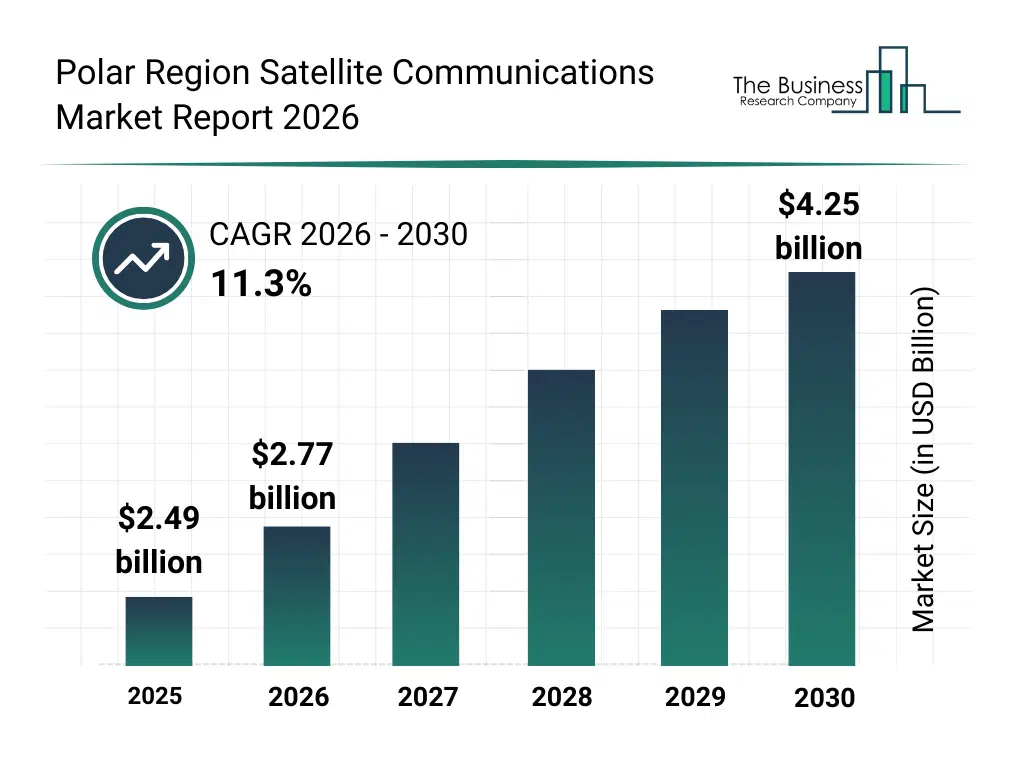
What Is The Polar Region Satellite Communications Market Size and Share 2026?
The polar region satellite communications market size has grown rapidly in recent years. It will grow from $2.49 billion in 2025 to $2.77 billion in 2026 at a compound annual growth rate (CAGR) of 11.5%. The growth in the historic period can be attributed to demand for connectivity in remote polar regions, adoption of high-latitude satellite constellations, growth in maritime and research expeditions, use of portable communication units, need for secure polar communication links.What Is The Polar Region Satellite Communications Market Growth Forecast?
The polar region satellite communications market size is expected to see rapid growth in the next few years. It will grow to $4.25 billion in 2030 at a compound annual growth rate (CAGR) of 11.3%. The growth in the forecast period can be attributed to deployment of low-earth orbit polar-focused constellations, integration with arctic navigation and surveillance, adoption of AI-enabled communication optimization, growth in polar resource exploration support, expansion of emergency and disaster communication service. Major trends in the forecast period include expansion of low-earth-orbit (leo) constellations for polar coverage, increasing demand for resilient communication systems for arctic shipping, growth in polar scientific research requiring high-bandwidth data relay, rising integration of portable satellite terminals for field operations, development of high-frequency ka- and ku-band solutions for extreme weather.
Global Polar Region Satellite Communications Market Segmentation
1) By Component: Hardware, Software, Services 2) By Platform: Ground Stations, Airborne, Maritime, Spaceborne 3) By Frequency Band: L-Band, S-Band, C-Band, X-Band, Ku-Band, Ka-Band, Other Frequency Bands 4) By Application: Defense And Military, Scientific Research, Oil And Gas, Maritime, Aviation, Other Applications 5) By End-User: Government, Commercial, Research Institutions, Other End-Users Subsegments: 1) By Hardware: Satellite Antennas, Ground Terminals, Signal Amplifiers, Transceivers, Tracking Systems, Satellite Modems 2) By Software: Network Management Software, Data Analysis Software, Simulation And Modeling Software, Threat Detection Software 3) By Services: Installation Services, Maintenance Services, Monitoring Services, Consulting ServicesWhat Is Driver Of The Polar Region Satellite Communications Market?
The increasing deployment of high-throughput and low earth orbit (LEO) satellite constellations is expected to propel the growth of the polar region satellite communications market going forward. A low Earth orbit (LEO) satellite is a satellite that orbits the Earth at an altitude typically between 160 and 2,000 kilometers, providing low-latency communication and high-resolution observation capabilities. The rise of high-throughput and low earth orbit (LEO) satellite constellations is due to growing demand for fast, reliable, and low-latency connectivity that ensures uninterrupted communication and broad coverage even in remote and underserved regions. Polar region satellite communications support low earth orbit (LEO) satellite constellations by enabling reliable connectivity and continuous coverage in high-latitude and remote areas, enhancing real-time communication and network performance. For instance, in February 2023, according to the European Parliament, a France-based government body, up to 170 low earth orbit (LEO) satellites may be built and launched between 2025 and 2027 as part of the infrastructure's ground and space segments, and approximately 20,000 more satellites are anticipated to be deployed over the next ten years. Therefore, the increasing deployment of high-throughput and low earth orbit (LEO) satellite constellations is driving growth of the polar region satellite communications industry.Key Players In The Global Polar Region Satellite Communications Market
Major companies operating in the polar region satellite communications market are Lockheed Martin Corporation, Raytheon Technologies Corporation, Northrop Grumman Corporation, Honeywell International Inc., L3Harris Technologies Inc., Viasat Inc., Thales Alenia Space, SES S.A., Eutelsat Communications S.A., Iridium Communications Inc., Cobham Limited, Telesat Canada, Hughes Network Systems LLC, Comtech Telecommunications Corp., Gilat Satellite Networks Ltd., KVH Industries Inc., Airbus Defence and Space, Springwise Ltd., China Great Wall Industry Corporation (CGWIC), Space Norway AS
This chart is for illustrative purposes; the full report includes a detailed competitor analysis and comprehensive overview of the top 10 companies in the market.
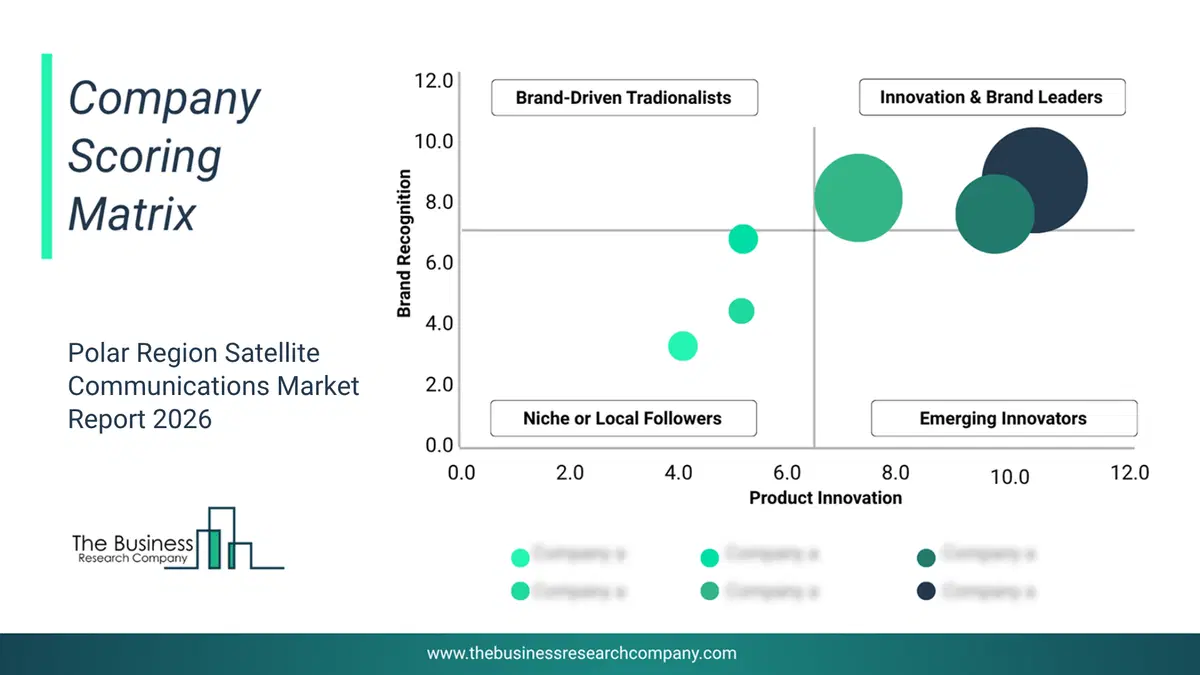
This chart maps companies by product innovation and brand strength, with bubble size indicating relative revenue, helping identify market leaders, challengers, and niche players. This is an illustrative chart; the full report provides a complete and accurate competitive analysis.
Global Polar Region Satellite Communications Market Trends and Insights
Major companies operating in the polar region satellite communications market are focusing on advanced technological innovations, such as artificial intelligence (AI)-powered microsatellite surveillance, to provide governments, defense agencies, and research organizations with reliable, real-time connectivity and enhanced monitoring capabilities in remote and high-latitude regions. Artificial intelligence (AI)-powered microsatellite surveillance is a system in that compact satellites use AI algorithms to autonomously monitor, analyze, and interpret data from remote or high-latitude regions in real time. For instance, in June 2025, Space Inventor, a Denmark-based satellite engineering and manufacturing company, launched a Danish Arctic satellite. The BIFROST satellite, developed in collaboration with Terma, Gatehouse SatCom, DTU, and Unibap Space Solutions, provides space-based surveillance, target identification, and real-time event reporting across Greenland, the Arctic, and the North Atlantic, enhancing situational awareness, supporting military and emergency operations, and enabling seamless data sharing between Danish and Swedish defense forces.What Are Latest Mergers And Acquisitions In The Polar Region Satellite Communications Market? Viasat’s Acquisition Of Inmarsat To Strengthen Polar Region Satellite Communications Capabilities
In May 2023, Viasat Inc., a US-based Internet service provider commercial company, acquired Inmarsat for $551 million in cash plus approximately 46.36 million shares. Through this acquisition, Viasat aims to combine its assets with Inmarsat’s to enhance global satellite connectivity, expand coverage in remote and polar regions, and accelerate innovation in high-speed, reliable, and secure communication services. Inmarsat is a UK-based satellite telecommunications company, offering mobile communications, including maritime, aeronautical, and government broadband services, with additional coverage via highly elliptical orbits (HEO) for polar regions.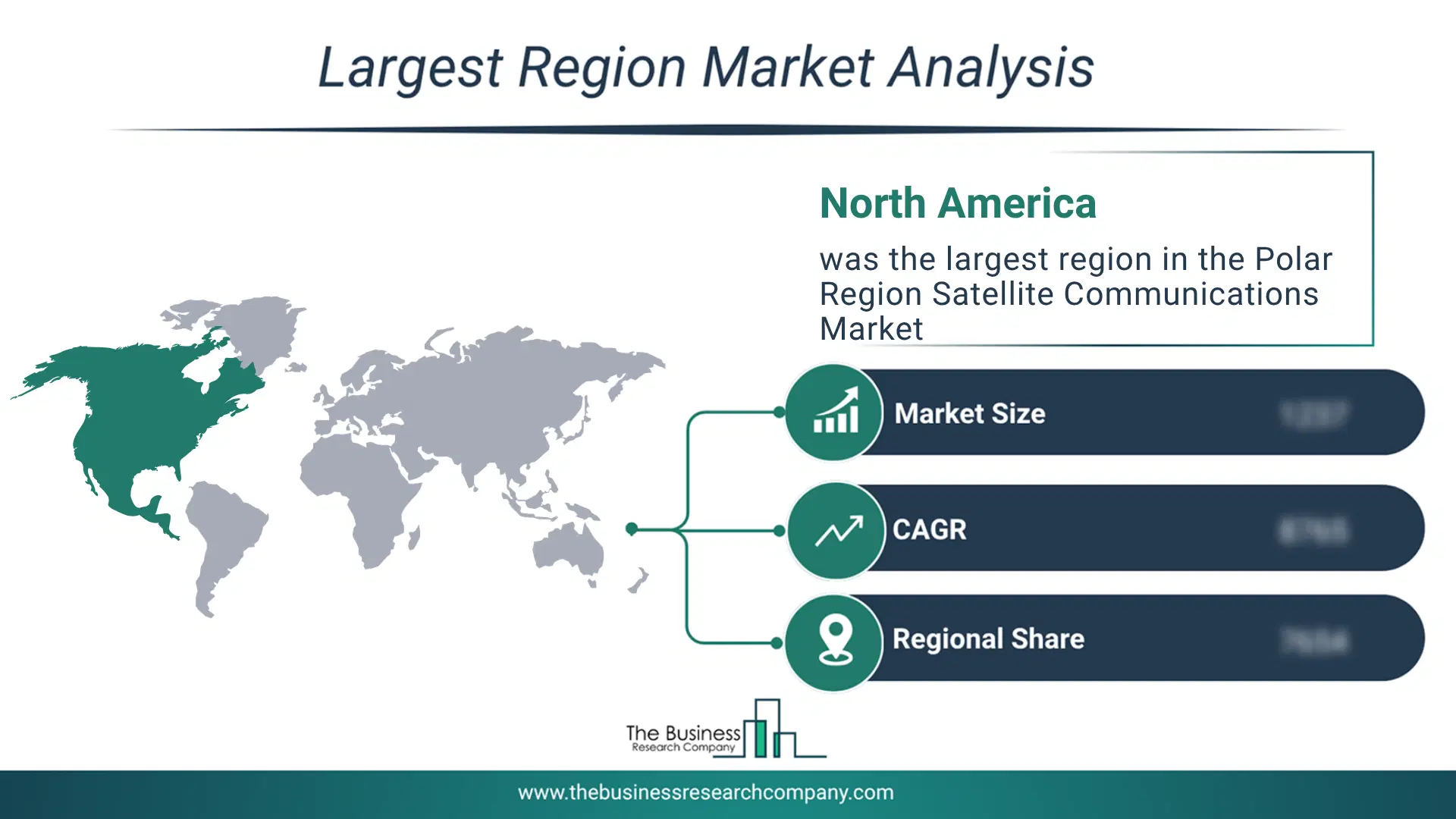
Regional Insights
North America was the largest region in the polar region satellite communications market in 2025. Asia-Pacific is expected to be the fastest-growing region in the forecast period. The regions covered in this market report are Asia-Pacific, South East Asia, Western Europe, Eastern Europe, North America, South America, Middle East, Africa. The countries covered in this market report are Australia, Brazil, China, France, Germany, India, Indonesia, Japan, Taiwan, Russia, South Korea, UK, USA, Canada, Italy, SpainWhat Defines the Polar Region Satellite Communications Market?
The polar region satellite communications market consists of revenues earned by entities by providing services such as secure communication, navigation, data transfer, remote connectivity, and emergency support. The market value includes the value of related goods sold by the service provider or included within the service offering. The polar region satellite communications market also includes sales of satellite antennas, ground terminals, user terminals, signal amplifiers, transceivers, tracking systems, satellite modems, portable communication units, and maritime communication devices. Values in this market are ‘factory gate’ values, that is, the value of goods sold by the manufacturers or creators of the goods, whether to other entities (including downstream manufacturers, wholesalers, distributors, and retailers) or directly to end customers. The value of goods in this market includes related services sold by the creators of the goods.How is Market Value Defined and Measured?
The market value is defined as the revenues that enterprises gain from the sale of goods and/or services within the specified market and geography through sales, grants, or donations in terms of the currency (in USD unless otherwise specified). The revenues for a specified geography are consumption values that are revenues generated by organizations in the specified geography within the market, irrespective of where they are produced. It does not include revenues from resales along the supply chain, either further along the supply chain or as part of other products.
This chart presents market attractiveness based on a quantitative evaluation of growth, competition, strategic alignment, and risk, offering a clear view of opportunity areas for decision-making. This chart is for illustrative purposes; the full report contains the complete analysis.

This chart highlights the Total Addressable Market (TAM) by estimating the maximum revenue opportunity using an assumption-driven approach, supporting strategic planning and opportunity sizing across markets. The chart is illustrative; the full report provides a more comprehensive analysis.
What Key Data and Analysis Are Included in the Polar Region Satellite Communications Market Report 2026?
The polar region satellite communications market research report is one of a series of new reports from The Business Research Company that provides market statistics, including industry global market size, regional shares, competitors with the market share, detailed market segments, market trends and opportunities, and any further data you may need to thrive in the polar region satellite communications industry. The market research report delivers a complete perspective of everything you need, with an in-depth analysis of the current and future state of the industry.Polar Region Satellite Communications Market Report Forecast Analysis
| Report Attribute | Details |
|---|---|
| Market Size Value In 2026 | $2.77 billion |
| Revenue Forecast In 2030 | $4.25 billion |
| Growth Rate | CAGR of 11.3% from 2026 to 2030 |
| Base Year For Estimation | 2025 |
| Actual Estimates/Historical Data | 2020-2025 |
| Forecast Period | 2026 - 2030 |
| Market Representation | Revenue in USD Billion and CAGR from 2026 to 2030 |
| Segments Covered | Component, Platform, Frequency Band, Application, End-User |
| Regional Scope | Asia-Pacific, Western Europe, Eastern Europe, North America, South America, Middle East, Africa |
| Country Scope | The countries covered in the polar region satellite communications market report are Australia, Brazil, China, France, Germany, India, Indonesia, Japan, Taiwan, Russia, South Korea, UK, USA, Canada, Italy, Spain |
| Key Companies Profiled | Lockheed Martin Corporation, Raytheon Technologies Corporation, Northrop Grumman Corporation, Honeywell International Inc., L3Harris Technologies Inc., Viasat Inc., Thales Alenia Space, SES S.A., Eutelsat Communications S.A., Iridium Communications Inc., Cobham Limited, Telesat Canada, Hughes Network Systems LLC, Comtech Telecommunications Corp., Gilat Satellite Networks Ltd., KVH Industries Inc., Airbus Defence and Space, Springwise Ltd., China Great Wall Industry Corporation (CGWIC), Space Norway AS |
| Customization Scope | Request for Customization |
| Pricing And Purchase Options | Explore Purchase Options |