

Pollen Allergy Market Report 2026
Global Outlook – By Product Type (Instruments, Consumables, Services ), By Allergen Type (Environmental Allergens, Inhaled, Airborne Allergens, Other Allergen Types ), By Therapeutics Drug class (Antihistamines, Decongestants, Corticosteroids, Mast Cell Stabilizers, Leukotriene Inhibitors, Nasal Anticholinergics, Immunomodulators, Auto injectable Epinephrine, Immunotherapy ), By End-User (Diagnostic Laboratories, Hospitals) - Market Size, Trends, Strategies, and Forecast to 2030
Pollen Allergy Market Overview
• Pollen Allergy market size has reached to $7.49 billion in 2025 • Expected to grow to $10.94 billion in 2030 at a compound annual growth rate (CAGR) of 7.8% • Growth Driver: Prevalence Of Allergic Rhinitis Driving Increased Demand For Pollen Allergens • Market Trend: Innovative Allergy Care Platforms Transforming Diagnosis And Treatment • North America was the largest region in 2025 and Asia-Pacific is the fastest growing region.What Is Covered Under Pollen Allergy Market?
Pollen allergy is an allergic reaction to pollen from trees, grasses, and weeds. It occurs when the immune system mistakenly identifies pollen as harmful and releases chemicals such as histamine to combat it. Pollen allergies are often seasonal, peaking during spring, summer, or fall, depending on the pollen an individual is sensitive to. The main product types in the pollen allergy market include instruments, consumables, and services. Instruments refer to medical devices used for diagnosing, monitoring, and treating pollen allergies, such as nasal irrigation devices, allergy testing equipment, and inhalers. The types of allergens include food, inhaled, drug, and other allergens. Various treatments used for pollen allergies include antihistamines, decongestants, corticosteroids, mast cell stabilizers, leukotriene inhibitors, nasal anticholinergics, immunomodulators, auto-injectable epinephrine, and immunotherapy. These products are primarily used in diagnostic laboratories and hospitals.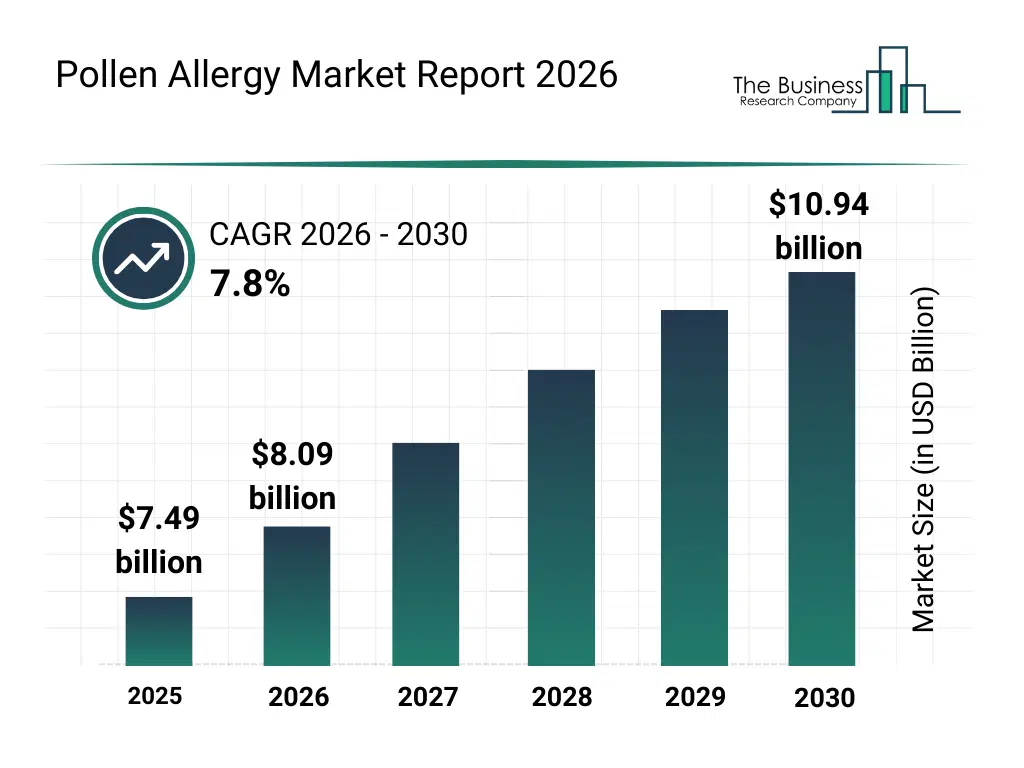
What Is The Pollen Allergy Market Size and Share 2026?
The pollen allergy market size has grown strongly in recent years. It will grow from $7.49 billion in 2025 to $8.09 billion in 2026 at a compound annual growth rate (CAGR) of 8.1%. The growth in the historic period can be attributed to increasing prevalence of seasonal allergies, rising environmental pollen exposure, growth in allergy diagnostic services, availability of antihistamine medications, expansion of allergy awareness programs.What Is The Pollen Allergy Market Growth Forecast?
The pollen allergy market size is expected to see strong growth in the next few years. It will grow to $10.94 billion in 2030 at a compound annual growth rate (CAGR) of 7.8%. The growth in the forecast period can be attributed to growing adoption of immunotherapy treatments, rising investments in precision allergy diagnostics, increasing focus on preventive allergy care, expansion of biologic allergy treatments, growing integration of digital allergy monitoring tools. Major trends in the forecast period include increasing adoption of personalized allergy therapies, rising use of advanced diagnostic testing for allergens, growing demand for long-term immunotherapy solutions, expansion of seasonal allergy management programs, enhanced focus on early allergy diagnosis.
Global Pollen Allergy Market Segmentation
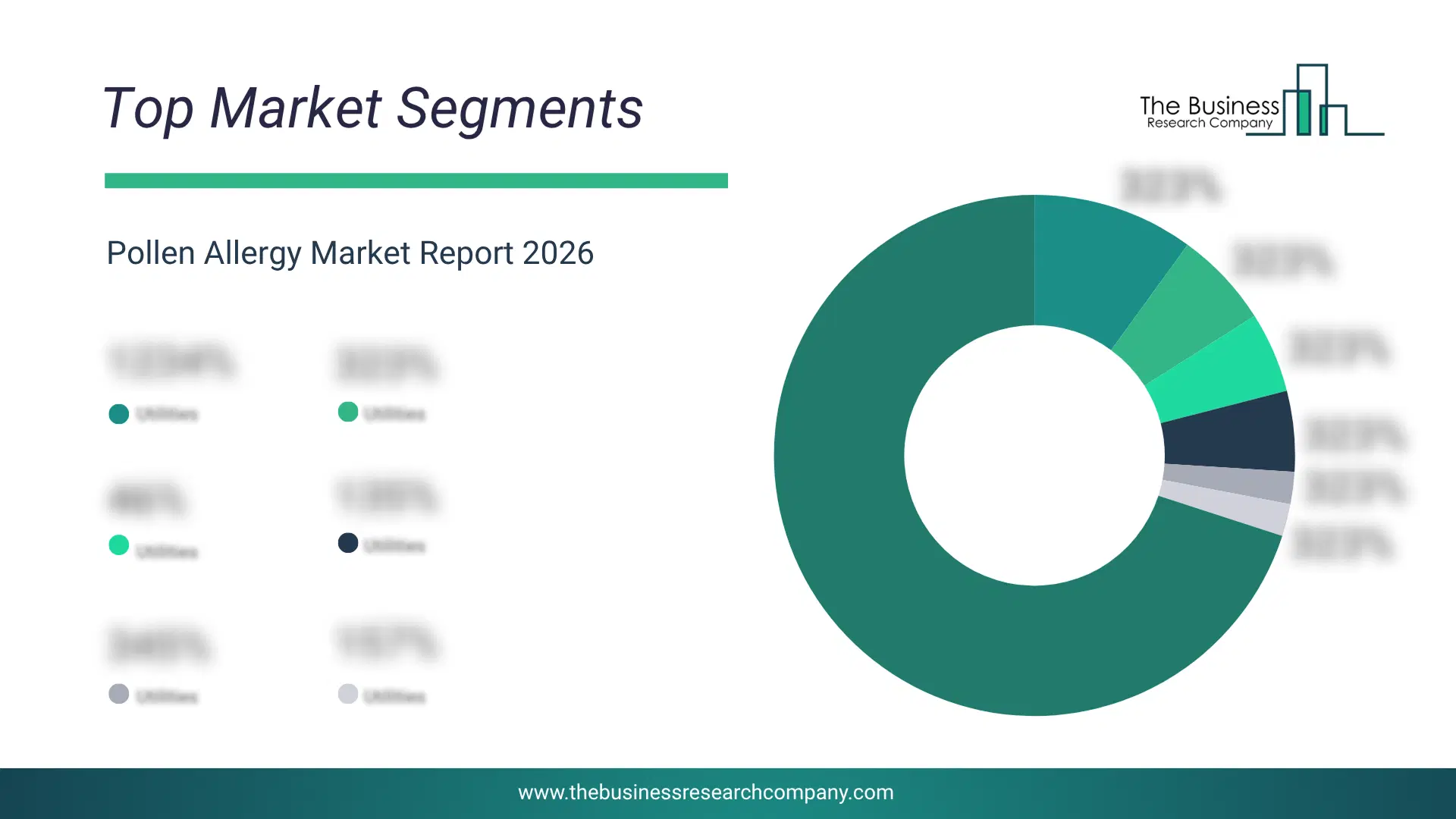
1) By Product Type: Instruments, Consumables, Services 2) By Allergen Type: Environmental Allergens, Inhaled, Airborne Allergens, Other Allergen Types 3) By Therapeutics Drug class: Antihistamines, Decongestants, Corticosteroids, Mast Cell Stabilizers, Leukotriene Inhibitors, Nasal Anticholinergics, Immunomodulators, Auto injectable Epinephrine, Immunotherapy 4) By End-User: Diagnostic Laboratories, Hospitals Subsegments: 1) By Instruments: Allergy Testing Equipment, Diagnostic Devices, Monitoring Devices 2) By Consumables: Allergy Test Kits, Pollen Filters, Diagnostic Reagents, Treatment Medications (Antihistamines) 3) By Services: Allergy Testing Services, Immunotherapy Services, Consultation And Diagnostic ServicesWhat Is The Driver Of The Pollen Allergy Market?
The prevalence of allergic rhinitis is expected to drive the growth of the pollen allergen market going forward. Allergic rhinitis is an allergic condition that inflames the nose, leading to sneezing, a blocked nose, and itchy eyes, usually caused by pollen or dust. The rise in allergic rhinitis is attributed to environmental pollution, climate change, urbanization, and lifestyle shifts, which increase exposure to allergens and pollutants. Allergic rhinitis is a common condition caused by pollen allergies, where exposure to pollen triggers inflammation in the nasal passages. For instance, in October 2023, according to the World Allergy Organization, a US-based umbrella organization for clinical allergic studies, allergic rhinitis impacts over 400 million people globally, with prevalence rates ranging from 10% to 30% in adults and exceeding 40% in children. Therefore, the rise in the prevalence of allergic rhinitis is driving the growth of the pollen allergen market.Key Players In The Global Pollen Allergy Market
Major companies operating in the pollen allergy market are Johnson & Johnson, F. Hoffmann-La Roche Ltd., Merck KGaA, AbbVie Inc., Bayer AG, Sanofi SA, AstraZeneca Plc, Novartis AG, GlaxoSmithKline PLC, Astellas Pharma Inc., Bausch Health Companies Inc., Sun Pharmaceutical Industries Ltd, Genentech Inc., Omega Pharma, ALK Abello, Stallergenes Greer, Aimmune Therapeutics, Allergy Therapeutics, McNeil Consumer Healthcare, Meda Pharmaceuticals Inc, HAL Allergy Group, Allergopharma, Biomay AG, Leti Pharma, Alerpharma S.A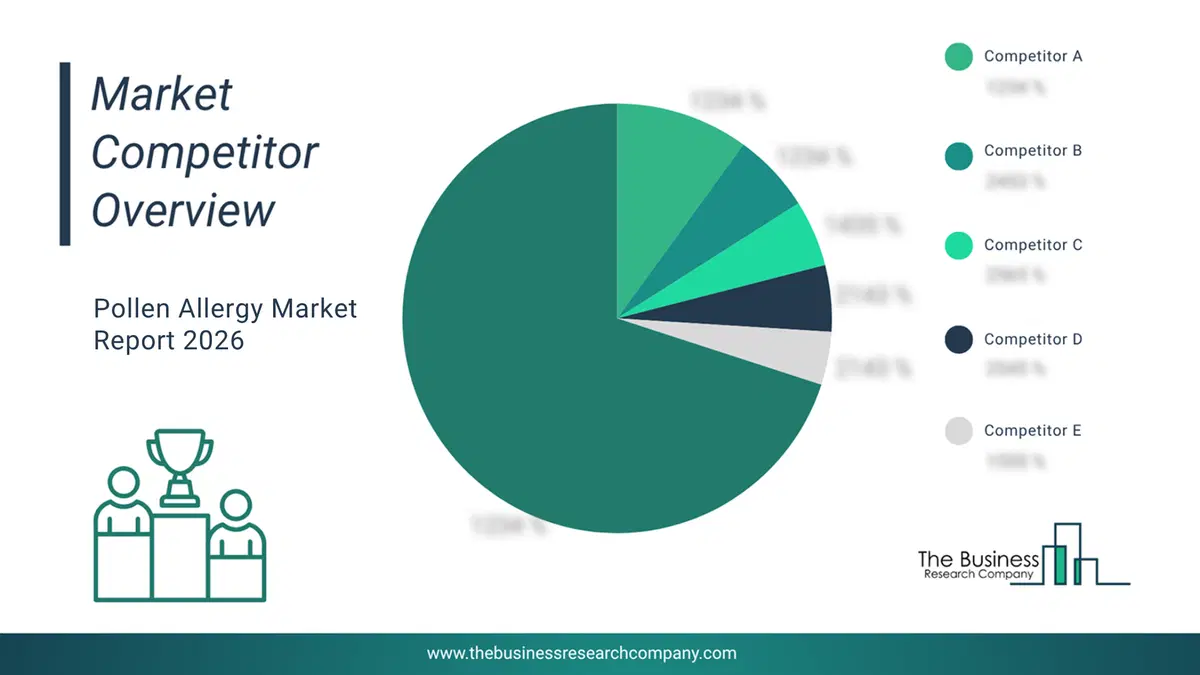
This chart is for illustrative purposes; the full report includes a detailed competitor analysis and comprehensive overview of the top 10 companies in the market.
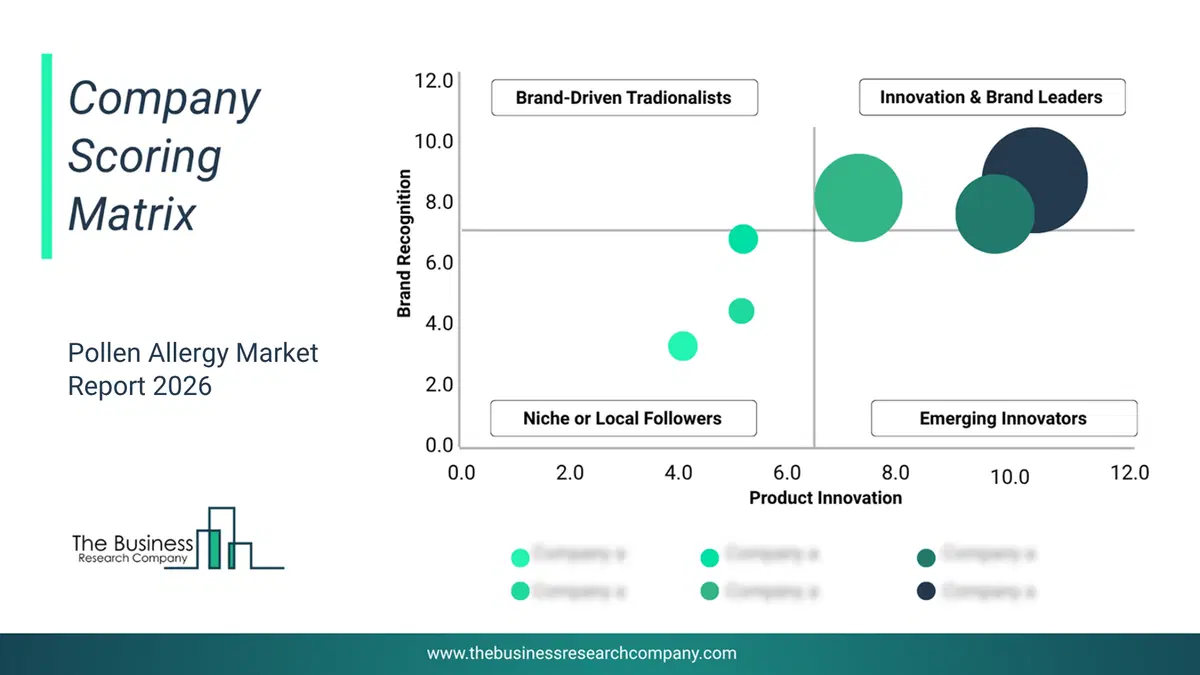
This chart maps companies by product innovation and brand strength, with bubble size indicating relative revenue, helping identify market leaders, challengers, and niche players. This is an illustrative chart; the full report provides a complete and accurate competitive analysis.
Global Pollen Allergy Market Trends and Insights
Major companies operating in the pollen allergy market are focusing on developing comprehensive allergy care platforms to provide integrated solutions for diagnosis, treatment, and management of allergies, ensuring improved patient outcomes and convenience. A comprehensive allergy care platform for pollen allergy refers to an integrated system or service that provides end-to-end support for individuals suffering from pollen allergies. For instance, in February 2023, Nectar Life Sciences, an India-based pharmaceutical company, launched Nectar, a comprehensive allergy care platform, introducing personalized sublingual immunotherapy drops as its first product. Nectar allergy drops, custom-formulated based on a CLIA-certified at-home allergy test, target the root cause of allergies, offering a convenient and effective alternative to traditional shots and antihistamines. The program simplifies allergy treatment with direct-to-home shipments and ongoing prescriptions every three months, enabling patients with moderate to severe allergies to build long-term tolerance and reduce symptoms over time. This innovative approach aims to revolutionize allergy care by combining personalization, convenience, and proven efficacy.What Are Latest Mergers And Acquisitions In The Pollen Allergy Market?
In September 2023, Stallergenes Greer International AG, a Switzerland-based pharmaceutical company, acquired peanut allergy oral immunotherapy treatment Palforzia from Nestlé S.A for an undisclosed amount. This acquisition strengthens the Stallergenes’s position as a leader in allergen immunotherapy by expanding its offerings to include both respiratory and food allergy treatments. Nestlé S.A is a Switzerland-based food and beverage services company actively addressing various allergies, including food and environmental allergies, such as those related to pollen.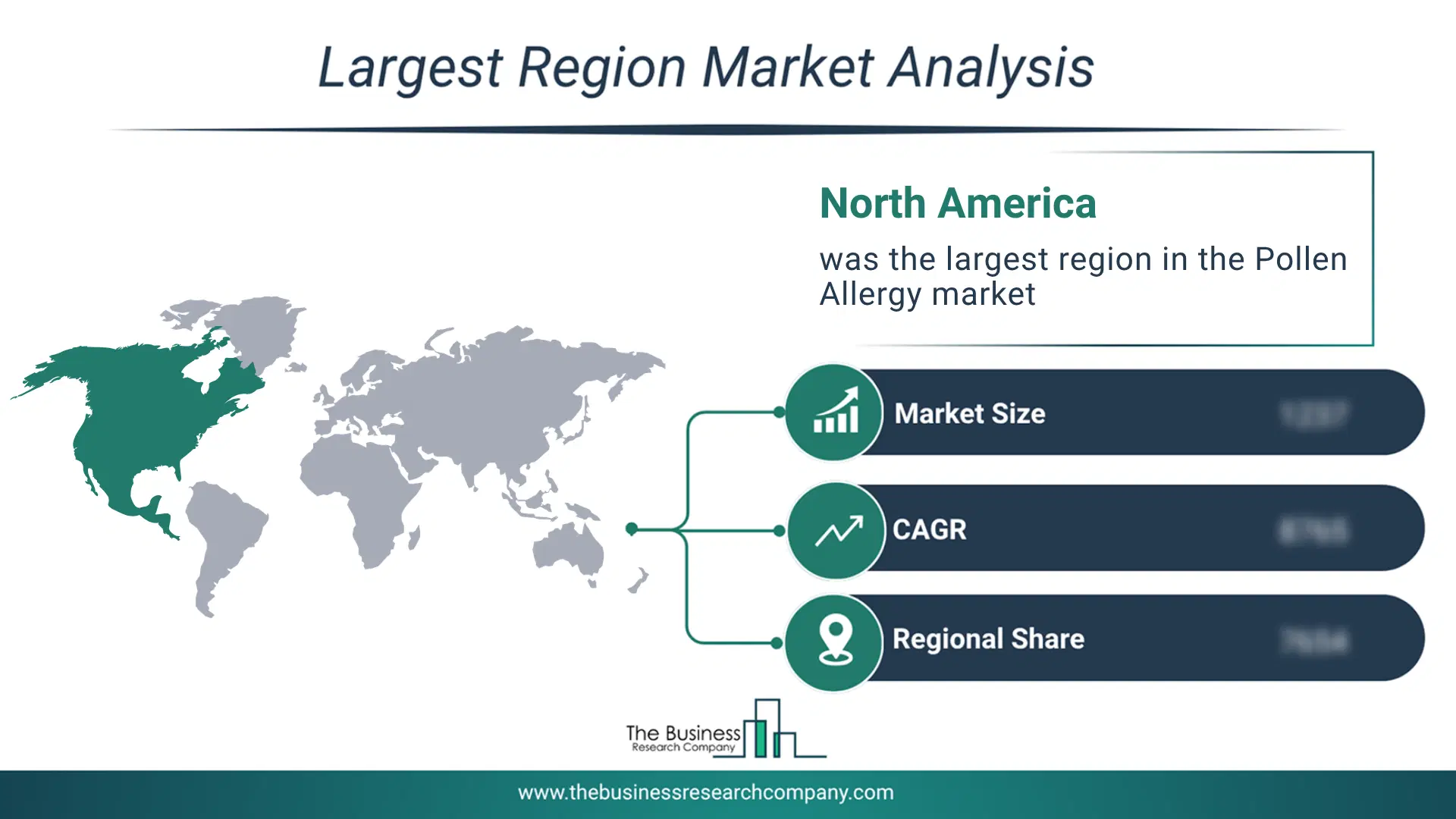
Regional Outlook
North America was the largest region in the pollen allergy market in 2025. Asia-Pacific is expected to be the fastest-growing region in the forecast period. The regions covered in this market report are Asia-Pacific, South East Asia, Western Europe, Eastern Europe, North America, South America, Middle East, Africa. The countries covered in this market report are Australia, Brazil, China, France, Germany, India, Indonesia, Japan, Taiwan, Russia, South Korea, UK, USA, Canada, Italy, Spain.What Defines the Pollen Allergy Market?
The pollen allergy market consists of sales of nasal sprays, eye drops, allergy masks, air purifiers, and pollen blockers. Values in this market are ‘factory gate’ values, that is, the value of goods sold by the manufacturers or creators of the goods, whether to other entities (including downstream manufacturers, wholesalers, distributors, and retailers) or directly to end customers. The value of goods in this market includes related services sold by the creators of the goods.How is Market Value Defined and Measured?
The market value is defined as the revenues that enterprises gain from the sale of goods and/or services within the specified market and geography through sales, grants, or donations in terms of the currency (in USD unless otherwise specified). The revenues for a specified geography are consumption values that are revenues generated by organizations in the specified geography within the market, irrespective of where they are produced. It does not include revenues from resales along the supply chain, either further along the supply chain or as part of other products.
This chart presents market attractiveness based on a quantitative evaluation of growth, competition, strategic alignment, and risk, offering a clear view of opportunity areas for decision-making. This chart is for illustrative purposes; the full report contains the complete analysis.

This chart highlights the Total Addressable Market (TAM) by estimating the maximum revenue opportunity using an assumption-driven approach, supporting strategic planning and opportunity sizing across markets. The chart is illustrative; the full report provides a more comprehensive analysis.
What Key Data and Analysis Are Included in the Pollen Allergy Market Report 2026?
The pollen allergy market research report is one of a series of new reports from The Business Research Company that provides market statistics, including industry global market size, regional shares, competitors with the market share, detailed market segments, market trends and opportunities, and any further data you may need to thrive in the pollen allergy industry. The market research report delivers a complete perspective of everything you need, with an in-depth analysis of the current and future state of the industry.Pollen Allergy Market Report Forecast Analysis
| Report Attribute | Details |
|---|---|
| Market Size Value In 2026 | $8.09 billion |
| Revenue Forecast In 2030 | $10.94 billion |
| Growth Rate | CAGR of 7.8% from 2026 to 2030 |
| Base Year For Estimation | 2025 |
| Actual Estimates/Historical Data | 2020-2025 |
| Forecast Period | 2026 - 2030 |
| Market Representation | Revenue in USD Billion and CAGR from 2026 to 2030 |
| Segments Covered | Product Type, Allergen Type, Therapeutics Drug class, End-User |
| Regional Scope | Asia-Pacific, Western Europe, Eastern Europe, North America, South America, Middle East, Africa |
| Country Scope | The countries covered in the report are Australia, Brazil, China, France, Germany, India, Indonesia, Japan, Taiwan, Russia, South Korea, UK, USA, Canada, Italy, Spain |
| Key Companies Profiled | Johnson & Johnson, F. Hoffmann-La Roche Ltd., Merck KGaA, AbbVie Inc., Bayer AG, Sanofi SA, AstraZeneca Plc, Novartis AG, GlaxoSmithKline PLC, Astellas Pharma Inc., Bausch Health Companies Inc., Sun Pharmaceutical Industries Ltd, Genentech Inc., Omega Pharma, ALK Abello, Stallergenes Greer, Aimmune Therapeutics, Allergy Therapeutics, McNeil Consumer Healthcare, Meda Pharmaceuticals Inc, HAL Allergy Group, Allergopharma, Biomay AG, Leti Pharma, Alerpharma S.A |
| Customization Scope | Request for Customization |
| Pricing And Purchase Options | Explore Purchase Options |