
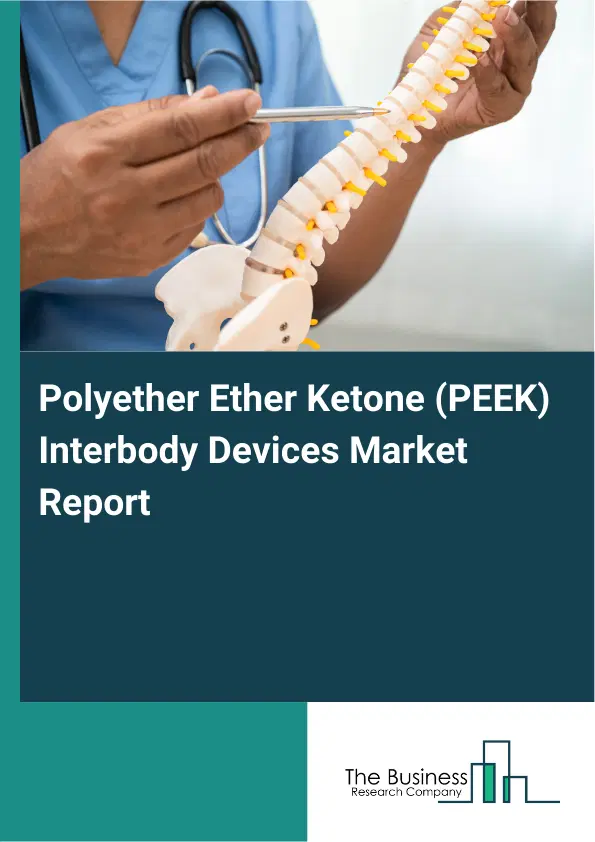
Polyether Ether Ketone (PEEK) Interbody Devices Market Report 2026
Global Outlook – By Product Type (Posterolateral Fusion Devices, Interbody Fusion Devices, Anterior Lumbar Interbody Fusion Devices (Alif), Extreme Lateral Interbody Fusion Devices (Xlif), Posterior Lumbar Interbody Fusion Devices (Plif), Transforaminal Lumbar Interbody Fusion Devices (Tlif)), By Application (Spinal Fusion Surgery, Degenerative Disc Disease, Spinal Trauma, Spinal Deformity), By Distribution Channel (Direct Sales, Third-Party Distributors), By End-User (Hospitals And Clinics, Ambulatory Surgery Clinics, Specialty Spine Centers) – Market Size, Trends, Strategies, and Forecast to 2030
Polyether Ether Ketone (PEEK) Interbody Devices Market Overview
• Polyether Ether Ketone (PEEK) Interbody Devices market size has reached to $1.92 billion in 2025 • Expected to grow to $2.74 billion in 2030 at a compound annual growth rate (CAGR) of 7.3% • Growth Driver: The Increasing Prevalence Of Spinal Disorders Is Fueling The Growth Of The Market Due To Rising Sedentary Lifestyles And Spinal Injuries • Market Trend: Innovative Porous PEEK Technologies Drive Next-Generation Spine Implants Growth • North America was the largest region in 2025 and Asia-Pacific is the fastest growing region.What Is Covered Under Polyether Ether Ketone (PEEK) Interbody Devices Market?
Polyether ether ketone (PEEK) interbody devices refer to medical implants made from polyether ether ketone (PEEK), a high-performance polymer widely used in spinal fusion surgeries. These devices are inserted between the vertebrae to provide support and stability following the removal of damaged or degenerated disc material. PEEK is favored for its biocompatibility, radiolucency, and mechanical properties, which closely mimic human bone. The main product types in PEEK interbody devices include posterolateral fusion devices, interbody fusion devices, anterior lumbar interbody fusion devices (ALIF), extreme lateral interbody fusion devices (XLIF), posterior lumbar interbody fusion devices (PLIF), transforaminal lumbar interbody fusion devices (TLIF), and others. Posterolateral fusion devices refer to spinal implants used in surgical procedures to fuse the vertebrae together from the posterior (back) and lateral (side) approach. The various applications include spinal fusion surgery, degenerative disc disease, spinal trauma, and spinal deformity, and distribution channels include direct sales, online sales, and third-party distributors. It is used by different end-users including hospitals and clinics, ambulatory surgery clinics, and others.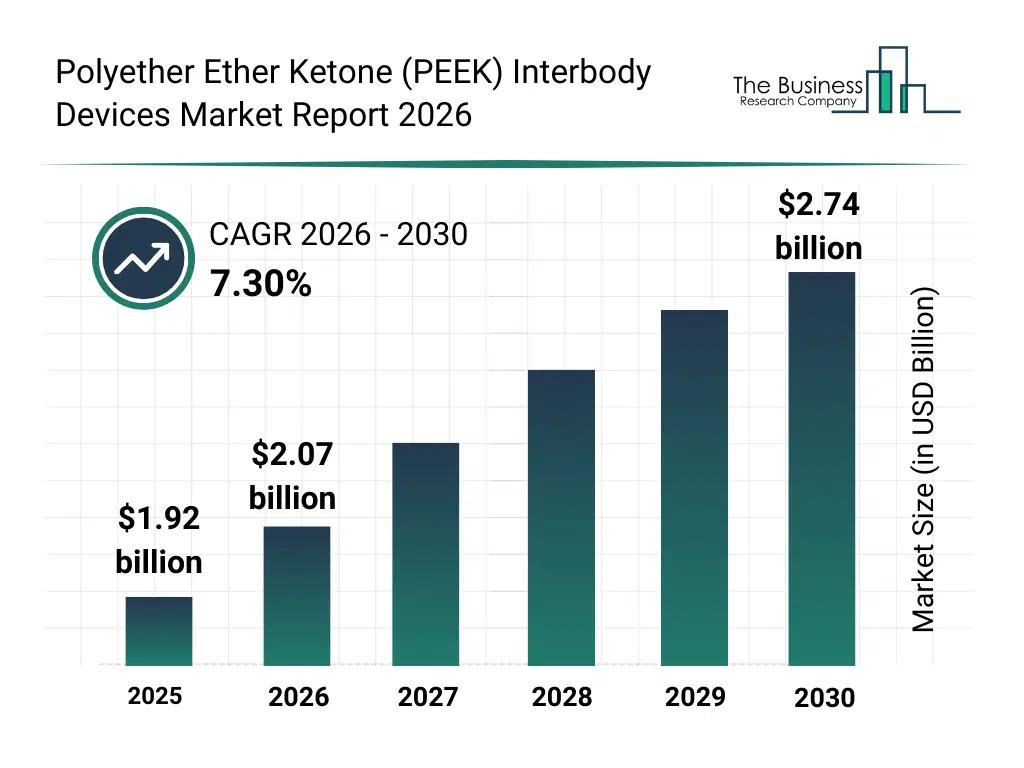
What Is The Polyether Ether Ketone (PEEK) Interbody Devices Market Size and Share 2026?
The polyether ether ketone (peek) interbody devices market size has grown strongly in recent years. It will grow from $1.92 billion in 2025 to $2.07 billion in 2026 at a compound annual growth rate (CAGR) of 7.8%. The growth in the historic period can be attributed to rising prevalence of degenerative disc disease, increasing spinal trauma cases, adoption of conventional spinal implants, growing geriatric population, limited awareness about advanced interbody devices.What Is The Polyether Ether Ketone (PEEK) Interbody Devices Market Growth Forecast?
The polyether ether ketone (peek) interbody devices market size is expected to see strong growth in the next few years. It will grow to $2.74 billion in 2030 at a compound annual growth rate (CAGR) of 7.3%. The growth in the forecast period can be attributed to advancements in peek material and design, growth in minimally invasive surgeries, increasing hospital infrastructure, rising demand for personalized implants, expansion of spinal fusion procedures globally. Major trends in the forecast period include minimally invasive surgical techniques, enhanced biocompatibility and material innovation, radiolucent implant development, personalized spinal implants, growth in spinal fusion surgeries.
Global Polyether Ether Ketone (PEEK) Interbody Devices Market Segmentation
1) By Product Type: Posterolateral Fusion Devices, Interbody Fusion Devices, Anterior Lumbar Interbody Fusion Devices (Alif), Extreme Lateral Interbody Fusion Devices (Xlif), Posterior Lumbar Interbody Fusion Devices (Plif), Transforaminal Lumbar Interbody Fusion Devices (Tlif) 2) By Application: Spinal Fusion Surgery, Degenerative Disc Disease, Spinal Trauma, Spinal Deformity 3) By Distribution Channel: Direct Sales, Third-Party Distributors 4) By End-User: Hospitals And Clinics, Ambulatory Surgery Clinics, Specialty Spine Centers Subsegments: 1) By Posterolateral Fusion Devices: Single-Level Devices, Multi-Level Devices, Expandable Devices 2) By Interbody Fusion Devices: Cervical Fusion Devices, Lumbar Fusion Devices, Hybrid Devices 3) By Anterior Lumbar Interbody Fusion Devices (ALIF): Flat-Profile Devices, Curved-Profile Devices, Cage-Style Devices 4) By Extreme Lateral Interbody Fusion Devices (XLIF): Plated Devices, Cage-Style Devices, Oblique Devices 5) By Posterior Lumbar Interbody Fusion Devices (PLIF): Lordotic Devices, Flat-Cage Devices, Mesh Or Porous Devices 6) By Transforaminal Lumbar Interbody Fusion Devices (TLIF): Hollow Devices, Expandable Cages, Radiolucent DevicesWhat Is The Driver Of The Polyether Ether Ketone (PEEK) Interbody Devices Market?
The increasing prevalence of spinal disorders is expected to propel the growth of the PEEK interbody devices market going forward. Spinal disorders refer to medical conditions that affect the spine, including the bones, discs, nerves, and muscles. Spinal disorders are rising due to sedentary lifestyles, as prolonged sitting and reduced physical activity weaken spinal support muscles and increase strain on the spine. PEEK interbody devices help treat spinal disorders by providing strong yet flexible support between vertebrae, promoting spinal stability, and encouraging natural bone growth while maintaining imaging clarity during follow-up scans. For instance, in May 2023, according to Spinal Cord Inc., a US-based resource for individuals affected by spinal cord injuries and their families, the United States recorded approximately 18,000 new cases of spinal cord injuries (SCI) in 2023, with around 302,000 people estimated to be living with SCI across the country. Therefore, the increasing prevalence of spinal disorders is driving the growth of the PEEK interbody devices market.Key Players In The Global Polyether Ether Ketone (PEEK) Interbody Devices Market
Major companies operating in the polyether ether ketone (peek) interbody devices market are Medtronic Inc., Stryker Corporation, Zimmer Biomet Holdings Inc., Globus Medical Inc., NuVasive Inc., Orthofix Medical Inc., Xtant Medical Holdings Inc., Alphatec Spine Inc., Spinal Elements Inc., Providence Medical Technology Inc., FossiLabs LLC, Life Spine Inc., Curiteva Inc., Medacta International S.A., LDR Holding Corporation, Cavendish Implants Limited, DePuy Synthes Spine, SeaSpine Holdings Corporation, Aesculap Spine, CoreLink LLC, Aurora Spine Corporation, ChoiceSpine LLC, K2M Group Holdings Inc.
This chart is for illustrative purposes; the full report includes a detailed competitor analysis and comprehensive overview of the top 10 companies in the market.
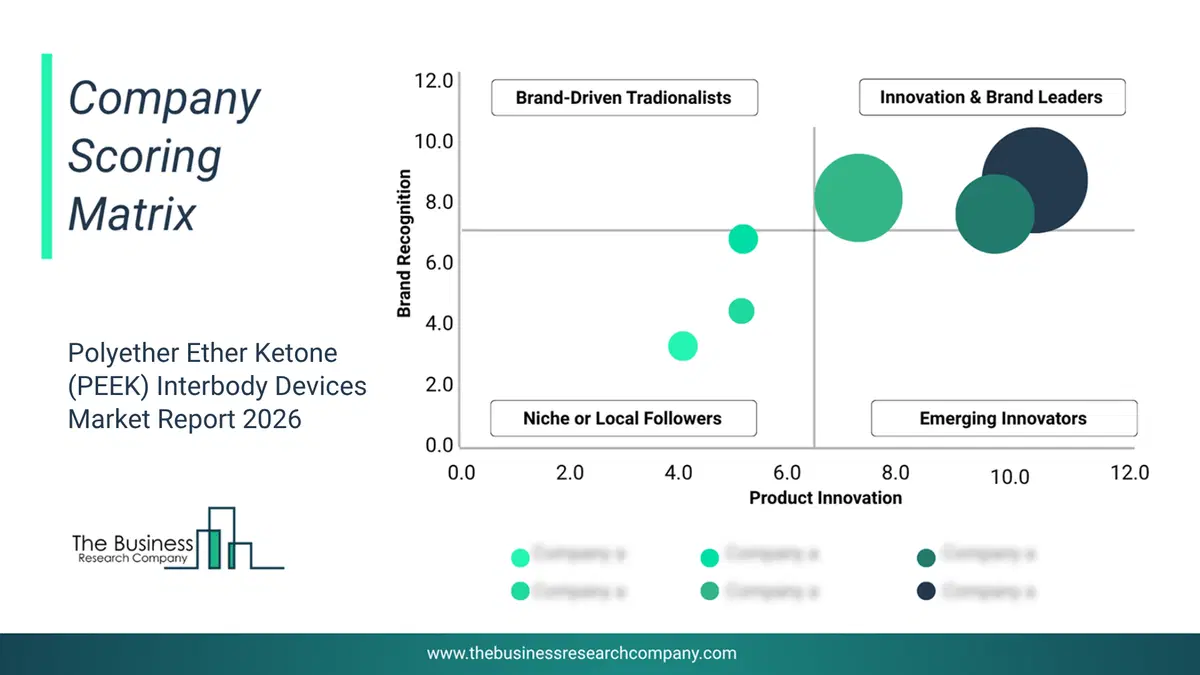
This chart maps companies by product innovation and brand strength, with bubble size indicating relative revenue, helping identify market leaders, challengers, and niche players. This is an illustrative chart; the full report provides a complete and accurate competitive analysis.
Global Polyether Ether Ketone (PEEK) Interbody Devices Market Trends and Insights
Major companies operating in the polyether ether ketone (PEEK) interbody devices market are focusing on developing innovative solutions, such as porous PEEK interbody spacers to improve osseointegration and promote better spinal fusion outcomes. Porous PEEK interbody spacers are spinal implants made from polyether ether ketone with a bone-like porous structure that allows bone ingrowth, helping enhance osseointegration and improve spinal fusion stability. For instance, in March 2025, Globus Medical Inc., a US-based musculoskeletal technology company, launched the COHERE ALIF Spacer, described by the company as the first Porous PEEK interbody spacer designed specifically for anterior lumbar interbody fusion (ALIF) surgery. The COHERE ALIF Spacer is composed of Globus Medical’s Porous PEEK advanced materials architecture engineered to encourage bone in-growth while maintaining PEEK’s imaging and mechanical advantages, is indicated for ALIF procedures and developed as part of an anterior spine portfolio expansion, features a porous surface/structure intended to increase biological fixation compared with smooth PEEK implants.What Are Latest Mergers And Acquisitions In The Polyether Ether Ketone (PEEK) Interbody Devices Market?
In February 2025, Medtronic, an Ireland-based medical technology company, acquired nano surface technology assets from Nanovis for an undisclosed amount. With this acquisition, Medtronic aims to enhance its interbody fusion systems by integrating Nanovis' innovative surface treatment technologies. Nanovis is a US-based company that manufactures PEEK interbody fusion devices.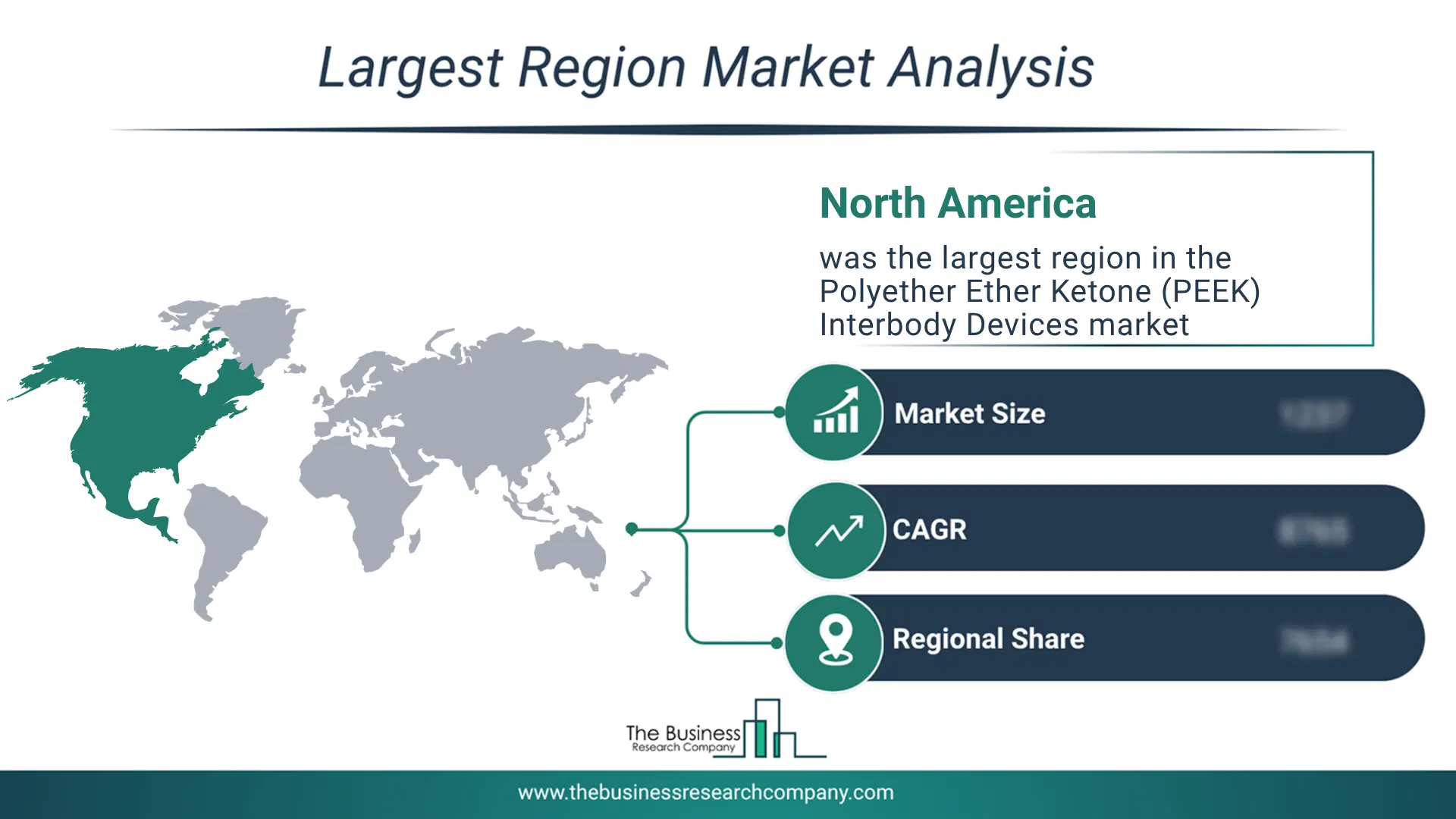
Regional Outlook
North America was the largest region in the polyether ether ketone (PEEK) interbody devices market in 2025. Asia-Pacific is expected to be the fastest-growing region in the forecast period. The regions covered in this market report are Asia-Pacific, South East Asia, Western Europe, Eastern Europe, North America, South America, Middle East, Africa. The countries covered in this market report are Australia, Brazil, China, France, Germany, India, Indonesia, Japan, Taiwan, Russia, South Korea, UK, USA, Canada, Italy, SpainWhat Defines the Polyether Ether Ketone (PEEK) Interbody Devices Market?
The polyether ether ketone (PEEK) interbody devices market consists of sales of cervical anterior interbody fusion (CAIF) devices, transpedicular lumbar fusion devices and lateral lumbar interbody fusion (LLIF) devices. Values in this market are ‘factory gate’ values, that is, the value of goods sold by the manufacturers or creators of the goods, whether to other entities (including downstream manufacturers, wholesalers, distributors, and retailers) or directly to end customers. The value of goods in this market includes related services sold by the creators of the goods.How is Market Value Defined and Measured?
The market value is defined as the revenues that enterprises gain from the sale of goods and/or services within the specified market and geography through sales, grants, or donations in terms of the currency (in USD unless otherwise specified). The revenues for a specified geography are consumption values that are revenues generated by organizations in the specified geography within the market, irrespective of where they are produced. It does not include revenues from resales along the supply chain, either further along the supply chain or as part of other products.
This chart presents market attractiveness based on a quantitative evaluation of growth, competition, strategic alignment, and risk, offering a clear view of opportunity areas for decision-making. This chart is for illustrative purposes; the full report contains the complete analysis.

This chart highlights the Total Addressable Market (TAM) by estimating the maximum revenue opportunity using an assumption-driven approach, supporting strategic planning and opportunity sizing across markets. The chart is illustrative; the full report provides a more comprehensive analysis.
What Key Data and Analysis Are Included in the Polyether Ether Ketone (PEEK) Interbody Devices Market Report 2026?
The polyether ether ketone (peek) interbody devices market research report is one of a series of new reports from The Business Research Company that provides market statistics, including industry global market size, regional shares, competitors with the market share, detailed market segments, market trends and opportunities, and any further data you may need to thrive in the polyether ether ketone (peek) interbody devices industry. The market research report delivers a complete perspective of everything you need, with an in-depth analysis of the current and future state of the industry.Polyether Ether Ketone (PEEK) Interbody Devices Market Report Forecast Analysis
| Report Attribute | Details |
|---|---|
| Market Size Value In 2026 | $2.07 billion |
| Revenue Forecast In 2030 | $2.74 billion |
| Growth Rate | CAGR of 7.3% from 2026 to 2030 |
| Base Year For Estimation | 2025 |
| Actual Estimates/Historical Data | 2020-2025 |
| Forecast Period | 2026 - 2030 |
| Market Representation | Revenue in USD Billion and CAGR from 2026 to 2030 |
| Segments Covered | Product Type, Application, Distribution Channel, End-User |
| Regional Scope | Asia-Pacific, Western Europe, Eastern Europe, North America, South America, Middle East, Africa |
| Country Scope | The countries covered in the report are Australia, Brazil, China, France, Germany, India, Indonesia, Japan, Taiwan, Russia, South Korea, UK, USA, Canada, Italy, Spain. |
| Key Companies Profiled | Medtronic Inc., Stryker Corporation, Zimmer Biomet Holdings Inc., Globus Medical Inc., NuVasive Inc., Orthofix Medical Inc., Xtant Medical Holdings Inc., Alphatec Spine Inc., Spinal Elements Inc., Providence Medical Technology Inc., FossiLabs LLC, Life Spine Inc., Curiteva Inc., Medacta International S.A., LDR Holding Corporation, Cavendish Implants Limited, DePuy Synthes Spine, SeaSpine Holdings Corporation, Aesculap Spine, CoreLink LLC, Aurora Spine Corporation, ChoiceSpine LLC, K2M Group Holdings Inc. |
| Customization Scope | Request for Customization |
| Pricing And Purchase Options | Explore Purchase Options |