
Polyglycerol Market Report 2026
Global Outlook – By Type (Polyglycerol Polyricinoleate, Polyglycerol Esters, Polyglycerol Sebacate), By Application (Food Additives, Emulsifiers, Stabilizers, Other Applications ), By End-Use (Food And Beverage, Personal Care And Cosmetics, Pharmaceuticals, Other End Users) – Market Size, Trends, Strategies, and Forecast to 2030
Polyglycerol Market Overview
• Polyglycerol market size has reached to $2.66 billion in 2025 • Expected to grow to $4.09 billion in 2030 at a compound annual growth rate (CAGR) of 8.8% • Growth Driver: Polyglycerol Market Driven By Increasing Health And Wellness Awareness • Market Trend: Facility Expansion To Meet The Growing Demand • Asia-Pacific was the largest region in 2025.What Is Covered Under Polyglycerol Market?
Polyglycerol is a homopolymer macromolecule that consists of a series of glycerol-1-phosphate units. It is a carbohydrate that is an acyclic polyol. It is used as emulsifiers in food, pharmaceutical, and personal care products. The main polyglycerol types are polyglycerol polyricinoleate, polyglycerol esters, and polyglycerol sebacate. Polyglycerol Polyricinoleate (PGPR) is produced by partial esterification of condensed castor oil fatty acids with polyglycerol. They are applied in food additives, emulsifiers, stabilizers, and others, and are used in food and beverage, personal care and cosmetics, pharmaceuticals, and others.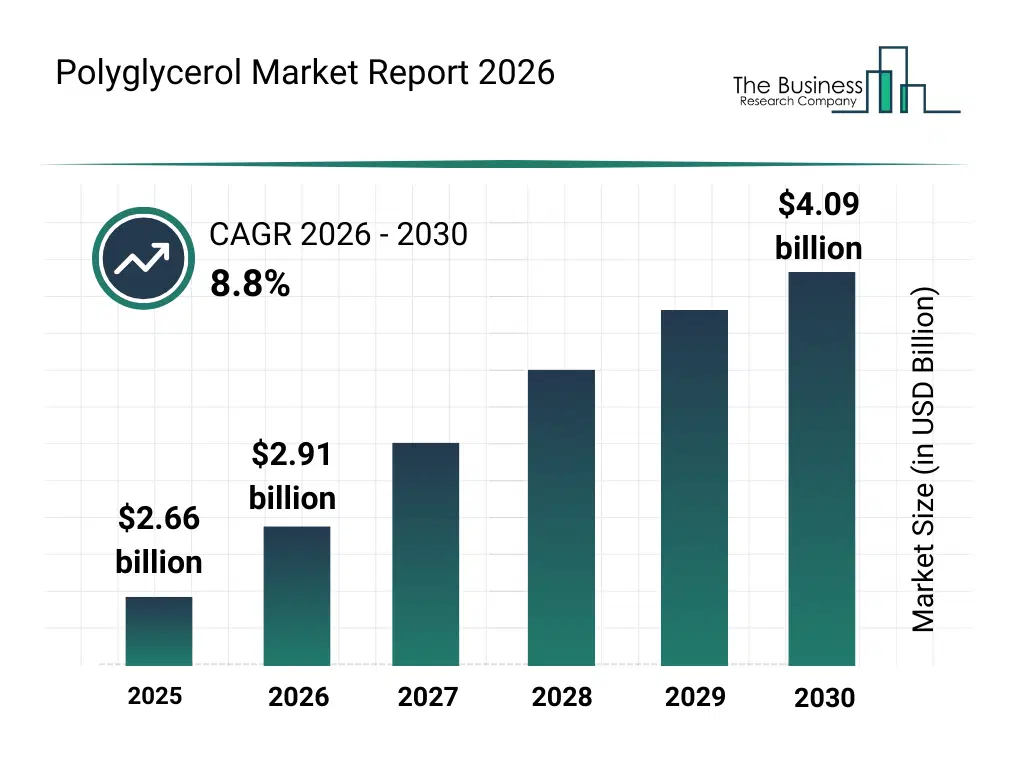
What Is The Polyglycerol Market Size and Share 2026?
The polyglycerol market size has grown strongly in recent years. It will grow from $2.66 billion in 2025 to $2.91 billion in 2026 at a compound annual growth rate (CAGR) of 9.4%. The growth in the historic period can be attributed to growth in processed food consumption, rising use of emulsifiers in confectionery, expansion of personal care manufacturing, increasing pharmaceutical formulation needs, availability of glycerol-based raw materials.What Is The Polyglycerol Market Growth Forecast?
The polyglycerol market size is expected to see strong growth in the next few years. It will grow to $4.09 billion in 2030 at a compound annual growth rate (CAGR) of 8.8%. The growth in the forecast period can be attributed to rising demand for sustainable food additives, increasing adoption in pharmaceutical excipients, expansion of natural cosmetic formulations, growing regulatory acceptance of bio-based ingredients, increasing focus on specialty emulsifiers. Major trends in the forecast period include rising adoption of bio-based emulsifiers, increasing use in clean-label food formulations, growing demand for multifunctional cosmetic ingredients, expansion of pharmaceutical excipient applications, enhanced focus on high-purity grades.
Global Polyglycerol Market Segmentation
1) By Type: Polyglycerol Polyricinoleate, Polyglycerol Esters, Polyglycerol Sebacate 2) By Application: Food Additives, Emulsifiers, Stabilizers, Other Applications 3) By End-Use: Food And Beverage, Personal Care And Cosmetics, Pharmaceuticals, Other End Users Subsegments: 1) By Polyglycerol Polyricinoleate: Food Grade, Industrial Grade 2) By Polyglycerol Esters: Polyglycerol Monostearate, Polyglycerol Distearate, Polyglycerol Tristearate 3) By Polyglycerol Sebacate: Cosmetic Grade: Pharmaceutical GradeWhat Are The Drivers Of The Polyglycerol Market?
The increasing health and wellness awareness is expected to propel the growth of the polyglycerol market in the coming years. Health is defined as a condition of complete psychological, interpersonal, and physical well-being rather than the absence of sickness or incapacity. Wellness is a proactive method by which individuals become aware of and choose a healthier way of life. Polyglycerols are used in different health and wellness applications like wound care, nutraceuticals, cosmetics, and personal care, and regulatory considerations and safety assessments play a crucial role in their application across various industries. For instance, in November 2025, according to Global Wellness Institute (GWI), a US-based nonprofit organization, reported that the global wellness economy grew by 7.9% from 2023 to 2024 and reached a new peak of $6.8 trillion in 2024. Therefore, increasing health and wellness awareness is driving the polyglycerol industry. The increasing demand from the food and beverage industry is expected to propel the growth of the polyglycerols market going forward. The food and beverage industry is a group of companies that are involved in transforming raw agricultural goods into consumer food products, ranging from packaging to preparing, transporting, and serving food or beverages. Polyglycerols are used in the food and beverage industry as emulsifiers, dispersants, stabilizers, emollients, surfactants, and others. Therefore, increasing demand for the food and beverage industry is driving the growth of the polyglycerols market. For instance, in December 2024, according to Food and Agriculture Organization (FAO), an Italy-based specialized agency of the United Nations, reported that world production of sugar crops increased by 122 million tonnes between 2022 and 2023. Sugarcane was by far the main sugar crop, with more than 2 billion tonnes in 2023 compared to 281 million tonnes for sugar beet. Therefore, increasing demand for the food and beverage industry is driving the growth of the polyglycerol industry.Key Players In The Global Polyglycerol Market
Major companies operating in the polyglycerol market are Sakamoto Yakuhin Kogyo Co. Ltd., Spiga Nord S.p.A., Lonza Group, Taiyo Kagaku Co. Ltd., Estelle Chemicals Pvt Ltd., Spell Organics Ltd., Oleon NV, Croda International Plc, Binzhou GIN&ING New Material Technology, Abitec Corporation, Daicel Corporation, Riken Vitamin Co. Ltd., Cargill Incorporated, Savannah Surfactants, BASF SE, NOVEL CHEM, Jinan Dowin Chemical Technology Co. Ltd., Mitsubishi Chemical Holdings Corporation, Mohini Organics Pvt Ltd., Palsgaard, DuPont, Foodchem International Corporation, Stepan Company, Merck KGaA, Solvay S.A.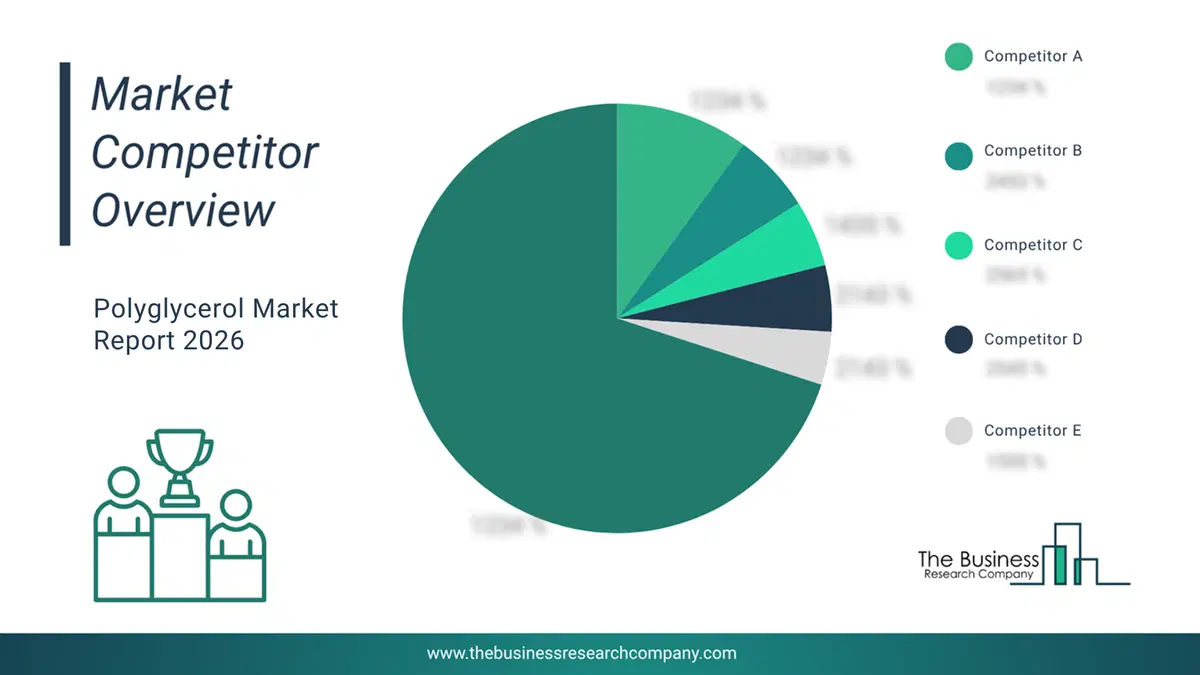
This chart is for illustrative purposes; the full report includes a detailed competitor analysis and comprehensive overview of the top 10 companies in the market.
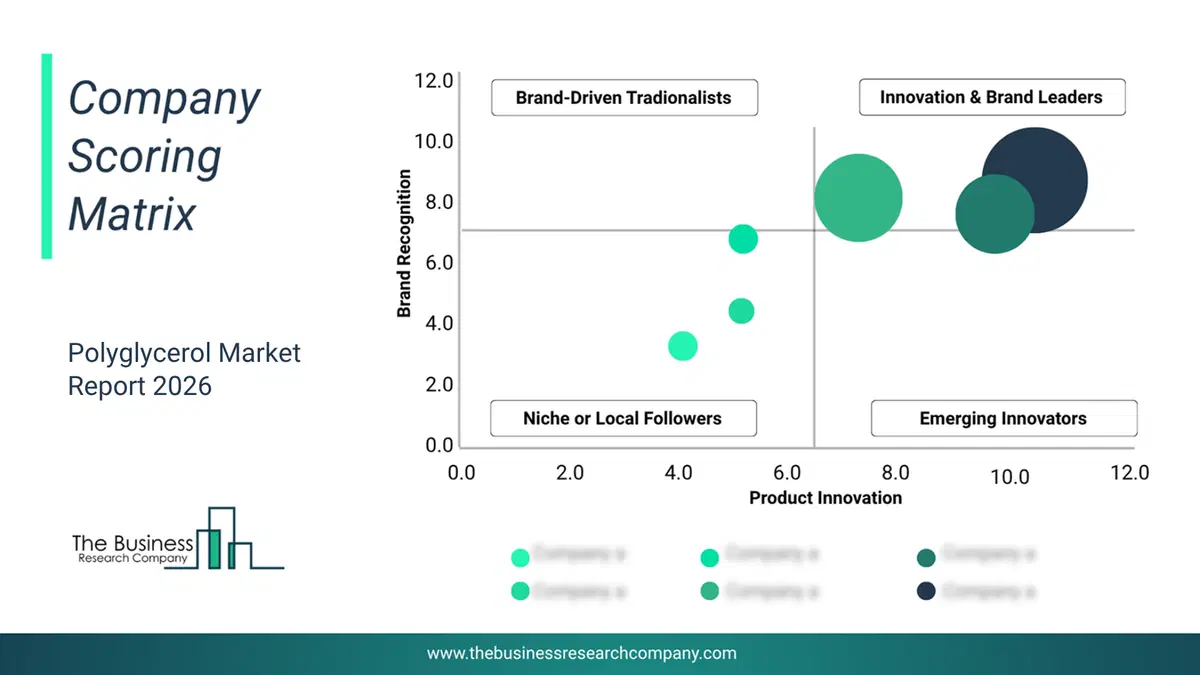
This chart maps companies by product innovation and brand strength, with bubble size indicating relative revenue, helping identify market leaders, challengers, and niche players. This is an illustrative chart; the full report provides a complete and accurate competitive analysis.
Global Polyglycerol Market Trends and Insights
Major companies operating in the polyglycerol market are focusing on facility expansions to better meet the needs of their existing consumers. Facility expansions involve the physical enlargement or enhancement of existing structures and resources to accommodate increased capacity, improve efficiency, or meet growing demands. For instance, in February 2023, Palsgaard A/S, a Denmark-based full-service emulsifier and stabilizer company, announced a huge expansion in its specialized Dutch manufacturing for high-grade polyglycerol polyricinoleate (PGPR) emulsifiers. The co-emulsifier PGPR is largely used in chocolate manufacture to regulate flow, reduce viscosity, and optimize molding and enrobing. It also decreases the fat content of margarine spreads and is a very effective plant-based color-dispersing aid that substitutes petrol-based waxes in plastics. Palsgaard's Netherlands factory, which already produces specialty ingredients for margarine and baking, will be expanded to increase the company's worldwide capacity to create PGPR, a product with a 10% annual growth rate.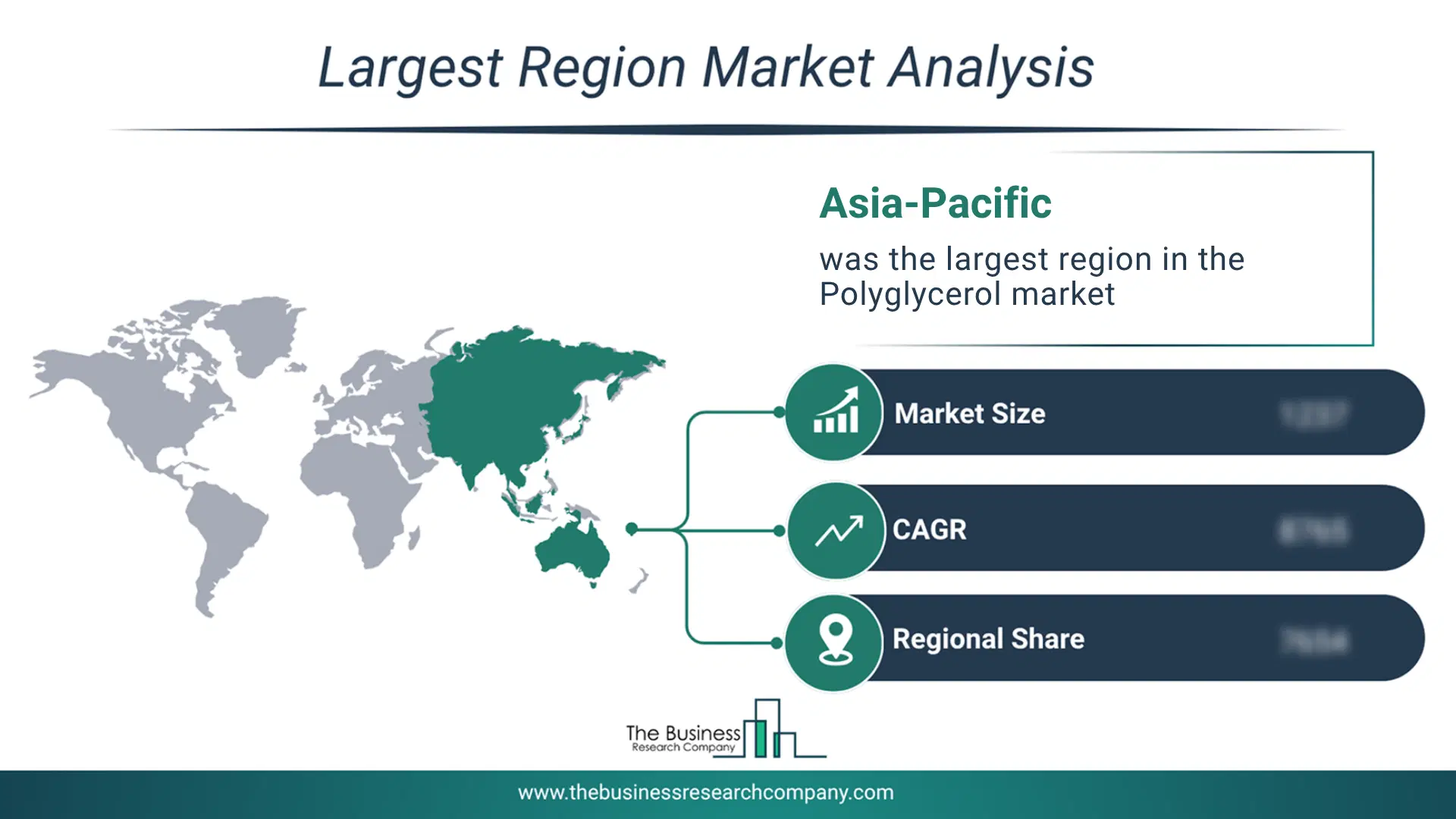
Regional Insights
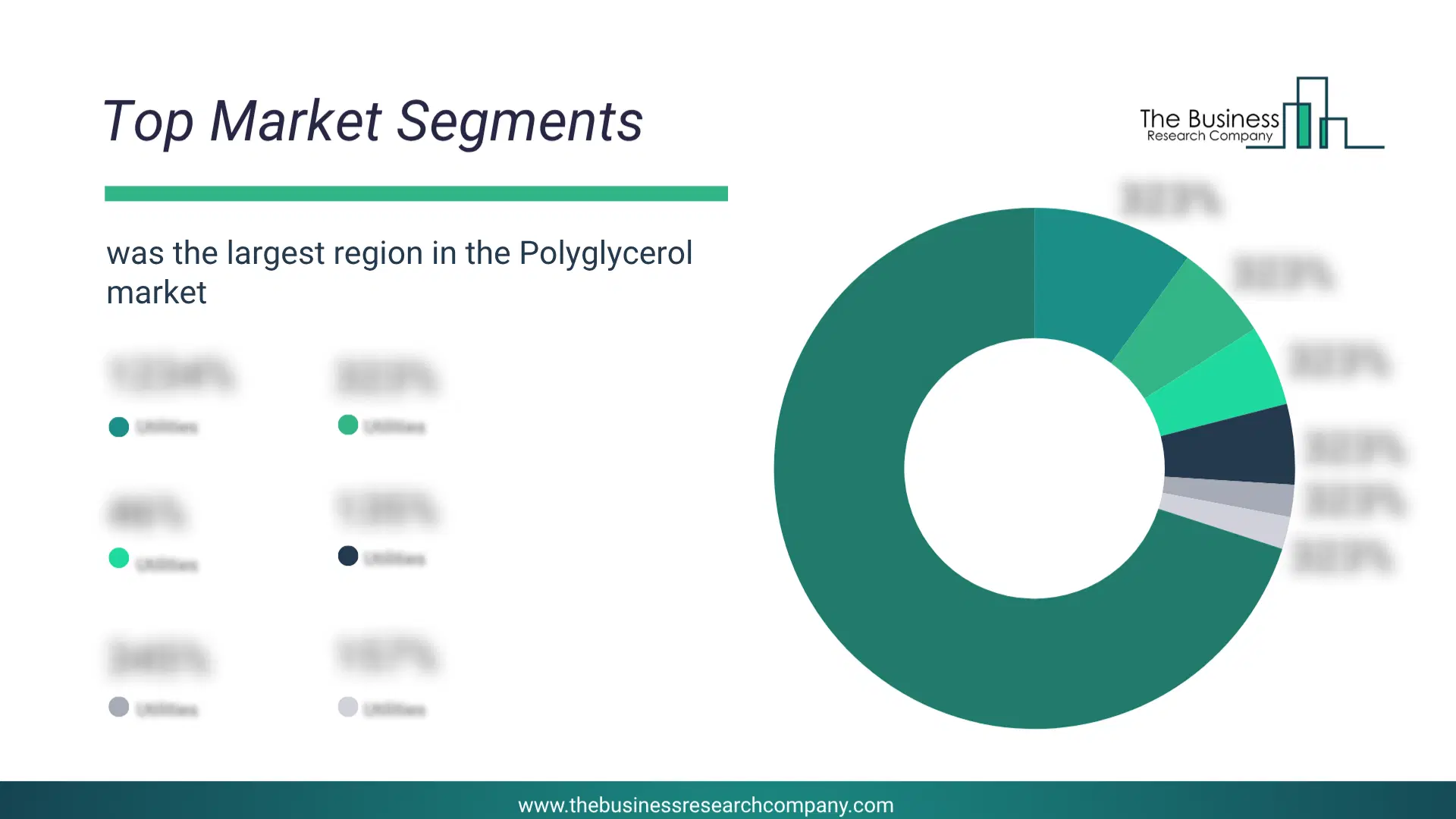
Asia-Pacific was the largest region in the polyglycerol market in 2025. The regions covered in this market report are Asia-Pacific, South East Asia, Western Europe, Eastern Europe, North America, South America, Middle East, Africa The countries covered in this market report are Australia, Brazil, China, France, Germany, India, Indonesia, Japan, Taiwan, Russia, South Korea, UK, USA, Canada, Italy, SpainWhat Defines the Polyglycerol Market?
The polyglycerol market consists of sales of polyglycerol-based emollients, thickeners, dispersants, surfactants and others. Values in this market are ‘factory gate’ values, that is the value of goods sold by the manufacturers or creators of the goods, whether to other entities (including downstream manufacturers, wholesalers, distributors and retailers) or directly to end customers. The value of goods in this market includes related services sold by the creators of the goods.How is Market Value Defined and Measured?
The market value is defined as the revenues that enterprises gain from the sale of goods and/or services within the specified market and geography through sales, grants, or donations in terms of the currency (in USD unless otherwise specified). The revenues for a specified geography are consumption values that are revenues generated by organizations in the specified geography within the market, irrespective of where they are produced. It does not include revenues from resales along the supply chain, either further along the supply chain or as part of other products.
This chart presents market attractiveness based on a quantitative evaluation of growth, competition, strategic alignment, and risk, offering a clear view of opportunity areas for decision-making. This chart is for illustrative purposes; the full report contains the complete analysis.

This chart highlights the Total Addressable Market (TAM) by estimating the maximum revenue opportunity using an assumption-driven approach, supporting strategic planning and opportunity sizing across markets. The chart is illustrative; the full report provides a more comprehensive analysis.
What Key Data and Analysis Are Included in the Polyglycerol Market Report 2026?
The polyglycerol market research report is one of a series of new reports from The Business Research Company that provides market statistics, including industry global market size, regional shares, competitors with the market share, detailed market segments, market trends and opportunities, and any further data you may need to thrive in the polyglycerol industry. The market research report delivers a complete perspective of everything you need, with an in-depth analysis of the current and future state of the industry.Polyglycerol Market Report Forecast Analysis
| Report Attribute | Details |
|---|---|
| Market Size Value In 2026 | $2.91 billion |
| Revenue Forecast In 2030 | $4.09 billion |
| Growth Rate | CAGR of 9.4% from 2026 to 2030 |
| Base Year For Estimation | 2025 |
| Actual Estimates/Historical Data | 2020-2025 |
| Forecast Period | 2026 - 2030 |
| Market Representation | Revenue in USD Billion and CAGR from 2026 to 2030 |
| Segments Covered | Type, Application, End-Use |
| Regional Scope | Asia-Pacific, Western Europe, Eastern Europe, North America, South America, Middle East, Africa |
| Country Scope | The countries covered in this market report are Australia, Brazil, China, France, Germany, India, Indonesia, Japan, Taiwan, Russia, South Korea, UK, USA, Canada, Italy, Spain |
| Key Companies Profiled | Sakamoto Yakuhin Kogyo Co. Ltd., Spiga Nord S.p.A., Lonza Group, Taiyo Kagaku Co. Ltd., Estelle Chemicals Pvt Ltd., Spell Organics Ltd., Oleon NV, Croda International Plc, Binzhou GIN&ING New Material Technology, Abitec Corporation, Daicel Corporation, Riken Vitamin Co. Ltd., Cargill Incorporated, Savannah Surfactants, BASF SE, NOVEL CHEM, Jinan Dowin Chemical Technology Co. Ltd., Mitsubishi Chemical Holdings Corporation, Mohini Organics Pvt Ltd., Palsgaard, DuPont, Foodchem International Corporation, Stepan Company, Merck KGaA, Solvay S.A. |
| Customization Scope | Request for Customization |
| Pricing And Purchase Options | Explore Purchase Options |