
Polymer Electrolyte Membrane Fuel Cells Market Report 2026
Global Outlook – By Type (Low-Temperature Polymer Electrolyte Membrane Fuel Cells, High-Temperature Polymer Electrolyte Membrane Fuel Cells), By Cooling Method (Air-Cooled, Liquid-Cooled), By Component (Balance-Of-Plant Components, Fuel Cell Stack, Membrane Electrode Assembly, Bipolar Plates, Gas Diffusion Layers, Catalysts), By Application (Portable Power, Transportation, Stationary Power), By End-User Industry (Automotive And Mobility, Utilities And Energy, Material Handling And Logistics, Residential And Commercial, Defense And Aerospace, Industrial) – Market Size, Trends, Strategies, and Forecast to 2030
Polymer Electrolyte Membrane Fuel Cells Market Overview
• Polymer Electrolyte Membrane Fuel Cells market size has reached to $5.57 billion in 2025 • Expected to grow to $15.05 billion in 2030 at a compound annual growth rate (CAGR) of 21.9% • Growth Driver: Surge In Adoption Of Hydrogen Fuel Cell Vehicles Fueling The Growth Of The Market Due To Rising Demand For Clean Mobility Solutions • Market Trend: Innovations In Polymer Electrolyte Membrane Fuel Cell Stack Technology Enhance Automotive Performance And Hydrogen Mobility • Asia-Pacific was the largest region and fastest growing region.What Is Covered Under Polymer Electrolyte Membrane Fuel Cells Market?
Polymer electrolyte membrane fuel cells are electrochemical devices that produce electricity by combining hydrogen and oxygen through a solid polymer electrolyte membrane. They operate at low temperatures, providing high power density, fast startup, and efficient energy conversion. Their compact design, low emissions, and reliable performance make them well-suited for applications requiring responsive and efficient power generation. The main types in the polymer electrolyte membrane fuel cells market include low-temperature polymer electrolyte membrane fuel cells and high-temperature polymer electrolyte membrane fuel cells. Low-temperature polymer electrolyte membrane fuel cells refer to fuel cells that operate at relatively low temperatures and use a proton-conducting polymer membrane to convert hydrogen and oxygen into electricity with high power density and rapid start-up. These fuel cells use air-cooled and liquid-cooled methods and incorporate balance-of-plant components, fuel cell stacks, membrane electrode assemblies, bipolar plates, gas diffusion layers, and catalysts. The key applications include portable power, transportation, and stationary power and end users include automotive and mobility, utilities and energy, material handling and logistics, residential and commercial, defense and aerospace, and industrial.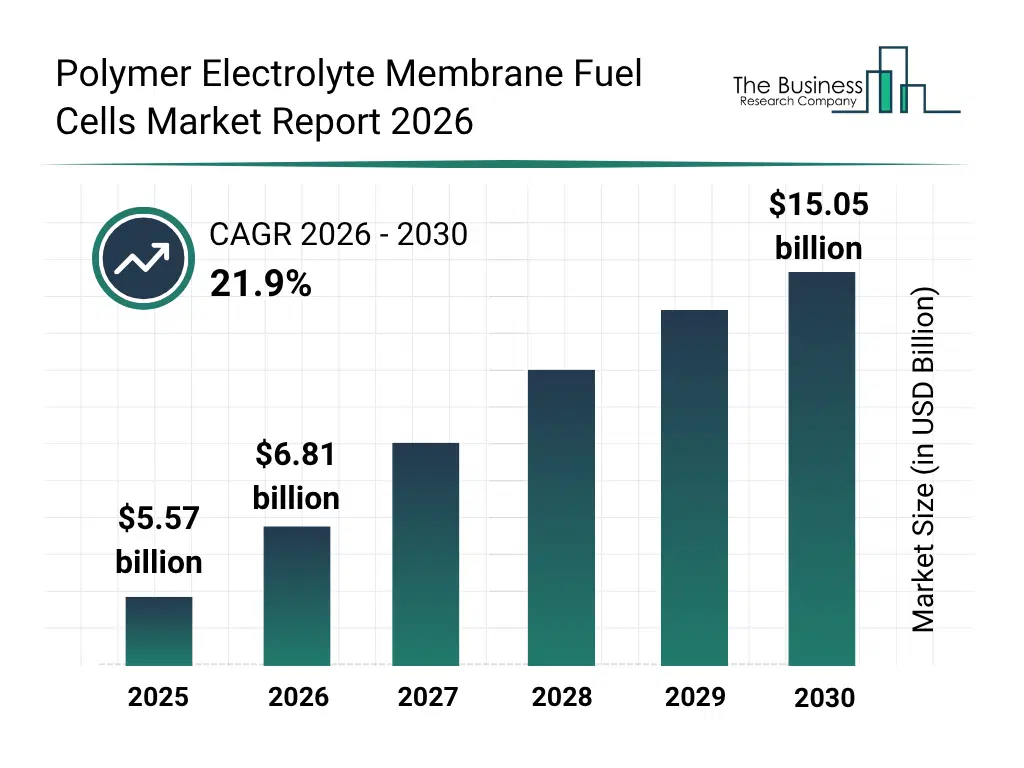
What Is The Polymer Electrolyte Membrane Fuel Cells Market Size and Share 2026?
The polymer electrolyte membrane fuel cells market size has grown exponentially in recent years. It will grow from $5.57 billion in 2025 to $6.81 billion in 2026 at a compound annual growth rate (CAGR) of 22.3%. The growth in the historic period can be attributed to increasing demand for clean power generation, rising adoption of hydrogen-powered vehicles, growing need for low-emission energy systems, increasing deployment of backup and stationary power systems, rising demand for high-efficiency power generation.What Is The Polymer Electrolyte Membrane Fuel Cells Market Growth Forecast?
The polymer electrolyte membrane fuel cells market size is expected to see exponential growth in the next few years. It will grow to $15.05 billion in 2030 at a compound annual growth rate (CAGR) of 21.9%. The growth in the forecast period can be attributed to expanding hydrogen refueling infrastructure, increasing demand for zero-emission commercial transportation, growing adoption of fuel cell systems for material handling, rising deployment of hydrogen-based distributed power systems, increasing government support for hydrogen energy adoption. Major trends in the forecast period include rising demand for high-power-density polymer electrolyte membrane fuel cells, increasing adoption of fast-startup fuel cell systems, growing deployment of compact fuel cell power solutions, rising use of low-emission hydrogen power generation, increasing demand for reliable fuel cell-based power systems.Tariff Impact On Polymer Electrolyte Membrane Fuel Cells Market
Tariffs are impacting the polymer electrolyte membrane fuel cells market by increasing the cost of imported fuel cell stacks, membrane electrode assemblies, catalysts, bipolar plates, and other specialized components required for fuel cell systems. This is increasing system costs and potentially slowing the deployment of fuel cell solutions, particularly in regions dependent on imported components. Hardware-intensive segments such as fuel cell stacks, membrane electrode assemblies, and balance-of-plant components are most affected due to global supply chain dependencies. However, tariffs are also encouraging local manufacturing, regional supplier diversification, and increased investment in domestic hydrogen and fuel cell supply chains, creating long-term resilience in the market.
Global Polymer Electrolyte Membrane Fuel Cells Market Segmentation
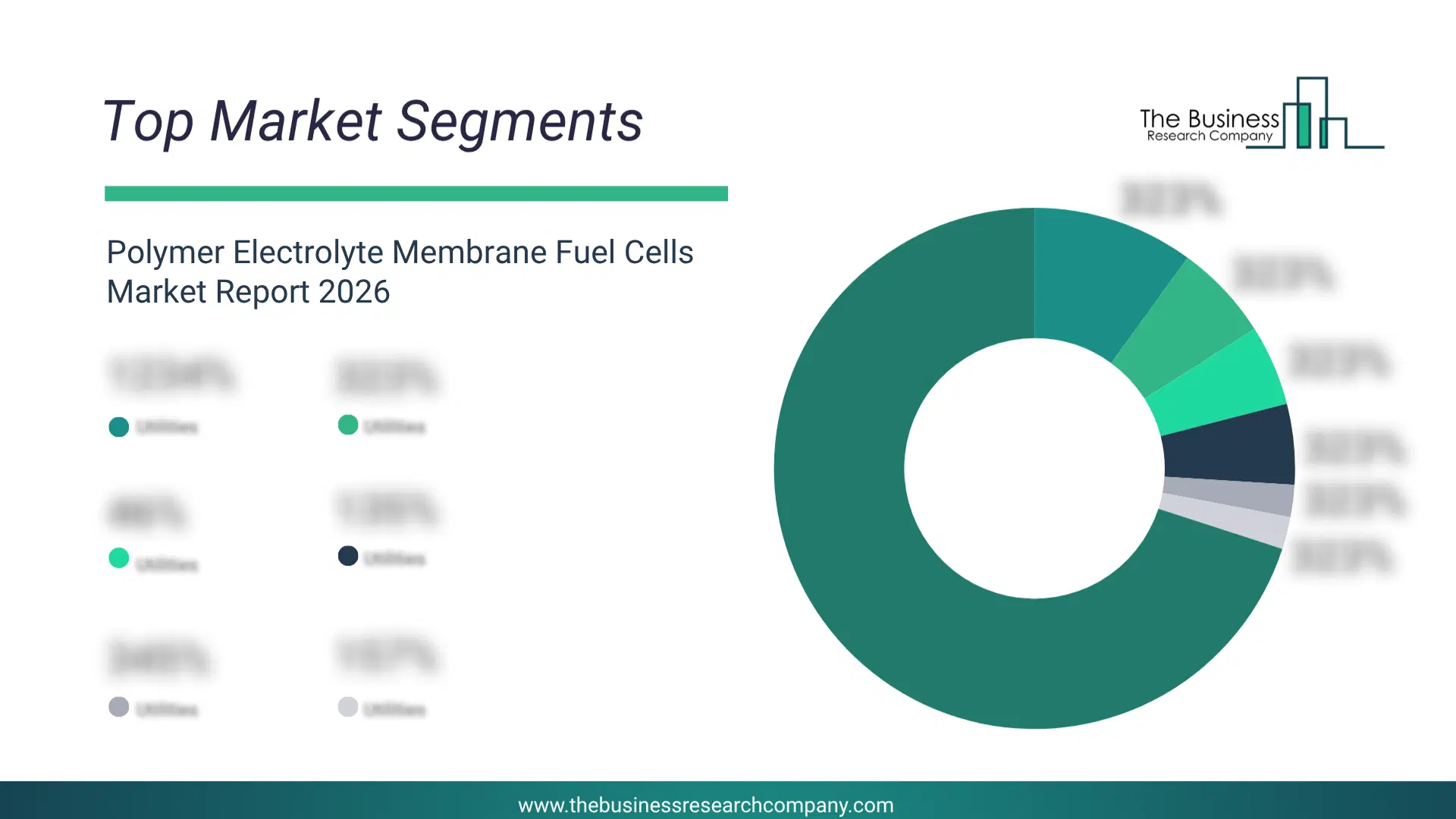
1) By Type: Low-Temperature Polymer Electrolyte Membrane Fuel Cells, High-Temperature Polymer Electrolyte Membrane Fuel Cells 2) By Cooling Method: Air-Cooled, Liquid-Cooled 3) By Component: Balance-Of-Plant Components, Fuel Cell Stack, Membrane Electrode Assembly, Bipolar Plates, Gas Diffusion Layers, Catalysts 4) By Application: Portable Power, Transportation, Stationary Power 5) By End-User Industry: Automotive And Mobility, Utilities And Energy, Material Handling And Logistics, Residential And Commercial, Defense And Aerospace, Industrial Subsegments: 1) By Low-Temperature Polymer Electrolyte Membrane Fuel Cells: Automotive Polymer Electrolyte Membrane Fuel Cells, Stationary Polymer Electrolyte Membrane Fuel Cells, Portable Polymer Electrolyte Membrane Fuel Cells 2) By High-Temperature Polymer Electrolyte Membrane Fuel Cells: High-Temperature Proton Exchange Membrane Fuel Cells, High-Temperature Composite Membrane Fuel Cells, High-Temperature Hydrocarbon Membrane Fuel CellsWhat Is The Driver Of The Polymer Electrolyte Membrane Fuel Cells Market?
The rising adoption of hydrogen fuel cell vehicles is expected to propel the growth of the polymer electrolyte membrane fuel cells market going forward. Hydrogen fuel cell vehicles (FCEVs) refer to vehicles that use hydrogen fuel cells to generate electricity through an electrochemical reaction, powering electric motors while producing only water vapor as an emission. The rising adoption of hydrogen fuel cell vehicles is driven by increasing demand for zero-emission transportation, as they provide clean mobility with longer driving ranges and faster refueling compared to battery electric vehicles. The growing adoption of hydrogen fuel cell vehicles supports the polymer electrolyte membrane fuel cells by driving demand for efficient, compact, and high-performance fuel cell systems that enable cleaner transportation. For instance, in June 2025, according to the California Energy Commission, a US-based government agency, hydrogen fueling stations operated at 62% capacity due to maintenance, equipment failures, supply chain issues, and hydrogen supply disruptions, but the existing network could support around 36,000 fuel cell electric vehicles (FCEVs), exceeding the 14,415 light-duty FCEVs estimated to be on the road. Therefore, the rising adoption of hydrogen fuel cell vehicles is driving the growth of the polymer electrolyte membrane fuel cells industry.Key Players In The Global Polymer Electrolyte Membrane Fuel Cells Market
Major companies operating in the polymer electrolyte membrane fuel cells market are Toyota Motor Corporation, General Motors Company, Honda Motor Co. Ltd., Robert Bosch GmbH, BASF SE, Panasonic Holdings Corporation, Hyundai Motor Company, Plug Power Inc., W. L. Gore & Associates Inc., Dana Incorporated, Johnson Matthey Plc, Umicore SA, Freudenberg SE, Ballard Power Systems Inc., Doosan Fuel Cell Co. Ltd., ElringKlinger AG, AVL List GmbH, PowerCell Sweden AB (publ), SFC Energy AG, Nedstack Fuel Cell Technology B.V., Horizon Fuel Cell Technologies Pte. Ltd., Intelligent Energy Limited, Blue World Technologies ApS, ZeroAvia Inc., Advent Technologies Holdings Inc.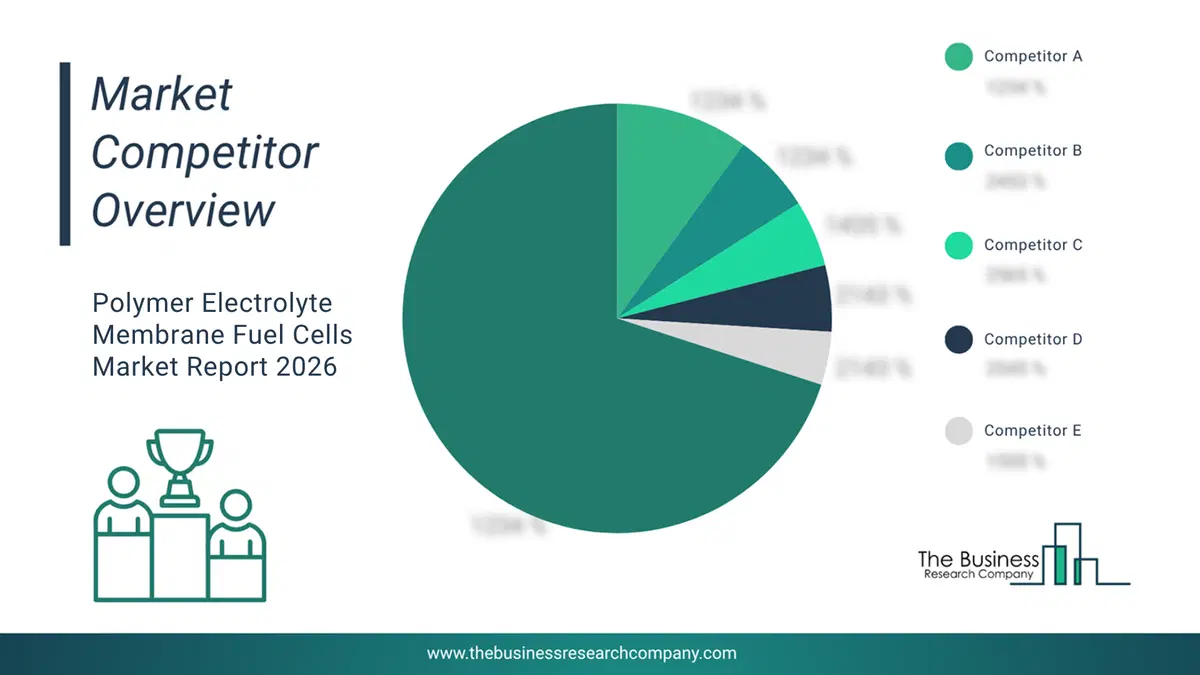
This chart is for illustrative purposes; the full report includes a detailed competitor analysis and comprehensive overview of the top 10 companies in the market.
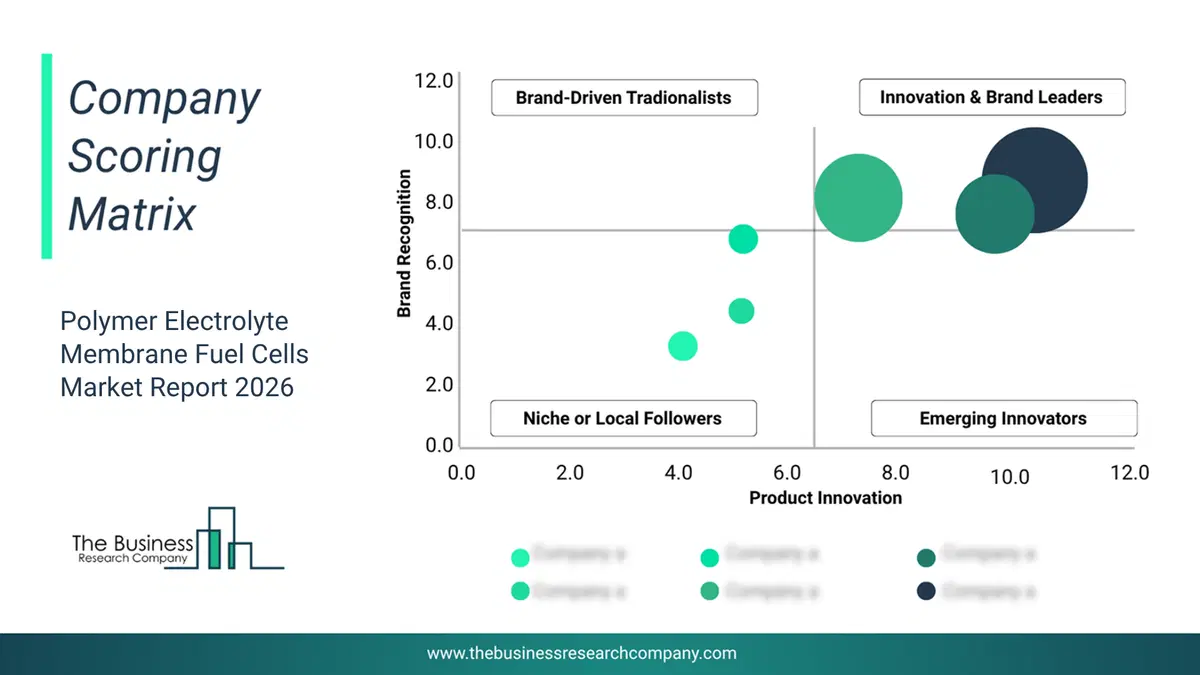
This chart maps companies by product innovation and brand strength, with bubble size indicating relative revenue, helping identify market leaders, challengers, and niche players. This is an illustrative chart; the full report provides a complete and accurate competitive analysis.
Global Polymer Electrolyte Membrane Fuel Cells Market Trends and Insights
Major companies operating in the polymer electrolyte membrane fuel cells market are focusing on developing advanced fuel cell stack technologies to improve power density, efficiency, durability, and vehicle integration for hydrogen-powered mobility. Fuel cell stack technology refers to the core electrochemical assembly that converts hydrogen and oxygen into electricity, enabling efficient and zero-emission vehicle propulsion. For instance, in September 2025, EKPO Fuel Cell Technologies GmbH, a Germany-based fuel cell technology company, showcased its NM12-singlepolymer electrolyte membrane fuel cell (PEMFC) stack module at IAA Mobility 2025. It is designed for passenger cars and light commercial vehicles. The automotive-grade stack delivers up to 123 kW of power while combining high power density, compact design, low hydrogen consumption, enhanced durability, operating temperatures of up to 84°C, and an integrated media module that simplifies vehicle system integration and supports improved cooling efficiency.What Are Latest Mergers And Acquisitions In The Polymer Electrolyte Membrane Fuel Cells Market?
In May 2025, Intelligent Energy plc, a UK-based manufacturer of polymer electrolyte membrane fuel cells (PEMFCs), entered into a collaboration agreement with IBT Co., Ltd. to develop a 100 kW polymer electrolyte membrane (PEM) hydrogen fuel cell generator for the South Korean market. Through this partnership, the companies aim to combine Intelligent Energy’s high-performance PEM fuel cell technology with IBT’s engineering and system integration expertise to accelerate the deployment of zero-emission stationary power solutions. IBT Co., Ltd. is a South Korea-based engineering company specializing in hydrogen energy systems and fuel cell integration.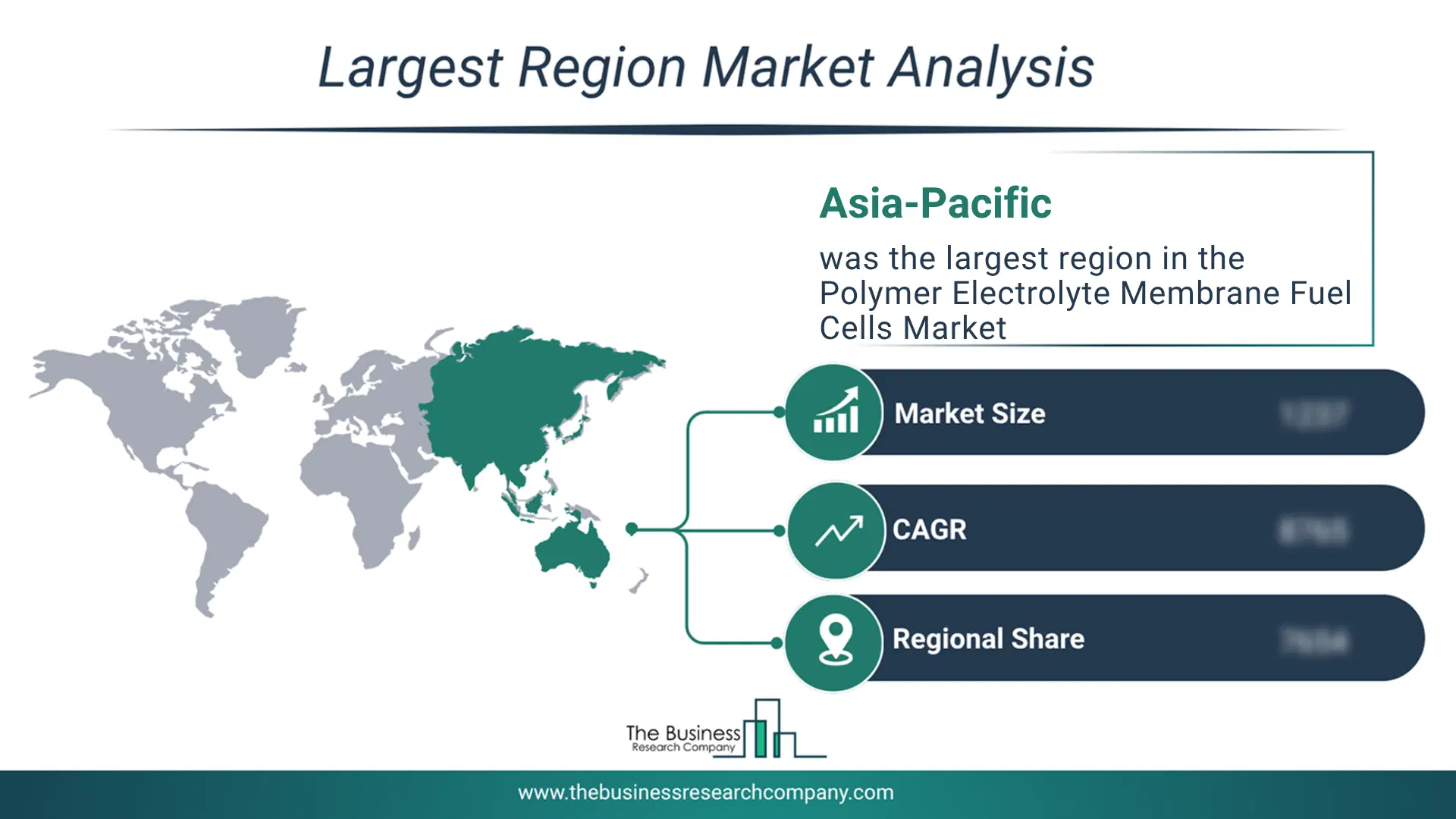
Regional Outlook
Asia-Pacific was the largest region in the polymer electrolyte membrane fuel cells market in 2025. Asia-Pacific is expected to be the fastest-growing region in the forecast period. The regions covered in this market report are Asia-Pacific, South East Asia, Western Europe, Eastern Europe, North America, South America, Middle East, Africa. The countries covered in this market report are Australia, Brazil, China, France, Germany, India, Indonesia, Japan, Taiwan, Russia, South Korea, UK, USA, Canada, Italy, Spain.What Defines the Polymer Electrolyte Membrane Fuel Cells Market?
The polymer electrolyte membrane fuel cells market consists of sales of fuel cell monitoring devices, fuel cell balance of plant equipment, and hydrogen supply systems. Values in this market are ‘factory gate’ values, that is, the value of goods sold by the manufacturers or creators of the goods, whether to other entities (including downstream manufacturers, wholesalers, distributors, and retailers) or directly to end customers. The value of goods in this market includes related services sold by the creators of the goods.How is Market Value Defined and Measured?
The market value is defined as the revenues that enterprises gain from the sale of goods and/or services within the specified market and geography through sales, grants, or donations in terms of the currency (in USD unless otherwise specified). The revenues for a specified geography are consumption values that are revenues generated by organizations in the specified geography within the market, irrespective of where they are produced. It does not include revenues from resales along the supply chain, either further along the supply chain or as part of other products.
This chart presents market attractiveness based on a quantitative evaluation of growth, competition, strategic alignment, and risk, offering a clear view of opportunity areas for decision-making. This chart is for illustrative purposes; the full report contains the complete analysis.

This chart highlights the Total Addressable Market (TAM) by estimating the maximum revenue opportunity using an assumption-driven approach, supporting strategic planning and opportunity sizing across markets. The chart is illustrative; the full report provides a more comprehensive analysis.
What Key Data and Analysis Are Included in the Polymer Electrolyte Membrane Fuel Cells Market Report 2026?
The polymer electrolyte membrane fuel cells market research report is one of a series of new reports from The Business Research Company that provides market statistics, including industry global market size, regional shares, competitors with the market share, detailed market segments, market trends and opportunities, and any further data you may need to thrive in the polymer electrolyte membrane fuel cells industry. The market research report delivers a complete perspective of everything you need, with an in-depth analysis of the current and future state of the industry.Polymer Electrolyte Membrane Fuel Cells Market Report Forecast Analysis
| Report Attribute | Details |
|---|---|
| Market Size Value In 2026 | $6.81 billion |
| Revenue Forecast In 2030 | $15.05 billion |
| Growth Rate | CAGR of 21.9% from 2026 to 2030 |
| Base Year For Estimation | 2025 |
| Actual Estimates/Historical Data | 2020-2025 |
| Forecast Period | 2026 - 2030 |
| Market Representation | Revenue in USD Billion and CAGR from 2026 to 2030 |
| Segments Covered | Type, Cooling Method, Component, Application, End-User Industry |
| Regional Scope | Asia-Pacific, Western Europe, Eastern Europe, North America, South America, Middle East, Africa |
| Country Scope | The countries covered in the report are Australia, Brazil, China, France, Germany, India, Indonesia, Japan, Taiwan, Russia, South Korea, UK, USA, Canada, Italy, Spain. |
| Key Companies Profiled | Toyota Motor Corporation, General Motors Company, Honda Motor Co. Ltd., Robert Bosch GmbH, BASF SE, Panasonic Holdings Corporation, Hyundai Motor Company, Plug Power Inc., W. L. Gore & Associates Inc., Dana Incorporated, Johnson Matthey Plc, Umicore SA, Freudenberg SE, Ballard Power Systems Inc., Doosan Fuel Cell Co. Ltd., ElringKlinger AG, AVL List GmbH, PowerCell Sweden AB (publ), SFC Energy AG, Nedstack Fuel Cell Technology B.V., Horizon Fuel Cell Technologies Pte. Ltd., Intelligent Energy Limited, Blue World Technologies ApS, ZeroAvia Inc., Advent Technologies Holdings Inc. |
| Customization Scope | Request for Customization |
| Pricing And Purchase Options | Explore Purchase Options |