

Polymercaptan Curing Agent Market Report 2026
Global Outlook – By Product Type (Epoxy Curing Agents, Polyurethane Curing Agents, Silicone Curing Agents, Other Product Types), By Processing Method (Casting, Injection Molding, Thermal Curing, Room Temperature Curing), By Distribution Channel (Direct Sales, Distributors, Online Sales), By Application (Coatings, Adhesives, Sealants, Composites, Other Applications), By End-Use Industry (Construction, Aerospace, Automotive, Electronics, Marine, Oil And Gas) – Market Size, Trends, Strategies, and Forecast to 2030
Polymercaptan Curing Agent Market Overview
• Polymercaptan Curing Agent market size has reached to $0.13 billion in 2025 • Expected to grow to $0.19 billion in 2030 at a compound annual growth rate (CAGR) of 7.7% • Growth Driver: Rising Construction Activity Driving The Market Growth Due To Increasing Demand For High-Performance Adhesive And Coating Solutions • Market Trend: Technological Advancements Improve Low-Temperature Curing, Adhesion, And Processing Performance Of Polymercaptan Curing Agents • North America was the largest region in 2025 and Asia-Pacific is the fastest growing region.What Is Covered Under Polymercaptan Curing Agent Market?
Polymercaptan curing agents refer to chemical compounds containing mercaptan functional groups that react with resin components to accelerate the curing process, particularly at low temperatures. They are formulated to provide rapid curing and help achieve properties such as flexibility, adhesion, chemical resistance, and durability in cured resin systems. Polymercaptan curing agents are available in different chemical formulations and are used as reactive curing components in thermosetting resin systems. The main product types in the polymercaptan curing agent market include epoxy curing agents, polyurethane curing agents, silicone curing agents, and other product types. Epoxy curing agents refer to chemical compounds that react with epoxy resins to initiate or accelerate crosslinking, forming hardened materials with improved strength, durability, and chemical resistance. These curing agents are used through casting, injection molding, thermal curing, and room temperature curing processes and distributed through direct sales, distributors, and online sales. The key applications include coatings, adhesives, sealants, and composites and end-use industries include construction, aerospace, automotive, electronics, marine, and oil and gas.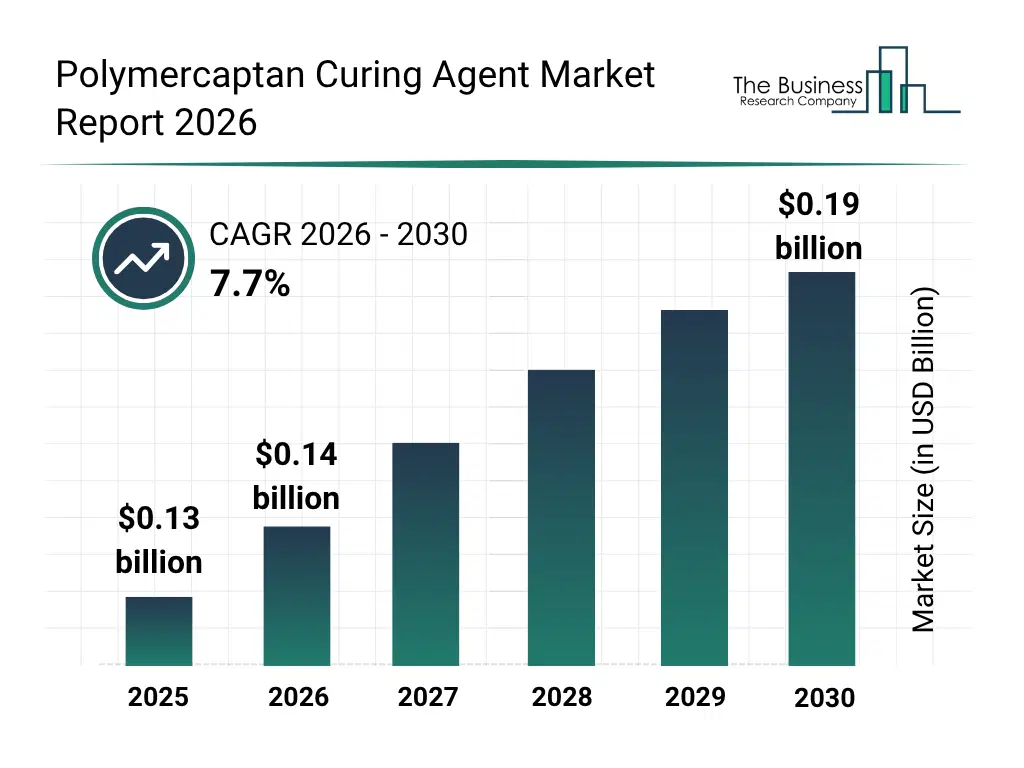
What Is The Polymercaptan Curing Agent Market Size and Share 2026?
The polymercaptan curing agent market size has grown strongly in recent years. It will grow from $0.13 billion in 2025 to $0.14 billion in 2026 at a compound annual growth rate (CAGR) of 8.4%. The growth in the historic period can be attributed to increasing demand for rapid curing systems, rising use of thermosetting resin systems, growing demand for low-temperature curing, increasing consumption of industrial adhesives, rising demand for durable protective coatings.What Is The Polymercaptan Curing Agent Market Growth Forecast?
The polymercaptan curing agent market size is expected to see strong growth in the next few years. It will grow to $0.19 billion in 2030 at a compound annual growth rate (CAGR) of 7.7%. The growth in the forecast period can be attributed to expanding construction activities, increasing demand for high-performance adhesives and sealants, growing aerospace component production, rising automotive manufacturing, increasing electronics assembly activities. Major trends in the forecast period include rising demand for rapid low-temperature curing solutions, increasing use of high-flexibility curing systems, growing demand for enhanced adhesion in cured resin systems, rising adoption of fast-acting polymercaptan formulations, increasing demand for chemical-resistant cured resin systems.Tariff Impact On Polymercaptan Curing Agent Market
Tariffs are impacting the polymercaptan curing agents market by increasing the cost of imported curing chemicals, specialty thiol compounds, resin components, and other raw materials required for polymercaptan formulations. This is raising production costs and affecting applications such as coatings, adhesives, sealants, and composites, particularly in regions dependent on imported chemical intermediates and specialty curing agents. Product types such as liquid polymercaptan curing agents and mercaptan-modified formulations may be more exposed to international supply chain and raw material cost pressures. However, tariffs are also encouraging domestic chemical production, regional supplier diversification, and increased investment in localized curing-agent manufacturing, strengthening supply chain resilience.
Global Polymercaptan Curing Agent Market Segmentation
1) By Product Type: Epoxy Curing Agents, Polyurethane Curing Agents, Silicone Curing Agents, Other Product Types 2) By Processing Method: Casting, Injection Molding, Thermal Curing, Room Temperature Curing 3) By Distribution Channel: Direct Sales, Distributors, Online Sales 4) By Application: Coatings, Adhesives, Sealants, Composites, Other Applications 5) By End-Use Industry: Construction, Aerospace, Automotive, Electronics, Marine, Oil And Gas Subsegments: 1) By Epoxy Curing Agents: Polythiol Curing Agents, Mercaptan-Terminated Curing Agents, Mercaptan-Modified Amine Curing Agents, Accelerated Mercaptan Curing Agents, Liquid Polymercaptan Curing Agents 2)By Polyurethane Curing Agents: Mercaptan-Modified Polyurethane Curing Agents, Polymercaptan Crosslinking Agents, Mercaptan-Terminated Polyurethane Curing Agents, Fast-Curing Polyurethane Curing Agents, M oisture-Resistant Polyurethane Curing Agents 3) By Silicone Curing Agents: Mercaptan-Modified Silicone Curing Agents, Polymercaptan Silicone Crosslinkers, Mercaptan-Terminated Silicone Curing Agents, Fast-Curing Silicone Curing Agents, High-Temperature Silicone Curing Agents 4) By Other Product Types: Polymercaptan Accelerators, Mercaptan-Based Crosslinking Agents, Mercaptan-Modified Curing Agents, Thiol-Based Curing Agents, Specialty Polymercaptan Curing AgentsWhat Are The Drivers Of The Polymercaptan Curing Agent Market?
The rising construction activity is expected to propel the growth of the polymercaptan curing agent market going forward. Construction activity refers to the development, expansion, renovation, and maintenance of residential, commercial, and infrastructure projects, including buildings, roads, bridges, and industrial facilities. The demand for construction activity is due to rapid urbanization, as the growing concentration of populations in urban areas increases the need for residential buildings, commercial spaces, transportation infrastructure, and other essential urban facilities. Rising construction activity drives demand for polymercaptan curing agents by increasing the need for fast-curing, high-performance epoxy formulations used in construction adhesives, sealants, coatings, and flooring applications. For instance, in September 2026, according to the Institute of Chartered Accountants in England and Wales (ICAEW), a UK-based professional membership organization for chartered accountants and finance professionals, construction output in Great Britain increased by 0.3% in the second quarter of 2026. Therefore, the rising construction activity is driving the growth of the polymercaptan curing agent industry. The increasing demand for electronics is expected to propel the growth of the polymercaptan curing agent market going forward. Electronics manufacturing refers to the process of designing, assembling, producing, and testing electronic components and devices such as semiconductors, printed circuit boards, consumer electronics, automotive electronics, and industrial electronic systems. The electronics manufacturing is increasing due to rising demand for consumer electronics, as increasing consumer adoption of smartphones, laptops, tablets, wearable devices, and other electronic products is driving higher production volumes and expanding manufacturing activities. The expansion of electronics manufacturing drives demand for polymercaptan curing agents, which provide fast-curing, high-adhesion, and chemically resistant solutions for epoxy-based encapsulation materials, adhesives, and protective coatings used in electronic assemblies. For instance, in February 2026, according to the Semiconductor Industry Association (SIA), a US-based trade association, global semiconductor sales increased to $791.7 billion in 2025 from $630.5 billion in 2024, representing a 25.6% growth driven by higher demand for semiconductor products used in artificial intelligence, automotive, and electronic applications. Therefore, the increasing demand for electronics is driving the growth of the polymercaptan curing agent industry.Key Players In The Global Polymercaptan Curing Agent Market
Major companies operating in the polymercaptan curing agent market are BASF SE, Bruno Bock GmbH, Dow Inc., Mitsubishi Chemical Corporation, Resonac Holdings Corporation, Toray Industries Inc., Evonik Industries AG, Sika AG, Arkema S.A., RPM International Inc., Olin Corporation, DIC Corporation, Nagase & Co. Ltd., Huntsman Corporation, Kukdo Chemical Co. Ltd., Atul Ltd., Cardolite Corporation, Jiangsu Sanmu Group Co. Ltd., Yifeng New Materials Co. Ltd., Ningbo Inno Pharmchem Co. Ltd., Jiangsu Dynamic Chemical Group Co. Ltd., Qingdao Hengda New Material Technology Co. Ltd., Hubei Xianlin Chemical Co. Ltd.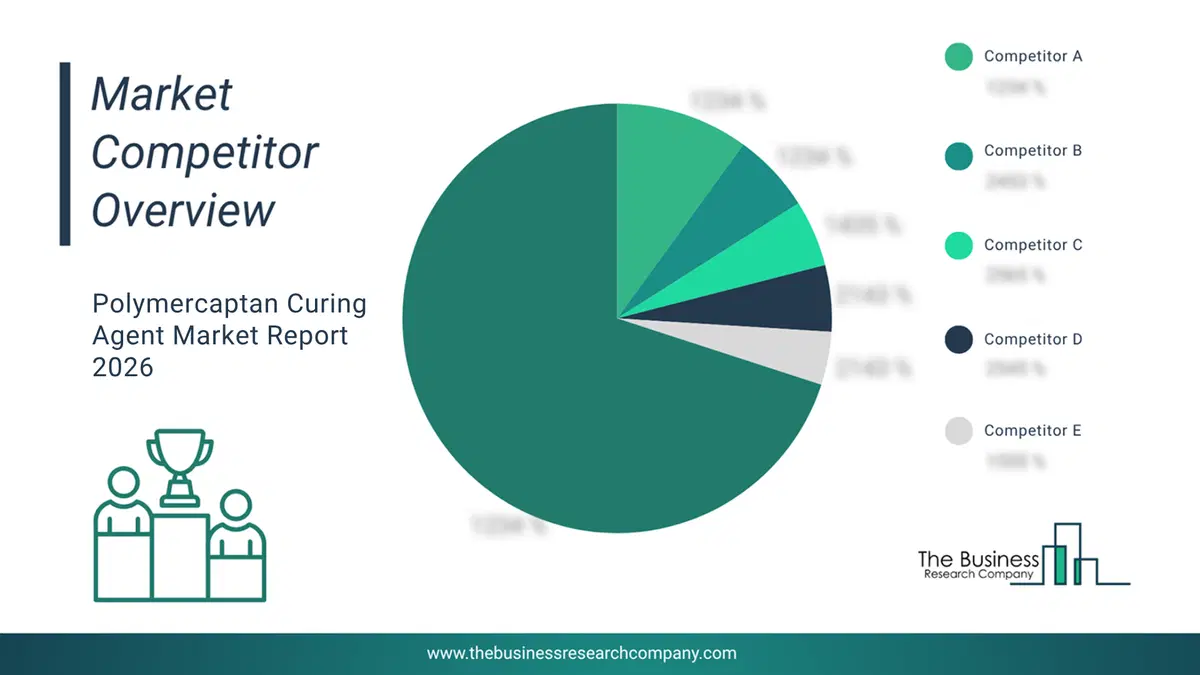
This chart is for illustrative purposes; the full report includes a detailed competitor analysis and comprehensive overview of the top 10 companies in the market.
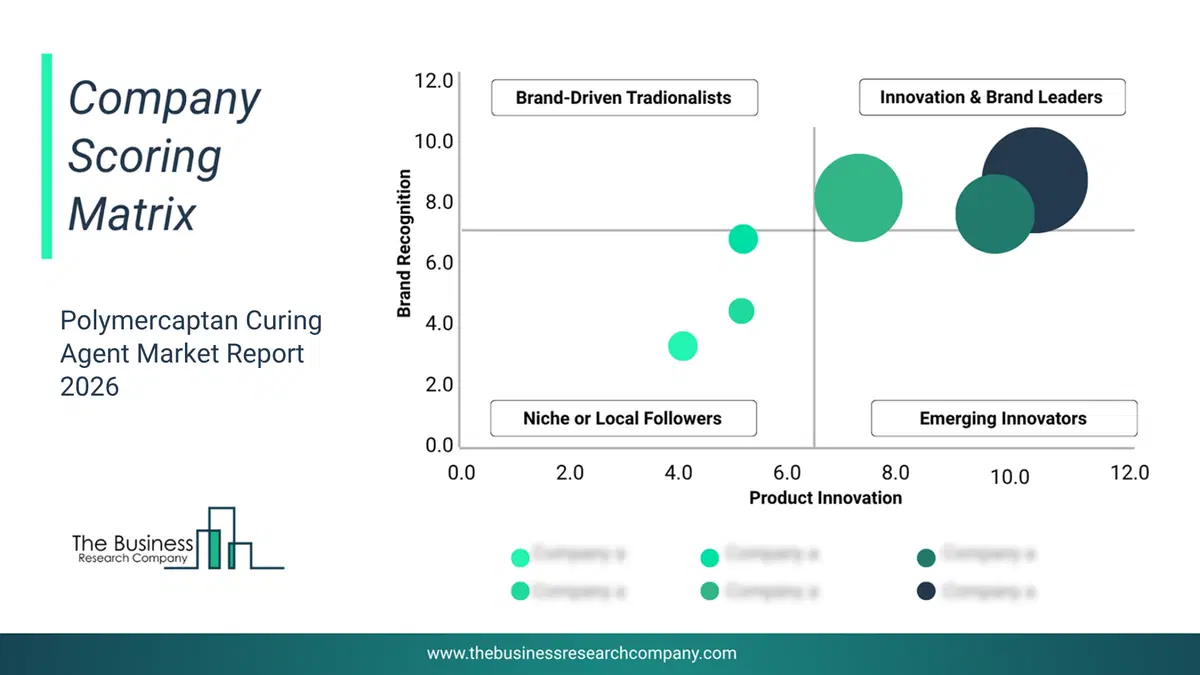
This chart maps companies by product innovation and brand strength, with bubble size indicating relative revenue, helping identify market leaders, challengers, and niche players. This is an illustrative chart; the full report provides a complete and accurate competitive analysis.
Global Polymercaptan Curing Agent Market Trends and Insights
Major companies operating in the polymercaptan curing agent market are focusing on developing advanced curing agents, such as secondary-distilled polythiol compounds, to enable rapid low-temperature curing and improve adhesion and processing performance in adhesive applications. Secondary-distilled polythiol compounds refer to purified mercaptan-functional curing agents that are designed to react rapidly with epoxy resins and acrylates at room or low temperatures while offering low viscosity and high adhesion. For instance, in May 2025, Shenzhen U-Sunny Technology, a China-based chemical materials company, launched Thiol-30L, a secondary-distilled polythiol curing agent designed for rapid curing applications. The product can cure epoxy resins and acrylates at temperatures as low as −20°C and is positioned for structural adhesives and other chemical, coating, and adhesive applications.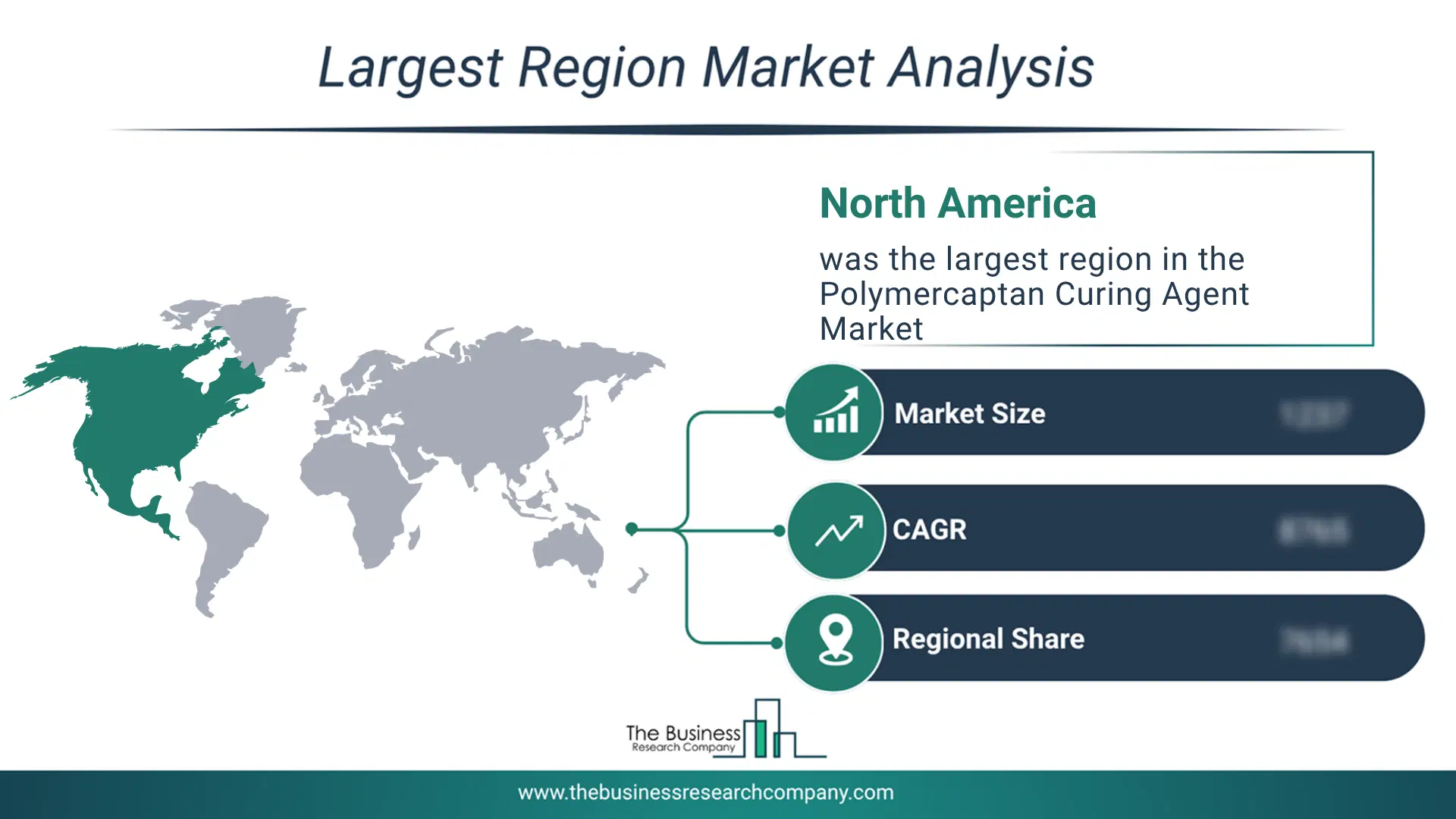
Regional Outlook
North America was the largest region in the polymercaptan curing agent market in 2025. Asia-Pacific is expected to be the fastest-growing region in the forecast period. The regions covered in this market report are Asia-Pacific, South East Asia, Western Europe, Eastern Europe, North America, South America, Middle East, Africa. The countries covered in this market report are Australia, Brazil, China, France, Germany, India, Indonesia, Japan, Taiwan, Russia, South Korea, UK, USA, Canada, Italy, Spain.What Defines the Polymercaptan Curing Agent Market?
The polymercaptan curing agent market consists of sales of liquid polymercaptan curing agents, mercaptan-terminated curing agents, polysulfide-based polymercaptan curing agents, modified polymercaptan curing agents, and blended polymercaptan curing formulations. Values in this market are ‘factory gate’ values, that is, the value of goods sold by the manufacturers or creators of the goods, whether to other entities (including downstream manufacturers, wholesalers, distributors, and retailers) or directly to end customers. The value of goods in this market includes related services sold by the creators of the goods.How is Market Value Defined and Measured?
The market value is defined as the revenues that enterprises gain from the sale of goods and/or services within the specified market and geography through sales, grants, or donations in terms of the currency (in USD unless otherwise specified). The revenues for a specified geography are consumption values that are revenues generated by organizations in the specified geography within the market, irrespective of where they are produced. It does not include revenues from resales along the supply chain, either further along the supply chain or as part of other products.
This chart presents market attractiveness based on a quantitative evaluation of growth, competition, strategic alignment, and risk, offering a clear view of opportunity areas for decision-making. This chart is for illustrative purposes; the full report contains the complete analysis.

This chart highlights the Total Addressable Market (TAM) by estimating the maximum revenue opportunity using an assumption-driven approach, supporting strategic planning and opportunity sizing across markets. The chart is illustrative; the full report provides a more comprehensive analysis.
What Key Data and Analysis Are Included in the Polymercaptan Curing Agent Market Report 2026?
The polymercaptan curing agent market research report is one of a series of new reports from The Business Research Company that provides market statistics, including industry global market size, regional shares, competitors with the market share, detailed market segments, market trends and opportunities, and any further data you may need to thrive in the polymercaptan curing agent industry. The market research report delivers a complete perspective of everything you need, with an in-depth analysis of the current and future state of the industry.Polymercaptan Curing Agent Market Report Forecast Analysis
| Report Attribute | Details |
|---|---|
| Market Size Value In 2026 | $0.14 billion |
| Revenue Forecast In 2030 | $0.19 billion |
| Growth Rate | CAGR of 7.7% from 2026 to 2030 |
| Base Year For Estimation | 2025 |
| Actual Estimates/Historical Data | 2020-2025 |
| Forecast Period | 2026 - 2030 |
| Market Representation | Revenue in USD Billion and CAGR from 2026 to 2030 |
| Segments Covered | Product Type, Processing Method, Distribution Channel, Application, End-Use Industry |
| Regional Scope | Asia-Pacific, Western Europe, Eastern Europe, North America, South America, Middle East, Africa |
| Country Scope | The countries covered in the report are Australia, Brazil, China, France, Germany, India, Indonesia, Japan, Taiwan, Russia, South Korea, UK, USA, Canada, Italy, Spain. |
| Key Companies Profiled | BASF SE, Bruno Bock GmbH, Dow Inc., Mitsubishi Chemical Corporation, Resonac Holdings Corporation, Toray Industries Inc., Evonik Industries AG, Sika AG, Arkema S.A., RPM International Inc., Olin Corporation, DIC Corporation, Nagase & Co. Ltd., Huntsman Corporation, Kukdo Chemical Co. Ltd., Atul Ltd., Cardolite Corporation, Jiangsu Sanmu Group Co. Ltd., Yifeng New Materials Co. Ltd., Ningbo Inno Pharmchem Co. Ltd., Jiangsu Dynamic Chemical Group Co. Ltd., Qingdao Hengda New Material Technology Co. Ltd., Hubei Xianlin Chemical Co. Ltd. |
| Customization Scope | Request for Customization |
| Pricing And Purchase Options | Explore Purchase Options |