
Polyolefin Plastomer (POP) Market Report 2026
Global Outlook – By Product Type (Ethylene-Based POP, Propylene-Based POP), By Processing Method (Injection Molding, Blow Molding, Extrusion, Other Processing Methods), By Applications (Food Packaging, Medical And Health, Home And Personal Care, Hot Melt Adhesive, Other Applications), By End-User Industry (Packaging, Automotive, Healthcare, Building And Construction, Other End-User Industries) – Market Size, Trends, Strategies, and Forecast to 2030
Polyolefin Plastomer (POP) Market Overview
• Polyolefin Plastomer (POP) market size has reached to $2.92 billion in 2025 • Expected to grow to $4.13 billion in 2030 at a compound annual growth rate (CAGR) of 7.1% • Growth Driver: Surge In Growing Shift Toward Recyclable And Sustainable Plastic Materials Fueling The Growth Of The Market Due To Increasing Environmental Awareness And Regulatory Pressure • Market Trend: Integrating Renewable-Feedstock Plastomers To Drive Sustainable, Low-Carbon Polymer Production • Asia-Pacific was the largest region and fastest growing region.What Is Covered Under Polyolefin Plastomer (POP) Market?
Polyolefin plastomer (POP) is a type of polyethylene-based polymer produced using metallocene catalyst technology, giving it a unique balance of softness, flexibility, and strength. It offers excellent sealability, clarity, and elasticity, making it suitable for high-performance film and molding applications. POPs are valued for their ability to enhance material performance while maintaining lightweight and durable characteristics. The main product types of polyolefin plastomer (POP) are including ethylene-based POP and propylene-based POP. Ethylene-based POP refers to a type of plastomer produced using ethylene to deliver desired performance characteristics in diverse applications. It includes various processing methods such as injection molding, blow molding, extrusion, and others, catering to different applications including food packaging, medical and health, home and personal care, hot melt adhesive, and others, serving multiple end-user industries including packaging, automotive, healthcare, building and construction, and others.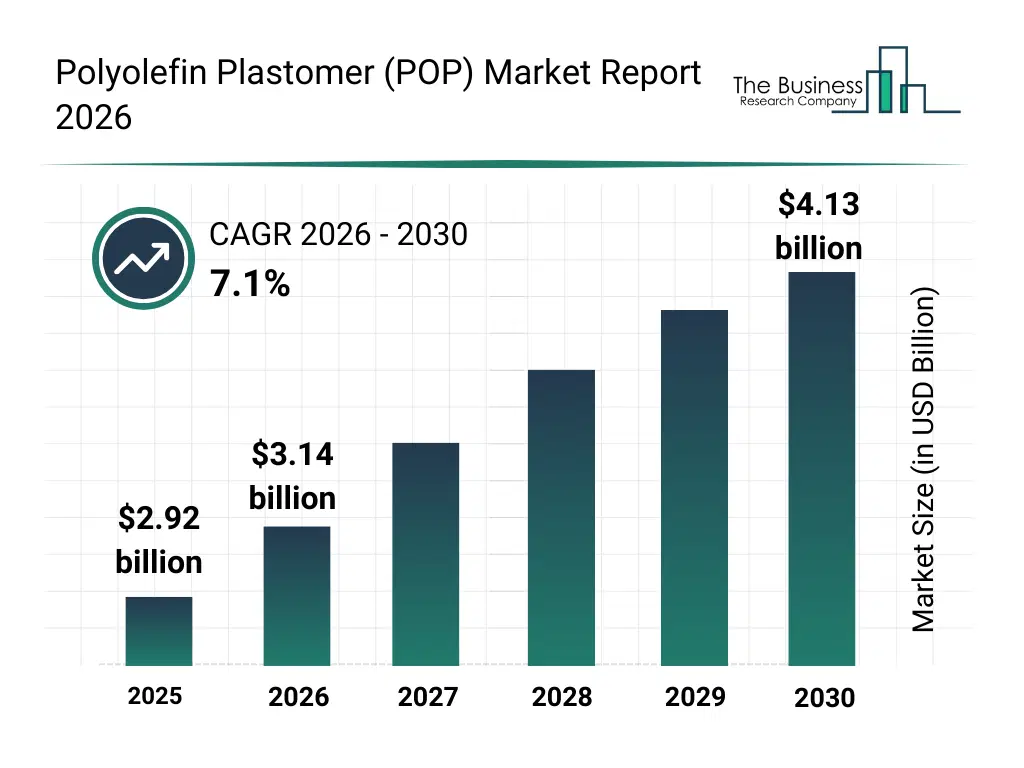
What Is The Polyolefin Plastomer (POP) Market Size and Share 2026?
The polyolefin plastomer (POP) market size has grown strongly in recent years. It will grow from $2.92 billion in 2025 to $3.14 billion in 2026 at a compound annual growth rate (CAGR) of 7.4%. The growth in the historic period can be attributed to increasing use of flexible packaging materials, growing demand for lightweight automotive components, rising consumption of high-performance polymer films, expanding applications in medical and hygiene products, and increasing adoption of sustainable plastomer solutions.What Is The Polyolefin Plastomer (POP) Market Growth Forecast?
The polyolefin plastomer (POP) market size is expected to see strong growth in the next few years. It will grow to $4.13 billion in 2030 at a compound annual growth rate (CAGR) of 7.1%. The growth in the forecast period can be attributed to a growing shift toward recyclable packaging solutions, increasing demand for soft-touch consumer goods, rising usage of plastomers in solar and renewable applications, expanding investment in advanced film processing technologies, increasing preference for high-clarity packaging films, and Major trends in the forecast period include technology advancements in polymer catalyst systems, innovations in film processing and extrusion, developments in recyclable and bio-based plastomers, research and developments in high-performance elastomer blends, and advancements in medical-grade polymer applications.
Global Polyolefin Plastomer (POP) Market Segmentation
1) By Product Type: Ethylene-Based POP, Propylene-Based POP 2) By Processing Method: Injection Molding, Blow Molding, Extrusion, Other Processing Methods 3) By Applications: Food Packaging, Medical And Health, Home And Personal Care, Hot Melt Adhesive, Other Applications 4) By End-User Industry: Packaging, Automotive, Healthcare, Building And Construction, Other End-User Industries Subsegments: 1) By Ethylene-Based POP: Linear Low-Density Ethylene, Very Low-Density Ethylene, Metallocene-Catalyzed Ethylene 2) By Propylene-Based POP: Random Propylene Copolymer, Block Propylene Copolymer, Specialty Propylene GradesWhat Are The Drivers Of The Polyolefin Plastomer (POP) Market?
The growing shift toward recyclable and sustainable plastic materials is expected to propel the polyolefin plastomer market going forward. Recyclable and sustainable plastic materials refer to polymer solutions designed to reduce environmental impact through improved recyclability, lower carbon footprint, and enhanced material efficiency while maintaining performance characteristics. Adoption of sustainable plastic materials is rising as manufacturers and brand owners seek to reduce plastic waste and support a circular economy. The polyolefin plastomer supports trecyclable and sustainable plastic materials by offering flexible, durable, and lightweight materials with excellent recyclability and compatibility with circular economy initiatives, making them suitable for packaging, automotive, and consumer goods applications. For instance, in August 2025, according to the HM Revenue & Customs, a UK-based government agency, plastic packaging with 30% or more recycled content increased from 1,289 thousand tonnes to 1,394 thousand tonnes between 2022 and 2023. Therefore, the growing shift toward recyclable and sustainable plastic materials is driving the growth of the polyolefin plastomer market. The growth in construction and infrastructure applications is expected to propel the growth of the polyolefin plastomer market going forward. Construction and infrastructure applications refer to the use of materials in building, renovation, and large-scale infrastructure projects such as roads, bridges, pipelines, and commercial structures. construction and infrastructure applications. Polyolefin plastomers support construction and infrastructure applications by offering enhanced flexibility, impact resistance, sealability, and durability, making them suitable for roofing membranes, waterproofing systems, pipes, and insulation materials. For instance, in November 2024, according to the Office for National Statistics, a UK-based government statistical authority, the value of construction new work in Great Britain increased by 4.2% in 2023 compared with 2022 to reach about $176,567 million (£139,029 million), reflecting a year on year rise of around $7,147 million (£5,628 million) supported by growth in private new work at 2.1% and a stronger expansion in public new work at 10.2%. Therefore, the growth in construction and infrastructure applications is driving the growth of the polyolefin plastomer market.Key Players In The Global Polyolefin Plastomer (POP) Market
Major companies operating in the polyolefin plastomer (pop) market are Sinopec Group, Exxon Mobil Corporation, Shell Plc, Dow Inc., LyondellBasell Industries N.V., Hanwha Group, LG Chem Ltd., Wanhua Chemical Group Co. Ltd., Sumitomo Chemical Co. Ltd., Westlake Chemical Corporation, Mitsui Chemicals Inc., Versalis S.p.A., Avient Corporation, Borealis AG, SK Geo Centric, RTP Company Inc., Americhem, Sekisui Voltek LLC, SABIC, SK Functional Polymer, Chemate Group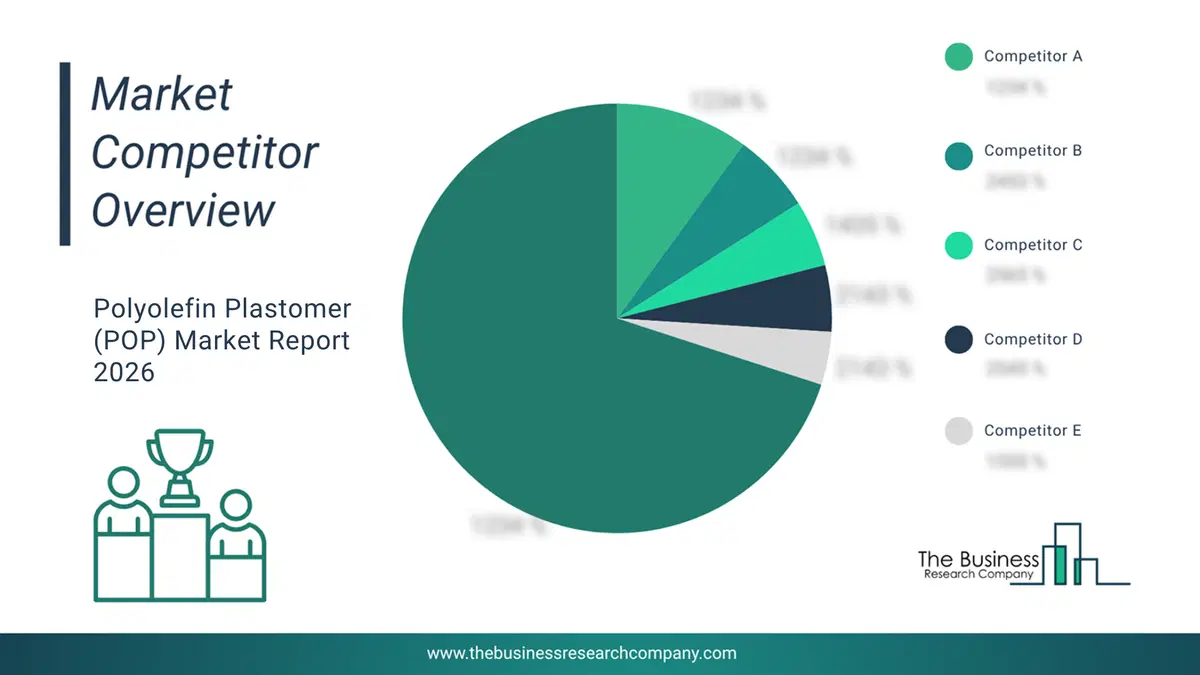
This chart is for illustrative purposes; the full report includes a detailed competitor analysis and comprehensive overview of the top 10 companies in the market.
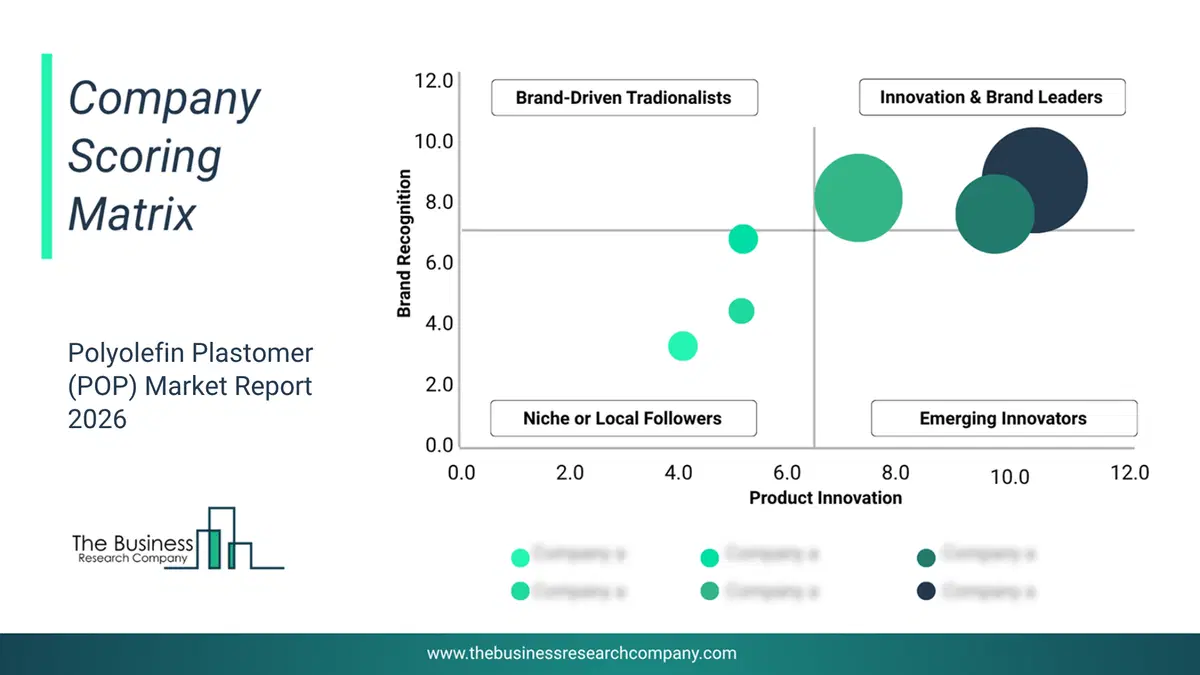
This chart maps companies by product innovation and brand strength, with bubble size indicating relative revenue, helping identify market leaders, challengers, and niche players. This is an illustrative chart; the full report provides a complete and accurate competitive analysis.
Global Polyolefin Plastomer (POP) Market Trends and Insights
Major companies operating in the polyolefin plastomers market are focusing on innovative products, such as ISCC-plus certified circular plastomers, to lower carbon exposure and stabilize raw-material sourcing. ISCC-plus certified circular plastomers use a mass-balance chain of custody that allows producers to attribute renewable feedstock to finished resins without changing processing lines. For instance, in May 2023, Borealis GmbH, an Austria-based polyolefins company, launched the Bornewables Queo line of plastomers and elastomers. ISCC PLUS-certified renewable feedstock delivers drop-in compatibility with existing processing and film structures, and reduces product carbon footprint compared with fossil-derived equivalents. This launch represents a significant technological advancement by extending renewable-feedstock solutions into high-performance plastomers, bridging sustainable sourcing with industrial-scale polymer production. It offers a scalable, efficient solution for lowering carbon impact and maintaining operational continuity in polyolefin manufacturing.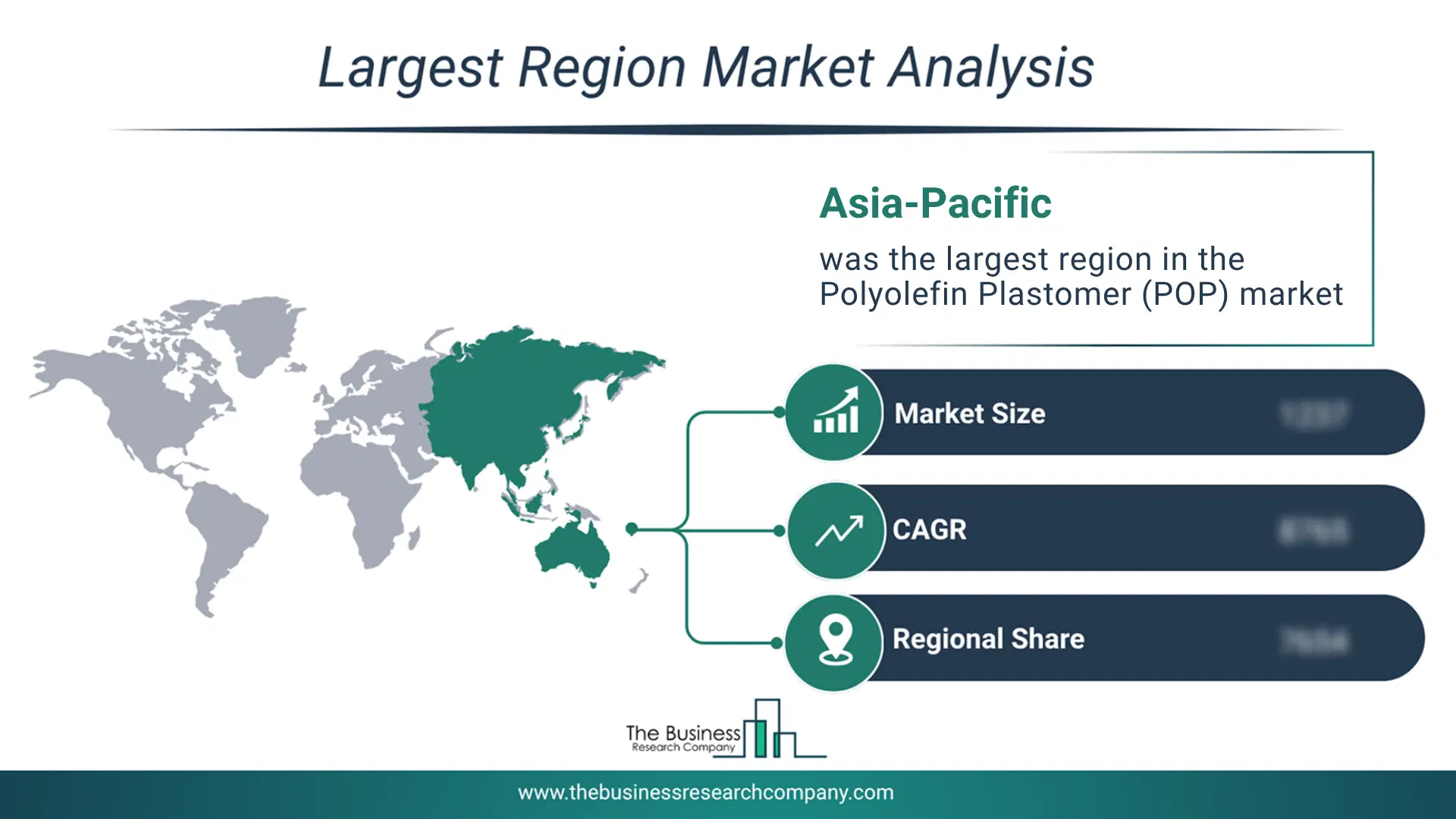
Regional Insights
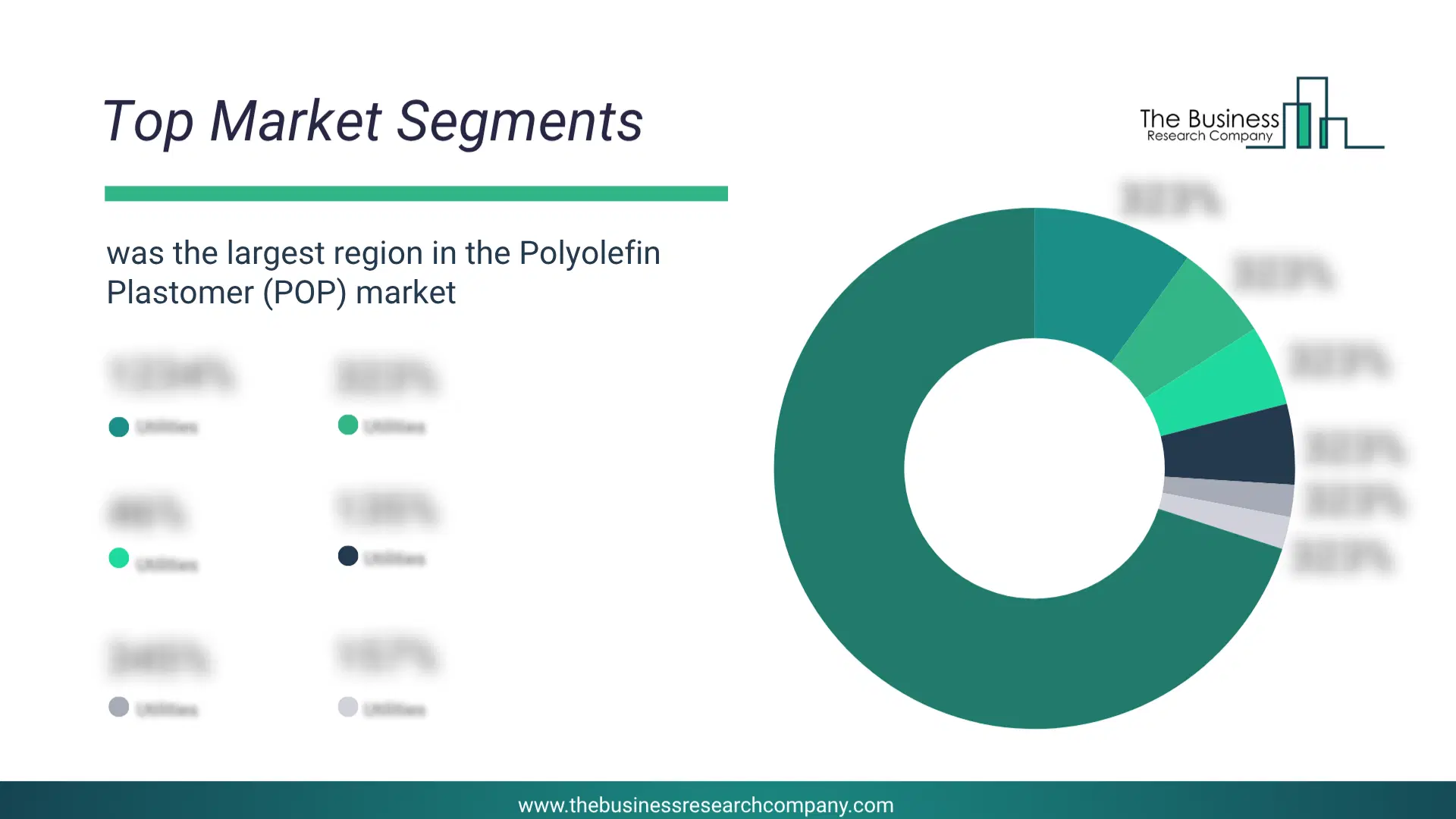
Asia-Pacific was the largest region in the polyolefin plastomer (POP) market in 2025. Asia-Pacific is expected to be the fastest-growing region in the forecast period. The regions covered in this market report are Asia-Pacific, South East Asia, Western Europe, Eastern Europe, North America, South America, Middle East, Africa. The countries covered in this market report are Australia, Brazil, China, France, Germany, India, Indonesia, Japan, Taiwan, Russia, South Korea, UK, USA, Canada, Italy, Spain.What Defines the Polyolefin Plastomer (POP) Market?
The polyolefin plastomer (POP) market consists of polymer formulation services, material testing services, custom compounding services, application development services, technical support services. Values in this market are ‘factory gate’ values, that is, the value of goods sold by the manufacturers or creators of the goods, whether to other entities (including downstream manufacturers, wholesalers, distributors, and retailers) or directly to end customers. The value of goods in this market includes related services sold by the creators of the goods.How is Market Value Defined and Measured?
The market value is defined as the revenues that enterprises gain from the sale of goods and/or services within the specified market and geography through sales, grants, or donations in terms of the currency (in USD unless otherwise specified). The revenues for a specified geography are consumption values that are revenues generated by organizations in the specified geography within the market, irrespective of where they are produced. It does not include revenues from resales along the supply chain, either further along the supply chain or as part of other products.
This chart presents market attractiveness based on a quantitative evaluation of growth, competition, strategic alignment, and risk, offering a clear view of opportunity areas for decision-making. This chart is for illustrative purposes; the full report contains the complete analysis.

This chart highlights the Total Addressable Market (TAM) by estimating the maximum revenue opportunity using an assumption-driven approach, supporting strategic planning and opportunity sizing across markets. The chart is illustrative; the full report provides a more comprehensive analysis.
What Key Data and Analysis Are Included in the Polyolefin Plastomer (POP) Market Report 2026?
The polyolefin plastomer (pop) market research report is one of a series of new reports from The Business Research Company that provides market statistics, including industry global market size, regional shares, competitors with the market share, detailed market segments, market trends and opportunities, and any further data you may need to thrive in the polyolefin plastomer (pop) industry. The market research report delivers a complete perspective of everything you need, with an in-depth analysis of the current and future state of the industry.Polyolefin Plastomer (POP) Market Report Forecast Analysis
| Report Attribute | Details |
|---|---|
| Market Size Value In 2026 | $3.14 billion |
| Revenue Forecast In 2030 | $4.13 billion |
| Growth Rate | CAGR of 7.4% from 2026 to 2030 |
| Base Year For Estimation | 2025 |
| Actual Estimates/Historical Data | 2020-2025 |
| Forecast Period | 2026 - 2030 |
| Market Representation | Revenue in USD Billion and CAGR from 2026 to 2030 |
| Segments Covered | Product Type, Processing Method, Applications, End-User Industry |
| Regional Scope | Asia-Pacific, Western Europe, Eastern Europe, North America, South America, Middle East, Africa |
| Country Scope | The countries covered in this market report are Australia, Brazil, China, France, Germany, India, Indonesia, Japan, Taiwan, Russia, South Korea, UK, USA, Canada, Italy, Spain |
| Key Companies Profiled | Sinopec Group, Exxon Mobil Corporation, Shell Plc, Dow Inc., LyondellBasell Industries N.V., Hanwha Group, LG Chem Ltd., Wanhua Chemical Group Co. Ltd., Sumitomo Chemical Co. Ltd., Westlake Chemical Corporation, Mitsui Chemicals Inc., Versalis S.p.A., Avient Corporation, Borealis AG, SK Geo Centric, RTP Company Inc., Americhem, Sekisui Voltek LLC, SABIC, SK Functional Polymer, Chemate Group |
| Customization Scope | Request for Customization |
| Pricing And Purchase Options | Explore Purchase Options |