
Polypropylene Impact Copolymer Market Report 2026
Global Outlook – By Product Type (Random Copolymer, Block Copolymer), By Grade Type (General Purpose Grade, High Impact Grade, High Stiffness Grade, Enhanced Flow Grade), By Processing Technology Type (Injection Molding, Blow Molding, Extrusion, Thermoforming, Other Processing Technology Types), By Distribution Channel Type (Direct Sales, Distributors, Online Retailers, Third Party Suppliers), By End Use Industry Type (Automotive, Packaging, Building And Construction, Consumer Goods, Electrical And Electronics, Healthcare And Medical, Industrial Manufacturing, Energy And Utilities, Other End Use Industry Types) – Market Size, Trends, Strategies, and Forecast to 2030
Polypropylene Impact Copolymer Market Overview
• Polypropylene Impact Copolymer market size has reached to $19.4 billion in 2025 • Expected to grow to $26.16 billion in 2030 at a compound annual growth rate (CAGR) of 6.1% • Growth Driver: Surge In Automotive Industry Fueling The Growth Of The Market Due To Increasing Vehicle Production And Demand For Lightweight Components • Market Trend: Advanced Polymer Engineering Enhances Mechanical Strength And Impact Resistance In Modern Materials • Asia-Pacific was the largest region and fastest growing region.What Is Covered Under Polypropylene Impact Copolymer Market?
Polypropylene impact copolymer is a modified form of polypropylene produced by incorporating ethylene-propylene rubber phase into a polypropylene matrix. This structure enhances the material’s toughness and impact resistance, especially at low temperatures, while retaining good stiffness and processability. Polypropylene impact copolymer is widely used as a high-performance thermoplastic where a balance of rigidity, durability, and resistance to cracking is required. The main product types of polypropylene impact copolymer include random copolymer and block copolymer. Random copolymer refers to a polypropylene copolymer in which ethylene or other comonomer units are randomly distributed along the polypropylene chain, providing improved clarity, flexibility, and impact performance compared to standard polypropylene. These materials are available in general purpose grade, high impact grade, high stiffness grade, and enhanced flow grade and are processed using injection molding, blow molding, extrusion, thermoforming, and other processing technology types. They are distributed through direct sales, distributors, online retailers, and third party suppliers and are utilized by end use industry types including automotive, packaging, building and construction, consumer goods, electrical and electronics, healthcare and medical, industrial manufacturing, energy and utilities, and others.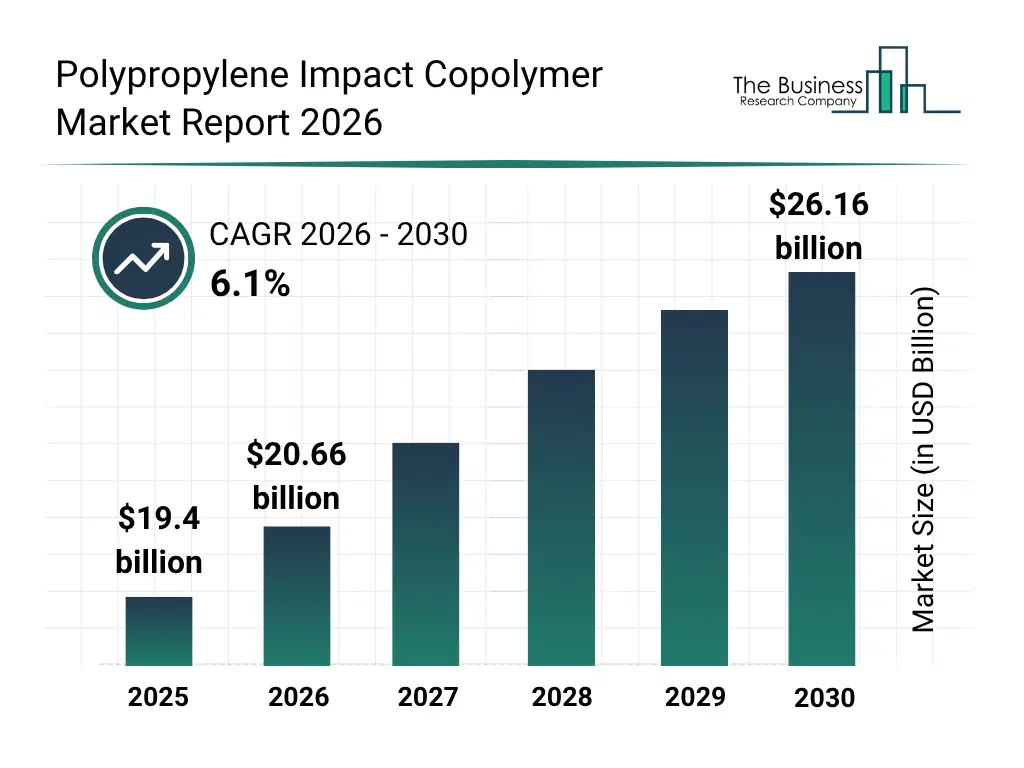
What Is The Polypropylene Impact Copolymer Market Size and Share 2026?
The polypropylene impact copolymer market size has grown strongly in recent years. It will grow from $19.4 billion in 2025 to $20.66 billion in 2026 at a compound annual growth rate (CAGR) of 6.5%. The growth in the historic period can be attributed to increasing demand for durable thermoplastic materials across automotive applications, growing replacement of conventional materials with lightweight polymer solutions, rising utilization of impact-resistant plastics in consumer goods manufacturing, expanding production of plastic components requiring improved toughness, increasing adoption of polypropylene materials due to processability and cost advantages.What Is The Polypropylene Impact Copolymer Market Growth Forecast?
The polypropylene impact copolymer market size is expected to see strong growth in the next few years. It will grow to $26.16 billion in 2030 at a compound annual growth rate (CAGR) of 6.1%.The growth in the forecast period can be attributed to growing demand for lightweight materials in electric vehicle components, increasing adoption of advanced polypropylene impact copolymers with enhanced performance properties, rising demand for recyclable and sustainable thermoplastic materials, expanding applications in high-performance packaging solutions, increasing investments in polymer modification and compounding technologies. Major trends in the forecast period include increasing adoption of polypropylene impact copolymers for lightweight and durable automotive components, growing demand for high impact polypropylene materials with improved toughness and crack resistance, rising development of customized polypropylene impact copolymer grades for specialized applications, expanding use of polypropylene impact copolymers in packaging and consumer product manufacturing, increasing preference for cost effective thermoplastic solutions with enhanced mechanical performance.
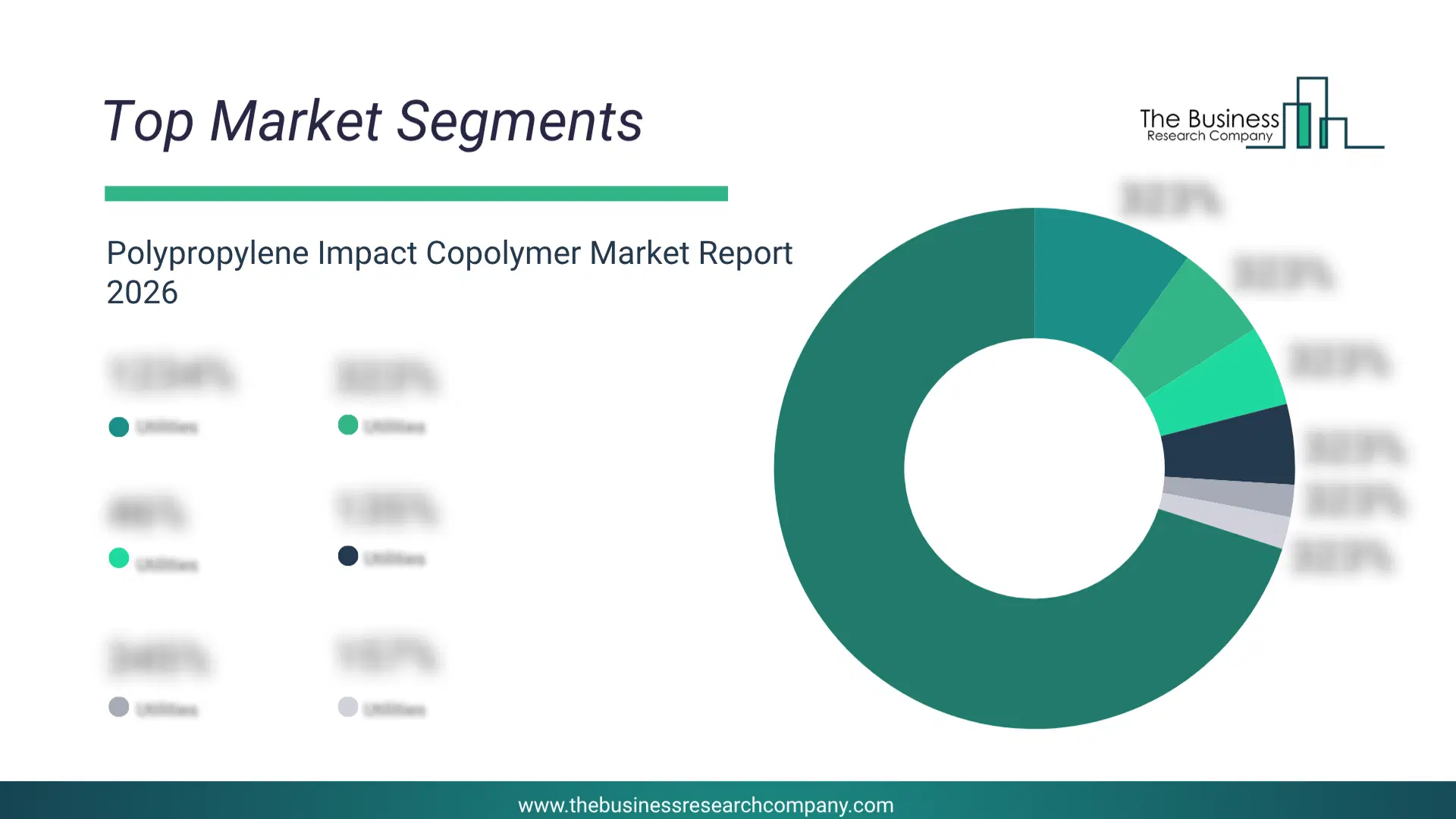
Global Polypropylene Impact Copolymer Market Segmentation
2) By Grade Type: General Purpose Grade, High Impact Grade, High Stiffness Grade, Enhanced Flow Grade 3) By Processing Technology Type: Injection Molding, Blow Molding, Extrusion, Thermoforming, Other Processing Technology Types 4) By Distribution Channel Type: Direct Sales, Distributors, Online Retailers, Third Party Suppliers 5) By End Use Industry Type: Automotive, Packaging, Building And Construction, Consumer Goods, Electrical And Electronics, Healthcare And Medical, Industrial Manufacturing, Energy And Utilities, Other End Use Industry Types Subsegments: 1) By Random Copolymer: Flexible Packaging Films, Food Packaging Containers, Medical Packaging Materials, Household Storage Products, Consumer Disposable Goods 2) By Block Copolymer: Automotive Interior Components, Automotive Exterior Components, Electrical Appliance Housings, Industrial Equipment Parts, Heavy Duty Crates And PalletsWhat Are The Drivers Of The Polypropylene Impact Copolymer Market?
The growing demand from the automotive industry is expected to propel the growth of the polypropylene impact copolymer market going forward. The automotive industry refers to the sector involved in the design, development, manufacturing, marketing, and sale of motor vehicles and their components. The growing demand from the automotive industry is driven by rising vehicle production and ownership, as increasing mobility needs and economic development are boosting global demand for passenger and commercial vehicles. Polypropylene impact copolymer helps the automotive industry by providing a lightweight, high-impact-resistant material that enhances vehicle durability, improves fuel efficiency through weight reduction, and supports cost-effective manufacturing of interior and exterior components. For instance, in April 2026, according to the Department for Transport, a UK-based government department, new vehicle registrations in 2025 grew by less than 1% compared to 2024, while by December 2025 there were 2,012,000 licensed zero-emission vehicles (4.8% of the total fleet), including 1,874,000 road-using units. Therefore, the growing demand from the automotive industry is driving the growth of the polypropylene impact copolymer industry. The expansion of the packaging industry is expected to propel the growth of the polypropylene impact copolymer market going forward. The packaging industry refers to the sector involved in the design, production, and distribution of materials used to protect, contain, and transport goods. The expansion of the packaging industry is driven by the growing demand for packaged and processed goods, as increasing urbanization and busy lifestyles are boosting the need for convenient, safe, and longer shelf-life product solutions. Polypropylene impact copolymer helps the packaging industry by offering excellent impact resistance, lightweight properties, and durability, making it ideal for producing strong, flexible, and cost-effective packaging materials. For instance, in September 2024, according to the State of the Flexible Packaging Industry Report by the Flexible Packaging Association, a US-based association, the U.S. flexible packaging industry reached an estimated $42.9 billion in sales in 2023, reflecting a 3.4% rise compared with $41.5 billion in 2022. Therefore, the expansion of the packaging industry is driving the growth of the polypropylene impact copolymer industry.Key Players In The Global Polypropylene Impact Copolymer Market
Major companies operating in the polypropylene impact copolymer market are Braskem S.A., Borouge International, China Petrochemical Corporation, Exxon Mobil Corporation, Formosa Plastics Corporation, Haldia Petrochemicals Limited, Hanwha Solutions Corporation, Hyosung Corporation, INEOS Group Holdings S.A., IRPC Public Company Limited, Japan Polypropylene Corporation, LG Chem Ltd., LyondellBasell Industries N.V., Mitsui Chemicals Inc., PetroChina Company Limited, Pinnacle Polymers, Reliance Industries Limited, Saudi Basic Industries Corporation, Sumitomo Chemical Co. Ltd., TotalEnergies SE, Versalis S.p.A., Chevron Phillips Chemical Company LLC, Borealis AG, LOTTE Chemical Corporation, Prime Polymer Co. Ltd., GS Caltex Corporation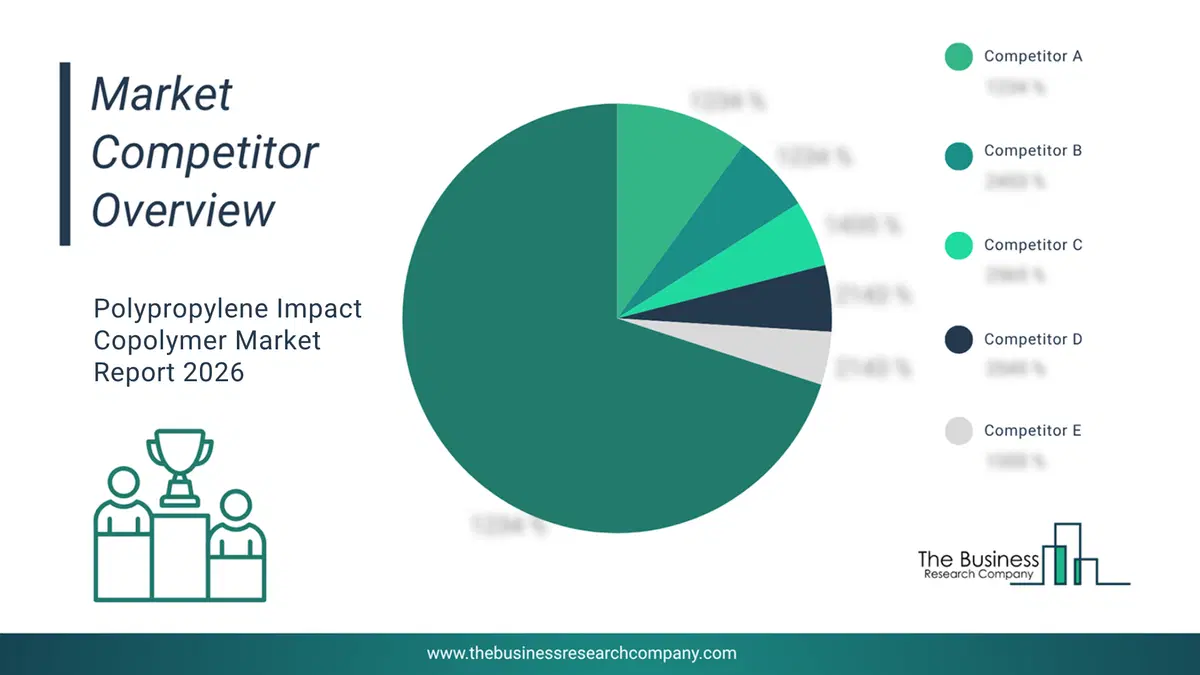
This chart is for illustrative purposes; the full report includes a detailed competitor analysis and comprehensive overview of the top 10 companies in the market.
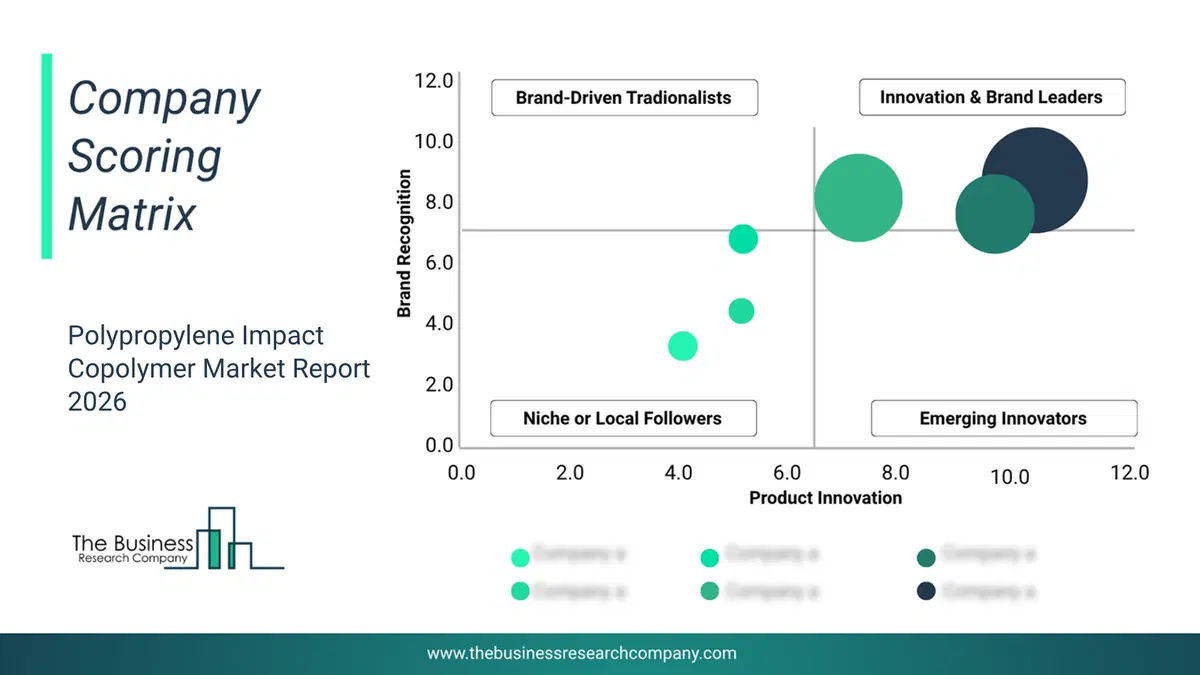
This chart maps companies by product innovation and brand strength, with bubble size indicating relative revenue, helping identify market leaders, challengers, and niche players. This is an illustrative chart; the full report provides a complete and accurate competitive analysis.
Global Polypropylene Impact Copolymer Market Trends and Insights
Major companies operating in the polypropylene impact copolymer market are focusing on developing advanced material solutions, such as high-performing polypropylene impact copolymer, to enhance impact resistance, durability, processability, and performance across automotive, packaging, and industrial applications. High-performing polypropylene impact copolymer is an advanced polypropylene material designed to deliver superior impact strength, toughness, and durability while maintaining excellent processing and mechanical performance across demanding applications. For instance, in October 2025, LyondellBasell Industries N.V., a US-based chemical industry company, unveiled Pro-fax EP648R, a new polypropylene impact copolymer grade designed for high-performance applications. It is designed to support improved material toughness and enhanced processing efficiency. The solution enables better impact resistance, improved stiffness balance, and greater suitability for demanding applications in packaging and consumer products, strengthening advanced polypropylene impact copolymer applications across global polymer and materials industries.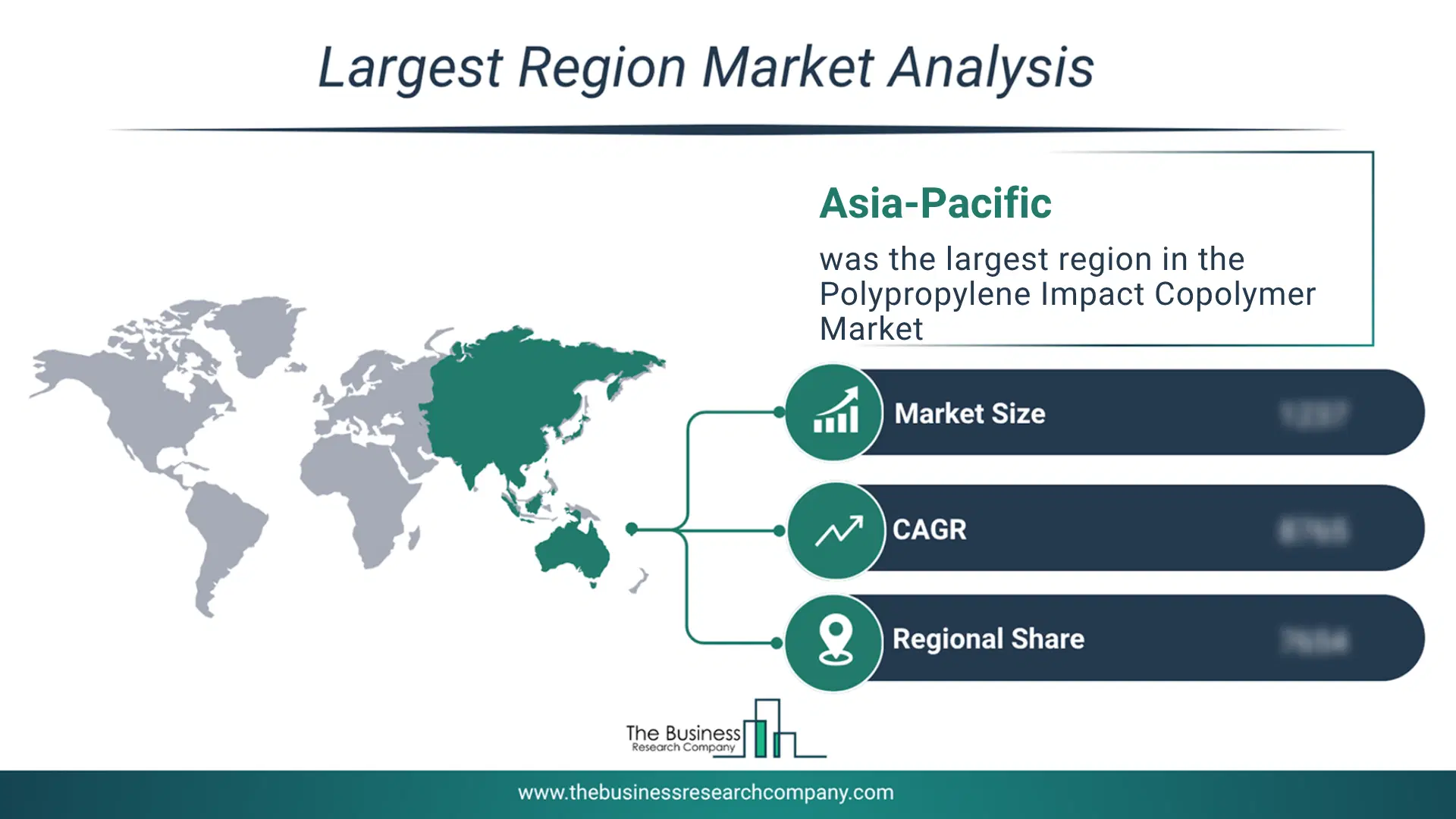
Regional Outlook/Insights
Asia-Pacific was the largest region in the polypropylene impact copolymer market in 2025. Asia-Pacific is expected to be the fastest-growing region in the forecast period. The regions covered in this market report are Asia-Pacific, South East Asia, Western Europe, Eastern Europe, North America, South America, Middle East, Africa. The countries covered in this market report are Australia, Brazil, China, France, Germany, India, Indonesia, Japan, Taiwan, Russia, South Korea, UK, USA, Canada, Italy, Spain.What Defines the Polypropylene Impact Copolymer Market?
The polypropylene impact copolymer market consists of sales of molded furniture parts, protective helmets, tool casings, and automotive battery trays. Values in this market are ‘factory gate’ values, that is, the value of goods sold by the manufacturers or creators of the goods, whether to other entities (including downstream manufacturers, wholesalers, distributors, and retailers) or directly to end customers. The value of goods in this market includes related services sold by the creators of the goods.How is Market Value Defined and Measured?
The market value is defined as the revenues that enterprises gain from the sale of goods and/or services within the specified market and geography through sales, grants, or donations in terms of the currency (in USD unless otherwise specified). The revenues for a specified geography are consumption values that are revenues generated by organizations in the specified geography within the market, irrespective of where they are produced. It does not include revenues from resales along the supply chain, either further along the supply chain or as part of other products.
This chart presents market attractiveness based on a quantitative evaluation of growth, competition, strategic alignment, and risk, offering a clear view of opportunity areas for decision-making. This chart is for illustrative purposes; the full report contains the complete analysis.

This chart highlights the Total Addressable Market (TAM) by estimating the maximum revenue opportunity using an assumption-driven approach, supporting strategic planning and opportunity sizing across markets. The chart is illustrative; the full report provides a more comprehensive analysis.
What Key Data and Analysis Are Included in the Polypropylene Impact Copolymer Market Report 2026?
The polypropylene impact copolymer market research report is one of a series of new reports from The Business Research Company that provides polypropylene impact copolymer market statistics, including polypropylene impact copolymer industry global market size, regional shares, competitors with a polypropylene impact copolymer market share, detailed polypropylene impact copolymer market segments, market trends and opportunities, and any further data you may need to thrive in the polypropylene impact copolymer industry. This polypropylene impact copolymer market research report delivers a complete perspective of everything you need, with an in-depth analysis of the current and future scenario of the industry.Polypropylene Impact Copolymer Market Report Forecast Analysis
| Report Attribute | Details |
|---|---|
| Market Size Value In 2026 | $20.66 billion |
| Revenue Forecast In 2030 | $26.16 billion |
| Growth Rate | CAGR of 6.1% from 2026 to 2030 |
| Base Year For Estimation | 2025 |
| Actual Estimates/Historical Data | 2020-2025 |
| Forecast Period | 2026 - 2030 |
| Market Representation | Revenue in USD Billion and CAGR from 2026 to 2030 |
| Segments Covered | Product Type, Grade Type, Processing Technology Type, Distribution Channel Type, End Use Industry Type |
| Regional Scope | Asia-Pacific, Western Europe, Eastern Europe, North America, South America, Middle East, Africa |
| Country Scope | The countries covered in the report are Australia, Brazil, China, France, Germany, India, Indonesia, Japan, Taiwan, Russia, South Korea, UK, USA, Canada, Italy, Spain. |
| Key Companies Profiled | Braskem S.A., Borouge International, China Petrochemical Corporation, Exxon Mobil Corporation, Formosa Plastics Corporation, Haldia Petrochemicals Limited, Hanwha Solutions Corporation, Hyosung Corporation, INEOS Group Holdings S.A., IRPC Public Company Limited, Japan Polypropylene Corporation, LG Chem Ltd., LyondellBasell Industries N.V., Mitsui Chemicals Inc., PetroChina Company Limited, Pinnacle Polymers, Reliance Industries Limited, Saudi Basic Industries Corporation, Sumitomo Chemical Co. Ltd., TotalEnergies SE, Versalis S.p.A., Chevron Phillips Chemical Company LLC, Borealis AG, LOTTE Chemical Corporation, Prime Polymer Co. Ltd., GS Caltex Corporation |
| Customization Scope | Request for Customization |
| Pricing And Purchase Options | Explore Purchase Options |