
Port Electrification Market Report 2026
Global Outlook – By Components (Cables And Accessories, Frequency Convertors, Switchgear Devices, Transformers, Other Components), By Port Equipment Type (Electric Cargo Handling Equipment, Electric Warehouse Equipment, Electric Marine Vessels), By Connection (New Installation, Retrofit), By Installation Type (Shipside, Shoreside) – Market Size, Trends, Strategies, and Forecast to 2030
Port Electrification Market Overview
• Port Electrification market size has reached to $2.79 billion in 2025 • Expected to grow to $4.64 billion in 2030 at a compound annual growth rate (CAGR) of 10.6% • Growth Driver: Rising Global Trade Driving Demand For The Market Due To Increasing Import-Export Activities • Market Trend: Industry Collaborations Accelerating Decarbonization And Sustainable Infrastructure Adoption • Europe was the largest region in 2025 and North America is the fastest growing region.What Is Covered Under Port Electrification Market?
Port electrification refers to the transition of port operations from fossil fuel-based energy sources to electricity. This shift allows vessels and port facilities to draw power from onshore electrical systems instead of relying on engines powered by conventional fuels. The process helps reduce air pollution, lower greenhouse gas emissions, and support environmentally sustainable operations, contributing to cleaner and more energy-efficient maritime and port activities. The main components of port electrification include cables and accessories, frequency converters, switchgear devices, transformers, and others. Cables and accessories refer to power cables, connectors, joints, and related fittings that ensure safe and efficient transmission of electricity across port electrification systems. Port equipment types in port electrification include electric cargo handling equipment, electric warehouse equipment, and electric marine vessels, with connections classified as new installations and retrofits, and installation types divided into shipside and shoreside.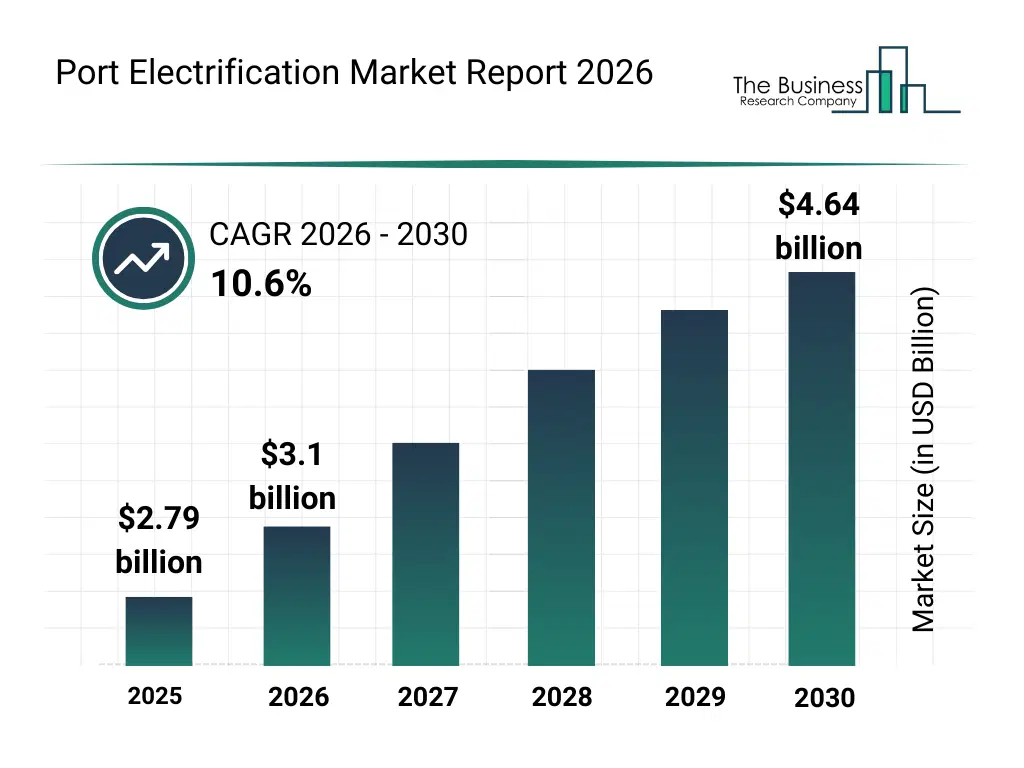
What Is The Port Electrification Market Size and Share 2026?
The port electrification market size has grown rapidly in recent years. It will grow from $2.79 billion in 2025 to $3.1 billion in 2026 at a compound annual growth rate (CAGR) of 11.1%. The growth in the historic period can be attributed to expansion of global maritime trade, rising regulatory pressure to reduce port emissions, early adoption of cold ironing solutions, investments in port infrastructure modernization, increasing electricity availability at major ports.What Is The Port Electrification Market Growth Forecast?
The port electrification market size is expected to see rapid growth in the next few years. It will grow to $4.64 billion in 2030 at a compound annual growth rate (CAGR) of 10.6%. The growth in the forecast period can be attributed to increasing net-zero commitments by port authorities, rising electrification of marine vessels, expansion of smart port initiatives, growing investments in renewable-powered ports, increasing replacement of diesel-based port equipment. Major trends in the forecast period include increasing adoption of shoreside power infrastructure, rising deployment of electric cargo handling equipment, expansion of retrofit electrification projects, growing integration of energy storage systems, enhanced focus on emission-free port operations.
Global Port Electrification Market Segmentation
1) By Components: Cables And Accessories, Frequency Convertors, Switchgear Devices, Transformers, Other Components 2) By Port Equipment Type: Electric Cargo Handling Equipment, Electric Warehouse Equipment, Electric Marine Vessels 3) By Connection: New Installation, Retrofit 4) By Installation Type: Shipside, Shoreside Subsegments: 1) By Cables And Accessories: Low Voltage Cables, Medium Voltage Cables, High Voltage Cables 2) By Frequency Convertors: Voltage Source Convertors, Current Source Convertors, Cycloconverters 3) By Switchgear Devices: Air Insulated Switchgear, Gas Insulated Switchgear, Vacuum Switchgear 4) By Transformers: Distribution Transformers, Power Transformers, Dry Type Transformers 5) By Other Components: Power Distribution Panels, Energy Storage Systems, Circuit BreakersWhat Is The Driver Of The Port Electrification Market?
The increase in global trade is expected to propel the growth of the port electrification market going forward. Trade refers to the exchange of goods, services, and capital across international borders to support economic growth and global connectivity. Trade is increasing due to rising consumer demand for diverse products that require countries to import and export beyond their local production capabilities. Port electrification helps trading by enabling faster, cleaner, and more efficient port operations, reducing delays and emissions to support the smooth movement of goods across international supply chains. For instance, in June 2024, according to the Bureau of Economic Analysis (BEA), a US-based government agency, average exports increased by $10.2 billion, while average imports rose by $13.1 billion from April 2023. Therefore, the increase in global trade is driving the growth of the port electrification industry.Key Players In The Global Port Electrification Market
Major companies operating in the port electrification market are Hitachi Energy Ltd., Siemens AG, Schneider Electric SE, ABB Ltd., Wärtsilä Corporation, Cavotec SA, PowerCon AS, Stemmann‑Technik GmbH, Danfoss Inc., GE Vernova Inc., Kalmar Corporation, Ormazabal International Business S.A., Conductix‑Wampfler GmbH, ESL Power Systems Inc., MJR Power And Automation, Enel X, Alstom, Prysmian Group, Eaton Corporation plc, Mitsubishi Electric Corporation
This chart is for illustrative purposes; the full report includes a detailed competitor analysis and comprehensive overview of the top 10 companies in the market.
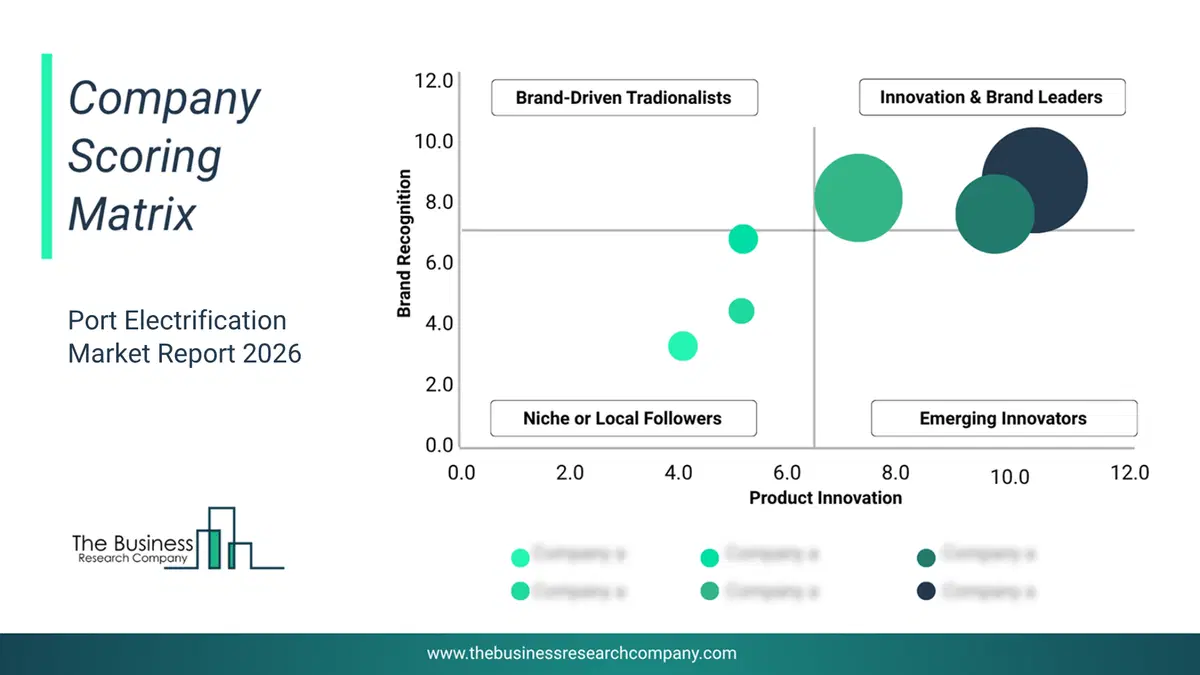
This chart maps companies by product innovation and brand strength, with bubble size indicating relative revenue, helping identify market leaders, challengers, and niche players. This is an illustrative chart; the full report provides a complete and accurate competitive analysis.
Global Port Electrification Market Trends and Insights
Major companies operating in the port electrification market are focusing on developing industry-wide strategic coalitions to accelerate decarbonization, standardize solutions, and drive large-scale adoption of zero-emission port infrastructure. Industry-wide strategic coalition refers to a collaborative alliance of key stakeholders across the sector working together to develop common standards, share resources, and accelerate the adoption of port electrification solutions. For instance, in December 2023, APM Terminals, a Netherlands-based shipping company, partnered with DP World, a UAE-based logistics company, to launch a zero-emission port alliance (ZEPA) at COP28 to accelerate the decarbonization of global ports. It aims to accelerate the adoption of battery-electric container handling equipment to decarbonize global ports. It focuses on making clean port equipment affordable, accessible, and attractive through industry collaboration. ZEPA drives collective action to reduce emissions, improve air quality, and enable sustainable port electrification this decade.What Are Latest Mergers And Acquisitions In The Port Electrification Market?
In March 2025, Wilh. Wilhelmsen Holding ASA, a Norway-based shipping company that offers port electrification, partnered with Yinson GreenTech and R W Marine Services Pte. Ltd. to advance shore power and zero-emission port solutions. This partnership aims to accelerate marine electrification in Singapore by reducing emissions, enhancing operational efficiency, and promoting the adoption of electric service vessels in line with the Maritime and Port Authority of Singapore’s sustainability goals. Yinson GreenTech is a Malaysia-based technology company, and R W Marine Services Pte. Ltd. is a Singapore-based company providing 24/7 sea transportation services.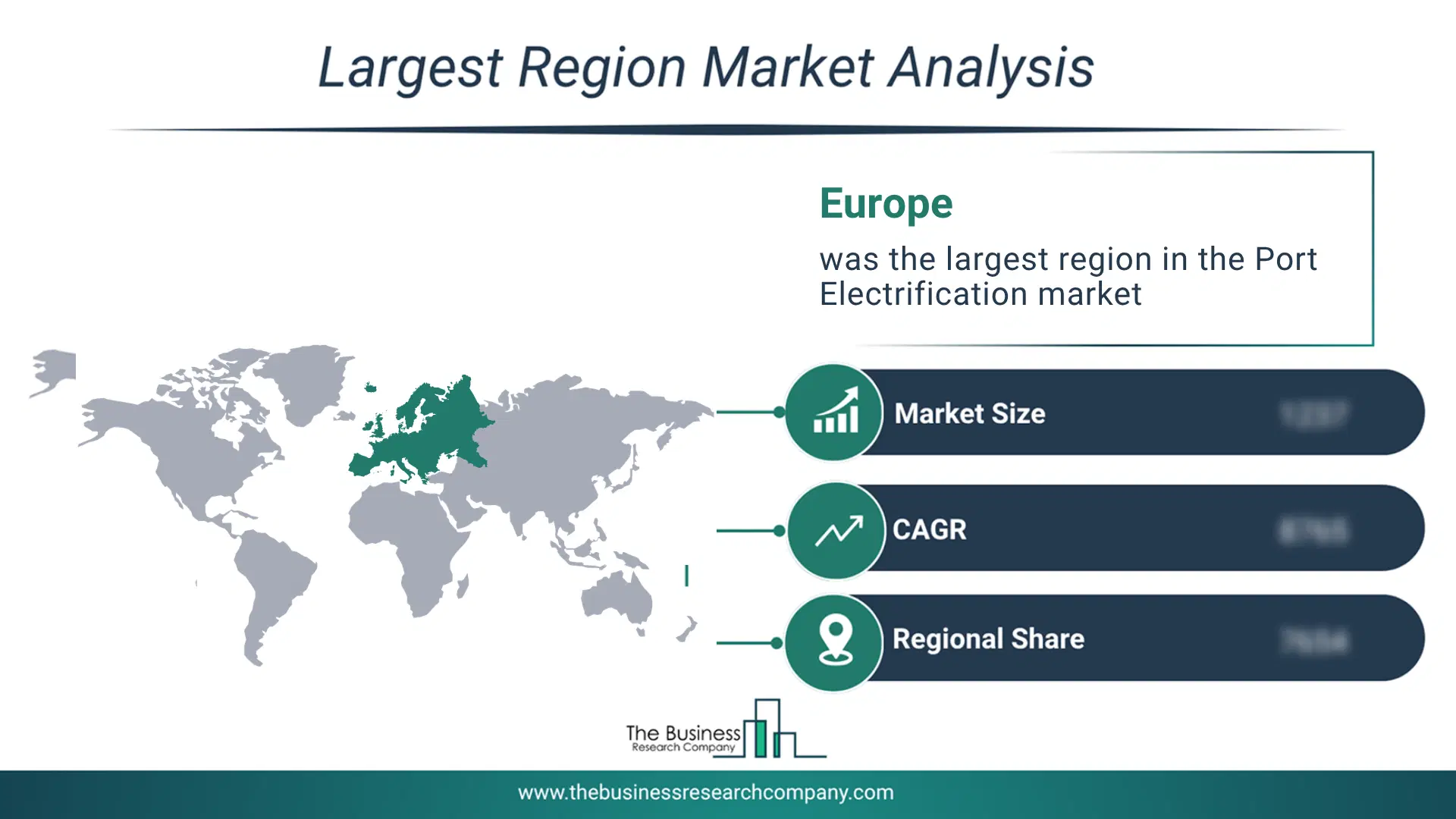
Regional Outlook
Europe was the largest region in the port electrification market in 2025. North America is expected to be the fastest-growing region in the forecast period. The regions covered in this market report are Asia-Pacific, South East Asia, Western Europe, Eastern Europe, North America, South America, Middle East, Africa. The countries covered in this market report are Australia, Brazil, China, France, Germany, India, Indonesia, Japan, Taiwan, Russia, South Korea, UK, USA, Canada, Italy, SpainWhat Defines the Port Electrification Market?
The port electrification market consists of sales of shore power systems, onshore power converters, and electrified cargo handling equipment. Values in this market are ‘factory gate’ values that is, the value of goods sold by the manufacturers or creators of the goods, whether to other entities (including downstream manufacturers, wholesalers, distributors, and retailers) or directly to end customers. The value of goods in this market includes related services sold by the creators of the goods.How is Market Value Defined and Measured?
The market value is defined as the revenues that enterprises gain from the sale of goods and/or services within the specified market and geography through sales, grants, or donations in terms of the currency (in USD unless otherwise specified). The revenues for a specified geography are consumption values that are revenues generated by organizations in the specified geography within the market, irrespective of where they are produced. It does not include revenues from resales along the supply chain, either further along the supply chain or as part of other products.
This chart presents market attractiveness based on a quantitative evaluation of growth, competition, strategic alignment, and risk, offering a clear view of opportunity areas for decision-making. This chart is for illustrative purposes; the full report contains the complete analysis.

This chart highlights the Total Addressable Market (TAM) by estimating the maximum revenue opportunity using an assumption-driven approach, supporting strategic planning and opportunity sizing across markets. The chart is illustrative; the full report provides a more comprehensive analysis.
What Key Data and Analysis Are Included in the Port Electrification Market Report 2026?
The port electrification market research report is one of a series of new reports from The Business Research Company that provides market statistics, including Market Report 2026?global market size, regional shares, competitors with the market share, detailed market segments, market trends and opportunities, and any further data you may need to thrive in the port electrification Market Report 2026? The market research report delivers a complete perspective of everything you need, with an in-depth analysis of the current and future state of the Market Report 2026?Port Electrification Market Report Forecast Analysis
| Report Attribute | Details |
|---|---|
| Market Size Value In 2026 | $3.1 billion |
| Revenue Forecast In 2030 | $4.64 billion |
| Growth Rate | CAGR of 11.1% from 2026 to 2030 |
| Base Year For Estimation | 2025 |
| Actual Estimates/Historical Data | 2020-2025 |
| Forecast Period | 2026 - 2030 - 2030 |
| Market Representation | Revenue in USD Billion and CAGR from 2026 to 2030 |
| Segments Covered | Components, Port Equipment Type, Connection, Installation Type |
| Regional Scope | Asia-Pacific, Western Europe, Eastern Europe, North America, South America, Middle East, Africa |
| Country Scope | The countries covered in the report are Australia, Brazil, China, France, Germany, India, Indonesia, Japan, Taiwan, Russia, South Korea, UK, USA, Canada, Italy, Spain. |
| Key Companies Profiled | Hitachi Energy Ltd., Siemens AG, Schneider Electric SE, ABB Ltd., Wärtsilä Corporation, Cavotec SA, PowerCon AS, Stemmann‑Technik GmbH, Danfoss Inc., GE Vernova Inc., Kalmar Corporation, Ormazabal International Business S.A., Conductix‑Wampfler GmbH, ESL Power Systems Inc., MJR Power And Automation, Enel X, Alstom, Prysmian Group, Eaton Corporation plc, Mitsubishi Electric Corporation |
| Customization Scope | Request for Customization |
| Pricing And Purchase Options | Explore Purchase Options |