
Port Equipment Predictive Maintenance Market Report 2026
Global Outlook – By Component (Software, Hardware, Services), By Equipment Type (Cranes, Forklifts, Reach Stackers, Terminal Tractors, Automated Guided Vehicles, Other Equipment Types), By Deployment Mode (On-Premises, Cloud), By Application (Container Terminals, Bulk Terminals, Ro-Ro Terminals, Other Applications), By End-User (Port Operators, Shipping Companies, Logistics Providers, Other End-Users) – Market Size, Trends, Strategies, and Forecast to 2030
Port Equipment Predictive Maintenance Market Overview
• Port Equipment Predictive Maintenance market size has reached to $1.22 billion in 2025 • Expected to grow to $2.87 billion in 2030 at a compound annual growth rate (CAGR) of 18.8% • Growth Driver: Rising Trade Volumes Driving Market Growth Due To Increasing Demand And Expansion Of International Shipping Networks • Market Trend: Smart Crane Deployments Drive Real-Time Monitoring And Operational Efficiency In Container Terminals • Asia-Pacific was the largest region in 2025 and North America is the fastest growing region.What Is Covered Under Port Equipment Predictive Maintenance Market?
Port equipment predictive maintenance is a strategy that uses real-time data and advanced analytics to anticipate equipment failures before they occur. It monitors machinery conditions, such as vibration, temperature, and usage patterns, to optimize maintenance schedules and reduce unexpected downtime. The main components of port equipment predictive maintenance include software, hardware, and services. Software refers to platforms that monitor and analyze equipment performance to predict maintenance needs, reduce downtime, and optimize operational efficiency. They cover equipment types such as cranes, forklifts, reach stackers, terminal tractors, automated guided vehicles, and other equipment types and are deployed through on-premises and cloud models. The various applications involved are container terminals, bulk terminals, and Ro-Ro terminals, and they are used by several end users such as port operators, shipping companies, logistics providers, and other end-users.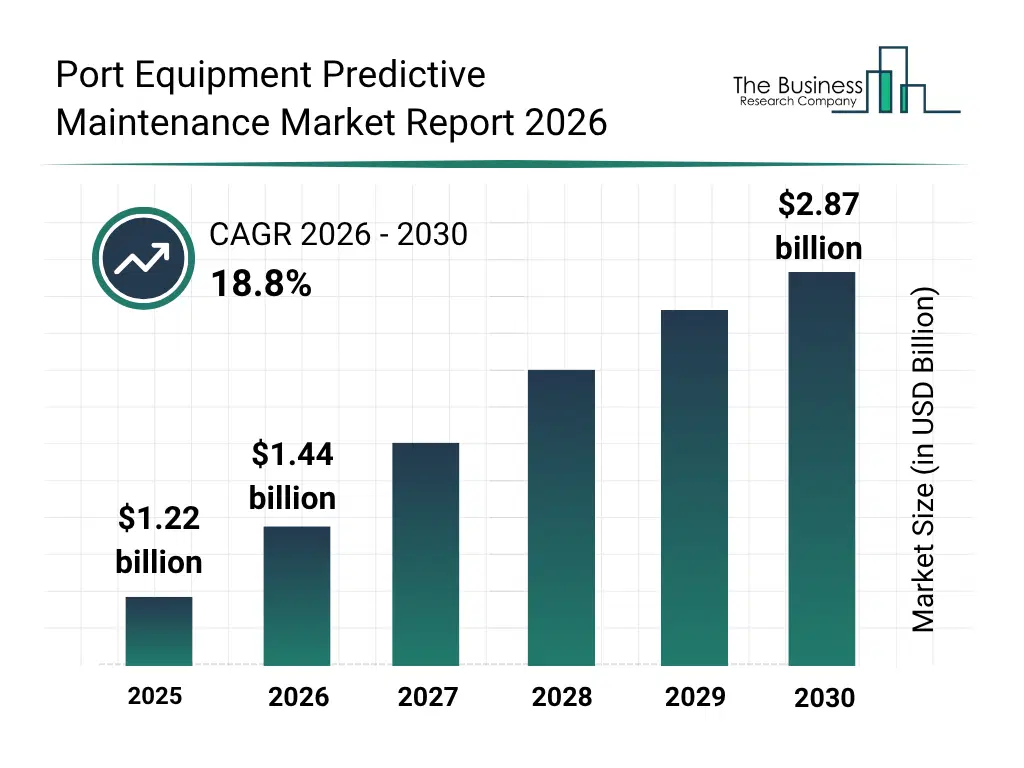
What Is The Port Equipment Predictive Maintenance Market Size and Share 2026?
The port equipment predictive maintenance market size has grown rapidly in recent years. It will grow from $1.22 billion in 2025 to $1.44 billion in 2026 at a compound annual growth rate (CAGR) of 18.6%. The growth in the historic period can be attributed to increasing port equipment downtime, reliance on reactive maintenance, adoption of basic monitoring systems, rising operational costs, growth of global port operations.What Is The Port Equipment Predictive Maintenance Market Growth Forecast?
The port equipment predictive maintenance market size is expected to see rapid growth in the next few years. It will grow to $2.87 billion in 2030 at a compound annual growth rate (CAGR) of 18.8%. The growth in the forecast period can be attributed to adoption of ai-based predictive maintenance, integration of iot sensors with port equipment, demand for reduced operational downtime, investment in cloud-based maintenance solutions, expansion of automated and smart port infrastructure. Major trends in the forecast period include real-time equipment health monitoring, predictive maintenance analytics, remote diagnostics and maintenance, integration with port management systems, ai-driven maintenance scheduling.
Global Port Equipment Predictive Maintenance Market Segmentation
1) By Component: Software, Hardware, Services 2) By Equipment Type: Cranes, Forklifts, Reach Stackers, Terminal Tractors, Automated Guided Vehicles, Other Equipment Types 3) By Deployment Mode: On-Premises, Cloud 4) By Application: Container Terminals, Bulk Terminals, Ro-Ro Terminals, Other Applications 5) By End-User: Port Operators, Shipping Companies, Logistics Providers, Other End-Users Subsegments: 1) By Software: Predictive Analytics Platforms, Maintenance Management Software, Data Integration And Visualization Software, Artificial Intelligence Based Monitoring Software, Cloud Based Maintenance Solutions 2) By Hardware: Sensors And Condition Monitoring Devices, Data Acquisition Systems, Edge Computing Devices, Communication And Networking Equipment, Industrial Controllers And Embedded Systems 3) By Services: System Integration Services, Consulting And Advisory Services, Installation And Deployment Services, Maintenance And Support Services, Training And Technical Assistance ServicesWhat Are The Drivers Of The Port Equipment Predictive Maintenance Market?
The rising trade volumes are expected to support the growth of the port equipment predictive maintenance market in the coming years. Trade volumes refer to the total quantity or value of goods and services exchanged through international commerce. The recovery and expansion of global economies are driving increased demand for goods, leading to higher cargo movement across major ports worldwide. As ports manage growing and more complex cargo flows, the operational reliability of equipment such as cranes, forklifts, and other handling machinery becomes increasingly critical. Predictive maintenance solutions help reduce unexpected equipment failures, optimize maintenance schedules, and improve asset utilization, enabling ports to handle higher throughput more efficiently while controlling operational costs. For instance, in 2024, according to UNCTAD, a Switzerland-based intergovernmental organization, total seaborne trade grew by 2.4% in 2024, and containerized trade is projected to grow at an average rate of 2.7% between 2025 and 2029. Therefore, the rising trade volumes are driving the growth of the port equipment predictive maintenance industry. The growth in automation of port equipment is expected to propel the growth of the port equipment predictive maintenance market going forward. Automation of port equipment refers to the adoption of technologies that reduce human involvement in loading, unloading, and moving cargo containers within terminals. The automation of port equipment is rising due to the need to improve operational efficiency and reduce human errors in handling increasing cargo volumes. Automation of port equipment enables real-time monitoring of machinery performance and operational conditions, allowing predictive maintenance systems to detect potential failures early, optimize maintenance schedules, and ensure smoother, more reliable port operations. For instance, in March 2024, according to the Government Accountability Office, a US-based government agency, all ten of the largest container ports in the U.S. have implemented automation technologies for cargo handling, with at least one terminal at each port using these systems to monitor and communicate container movements. Therefore, growth in automation of port equipment is driving the growth of the port equipment predictive maintenance industry.Key Players In The Global Port Equipment Predictive Maintenance Market
Major companies operating in the port equipment predictive maintenance market are Siemens AG, IBM Corporation, Oracle Corporation, Schneider Electric SE, Honeywell International Inc., SAP SE, ABB Ltd., Parker Hannifin Corporation, Schaeffler Technologies AG & Co. KG, Emerson Electric Co., Liebherr-International AG, KION Group AG, SANY Group Co. Ltd., SKF AB, Rockwell Automation Inc., Terex Corporation, Konecranes Oyj, Hyster-Yale Materials Handling Inc., Trelleborg AB, National Instruments Corporation, Banner Engineering Corp., Mi-Jack Products Inc., and Anhui Heli Co. Ltd.
This chart is for illustrative purposes; the full report includes a detailed competitor analysis and comprehensive overview of the top 10 companies in the market.
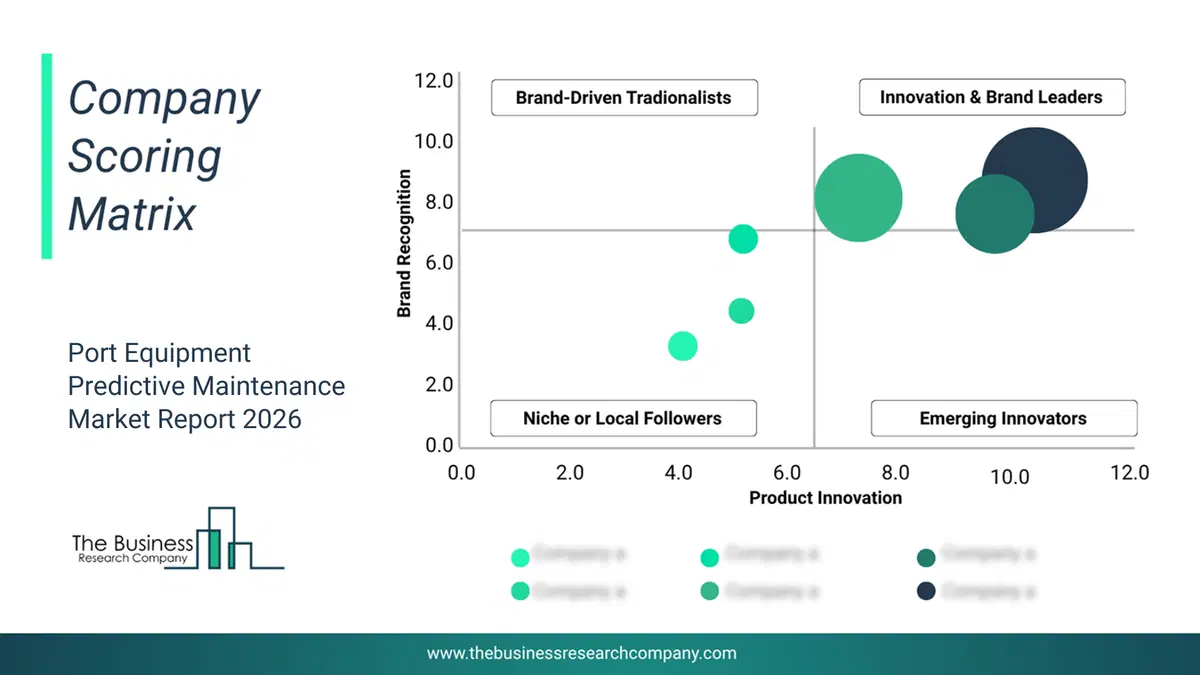
This chart maps companies by product innovation and brand strength, with bubble size indicating relative revenue, helping identify market leaders, challengers, and niche players. This is an illustrative chart; the full report provides a complete and accurate competitive analysis.
Global Port Equipment Predictive Maintenance Market Trends and Insights
Major companies operating in the port equipment predictive maintenance market are focusing on developing innovative solutions such as, port container handling gantry cranes, to enhance real-time equipment monitoring, minimize unplanned downtime, and improve operational efficiency across container terminals. Port container handling gantry cranes are large automated or semi-automated lifting systems used at ports to load, unload, and stack shipping containers efficiently between ships, trucks, and storage yards. For instance, in September 2025, Dubai Ports World, a UAE-based ports and logistics company, launched quay cranes and electric rubber-tyre gantry (RTG) cranes at the Mundra international container terminal, integrating predictive-maintenance-ready monitoring technologies into the equipment. These port container handling gantry cranes are large, rail- or wheel-mounted lifting systems designed to efficiently load, unload, and stack standardized shipping containers between vessels and yard storage areas. The newly deployed cranes feature advanced sensor-based diagnostics, real-time condition monitoring, CCTV-enabled operational analytics, and energy-efficient drive mechanisms to enhance safety, precision, and equipment uptime. The electric RTG cranes further reduce emissions and operational noise while enabling continuous digital tracking of critical components to support proactive maintenance scheduling.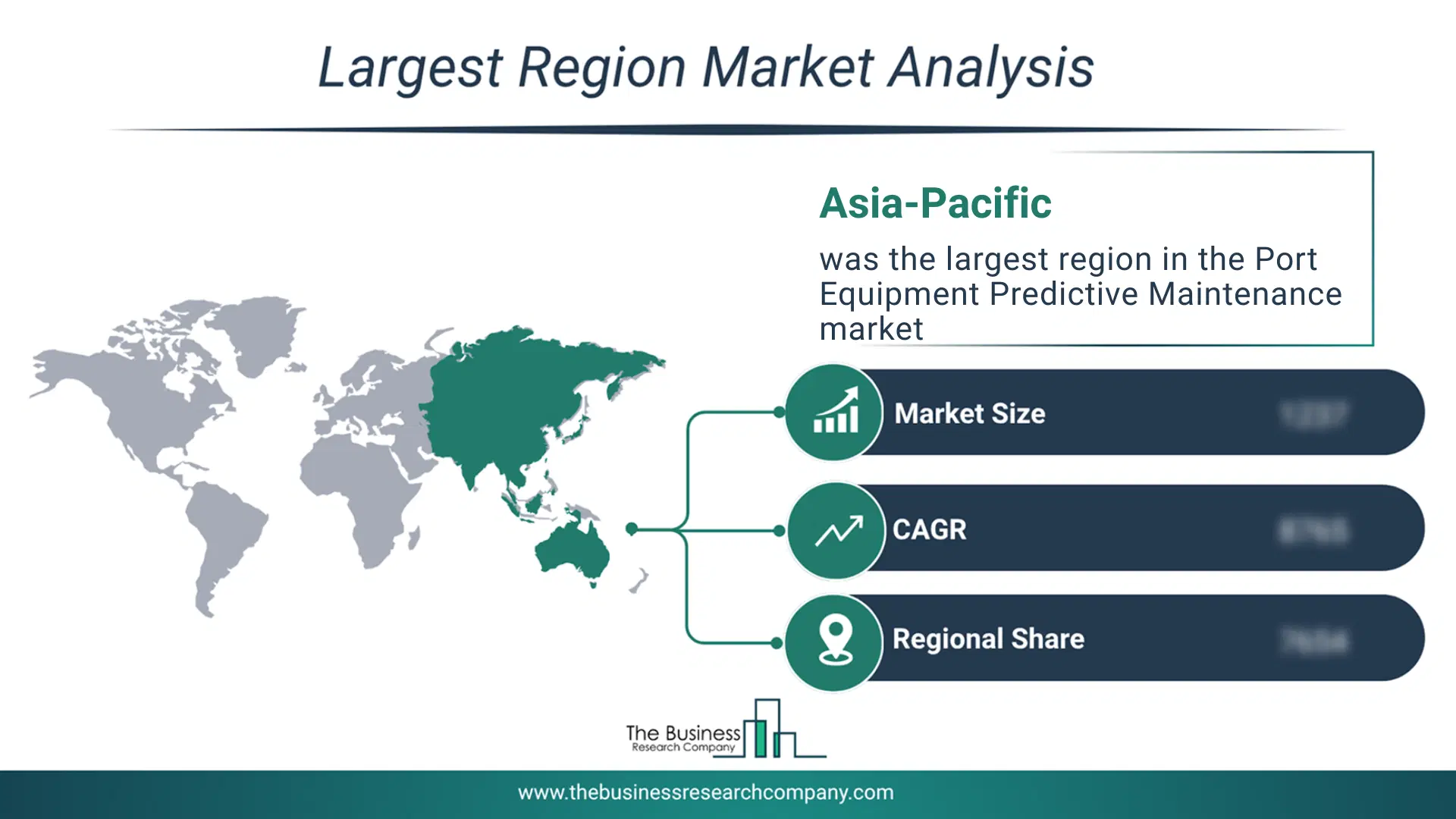
Regional Insights
Asia-Pacific was the largest region in the port equipment predictive maintenance market in 2025. North America is expected to be the fastest-growing region in the forecast period. The regions covered in this market report are Asia-Pacific, South East Asia, Western Europe, Eastern Europe, North America, South America, Middle East, Africa. The countries covered in this market report are Australia, Brazil, China, France, Germany, India, Indonesia, Japan, Taiwan, Russia, South Korea, UK, USA, Canada, Italy, Spain.What Defines the Port Equipment Predictive Maintenance Market?
The port equipment predictive maintenance market consists of revenues earned by entities by providing services such as condition monitoring, diagnostic inspections, predictive analytics, equipment performance assessment, failure analysis, and maintenance scheduling. The market value includes the value of related hardware, sensors, and digital monitoring systems sold by the service provider or included within the service offering. The port equipment predictive maintenance market includes sales of industrial sensors, monitoring devices, monitoring equipment, diagnostic tools, and integrated maintenance management systems. Values in this market are ‘factory gate’ values, that is, the value of goods sold by the manufacturers or creators of the goods, whether to other entities including downstream manufacturers, system integrators, distributors, and service providers, or directly to end customers.How is Market Value Defined and Measured?
The market value is defined as the revenues that enterprises gain from the sale of goods and/or services within the specified market and geography through sales, grants, or donations in terms of the currency (in USD unless otherwise specified). The revenues for a specified geography are consumption values that are revenues generated by organizations in the specified geography within the market, irrespective of where they are produced. It does not include revenues from resales along the supply chain, either further along the supply chain or as part of other products.
This chart presents market attractiveness based on a quantitative evaluation of growth, competition, strategic alignment, and risk, offering a clear view of opportunity areas for decision-making. This chart is for illustrative purposes; the full report contains the complete analysis.

This chart highlights the Total Addressable Market (TAM) by estimating the maximum revenue opportunity using an assumption-driven approach, supporting strategic planning and opportunity sizing across markets. The chart is illustrative; the full report provides a more comprehensive analysis.
What Key Data And Analysis Are Included In The Port Equipment Predictive Maintenance Market Report 2026?
The port equipment predictive maintenance market research report is one of a series of new reports from The Business Research Company that provides market statistics, including industry global market size, regional shares, competitors with the market share, detailed market segments, market trends and opportunities, and any further data you may need to thrive in the port equipment predictive maintenance industry. The market research report delivers a complete perspective of everything you need, with an in-depth analysis of the current and future state of the industry.Port Equipment Predictive Maintenance Market Report Forecast Analysis
| Report Attribute | Details |
|---|---|
| Market Size Value In 2026 | $1.44 billion |
| Revenue Forecast In 2030 | $2.87 billion |
| Growth Rate | CAGR of 18.6% from 2026 to 2030 |
| Base Year For Estimation | 2025 |
| Actual Estimates/Historical Data | 2020-2025 |
| Forecast Period | 2026 - 2030 - 2030 |
| Market Representation | Revenue in USD Billion and CAGR from 2026 to 2030 |
| Segments Covered | Component, Equipment Type, Deployment Mode, Application, End-User |
| Regional Scope | Asia-Pacific, Western Europe, Eastern Europe, North America, South America, Middle East, Africa |
| Country Scope | The countries covered in the report are Australia, Brazil, China, France, Germany, India, Indonesia, Japan, Taiwan, Russia, South Korea, UK, USA, Canada, Italy, Spain. |
| Key Companies Profiled | Siemens AG, IBM Corporation, Oracle Corporation, Schneider Electric SE, Honeywell International Inc., SAP SE, ABB Ltd., Parker Hannifin Corporation, Schaeffler Technologies AG & Co. KG, Emerson Electric Co., Liebherr-International AG, KION Group AG, SANY Group Co. Ltd., SKF AB, Rockwell Automation Inc., Terex Corporation, Konecranes Oyj, Hyster-Yale Materials Handling Inc., Trelleborg AB, National Instruments Corporation, Banner Engineering Corp., Mi-Jack Products Inc., and Anhui Heli Co. Ltd. |
| Customization Scope | Request for Customization |
| Pricing And Purchase Options | Explore Purchase Options |