
Position, Navigation And Timing (PNT) Clock Market Report 2026
Global Outlook – By Component Offering (Hardware, Software, Integrated Systems, Services), By Clock Technology (Atomic Clocks, Optical Clocks, Chip-Scale Atomic Clocks, Quantum-Based Timing Mechanisms, Timing Modules), By Application (Precise Time Synchronization, Satellite-Based Positioning And Navigation, Timing-As-A-Service, Resilient And Backup Timing), By End-User Industry (Telecommunications, Defense And Aerospace, Critical Infrastructure, Space And Satellite Systems, Transportation And Automotive) – Market Size, Trends, Strategies, and Forecast to 2035
Position, Navigation And Timing (PNT) Clock Market Overview
• Position, Navigation And Timing (PNT) Clock market size has reached to $0.24 billion in 2025 • Expected to grow to $0.3 billion in 2030 at a compound annual growth rate (CAGR) of 29.7% • Growth Driver: Expansion Of Space Exploration And Satellite Deployments Fueling The Growth Of The Market Due To Increasing Need For Precise Timing Signals And Global Navigation Synchronization • Market Trend: Compact Atomic Clock Launch Supports Next-Generation PNT Systems • North America was the largest region in 2025 and Asia-Pacific is the fastest growing region.What Is Covered Under Position, Navigation And Timing (PNT) Clock Market?
Position, navigation and timing (PNT) clocks are highly precise timekeeping systems that provide accurate and synchronized timing signals essential for satellite navigation, telecommunications, defense systems, and critical infrastructure operations. These systems utilize advanced technologies to ensure ultra-stable and highly accurate time reference generation for positioning and navigation applications. They enable precise coordination of systems that depend on synchronized timing and geospatial accuracy. The main components of position, navigation and timing (pnt) clock solutions include hardware, software, integrated systems and services. Hardware refers to precision timing devices and physical synchronization equipment such as atomic clock units and chip-scale modules that deliver ultra-accurate time references essential for navigation, communication and positioning applications. The clock technologies include atomic clocks, optical clocks, chip-scale atomic clocks, quantum-based timing mechanisms and timing modules, and the application areas include precise time synchronization, satellite-based positioning and navigation, timing-as-a-service and resilient and backup timing, and the key end-user industry such as telecommunications, defence and aerospace, critical infrastructure, space and satellite systems as well as transportation and automotive.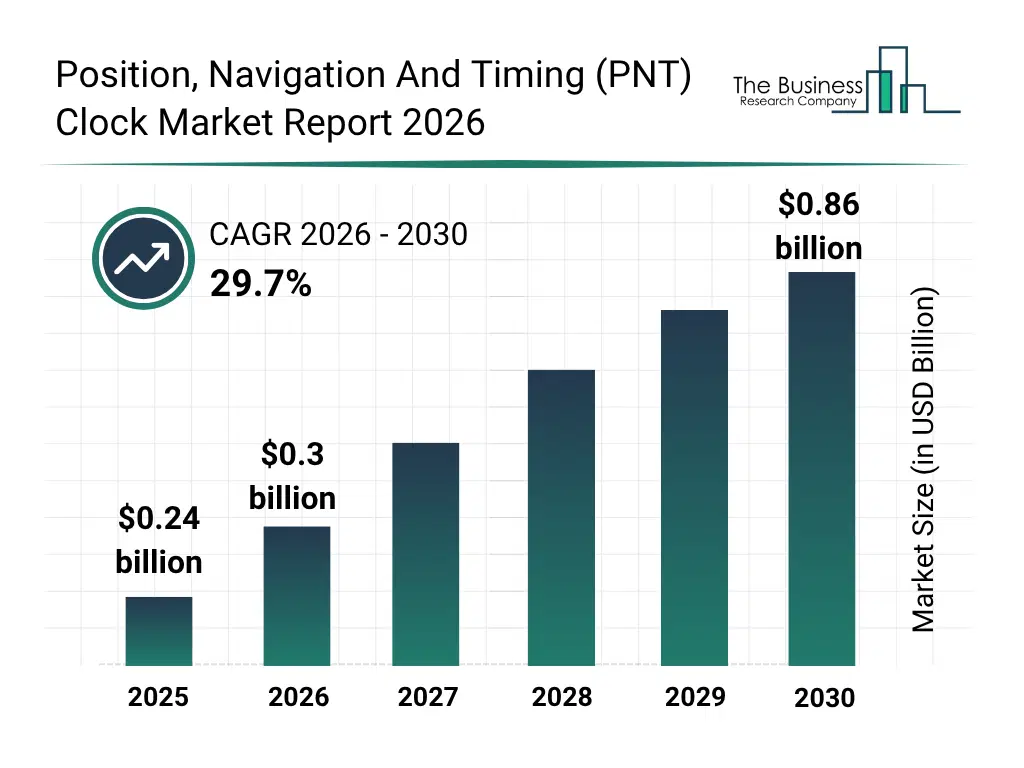
What Is The Position, Navigation And Timing (PNT) Clock Market Size and Share 2026?
The position, navigation and timing (pnt) clock market size has grown exponentially in recent years. It will grow from $0.24 billion in 2025 to $0.3 billion in 2026 at a compound annual growth rate (CAGR) of 29.5%. The growth in the historic period can be attributed to gps based timing adoption growth, expansion of telecom network infrastructure, rise of satellite navigation systems, increasing defense communication modernization, development of atomic clock technologies.What Is The Position, Navigation And Timing (PNT) Clock Market Growth Forecast?
The position, navigation and timing (pnt) clock market size is expected to see exponential growth in the next few years. It will grow to $0.86 billion by 2030 at a compound annual growth rate (CAGR) of 29.7%. The growth in the forecast period can be attributed to surge in autonomous system navigation demand, expansion of 5g and 6g networks, rising need for cyber secure timing infrastructure, growth of space based communication systems, increasing adoption of precision critical industrial automation. Major trends in the forecast period include AI driven timing synchronization optimization, 5g and next generation network time precision expansion, edge based distributed timing architecture adoption, quantum and chIP scale atomic clock advancement, resilient gnss independent timing solutions development.
Global Position, Navigation And Timing (PNT) Clock Market Segmentation
1) By Component Offering: Hardware, Software, Integrated Systems, Services 2) By Clock Technology: Atomic Clocks, Optical Clocks, Chip-Scale Atomic Clocks, Quantum-Based Timing Mechanisms, Timing Modules 3) By Application: Precise Time Synchronization, Satellite-Based Positioning And Navigation, Timing-As-A-Service, Resilient And Backup Timing 4) By End-User Industry: Telecommunications, Defense And Aerospace, Critical Infrastructure, Space And Satellite Systems, Transportation And Automotive Subsegments: 1) By Hardware: Atomic Clock Units, Quartz Crystal Oscillators, Chip Scale Atomic Clocks, Timing Modules, Frequency Control Units 2) By Software: Timing Synchronization Software, Clock Management Software, Signal Processing Software, Network Time Distribution Software, Monitoring And Control Software 3) By Integrated Systems: Time Synchronization Systems, Navigation And Timing Systems, Network Timing Systems, Resilient Timing Systems, Multi Source Timing Systems 4) By Services: System Integration Services, Consulting Services, Deployment And Implementation Services, Maintenance And Support Services, Calibration And Testing ServicesWhat Is The Driver Of The Position, Navigation And Timing (PNT) Clock Market?
The expansion of space exploration and satellite deployments are expected to propel the growth of the position, navigation and timing (PNT) clock forward. Space exploration and satellite deployments refer to the launch and operation of spacecraft and satellites to study space, support scientific research, and provide essential services such as communication, Earth observation, navigation, and timing. The rise in space exploration and satellite deployments is expanding due to the rapid growth of commercial satellite constellations, which require frequent launches to deploy and maintain large networks for global communication and data services. Space exploration and satellite deployments are essential for Position, Navigation, and Timing (PNT) clocks because they enable the deployment of satellite constellations that transmit precise timing signals required for accurate global synchronization and navigation systems. For instance, in January 2026, according to Davidson Institute of Science Education, a Israel-based educational outreach arm, indicates that Orbital launch activity recorded strong and sustained growth, reaching a record 324 launches in 2025, representing a 24.1% increase from 261 launches in 2024 and a 45.3% increase from 223 launches in 2023. Launch reliability remained high, with a 96% success rate in 2025 (311 successful missions), compared to 97% in 2024 and 95% in 2023. Therefore, expansion of space exploration and satellite deployments is driving the growth of the position, navigation and timing (PNT) clock industry.Key Players In The Global Position, Navigation And Timing (PNT) Clock Market
Major companies operating in the position, navigation and timing (pnt) clock market are RTX Corporation; Northrop Grumman Corporation; Qualcomm Technologies Inc.; BAE Systems plc; Safran Electronics & Defense SAS; Thales S.A.; Leonardo S.p.A.; Microchip Technology Incorporated; Hexagon AB; Teledyne Technologies Incorporated; Garmin Ltd.; SiTime Corporation; Frequency Electronics Inc.; Menlo Systems GmbH; Stanford Research Systems Inc.; Calnex Solutions plc; Meinberg Funkuhren GmbH & Co. KG; AccuBeat Ltd.; NAVSYS Corporation; EndRun Technologies LLC; SpacePNT Inc.; TrustPoint Inc.; TOPTICA Photonics AGGlobal Position, Navigation And Timing (PNT) Clock Market Trends and Insights
Major companies operating in the position, navigation and timing (PNT) clock market are focusing on developing advanced timing technologies such as chip-scale atomic clocks (CSACs) to enhance synchronization accuracy, resilience, and reliable timing performance in contested and GNSS-denied environments. Chip-scale atomic clocks (CSACs) refer to ultra-compact, low-power atomic timing devices that deliver highly precise and stable frequency references for applications requiring continuous timing when satellite signals are disrupted or unavailable. For instance, in March 2026, Microchip Technology Incorporated, a US-based semiconductor company, launched the SA65-LN Chip-Scale Atomic Clock (CSAC) designed for GNSS-denied environments. The launched clock provides ultra-precise timing synchronization for defense, aerospace, and resilient PNT applications where satellite signals may be unavailable, jammed, or spoofed. Additionally, it supports compact and power-efficient deployment in mission-critical systems requiring dependable autonomous timing performance.What Are Latest Mergers And Acquisitions In The Position, Navigation And Timing (PNT) Clock Market?
In August 2025, NextNav, a US–based resilient Position, Navigation, and Timing technology company, formed a strategic partnership with Oscilloquartz to advance 5G based timing solutions for critical infrastructure. With this partnership, NextNav and Oscilloquartz aim to develop and deploy 5G-based resilient timing and synchronization solutions that can complement GPS and other PNT clocks, providing highly accurate and reliable timing for critical infrastructure, communications networks, and applications where uninterrupted and precise time distribution is essential. Oscilloquartz is a Switzerland-based company that specializes in global time synchronization solutions and PNT clock systems.Regional Insights
North America was the largest region in the position, navigation and timing (PNT) clock market in 2025. Asia-Pacific is expected to be the fastest-growing region in the forecast period. The regions covered in this market report are Asia-Pacific, South East Asia, Western Europe, Eastern Europe, North America, South America, Middle East, Africa. The countries covered in this market report are Australia, Brazil, China, France, Germany, India, Indonesia, Japan, Taiwan, Russia, South Korea, UK, USA, Canada, Italy, Spain.What Defines the Position, Navigation And Timing (PNT) Clock Market?
The position, navigation and timing (PNT) clock market consists of revenues earned by entities by providing services such as precise time synchronization services, satellite-based positioning and navigation services, timing-as-a-service, and resilient and backup timing services. The market value includes the value of related goods sold by the manufacturer or included within the solution offering. The position, navigation and timing (PNT) clock market also includes sales of temperature-compensated crystal oscillators, oven-controlled crystal oscillators, timing cards, and embedded timing modules. Values in this market are ‘factory gate’ values, that is, the value of goods sold by the manufacturers or creators of the goods, whether to other entities (including downstream integrators, wholesalers, distributors, and system providers) or directly to end customers. The value of goods in this market includes related services sold by the creators of the goods.How is Market Value Defined and Measured?
The market value is defined as the revenues that enterprises gain from the sale of goods and/or services within the specified market and geography through sales, grants, or donations in terms of the currency (in USD unless otherwise specified). The revenues for a specified geography are consumption values that are revenues generated by organizations in the specified geography within the market, irrespective of where they are produced. It does not include revenues from resales along the supply chain, either further along the supply chain or as part of other products.What Key Data and Analysis Are Included in the Position, Navigation And Timing (PNT) Clock Market Report 2026?
The position, navigation and timing (pnt) clock market research report is one of a series of new reports from The Business Research Company that provides market statistics, including industry global market size, regional shares, competitors with the market share, detailed market segments, market trends and opportunities, and any further data you may need to thrive in the position, navigation and timing (pnt) clock industry. The market research report delivers a complete perspective of everything you need, with an in-depth analysis of the current and future state of the industry.Position, Navigation And Timing (PNT) Clock Market Report Forecast Analysis
| Report Attribute | Details |
|---|---|
| Market Size Value In 2026 | $0.3 billion |
| Revenue Forecast In 2035 | $0.86 billion |
| Growth Rate | CAGR of 29.70% from 2026 to 2035 |
| Base Year For Estimation | 2025 |
| Actual Estimates/Historical Data | 2020-2025 |
| Forecast Period | 2026 - 2030 - 2035 |
| Market Representation | Revenue in USD Billion and CAGR from 2026 to 2035 |
| Segments Covered | Component Offering, Clock Technology, Application, End-User Industry |
| Regional Scope | Asia-Pacific, Western Europe, Eastern Europe, North America, South America, Middle East, Africa |
| Country Scope | The countries covered in the position, navigation and timing (pnt) clock market report are Australia, Brazil, China, France, Germany, India, Indonesia, Japan, Taiwan, Russia, South Korea, UK, USA, Canada, Italy, Spain. |
| Key Companies Profiled | RTX Corporation; Northrop Grumman Corporation; Qualcomm Technologies Inc.; BAE Systems plc; Safran Electronics & Defense SAS; Thales S.A.; Leonardo S.p.A.; Microchip Technology Incorporated; Hexagon AB; Teledyne Technologies Incorporated; Garmin Ltd.; SiTime Corporation; Frequency Electronics Inc.; Menlo Systems GmbH; Stanford Research Systems Inc.; Calnex Solutions plc; Meinberg Funkuhren GmbH & Co. KG; AccuBeat Ltd.; NAVSYS Corporation; EndRun Technologies LLC; SpacePNT Inc.; TrustPoint Inc.; TOPTICA Photonics AG |
| Customization Scope | Request for Customization |
| Pricing And Purchase Options | Explore Purchase Options |