
Post-Quantum Transport Layer Security (TLS) Hardware Accelerator Market Report 2026
Global Outlook – By Product Type (Field-Programmable Gate Array (FPGA)–Based Accelerators, Application-Specific Integrated Circuit (ASIC)–Based Accelerators, System-On-Chip (SoC)-Based Accelerators, Other Product Types), By Algorithm (Lattice-Based, Code-Based, Multivariate, Hash-Based, Other Algorithms), By End-User (Banking, Financial Services, And Insurance (BFSI), Information Technology (IT) And Telecommunications, Healthcare, Government, Manufacturing, Other End-Users) – Market Size, Trends, Strategies, and Forecast to 2030
Post-Quantum Transport Layer Security (TLS) Hardware Accelerator Market Overview
• Post-Quantum Transport Layer Security (TLS) Hardware Accelerator market size has reached to $1.2 billion in 2025 • Expected to grow to $4.16 billion in 2030 at a compound annual growth rate (CAGR) of 28.2% • Growth Driver: Increasing Frequency of Cyberattacks Driving The Market Growth Due To Cryptographic Protection Requirements • Market Trend: High-Performance Cryptography For Quantum-Safe Data Transmission • North America was the largest region in 2025 and Asia-Pacific is the fastest growing region.What Is Covered Under Post-Quantum Transport Layer Security (TLS) Hardware Accelerator Market?
A post-quantum transport layer security (TLS) hardware accelerator is a specialized device designed to perform cryptographic operations that secure communications against attacks from quantum computers. It optimizes the computation of post-quantum algorithms, enabling faster and more efficient encryption, decryption, and key exchange. It offloads these complex operations from general-purpose processors, enhancing overall system performance while maintaining quantum-resistant security. The main product types of post-quantum transport layer security (TLS) hardware accelerators are field-programmable gate array (FPGA)–based accelerators, application-specific integrated circuit (ASIC)–based accelerators, system-on-chip (SoC)–based accelerators, and other product types. FPGA-based accelerators are reconfigurable modules that offload tasks to boost throughput and reduce latency, enabling post-quantum handshake and signature flows at wire speed. These accelerators use algorithms such as lattice-based, code-based, multivariate, hash-based, and other algorithms, and are utilized by end-users including banking, financial services, and insurance (BFSI), information technology (IT) and telecommunications, healthcare, government, manufacturing, and other organizations.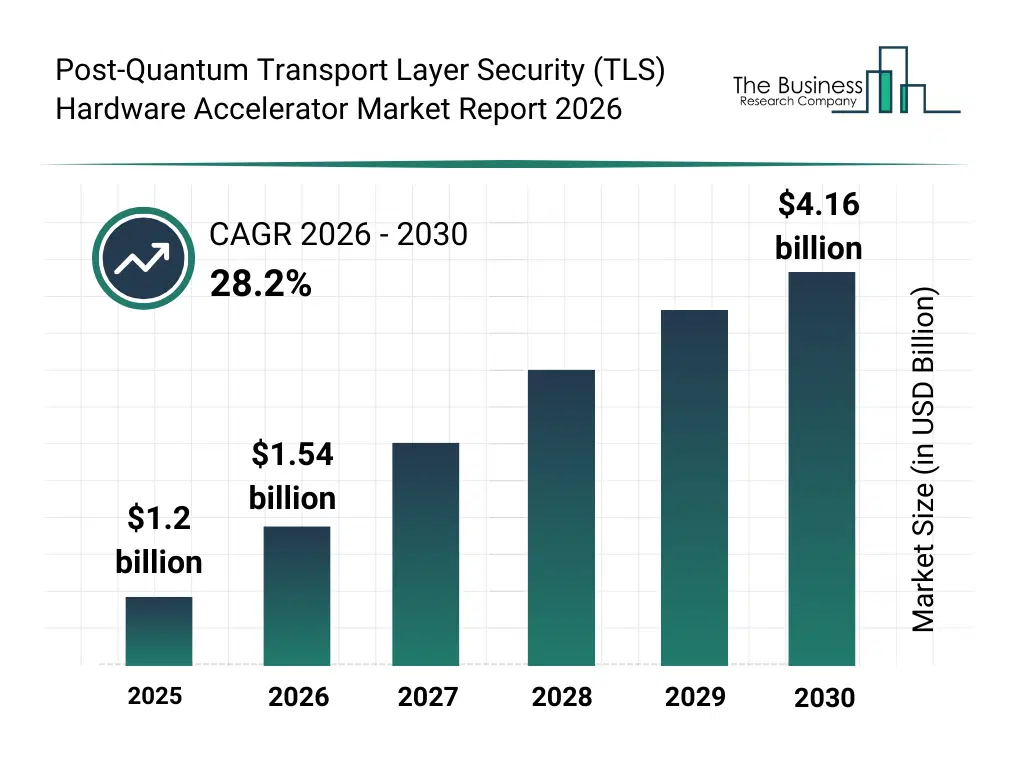
What Is The Post-Quantum Transport Layer Security (TLS) Hardware Accelerator Market Size and Share 2026?
The post-quantum transport layer security (tls) hardware accelerator market size has grown exponentially in recent years. It will grow from $1.2 billion in 2025 to $1.54 billion in 2026 at a compound annual growth rate (CAGR) of 28.4%. The growth in the historic period can be attributed to increasing cyber threats, adoption of classical tls appliances, growth of enterprise it infrastructure, rising demand for secure banking transactions, advancements in encryption algorithms.What Is The Post-Quantum Transport Layer Security (TLS) Hardware Accelerator Market Growth Forecast?
The post-quantum transport layer security (tls) hardware accelerator market size is expected to see exponential growth in the next few years. It will grow to $4.16 billion in 2030 at a compound annual growth rate (CAGR) of 28.2%. The growth in the forecast period can be attributed to rising quantum computing threats, integration of pqc in enterprise networks, demand for high-performance hardware accelerators, expansion of fintech and digital banking, regulatory push for quantum-safe security. Major trends in the forecast period include quantum-resistant encryption adoption, high-speed cryptographic computation, low-latency key exchange optimization, hardware offloading for pqc, integrated post-quantum security modules.
Global Post-Quantum Transport Layer Security (TLS) Hardware Accelerator Market Segmentation
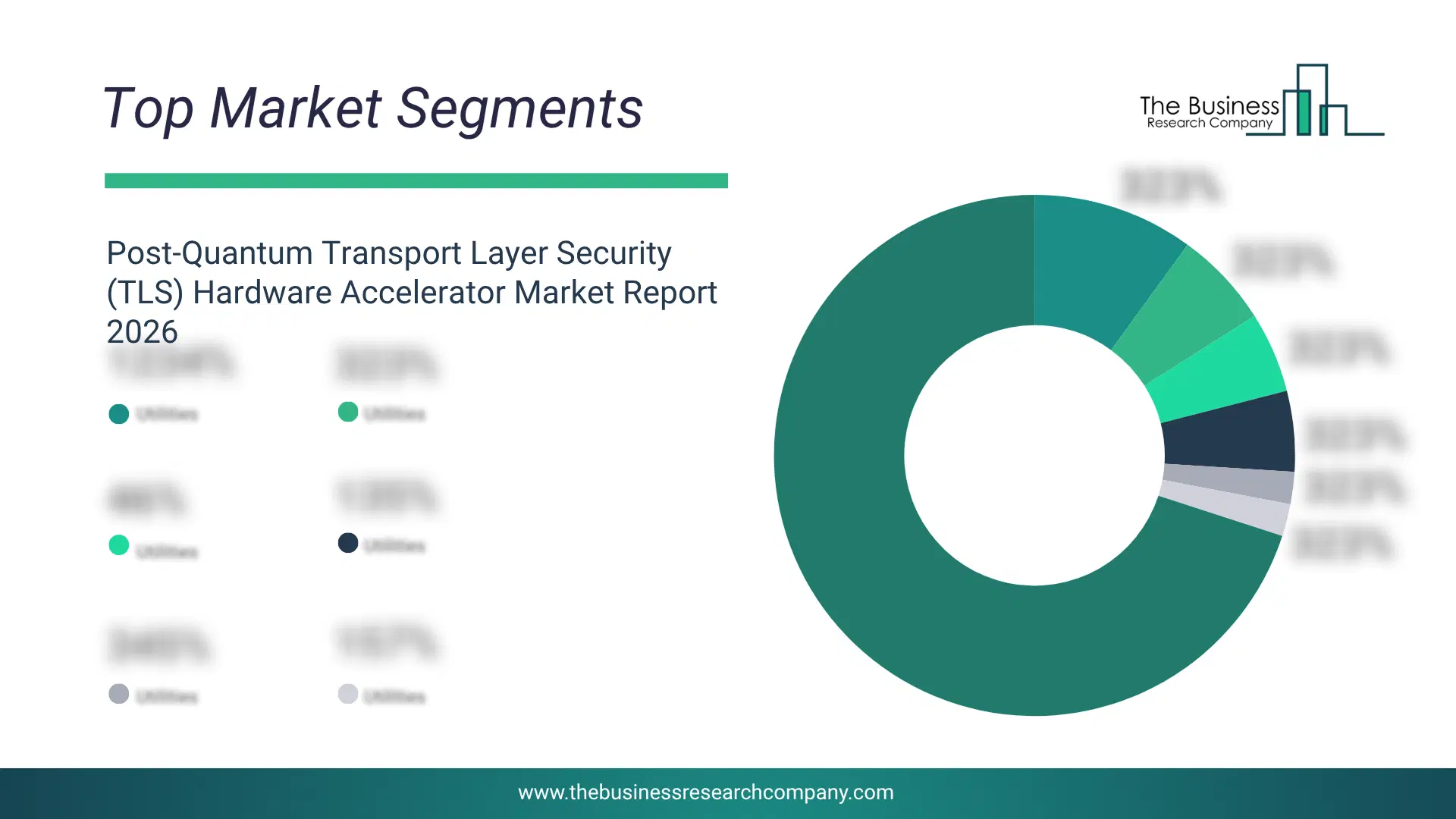
1) By Product Type: Field-Programmable Gate Array (FPGA)–Based Accelerators, Application-Specific Integrated Circuit (ASIC)–Based Accelerators, System-On-Chip (SoC)-Based Accelerators, Other Product Types 2) By Algorithm: Lattice-Based, Code-Based, Multivariate, Hash-Based, Other Algorithms 3) By End-User: Banking, Financial Services, And Insurance (BFSI), Information Technology (IT) And Telecommunications, Healthcare, Government, Manufacturing, Other End-Users Subsegments: 1) By Field-Programmable Gate Array (FPGA) Based Accelerators: Standard Field-Programmable Gate Array (FPGA) Accelerators, High Performance Field-Programmable Gate Array (FPGA) Accelerators, Low Power Field-Programmable Gate Array (FPGA) Accelerators, Custom Configured Field-Programmable Gate Array (FPGA) Accelerators 2) By Application-Specific Integrated Circuit (ASIC) Based Accelerators: High Speed Application-Specific Integrated Circuit (ASIC) Accelerators, Low Latency Application-Specific Integrated Circuit (ASIC) Accelerators, Energy Efficient Application-Specific Integrated Circuit (ASIC) Accelerators, Custom Designed Application-Specific Integrated Circuit (ASIC) Accelerators 3) By System-On-Chip (SoC) Based Accelerators: Embedded System-On-Chip (SoC) Accelerators, High Performance System-On-Chip (SoC) Accelerators, Low Power System-On-Chip (SoC) Accelerators, Custom Configured System-On-Chip (SoC) Accelerators 4) By Other Product Types: Hybrid Accelerators, Multi-Chip Module Accelerators, Graphics Processing Unit (GPU) Integrated Accelerators, Custom Quantum Resistant AcceleratorsWhat Is The Driver Of The Post-Quantum Transport Layer Security (TLS) Hardware Accelerator Market?
The increasing frequency of cyberattacks is expected to propel the growth of the post-quantum transport layer security (TLS) hardware accelerator market going forward. Cyberattacks are deliberate attempts by malicious actors to breach, damage, or gain unauthorized access to computer systems, networks, or data. The frequency of cyberattacks has increased due to digitalization, as the rapid adoption of online systems, cloud services, and connected devices has expanded the number of vulnerable targets, while the reliance on digital platforms for communication, banking, and business operations has made cybercrime more profitable and impactful. Post-quantum transport layer security (TLS) hardware accelerator enhances cybersecurity by accelerating quantum-resistant encryption, strengthening the protection of sensitive data in transit, reducing the risk of interception or tampering, and making it significantly harder for attackers, including those using advanced quantum computing techniques, to exploit communication channels and launch successful cyberattacks. For instance, in March 2024, according to the Federal Bureau of Investigation, a US-based federal law enforcement agency, the number of internet crime complaints rose from 800,944 in 2022 to 880,418 in 2023, with associated losses increasing from $10.3 billion to $12.5 billion, reflecting a 22% increase in financial damages. Therefore, the increasing frequency of cyberattacks is driving the growth of the post-quantum transport layer security (TLS) hardware accelerator industry.Key Players In The Global Post-Quantum Transport Layer Security (TLS) Hardware Accelerator Market
Major companies operating in the post-quantum transport layer security (tls) hardware accelerator market are IBM Corporation, Intel Corporation, Broadcom Inc., Hewlett Packard Enterprise Company, NVIDIA Corporation, Thales S.A., Infineon Technologies AG, NXP Semiconductors N.V., Microchip Technology Inc., IDEMIA Secure Transactions, Lattice Semiconductor Corporation, Napatech A/S, Silicom Ltd., Futurex Inc., Axiado Corporation, Securosys SA, Eideticom Inc., fragmentiX AG, Xiphera Oy, PQShield Limited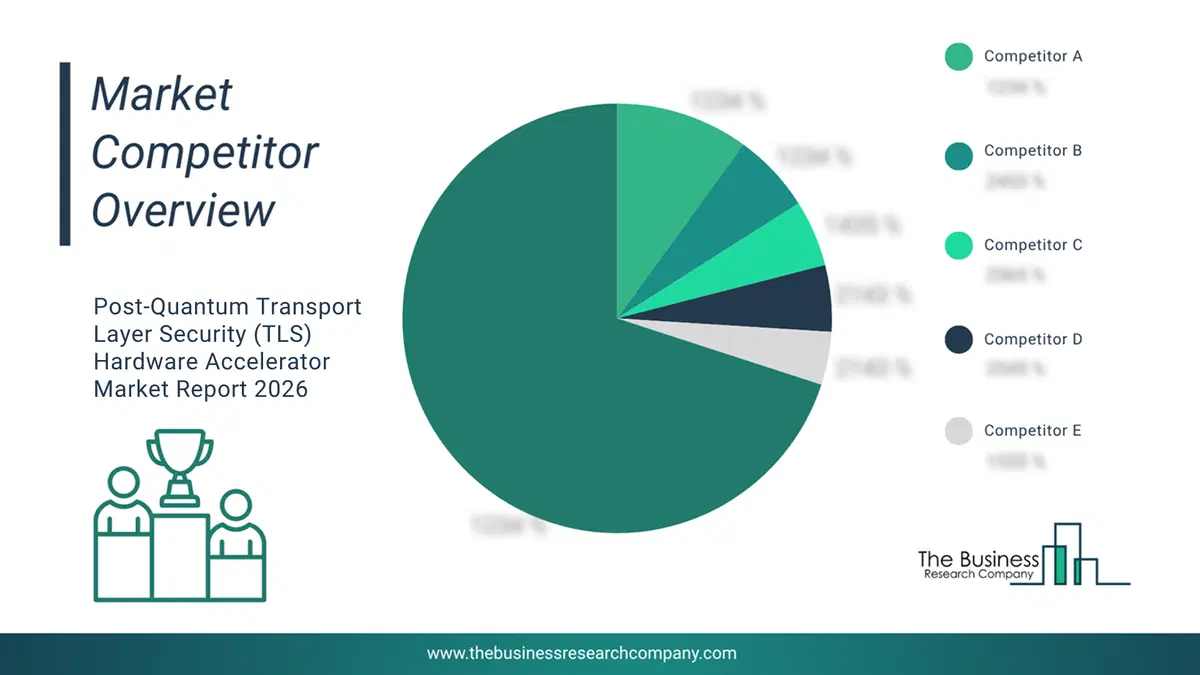
This chart is for illustrative purposes; the full report includes a detailed competitor analysis and comprehensive overview of the top 10 companies in the market.
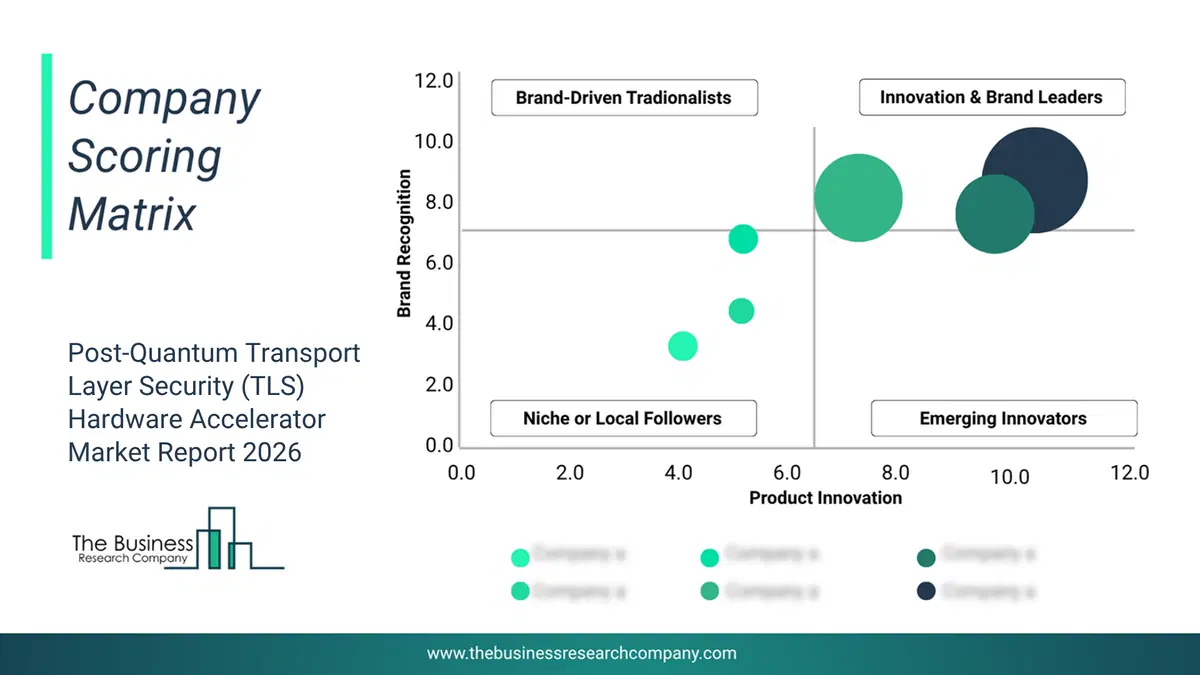
This chart maps companies by product innovation and brand strength, with bubble size indicating relative revenue, helping identify market leaders, challengers, and niche players. This is an illustrative chart; the full report provides a complete and accurate competitive analysis.
Global Post-Quantum Transport Layer Security (TLS) Hardware Accelerator Market Trends and Insights
Major companies operating in the post-quantum transport layer security (TLS) hardware accelerator market are focusing on developing innovative solutions such as high-throughput key exchange to enable secure, low-latency communications resistant to quantum attacks. High-throughput key exchange is the rapid generation and sharing of cryptographic keys between parties to establish secure communication channels, helping enable faster, large-scale secure connections, reduce latency, and support quantum-resistant TLS under heavy traffic. For instance, in December 2024, NVIDIA Corporation, a US-based technology company, launched cuPQC, a GPU-accelerated software development kit (SDK) designed to facilitate the transition to post-quantum cryptography (PQC) protocols. The initiative aims to provide secure, low-latency communications resistant to quantum attacks, particularly focusing on high-throughput key exchange mechanisms. cuPQC leverages the parallel processing capabilities of NVIDIA GPUs to accelerate cryptographic operations, such as key generation, encapsulation, and decapsulation, by up to 143 times compared to state-of-the-art CPUs. Such acceleration is crucial for enabling secure, large-scale connections under heavy traffic, ensuring that communications remain secure even in the face of potential quantum computing threats. Integration of cuPQC allows organizations to implement NIST-approved PQC algorithms, including ML-KEM and ML-DSA, preparing their systems for the quantum era and supporting industries such as telecommunications, finance, and cloud infrastructure in maintaining secure communications.What Are Latest Mergers And Acquisitions In The Post-Quantum Transport Layer Security (TLS) Hardware Accelerator Market?
In January 2025, the Post-Quantum Cryptography Alliance (PQCA), a part of the Linux Foundation, a US-based nonprofit consortium, partnered with NVIDIA to integrate NVIDIA’s cuPQC GPU-accelerated library into the open quantum safe (LibOQS) project. With this partnership, PQCA and NVIDIA aim to accelerate the adoption of post-quantum cryptography by delivering scalable, quantum-resistant cryptographic operations that can support high-throughput applications such as TLS offloading, key management, and large-scale data center security, while ensuring future agility for emerging cryptographic standards. NVIDIA Corporation is a US-based technology company that specializes in providing post-quantum Transport Layer Security (TLS) hardware accelerators.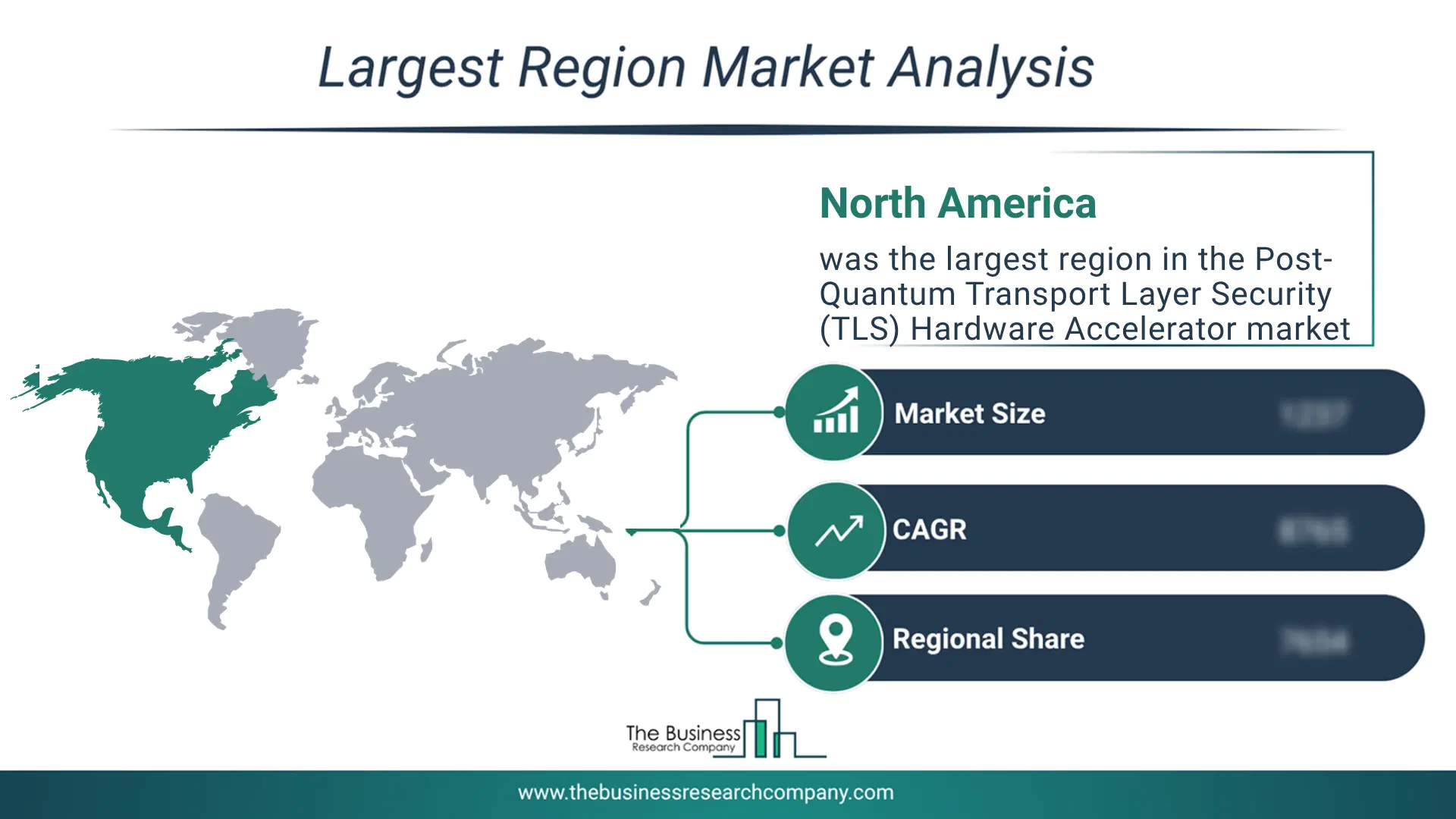
Regional Insights
North America was the largest region in the post-quantum transport layer security (TLS) hardware accelerator market in 2025. Asia-Pacific is expected to be the fastest-growing region in the forecast period. The regions covered in this market report are Asia-Pacific, South East Asia, Western Europe, Eastern Europe, North America, South America, Middle East, Africa. The countries covered in this market report are Australia, Brazil, China, France, Germany, India, Indonesia, Japan, Taiwan, Russia, South Korea, UK, USA, Canada, Italy, Spain.What Defines the Post-Quantum Transport Layer Security (TLS) Hardware Accelerator Market?
The post-quantum transport layer security (TLS) hardware accelerator market consists of revenues earned by entities by providing services such as performance optimization and testing, managed security services, firmware and software updates, quantum-resistant protocol implementation, cloud security services, and cryptographic research and development. The market value includes the value of related goods sold by the service provider or included within the service offering. The post-quantum transport layer security (TLS) hardware accelerator market also includes sales of hardware security modules (HSMs), network security accelerators, cryptographic co-processors, encryption or decryption cards, secure key management modules, and packet processing accelerators. Values in this market are ‘factory gate’ values, that is the value of goods sold by the manufacturers or creators of the goods, whether to other entities (including downstream manufacturers, wholesalers, distributors and retailers) or directly to end customers. The value of goods in this market includes related services sold by the creators of the goods.How is Market Value Defined and Measured?
The market value is defined as the revenues that enterprises gain from the sale of goods and/or services within the specified market and geography through sales, grants, or donations in terms of the currency (in USD unless otherwise specified). The revenues for a specified geography are consumption values that are revenues generated by organizations in the specified geography within the market, irrespective of where they are produced. It does not include revenues from resales along the supply chain, either further along the supply chain or as part of other products.
This chart presents market attractiveness based on a quantitative evaluation of growth, competition, strategic alignment, and risk, offering a clear view of opportunity areas for decision-making. This chart is for illustrative purposes; the full report contains the complete analysis.

This chart highlights the Total Addressable Market (TAM) by estimating the maximum revenue opportunity using an assumption-driven approach, supporting strategic planning and opportunity sizing across markets. The chart is illustrative; the full report provides a more comprehensive analysis.
What Key Data and Analysis Are Included in the Post-Quantum Transport Layer Security (TLS) Hardware Accelerator Market Report 2026?
The post-quantum transport layer security (tls) hardware accelerator market research report is one of a series of new reports from The Business Research Company that provides market statistics, including industry global market size, regional shares, competitors with the market share, detailed market segments, market trends and opportunities, and any further data you may need to thrive in the post-quantum transport layer security (tls) hardware accelerator industry. The market research report delivers a complete perspective of everything you need, with an in-depth analysis of the current and future state of the industry.Post-Quantum Transport Layer Security (TLS) Hardware Accelerator Market Report Forecast Analysis
| Report Attribute | Details |
|---|---|
| Market Size Value In 2026 | $1.54 billion |
| Revenue Forecast In 2030 | $4.16 billion |
| Growth Rate | CAGR of 28.2% from 2026 to 2030 |
| Base Year For Estimation | 2025 |
| Actual Estimates/Historical Data | 2020-2025 |
| Forecast Period | 2026 - 2030 |
| Market Representation | Revenue in USD Billion and CAGR from 2026 to 2030 |
| Segments Covered | Product Type, Algorithm, End-User |
| Regional Scope | Asia-Pacific, Western Europe, Eastern Europe, North America, South America, Middle East, Africa |
| Country Scope | The Countries Covered In This Market Report Are Australia, Brazil, China, France, Germany, India, Indonesia, Japan, Taiwan, Russia, South Korea, Uk, Usa, Canada, Italy, Spain. |
| Key Companies Profiled | IBM Corporation, Intel Corporation, Broadcom Inc., Hewlett Packard Enterprise Company, NVIDIA Corporation, Thales S.A., Infineon Technologies AG, NXP Semiconductors N.V., Microchip Technology Inc., IDEMIA Secure Transactions, Lattice Semiconductor Corporation, Napatech A/S, Silicom Ltd., Futurex Inc., Axiado Corporation, Securosys SA, Eideticom Inc., fragmentiX AG, Xiphera Oy, PQShield Limited |
| Customization Scope | Request for Customization |
| Pricing And Purchase Options | Explore Purchase Options |