
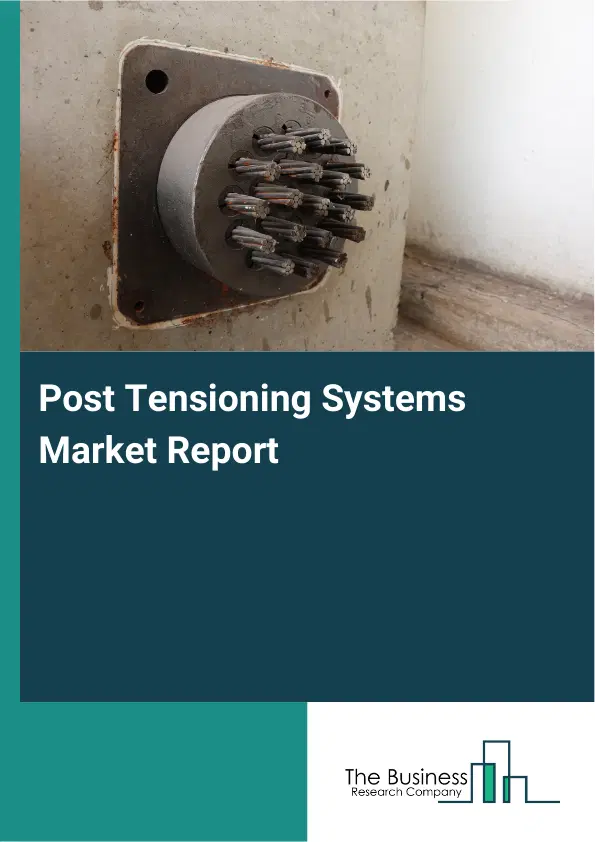
Post Tensioning Systems Market Report 2026
Global Outlook – By Type (Bonded, Unbonded), By Structure Type (New Structures, Structure Repairing), By Application (Building, Bridge - Internal Post-Tensioning, Bridge - External Post-Tensioning, Energy And Power Industry, Other Applications) – Market Size, Trends, Strategies, and Forecast to 2030
Post Tensioning Systems Market Overview
• Post Tensioning Systems market size has reached to $12.55 billion in 2025 • Expected to grow to $19.63 billion in 2030 at a compound annual growth rate (CAGR) of 9.3% • Growth Driver: Impact Of Manufacturing And Construction Industry Growth On The Post-Tensioning System Market • Market Trend: Innovations In Post-Tension Concrete Court Systems Enhance Structural Durability And Longevity Of Sports Surfaces • North America was the largest region and fastest growing region.Market Gains By 2030 – Top Opportunities By Segment
Market Gain identifies the most promising market opportunities by highlighting the segments or products expected to generate the highest incremental revenue growth over the next five years.
What Is Covered Under Post Tensioning Systems Market?
Post-tensioning systems are structural reinforcement methods used in concrete construction where steel tendons (cables or rods) are tensioned after the concrete has been cast and has gained sufficient strength. This technique improves the concrete's performance by placing it in compression, increasing its load-carrying capacity and resistance to cracking, thereby allowing for longer spans, thinner slabs, and greater design flexibility in buildings, bridges, and other structures. The main types of post tensioning systems are bonded and unbonded. Bonded post-tensioning systems involve embedding high-strength steel cables within concrete and then tensioning them to strengthen the structure. The cables are encased in ducts and bonded with grout to enhance durability and load-carrying capacity. These systems are used in various structures, including new constructions and structural repairs, and are applied in buildings, bridge-internal post-tensioning, bridge-external post-tensioning, the energy and power industry, and others.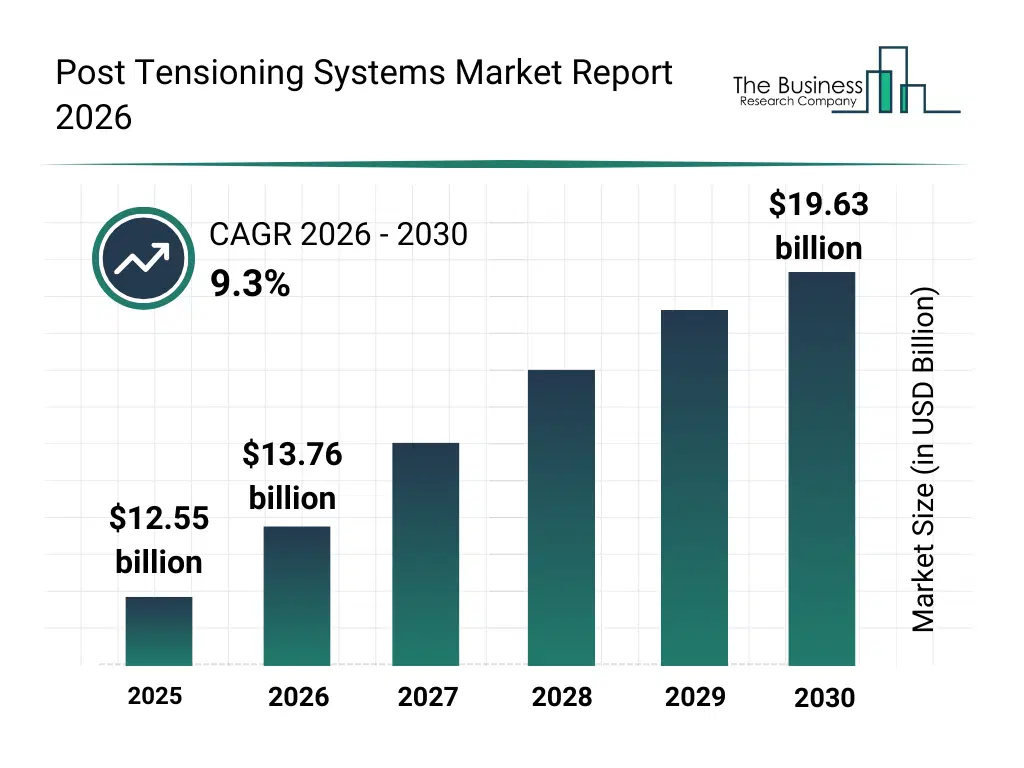
What Is The Post Tensioning Systems Market Size and Share 2026?
The post tensioning systems market size has grown strongly in recent years. It will grow from $12.55 billion in 2025 to $13.76 billion in 2026 at a compound annual growth rate (CAGR) of 9.6%. The growth in the historic period can be attributed to rising use of post-tensioning in bridge construction, increased adoption in high-rise buildings, growing demand for structural efficiency, expansion in energy sector applications, rising infrastructure projects.What Is The Post Tensioning Systems Market Growth Forecast?
The post tensioning systems market size is expected to see strong growth in the next few years. It will grow to $19.63 billion in 2030 at a compound annual growth rate (CAGR) of 9.3%. The growth in the forecast period can be attributed to increasing deployment of IoT-enabled monitoring, growing adoption of automated jacking and tensioning equipment, development of hybrid systems, expansion of predictive maintenance technologies, rising integration of advanced anchorage devices. Major trends in the forecast period include integration of AI-based post-tensioning monitoring systems, adoption of smart concrete reinforcement solutions, deployment of automated tensioning and jacking equipment, expansion of IOT-enabled structural health monitoring, development of predictive analytics for load-bearing performance.
Global Post Tensioning Systems Market Segmentation
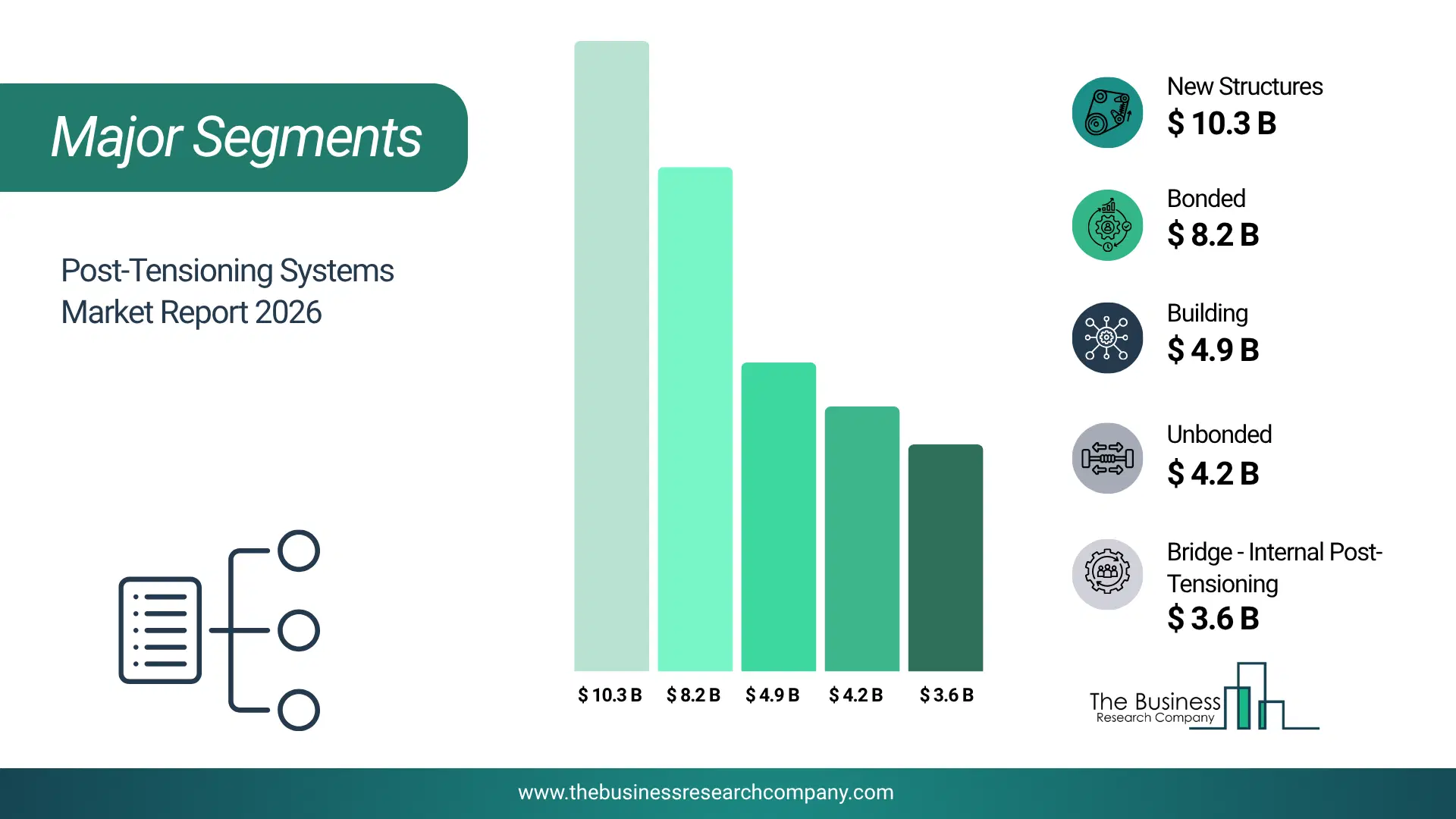
1) By Type: Bonded, Unbonded 2) By Structure Type: New Structures, Structure Repairing 3) By Application: Building, Bridge - Internal Post-Tensioning, Bridge - External Post-Tensioning, Energy And Power Industry, Other Applications Subsegments: 1) By Bonded: Grouted Bonded Systems, Dry Bonded Systems, Hybrid Bonded Systems 2) By Unbonded: Single Strand Unbonded Systems, Multi-Strand Unbonded Systems, Steel Strand Unbonded Systems The top segments in the post-tensioning systems market will be: • New Structures will reach $10326.53 Million by 2025. • Bonded will reach $8229.8 Million by 2025. • Building will reach $4996.14 Million by 2025. • Unbonded will reach $4209.8 Million by 2025. • Bridge - Internal Post-Tensioning will reach $3637.91 Million by 2025.What Is The Driver Of The Post Tensioning Systems Market?
The rise in the construction industry is expected to propel the growth of the post tensioning system market going forward. The expansion of the construction industry is driven by several factors, including climate change, the need for material reduction, water supply considerations, and population growth. Post-tensioning systems are used in the construction industry to enhance the strength and flexibility of concrete structures, enabling longer spans, thinner slabs, and reduced material usage. For instance, in August 2024, according to the US Census Bureau, a US-based government agency, the value of construction operations rose from $2.01 trillion in May 2023 to $2.14 trillion in May 2024. The value of construction operations in June 2024 was approximately $2,148.4 billion, reflecting a 6.2% increase compared to the June 2023 estimate of $2,023.0 billion. Therefore, the rise in the construction industry is driving the growth of the post tensioning system industry.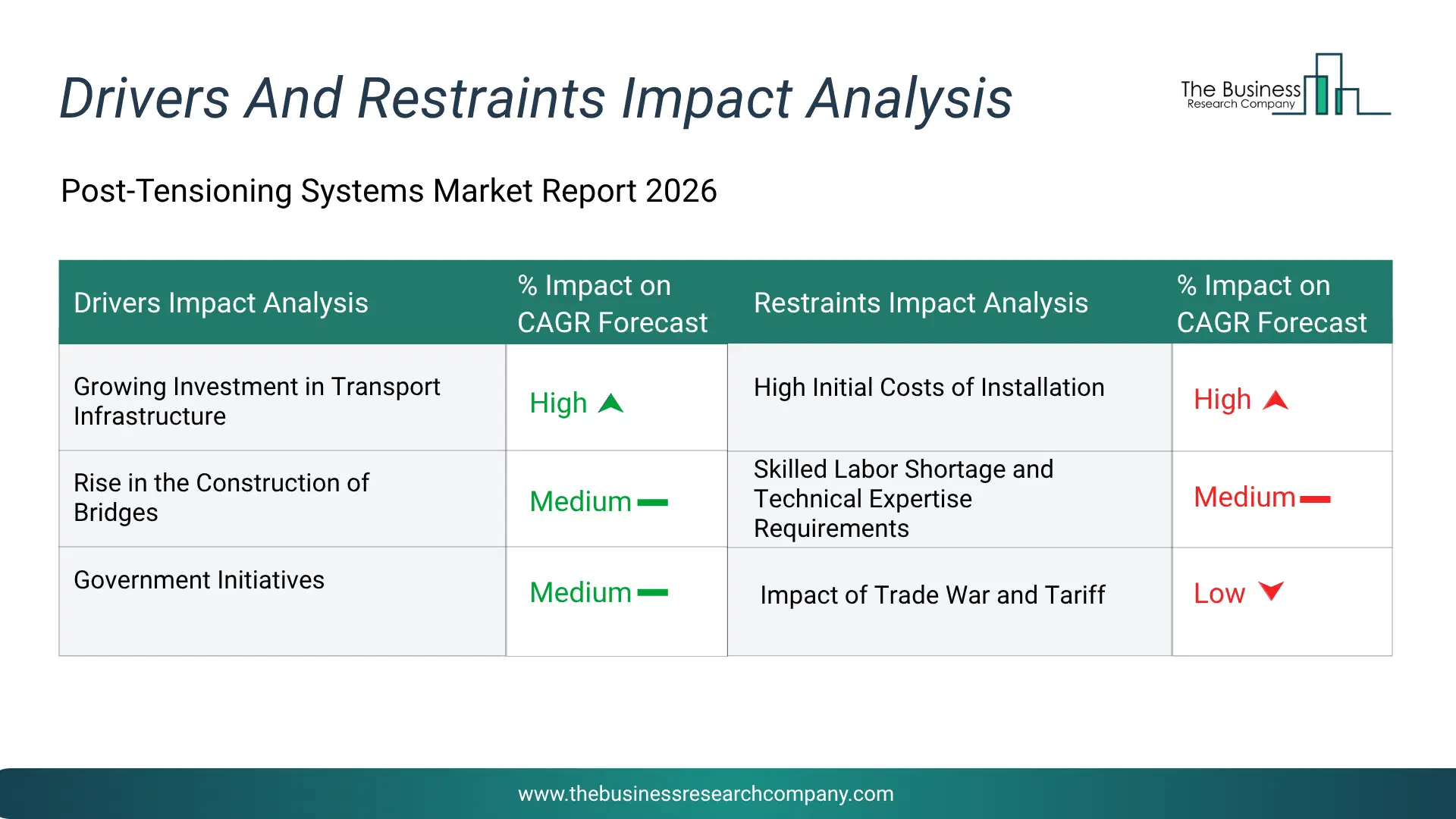
Infographic Chart Showing Key Market Drivers Analysis And Restraints For Post Tensioning Systems Market
The chart presents an impact analysis of key drivers and restraints, quantifying their relative influence on the market's growth rate and helping assess the balance between growth enablers and limiting factors. This chart offers a high-level perspective; the full report contains more detailed insights.
How Will The Drivers Impact Growth In The Global Post-Tensioning Systems Market?
• Growing Investment in Transport Infrastructure (High) – The growing investment in transport infrastructure will become a key driver of growth in the post-tensioning systems market by 2030. As transport infrastructure projects such as highways, bridges, tunnels, metros and rail stations demand long-span, high-strength structures capable of handling heavy, continuous traffic. Post-tensioning enhances concrete’s load-bearing capacity, enabling fewer supports and longer spans, which are essential in bridges and elevated corridors. It also allows faster construction through reduced formwork and early concrete stress, helping meet tight project timelines. Though initial costs may be higher, post-tensioned systems offer lifecycle cost efficiency by minimizing long-term maintenance and repair. Their ability to withstand heavier loads, vibrations and thermal shifts ensures structural reliability, making them a preferred choice for both public and private infrastructure stakeholders. As a result growing investment in transport infrastructure is 6anticipated to contributing to a 2.0% annual growth in the market. • Rise in the Construction of Bridges (Medium) – The rise in the construction of bridges will become a significant driver contributing to the growth of the post-tensioning systems market by 2030. Post-tensioning systems are critical in modern bridge construction due to their ability to support long spans with minimal support while effectively handling heavy dynamic loads. By enhancing concrete’s tensile strength, they reduce deflection and improve load distribution. These systems also offer greater durability, resisting cracking and corrosion, which lowers long-term maintenance costs. Their compatibility with precast and segmental construction methods significantly shortens project timelines vital for minimizing public disruption. Additionally, post-tensioning enables innovative bridge designs, including curved or cable-stayed structures, providing both flexibility and structural integrit. Consequently, the rise in the construction of bridges is projected to contributing to a 0.5% annual growth in the market. • Government Initiatives (Medium) – The government initiative will serve as a key growth catalyst for post-tensioning systems market by 2030. Government-led infrastructure programs covering highways, metros, flyovers and bridges are driving demand for durable, long-span and cost-efficient construction solutions, making post-tensioning systems a preferred choice. Initiatives like affordable housing and smart city missions further boost the need for space-efficient, multi-storey buildings, where post-tensioning supports faster execution and reduced material usage. Additionally, the growing use of Public-Private Partnerships (PPPs) in large-scale projects promotes adoption of advanced construction technologies, with post-tensioning offering benefits such as enhanced structural longevity, reduced maintenance and overall cost savings. Therefore, this government initiative is projected to supporting to a 1.0% annual growth in the market. • Rise in River Dam Construction (Low) – The rise in river dam construction will emerge as a major factor driving the expansion of the post-tensioning systems market by 2030. The rise of omnichannel retailing is significantly boosting demand for high-throughput and reliable parcel delivery logistics solutions. Retailers operating across multiple online and offline channels increasingly rely on automated systems to manage large volumes of orders with speed and accuracy. Investments in fulfillment infrastructure such as smart warehouses, last-mile delivery hubs and advanced tracking systems are accelerating adoption of integrated logistics technologies, especially in emerging markets. Consequently, the rise in river dam construction is projected to contributing to a 1.5% annual growth in the market.How Will The Restraints Impact Growth In The Global Post-Tensioning Systems Market?
• High Initial Costs of Installation (High) – High Initial Costs of Installation will restrict the growth of the Post-Tensioning Systems market during the forecast period. Post-tensioning systems require specialized materials, equipment, and skilled labor for installation, resulting in high initial project costs. The cost premium over conventional reinforcement methods can deter adoption in budget-constrained projects. Despite long-term benefits in structural efficiency and durability, the immediate cost impact often influences decision-making against post-tensioning systems. • Skilled Labor Shortage and Technical Expertise Requirements (Medium) – Skilled Labor Shortage and Technical Expertise Requirements will restrict the growth of the Post-Tensioning Systems market during the forecast period. The installation and monitoring of post-tensioning systems require specialized technical expertise in tensioning procedures, grouting, and quality control. The shortage of qualified professionals with post-tensioning experience in many regions creates project delays and increases labor costs. This skill gap limits the capacity of contractors to deliver post-tensioning projects efficiently. • Impact of Trade War and Tariff (Medium) – Impact of Trade War and Tariff will restrict the growth of the Post-Tensioning Systems market during the forecast period. Post-tensioning systems rely on imported strands, anchors, and specialized equipment. Trade tariffs on steel and other materials increase project costs, making post-tensioning less competitive compared to alternative construction methods. Trade barriers may also restrict technology transfer between countries, limiting expertise development.Key Players In The Global Post Tensioning Systems Market
Major companies operating in the post tensioning systems market are Freyssinet, SRG Global Solutions Limited, VSL International Ltd., Structural Group Inc., DYWIDAG Inc., Suncoast Post-Tension, Tendon LLC, General Technologies Inc., VLM International, Mekano 4, Amsysco Inc., BBV Systems GmbH, Prestressed Concrete Constructions Inc., TMG Global Pte Ltd., Asian Ferrotech Inc., OVM MENA, Liuuzhou OVM Machinery Co. Ltd., Post Tension Services India Pvt. Ltd., Mega Post Tension System, Enzo Post-Tension Systems.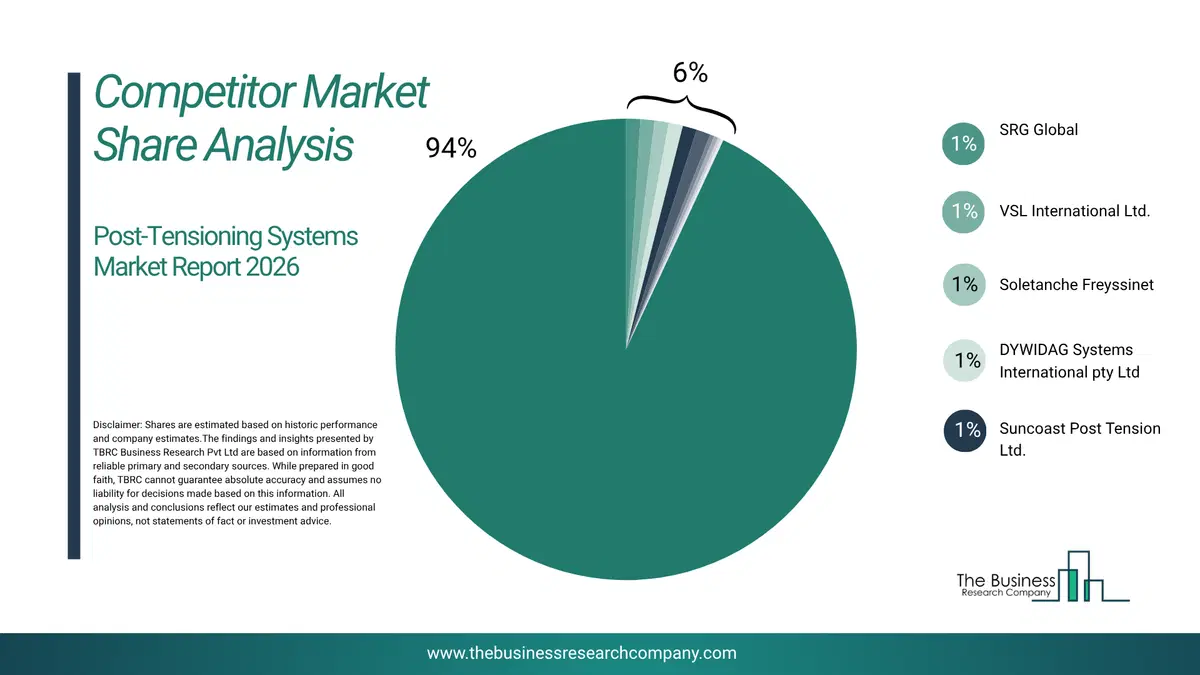
This chart is for illustrative purposes; the full report includes a detailed competitor analysis and comprehensive overview of the top 10 companies in the market.
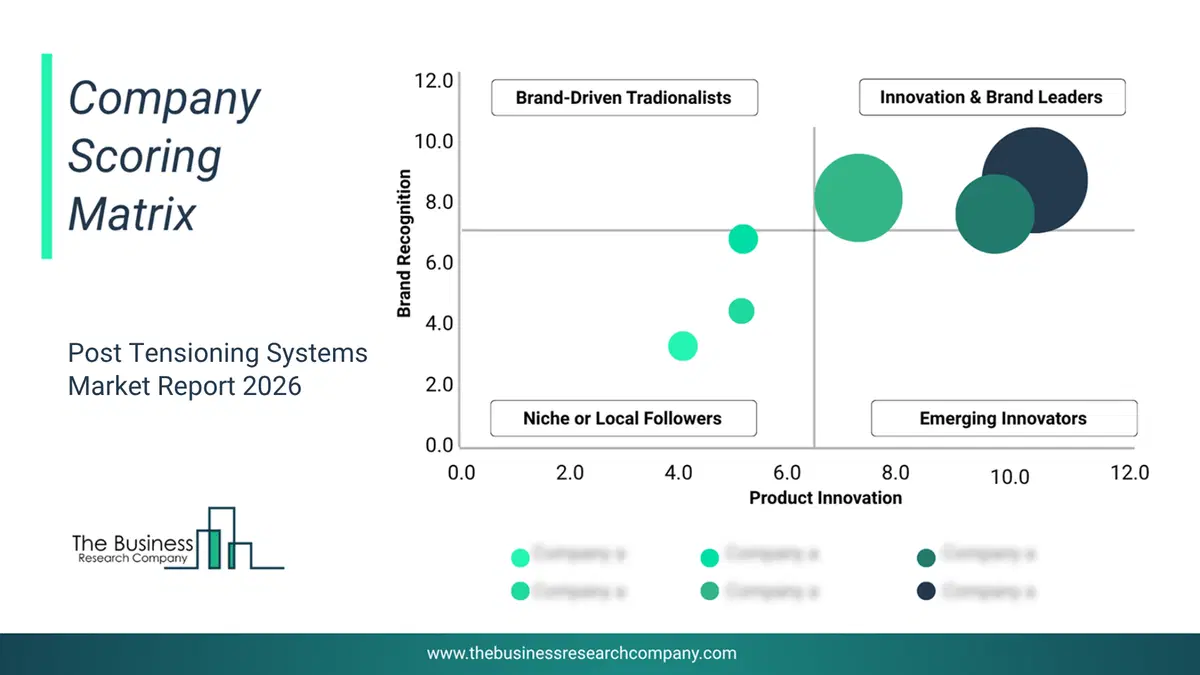
This chart maps companies by product innovation and brand strength, with bubble size indicating relative revenue, helping identify market leaders, challengers, and niche players. This is an illustrative chart; the full report provides a complete and accurate competitive analysis.
Global Post Tensioning Systems Market Trends and Insights
Major companies operating in the post-tensioning system market are focusing on developing advanced solutions, such as post-tension concrete court systems, to enhance structural durability, minimize cracking, and extend the lifespan of concrete surfaces. Post-tension concrete court systems refer to reinforced concrete sports surfaces that use tensioned steel cables to maintain constant compression, preventing cracks and ensuring long-term structural stability. For instance, in May 2025, Tarkett Sports, a US-based sports construction and surfacing company, launched ClassicCourt. It is engineered as a high-performance post-tension concrete court system with a 50-year structural warranty and a 10-year surfacing warranty. It uses high-performance U.S.-made steel cables and powder-coated hardware, combined with a patented “Diamond Coating” to regulate moisture release and prevent surface bubbling and acrylic adhesion issues.What Are Latest Mergers And Acquisitions In The Post Tensioning Systems Market?
In March 2023, Commercial Metals Company, a US-based rebar and related product manufacturer, acquired Tendon Systems LLC for an undisclosed amount. The acquisition bolsters CMC's leadership in construction reinforcement and expands its capabilities to better address customer needs. It also enhances steelmaking efficiency by ensuring a reliable supply of cost-effective materials, which improves operations and increases market agility. Tendon Systems LLC is a US-based concrete construction company that provides barrier cables and post-tensioning systems.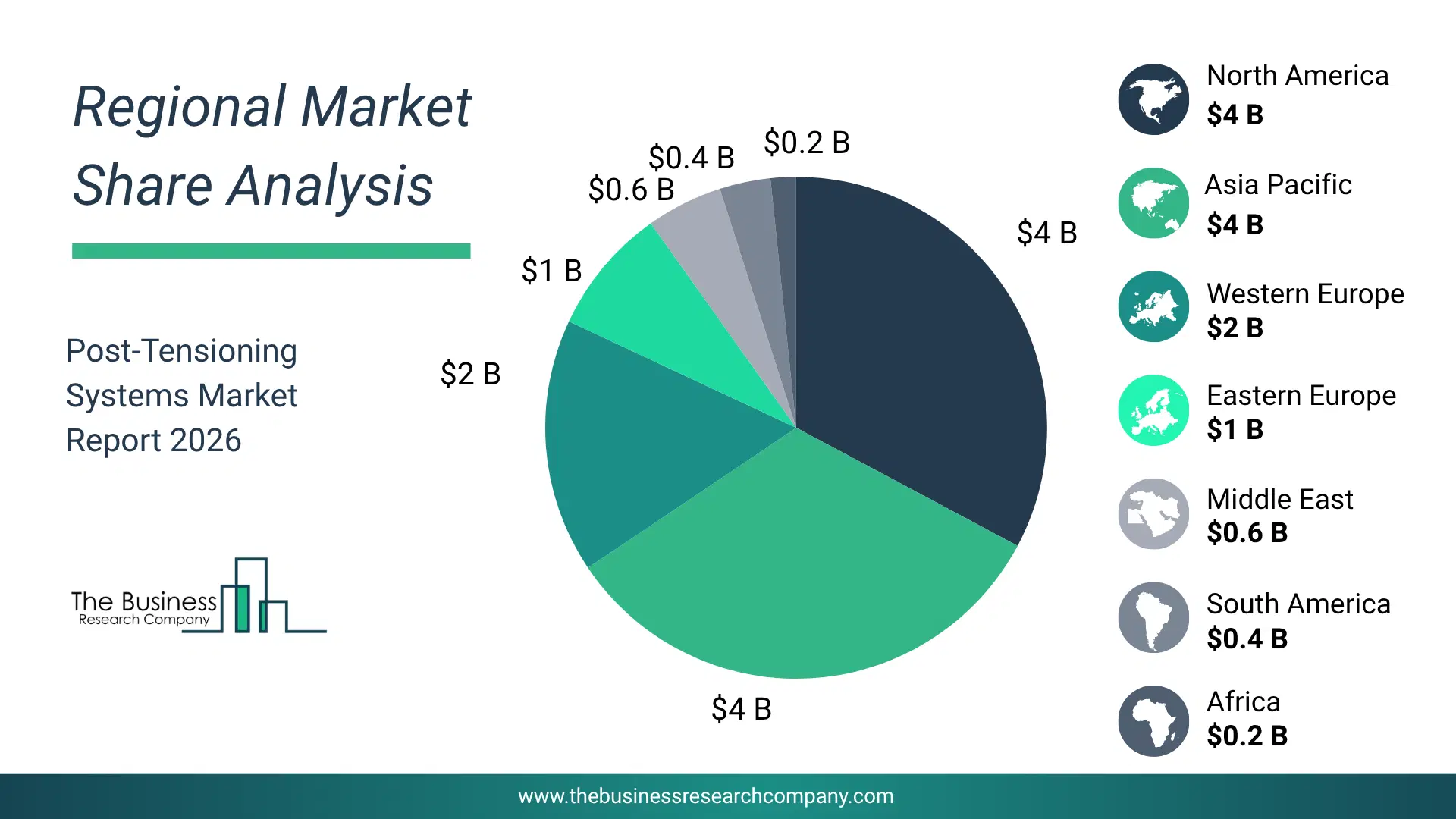
Regional Insights
North America was the largest region in the post tensioning systems market in 2025. The regions covered in this market report are Asia-Pacific, South East Asia, Western Europe, Eastern Europe, North America, South America, Middle East, Africa. The countries covered in this market report are Australia, Brazil, China, France, Germany, India, Indonesia, Japan, Taiwan, Russia, South Korea, UK, USA, Canada, Italy, Spain.What Defines the Post Tensioning Systems Market?
The post tensioning systems market consists of sales of steel cables or tendons, anchorage devices, pumping and grouting equipment, jacking equipment, ducts, and tubes. Values in this market are ‘factory gate’ values, that is the value of goods sold by the manufacturers or creators of the goods, whether to other entities (including downstream manufacturers, wholesalers, distributors and retailers) or directly to end customers. The value of goods in this market includes related services sold by the creators of the goods.How is Market Value Defined and Measured?
The market value is defined as the revenues that enterprises gain from the sale of goods and/or services within the specified market and geography through sales, grants, or donations in terms of the currency (in USD unless otherwise specified). The revenues for a specified geography are consumption values that are revenues generated by organizations in the specified geography within the market, irrespective of where they are produced. It does not include revenues from resales along the supply chain, either further along the supply chain or as part of other products.
This chart presents market attractiveness based on a quantitative evaluation of growth, competition, strategic alignment, and risk, offering a clear view of opportunity areas for decision-making. This chart is for illustrative purposes; the full report contains the complete analysis.

This chart highlights the Total Addressable Market (TAM) by estimating the maximum revenue opportunity using an assumption-driven approach, supporting strategic planning and opportunity sizing across markets. The chart is illustrative; the full report provides a more comprehensive analysis.
What Key Data and Analysis Are Included in thePost Tensioning Systems Market Report 2026?
The post tensioning systems market research report is one of a series of new reports from The Business Research Company that provides market statistics, including industry global market size, regional shares, competitors with the market share, detailed market segments, market trends and opportunities, and any further data you may need to thrive in the post tensioning systems industry. The market research report delivers a complete perspective of everything you need, with an in-depth analysis of the current and future state of the industry.Post Tensioning Systems Market Report Forecast Analysis
| Report Attribute | Details |
|---|---|
| Market Size Value In 2026 | $13.76 billion |
| Revenue Forecast In 2030 | $19.63 billion |
| Growth Rate | CAGR of 9.6% from 2026 to 2030 |
| Base Year For Estimation | 2025 |
| Actual Estimates/Historical Data | 2020-2025 |
| Forecast Period | 2026 - 2030 |
| Market Representation | Revenue in USD Billion and CAGR from 2026 to 2030 |
| Segments Covered | Type, Structure Type, Application |
| Regional Scope | Asia-Pacific, Western Europe, Eastern Europe, North America, South America, Middle East, Africa |
| Country Scope | The countries covered in the report are Australia, Brazil, China, France, Germany, India, Indonesia, Japan, Taiwan, Russia, South Korea, UK, USA, Canada, Italy, Spain. |
| Key Companies Profiled | Freyssinet, SRG Global Solutions Limited, VSL International Ltd., Structural Group Inc., DYWIDAG Inc., Suncoast Post-Tension, Tendon LLC, General Technologies Inc., VLM International, Mekano 4, Amsysco Inc., BBV Systems GmbH, Prestressed Concrete Constructions Inc., TMG Global Pte Ltd., Asian Ferrotech Inc., OVM MENA, Liuuzhou OVM Machinery Co. Ltd., Post Tension Services India Pvt. Ltd., Mega Post Tension System, Enzo Post-Tension Systems. |
| Customization Scope | Request for Customization |
| Pricing And Purchase Options | Explore Purchase Options |