

Post-Traumatic Stress Disorder Therapeutics Market Report 2026
Global Outlook – By Drug Class (Antidepressants, Anti-Anxiety, Antihypertensive, Antipsychotics Or Second Generation Antipsychotics (SGOs), Beta-Blockers, Other Classes), By Age Group (Pediatric, Geriatric, Adult), By End User (Mental Health Center, Hospitals, Outpatient Clinics, Other End Users) – Market Size, Trends, Strategies, and Forecast to 2030
Post-Traumatic Stress Disorder Therapeutics Market Overview
• Post-Traumatic Stress Disorder Therapeutics market size has reached to $1.2 billion in 2025 • Expected to grow to $1.41 billion in 2030 at a compound annual growth rate (CAGR) of 3.4% • Growth Driver: Surge In PTSD Cases Drives Growth In Therapeutics Market • Market Trend: Advancements In PTSD Therapeutics With Self-Neuromodulation Devices • North America was the largest region in 2025 and Asia-Pacific is the fastest growing region.What Is Covered Under Post-Traumatic Stress Disorder Therapeutics Market?
Post-traumatic stress disorder Therapeutics refers to therapeutics used to treat post-traumatic stress disorder (PTSD), a mental health condition triggered by either experiencing it or witnessing it. Post-traumatic stress disorder treatment helps to improve patients thinking power, changes in physical activity, and regain a sense of control over life. The mode of treatment applied for post-traumatic stress disorder includes medication, therapies, self-care, and nutrition. The main drugs in post-traumatic stress disorder therapeutics include antidepressants, anti-anxiety, antihypertensive, monoamine oxidase (MAOS), antipsychotics or second-generation antipsychotics (SGOS), beta-blockers, others (benzodiazepines and others). Antidepressants refer to a class of drugs that are used to manage addictions and treat illnesses like major depressive disorder, anxiety disorders, and chronic pain. The age group receiving the therapeutics includes pediatric, geriatric, and adults, by various end users including mental health centers, hospitals, outpatient clinics, and others.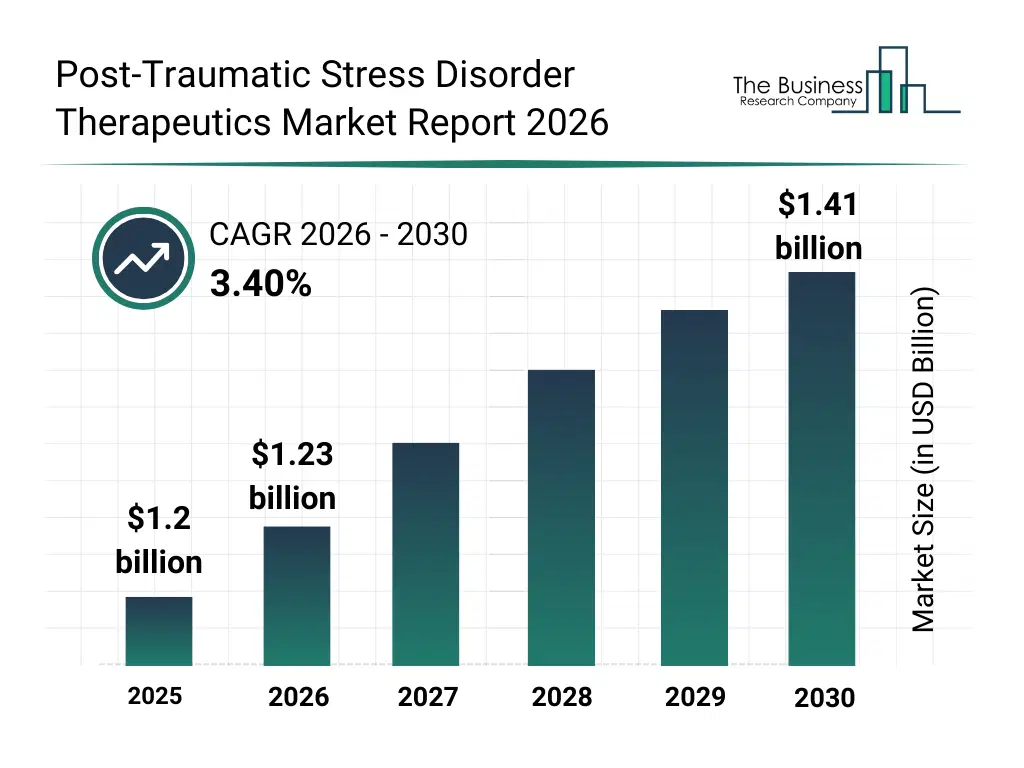
What Is The Post-Traumatic Stress Disorder Therapeutics Market Size and Share 2026?
The post-traumatic stress disorder therapeutics market size has grown steadily in recent years. It will grow from $1.2 billion in 2025 to $1.23 billion in 2026 at a compound annual growth rate (CAGR) of 3.1%. The growth in the historic period can be attributed to increased prevalence of ptsd, growing awareness of mental health, limited availability of specialized therapists, reliance on traditional pharmacological treatments, rising incidence of trauma from conflicts and disasters.What Is The Post-Traumatic Stress Disorder Therapeutics Market Growth Forecast?
The post-traumatic stress disorder therapeutics market size is expected to see steady growth in the next few years. It will grow to $1.41 billion in 2030 at a compound annual growth rate (CAGR) of 3.4%. The growth in the forecast period can be attributed to advancement in ai-driven diagnostics, expansion of telehealth platforms, growth in precision medicine solutions, adoption of wearable health monitoring, increasing investment in holistic mental health therapies. Major trends in the forecast period include personalized ptsd treatment plans, teletherapy & remote mental health services, integration of nutritional interventions in ptsd care, non-pharmacological therapy adoption, wearable monitoring devices for stress management.
Global Post-Traumatic Stress Disorder Therapeutics Market Segmentation
1) By Drug Class: Antidepressants, Anti-Anxiety, Antihypertensive, Antipsychotics Or Second Generation Antipsychotics (SGOs), Beta-Blockers, Other Classes 2) By Age Group: Pediatric, Geriatric, Adult 3) By End User: Mental Health Center, Hospitals, Outpatient Clinics, Other End Users Subsegments: 1) By Antidepressants: Selective Serotonin Reuptake Inhibitors (SSRIs), Serotonin-Norepinephrine Reuptake Inhibitors (SNRIs) 2) By Anti-Anxiety: Benzodiazepines, Buspirone 3) By Antihypertensive: Prazosin, Clonidine 4) By Antipsychotics (Second Generation Antipsychotics - SGOs): Risperidone, Quetiapine 5) By Beta-Blockers: Propranolol, Atenolol 6) By Other Classes: Mood Stabilizers, Adjunctive TherapiesWhat Is The Driver Of The Post-Traumatic Stress Disorder Therapeutics Market?
The rise in the burden of post-traumatic stress disorder (PTSD) cases across the globe are expected to propel the growth of the post-traumatic stress disorder therapeutics market going forward. Post-traumatic stress disorder refers to a disorder that develops in people who have experienced a scary, shocking, or dangerous event. Post-traumatic stress disorder treatment such as psychotherapy and medication can help to regain a sense of control over their life. For instance, in March 2024, according to the Ministry of Defence (MoD) Department of Community Mental Health (DCMH), a UK-based company that provides mental health services to serving personnel and reservists, a UK-based website covering defense industry news, the number of armed forces personnel receiving initial PTSD assessments by a specialist mental health clinician increased from 266 cases in 2022 to 320 cases in 2023, reflecting a significant rise in reported cases. Hence the rise in the burden of post-traumatic stress disorder (PTSD) cases is driving the growth of the post-traumatic stress disorder therapeutics industry.Key Players In The Global Post-Traumatic Stress Disorder Therapeutics Market
Major companies operating in the post-traumatic stress disorder therapeutics market are Pfizer Inc., GlaxoSmithKline plc, Otsuka Pharmaceutical Co Ltd., Eli Lilly and Company, AstraZeneca plc, Tonix Pharmaceuticals Holding Corp., Freespira Inc., MicroTransponder Inc., Halucenex Life Sciences Inc., MAPS Europe BV, Hoffmann-La Roche Ltd., Praxis Precision Medicines Inc., H Lundbeck A/S, Johnson & Johnson, Sanofi SA, Compass Pathways plc, Alkermes plc, MindMed Inc., Atai Life Sciences, Karuna Therapeutics, Mindbloom Inc.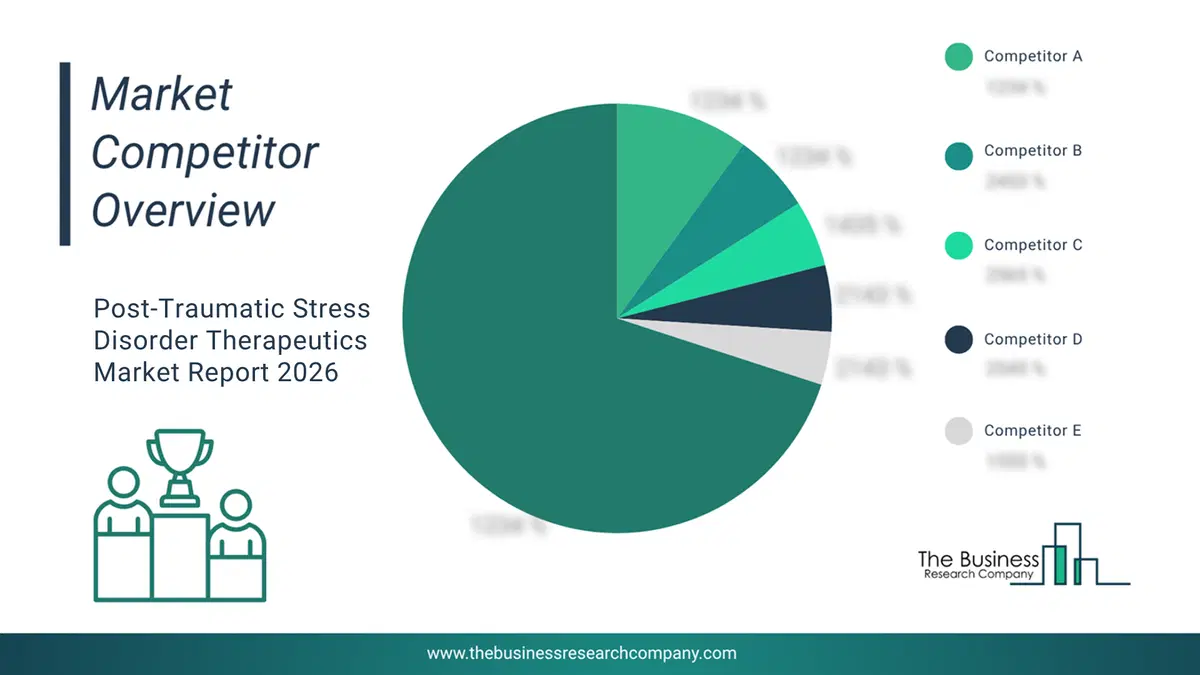
This chart is for illustrative purposes; the full report includes a detailed competitor analysis and comprehensive overview of the top 10 companies in the market.
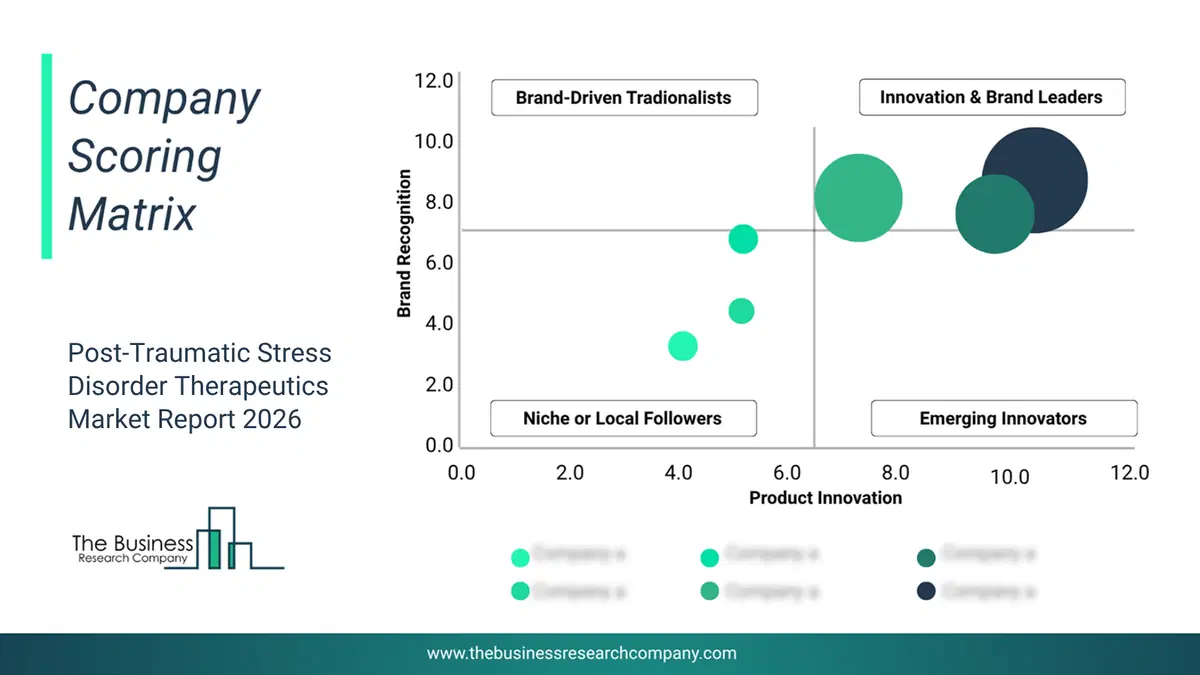
This chart maps companies by product innovation and brand strength, with bubble size indicating relative revenue, helping identify market leaders, challengers, and niche players. This is an illustrative chart; the full report provides a complete and accurate competitive analysis.
Global Post-Traumatic Stress Disorder Therapeutics Market Trends and Insights
Major companies operating in the post-traumatic stress disorder therapeutics market are focused on developing advanced technological devices, such as self-neuromodulation devices, to enhance patient outcomes and provide alternative solutions to conventional therapies. A self-neuromodulation device aims to enhance treatment for posttraumatic stress disorder by combining computer simulations with EEG technology, which allows patients to gain control over amygdala activity, addressing the hyperactivity associated with PTSD, and providing complementary therapy alongside traditional treatments. For instance, in January 2024, GrayMatters Health, a US-based health technology company, officially launched Prism for PTSD, the first FDA-approved self-neuromodulation device aimed at treating posttraumatic stress disorder in the U.S. It uses a combination of computer simulations and an EEG headset to create an immersive environment, helping individuals regulate amygdala-based biomarker activity linked to PTSD. The key technology behind Prism for PTSD is digital EEG-fMRI-Pattern (EFP) biomarker, the first in the world to track brain-area-specific activity. Developed using advanced statistical models, this technology synchronizes fMRI amygdala data with EEG readings. The therapy targets an amygdala-based biomarker, addressing research findings that PTSD is connected to heightened amygdala activity.What Are Latest Mergers And Acquisitions In The Post-Traumatic Stress Disorder Therapeutics Market?
In June 2023, Stella Center, a US-based treatment provider for post-traumatic stress disorder (PTSD) treatment, acquired the U.S. assets of Field Trip Health for an undisclosed amount. This acquisition will broaden Stella’s range of advanced treatments. Through this transaction, assets acquired include Field Trip’s advanced outcome data, research, tech stack, clinics, and leadership. Field Trip Health is a Canada-based provider of psychedelic-assisted therapies for a range of mental health conditions, including PTSD.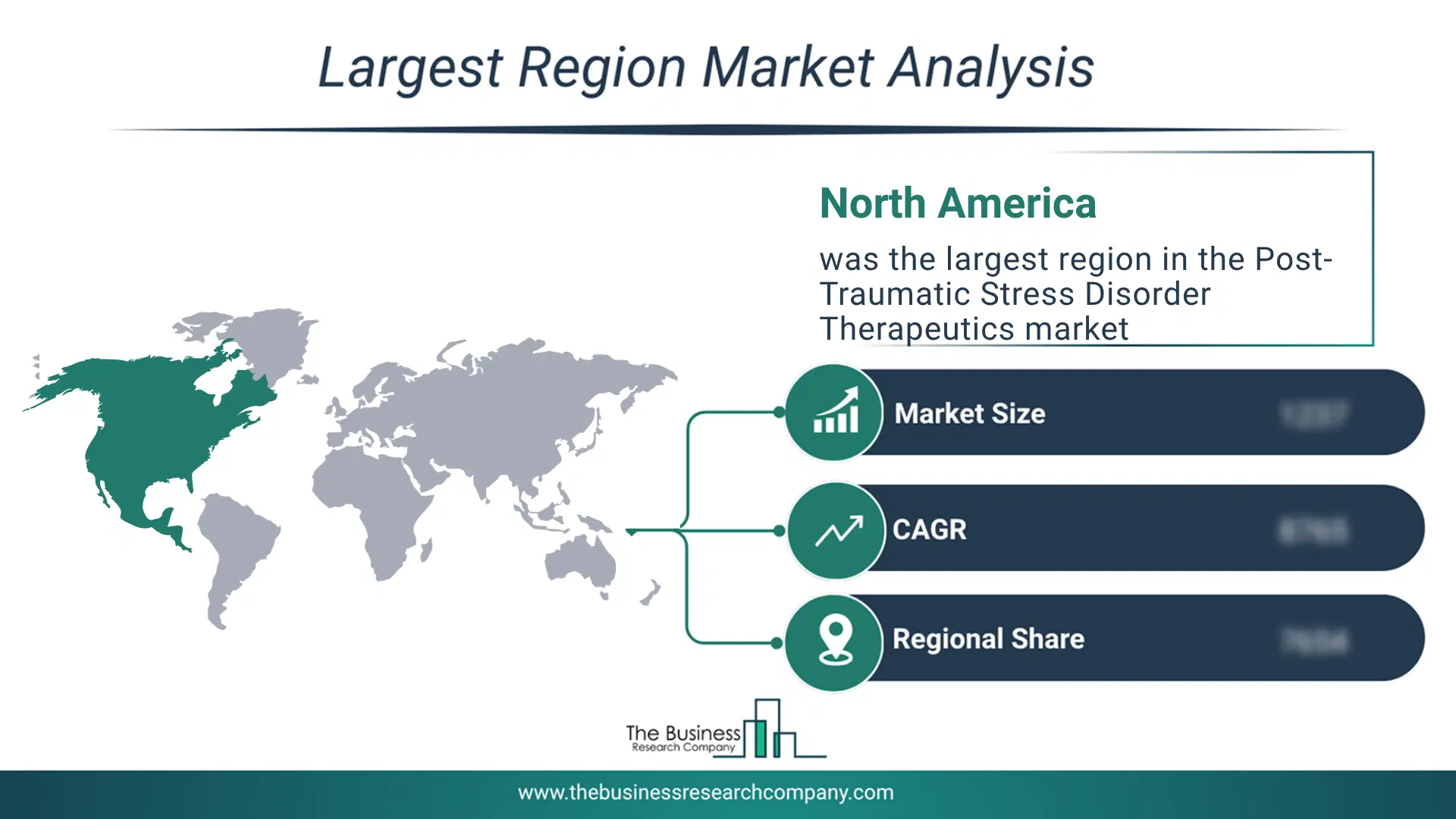
Regional Insights
North America was the largest region in the post-traumatic stress disorder therapeutics market in 2025. Asia-Pacific is expected to be the fastest-growing region in the forecast period. The regions covered in this market report are Asia-Pacific, South East Asia, Western Europe, Eastern Europe, North America, South America, Middle East, Africa. The countries covered in this market report are Australia, Brazil, China, France, Germany, India, Indonesia, Japan, Taiwan, Russia, South Korea, UK, USA, Canada, Italy, Spain.What Defines the Post-Traumatic Stress Disorder Therapeutics Market?
The post-traumatic stress disorder therapeutics market consists of revenues earned by entities by providing treatment services such as psychotherapy, medication, and the combination. The market value includes the value of related goods sold by the service provider or included within the service offering. The post-traumatic stress disorder therapeutics market also includes sales of drugs including Sertraline, Paroxetine, and Fluoxetine. Values in this market are ‘factory gate’ values, that is the value of goods sold by the manufacturers or creators of the goods, whether to other entities (including downstream manufacturers, wholesalers, distributors, and retailers) or directly to end customers. The value of goods in this market includes related services sold by the creators of the goods.How is Market Value Defined and Measured?
The market value is defined as the revenues that enterprises gain from the sale of goods and/or services within the specified market and geography through sales, grants, or donations in terms of the currency (in USD unless otherwise specified). The revenues for a specified geography are consumption values that are revenues generated by organizations in the specified geography within the market, irrespective of where they are produced. It does not include revenues from resales along the supply chain, either further along the supply chain or as part of other products.
This chart presents market attractiveness based on a quantitative evaluation of growth, competition, strategic alignment, and risk, offering a clear view of opportunity areas for decision-making. This chart is for illustrative purposes; the full report contains the complete analysis.

This chart highlights the Total Addressable Market (TAM) by estimating the maximum revenue opportunity using an assumption-driven approach, supporting strategic planning and opportunity sizing across markets. The chart is illustrative; the full report provides a more comprehensive analysis.
What Key Data and Analysis Are Included in the Post-Traumatic Stress Disorder Therapeutics Market Report 2026?
The post-traumatic stress disorder therapeutics market research report is one of a series of new reports from The Business Research Company that provides market statistics, including industry global market size, regional shares, competitors with the market share, detailed market segments, market trends and opportunities, and any further data you may need to thrive in the post-traumatic stress disorder therapeutics industry. The market research report delivers a complete perspective of everything you need, with an in-depth analysis of the current and future state of the industry.Post-Traumatic Stress Disorder Therapeutics Market Report Forecast Analysis
| Report Attribute | Details |
|---|---|
| Market Size Value In 2026 | $1.23 billion |
| Revenue Forecast In 2030 | $1.41 billion |
| Growth Rate | CAGR of 3.1% from 2026 to 2030 |
| Base Year For Estimation | 2025 |
| Actual Estimates/Historical Data | 2020-2025 |
| Forecast Period | 2026 - 2030 |
| Market Representation | Revenue in USD Billion and CAGR from 2026 to 2030 |
| Segments Covered | Drug Class, Age Group, End User |
| Regional Scope | Asia-Pacific, Western Europe, Eastern Europe, North America, South America, Middle East, Africa |
| Country Scope | The countries covered in the report are Australia, Brazil, China, France, Germany, India, Indonesia, Japan, Taiwan, Russia, South Korea, UK, USA, Canada, Italy, Spain. |
| Key Companies Profiled | Pfizer Inc., GlaxoSmithKline plc, Otsuka Pharmaceutical Co Ltd., Eli Lilly and Company, AstraZeneca plc, Tonix Pharmaceuticals Holding Corp., Freespira Inc., MicroTransponder Inc., Halucenex Life Sciences Inc., MAPS Europe BV, Hoffmann-La Roche Ltd., Praxis Precision Medicines Inc., H Lundbeck A/S, Johnson & Johnson, Sanofi SA, Compass Pathways plc, Alkermes plc, MindMed Inc., Atai Life Sciences, Karuna Therapeutics, Mindbloom Inc. |
| Customization Scope | Request for Customization |
| Pricing And Purchase Options | Explore Purchase Options |