

Postbiotic Ingredient Market Report 2026
Global Outlook – By Product Type (Powder, Liquid, Capsules, Tablets, Other Product Types), By Source (Plant-Based, Animal-Based, Microbial-Based, Other Sources), By Distribution Channel (Online Stores, Supermarkets or Hypermarkets, Specialty Stores, Other Distribution Channels), By Application (Dietary Supplements, Functional Food And Beverages, Animal Feed, Pharmaceuticals, Personal Care, Other Applications) – Market Size, Trends, Strategies, and Forecast to 2035
Postbiotic Ingredient Market Overview
• Postbiotic Ingredient market size has reached to $1.2 billion in 2025 • Expected to grow to $2.02 billion in 2030 at a compound annual growth rate (CAGR) of 11.1% • Growth Driver: Rising Preventive Healthcare Awareness Driving Market Growth Due to Increasing Focus on Early Disease Detection and Lifestyle Management • Market Trend: Kerry Advances Clean Label Postbiotic Formulation Through Introduction Of A Rice Derived Postbiotic Ingredient • North America was the largest region in 2025 and Asia-Pacific is the fastest growing region.What Is Covered Under Postbiotic Ingredient Market?
Postbiotic ingredients are bioactive compounds produced by probiotic microorganisms during fermentation, including metabolites, cell components, and byproducts that deliver health benefits. Its primary purpose is to support gut health, enhance immune function, and improve overall wellness by providing functional benefits without the need for live microorganisms. The main product types of postbiotic ingredient include powder, liquid, capsules, tablets, and other product types. Powder refers to dried postbiotic formulations derived from beneficial microbial activity used for easy incorporation into supplements and functional foods. These products are sourced from plant-based, animal-based, microbial-based, and other sources. They are distributed through online stores, supermarkets or hypermarkets, specialty stores, and other distribution channels and find application in dietary supplements, functional food and beverages, animal feed, pharmaceuticals, personal care, and others.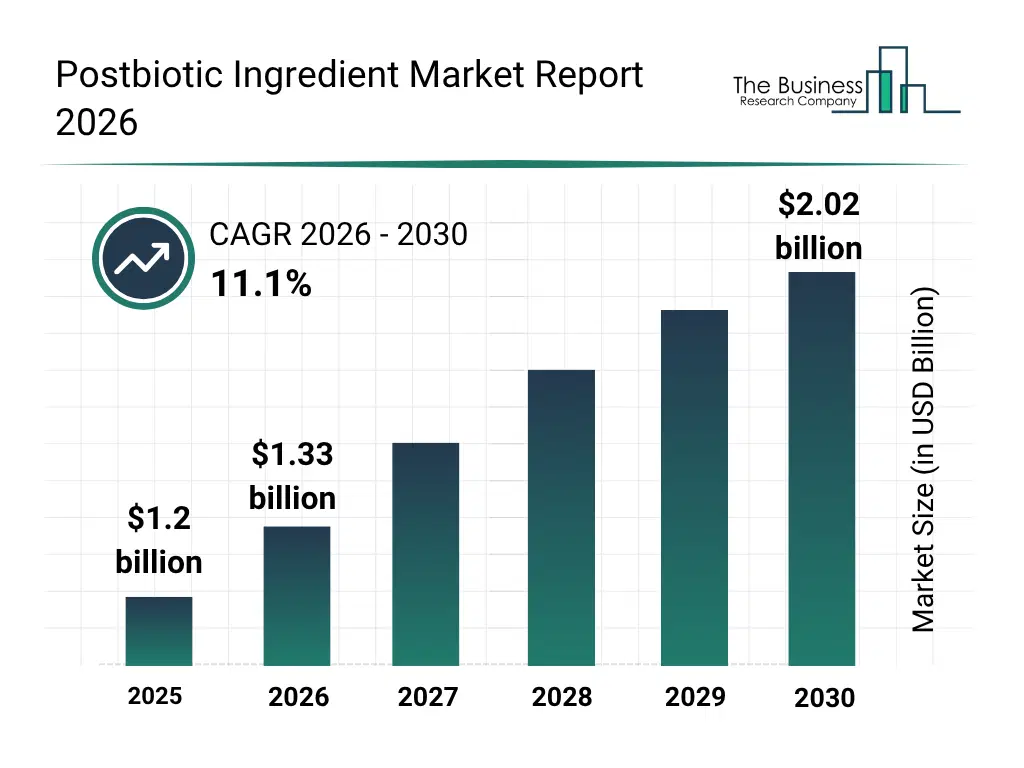
What Is The Postbiotic Ingredient Market Size and Share 2026?
The postbiotic ingredient market size has grown rapidly in recent years.It will grow from $1.2 billion in 2025 to $1.33 billion in 2026 at a compound annual growth rate (CAGR) of 10.9%. The growth in the historic period can be attributed to rising awareness of gut health benefits, increasing probiotic product adoption, growth in functional food consumption, expansion of dietary supplement industry, early research on microbiome health benefits.What Is The Postbiotic Ingredient Market Growth Forecast?
The postbiotic ingredient market size is expected to see rapid growth in the next few years.It will grow to $2.02 billion by 2030 at a compound annual growth rate (CAGR) of 11.1%. The growth in the forecast period can be attributed to increasing demand for immune health support products, rising prevalence of lifestyle-related disorders, growing focus on preventive healthcare nutrition, expansion of personalized nutrition solutions, increasing investment in microbiome-based research and development.Major trends in the forecast period include increasing adoption of clean-label and natural postbiotic formulations in functional foods, growing integration of postbiotics in personalized nutrition and gut health solutions, rising use of fermentation-derived bioactive compounds in dietary supplements, expansion of microbiome-targeted product development in pharmaceutical applications, increasing demand for stable non-living probiotic alternatives in food and beverage innovation.
Global Postbiotic Ingredient Market Segmentation
1) By Product Type: Powder, Liquid, Capsules, Tablets, Other Product Types 2) By Source: Plant-Based, Animal-Based, Microbial-Based, Other Sources 3) By Distribution Channel: Online Stores, Supermarkets or Hypermarkets, Specialty Stores, Other Distribution Channels 4) By Application: Dietary Supplements, Functional Food And Beverages, Animal Feed, Pharmaceuticals, Personal Care, Other Applications Subsegments: 1) By Powder: Spray Dried Postbiotic Powder, Freeze Dried Postbiotic Powder, Microencapsulated Postbiotic Powder, Heat Treated Postbiotic Powder, Fermented Postbiotic Powder 2) By Liquid: Concentrated Postbiotic Liquid, Fermented Postbiotic Liquid, Stabilized Postbiotic Liquid, Ready to Use Postbiotic Liquid, Water Soluble Postbiotic Liquid 3) By Capsules: Hard Shell Postbiotic Capsules, Soft Gel Postbiotic Capsules, Delayed Release Postbiotic Capsules, Vegetarian Postbiotic Capsules, Enteric Coated Postbiotic Capsules 4) By Tablets: Chewable Postbiotic Tablets, Effervescent Postbiotic Tablets, Sustained Release Postbiotic Tablets, Film Coated Postbiotic Tablets, Orally Disintegrating Postbiotic Tablets 5) By Other Product Types: Cell Free Supernatants, Inactivated Microbial Biomass, Peptidoglycan Derivatives, Lipoteichoic Acid Extracts, Exopolysaccharide Compounds, Enzyme Derived Metabolites, Fermentation Derived Organic Acids, Bacterial Lysate Fractions, Microbial Cell Wall Fragments, Post Fermentation Bioactive CompoundsWhat Is The Driver Of The Postbiotic Ingredient Market?
The rising demand for preventive healthcare options is expected to propel the growth of the postbiotic ingredient industry going forward.Preventive healthcare options include measures and interventions aimed at reducing disease risk, promoting overall wellness, and enabling early detection of health conditions before they become severe.The increasing demand for preventive healthcare is driven by growing awareness of the benefits of early intervention, healthy lifestyles, and long-term disease prevention.Postbiotic ingredients support preventive healthcare by enhancing gut microbiome balance and strengthening immune and metabolic functions, thereby contributing to reduced risk of chronic diseases.For example, in November 2025, according to the Organization for Economic Co-operation and Development report Health at a Glance 2025, a France-based government agency, spending on preventive care accounted for approximately 3% of total health expenditure across OECD countries, indicating that preventive care remains a relatively small share of overall health spending.Therefore, the rising demand for preventive healthcare options is driving the growth of the postbiotic ingredient industry.Key Players In The Global Postbiotic Ingredient Market
Major companies operating in the postbiotic ingredient market are Nestlé S. A., Unilever PLC, BASF SE, Danone S. A., Archer Daniels Midland (ADM), Givaudan SA, dsm-firmenich, Associated British Foods (ABF), CJ CheilJedang, International Flavors & Fragrances (IFF), Asahi Group Holdings, Kerry Group, Novonesis (NZYM. VI), Kirin Holdings, Evonik Industries AG, Croda International, Symrise AG, Clariant AG, Ashland Inc., Morinaga Milk IndustryGlobal Postbiotic Ingredient Market Trends and Insights
Major companies operating in the postbiotic ingredient market are focusing on shift towards clean-label formulations, such as rice-derived heat-inactivated postbiotics, to meet growing consumer demand for safe, transparent, and naturally derived functional ingredients. These ingredients are non-living microbial preparations designed to deliver gut and related wellness benefits with strong processing stability, simple label positioning, and broad compatibility across supplement, food, and beverage formats. For instance, in February 2024, Kerry Group PLC, an Ireland-based taste and nutrition company, launched Plenibiotic. It is a rice-derived postbiotic ingredient that supports gut and skin health, offers stability across diverse temperature, moisture, and pH conditions, and works at a low serving size for formulation versatility across human and pet applications. These capabilities strengthen the relevance of clean-label formulation trends for the postbiotic ingredient market.What Are Latest Mergers And Acquisitions In The Postbiotic Ingredient Market?
In June 2023, Biocodex, a France-based provider of microbiota care products, women’s health solutions, and orphan disease treatments, acquired TargEDys for an undisclosed amount. With this acquisition, Biocodex aimed to strengthen its microbiome portfolio, accelerate TargEDys’ development, and advance its strategic ambition to become a leader in microbiota care through microbiome-based innovation. TargEDys is a France-based provider of microbiome-based nutraceutical solutions, including precision probiotic and postbiotic products for appetite control, weight management, undernutrition, and mental health support.Regional Insights
North America was the largest region in the postbiotic ingredient market in 2025. Asia-Pacific is expected to be the fastest-growing region in the forecast period. The regions covered in this market report are Asia-Pacific, South East Asia, Western Europe, Eastern Europe, North America, South America, Middle East and Africa. The countries covered in this market report are Australia, Brazil, China, France, Germany, India, Indonesia, Japan, Taiwan, Russia, South Korea, UK, USA, Canada, Italy, Spain.What Defines the Postbiotic Ingredient Market?
The postbiotic ingredients market consists of sales of products including Epicor, Ganedenbc30, Humiome Post LB, Lactobacillus postbiotic complex, and postbiotic digestive yeast blend. Values in this market are ‘factory gate’ values, that is, the value of goods sold by the manufacturers or creators of the goods, whether to other entities (including downstream manufacturers, wholesalers, distributors, and retailers) or directly to end customers. The value of goods in this market includes related services sold by the creators of the goods.What is the Market Assessment and Strategic Outlook for the Postbiotic Ingredient Industry?
The postbiotic ingredient market research report is one of a series of new reports from The Business Research Company that provides market statistics, including industry global market size, regional shares, competitors with the market share, detailed market segments, market trends and opportunities, and any further data you may need to thrive in the postbiotic ingredient industry. The market research report delivers a complete perspective of everything you need, with an in-depth analysis of the current and future state of the industry.What is the Market Assessment and Strategic Outlook for the Postbiotic Ingredient Market Report 2026?
The postbiotic ingredient market research report is one of a series of new reports from The Business Research Company that provides postbiotic ingredient market statistics, including postbiotic ingredient industry global market size, regional shares, competitors with a postbiotic ingredient market share, detailed postbiotic ingredient market segments, market trends and opportunities, and any further data you may need to thrive in the postbiotic ingredient industry. This postbiotic ingredient market research report delivers a complete perspective of everything you need, with an in-depth analysis of the current and future scenario of the industry.Postbiotic Ingredient Market Report Forecast Analysis
| Report Attribute | Details |
|---|---|
| Market Size Value In 2026 | $1.33 billion |
| Revenue Forecast In 2035 | $2.02 billion |
| Growth Rate | CAGR of 11.1% from 2026 to 2035 |
| Base Year For Estimation | 2025 |
| Actual Estimates/Historical Data | 2020-2025 |
| Forecast Period | 2026 - 2030 - 2035 |
| Market Representation | Revenue in USD Billion and CAGR from 2026 to 2035 |
| Segments Covered | Product Type, Source, Distribution Channel, Application |
| Regional Scope | Asia-Pacific, Western Europe, Eastern Europe, North America, South America, Middle East, Africa |
| Country Scope | The countries covered in the report are Australia, Brazil, China, France, Germany, India, Indonesia, Japan, Taiwan, Russia, South Korea, UK, USA, Canada, Italy, Spain. |
| Key Companies Profiled | Nestlé S. A., Unilever PLC, BASF SE, Danone S. A., Archer Daniels Midland (ADM), Givaudan SA, dsm-firmenich, Associated British Foods (ABF), CJ CheilJedang, International Flavors & Fragrances (IFF), Asahi Group Holdings, Kerry Group, Novonesis (NZYM. VI), Kirin Holdings, Evonik Industries AG, Croda International, Symrise AG, Clariant AG, Ashland Inc., Morinaga Milk Industry |
| Customization Scope | Request for Customization |
| Pricing And Purchase Options | Explore Purchase Options |