
Powder Bed Fusion Three-Dimensional (3D) Printing Technology Market Report 2026
Global Outlook – By Component (Hardware, Software, Services, Material), By Technology (Multi Jet Fusion, Selective Laser Sintering, Direct Metal Laser Sintering Or Selective Laser Melting, Electron Beam Melting), By End-User (Healthcare, Automotive, Aerospace And Defense, Other End-Users) – Market Size, Trends, Strategies, and Forecast to 2030
Powder Bed Fusion Three-Dimensional (3D) Printing Technology Market Overview
• Powder Bed Fusion Three-Dimensional (3D) Printing Technology market size has reached to $3.04 billion in 2025 • Expected to grow to $7.15 billion in 2030 at a compound annual growth rate (CAGR) of 18.5% • Growth Driver: Growing Aerospace And Defense Industry Boosts Market Growth Due To Demand For Advanced Manufacturing Solutions • Market Trend: Advancements In Selective Laser Sintering (SLS) Technology For High-Performance 3D Printing • North America was the largest region in 2025 and Asia-Pacific is the fastest growing region.What Is Covered Under Powder Bed Fusion Three-Dimensional (3D) Printing Technology Market?
Powder bed fusion (PBF) 3D printing technology is an additive manufacturing process that uses a heat source, such as a laser or electron beam, to fuse powdered material layer by layer selectively. It is widely used for producing high-precision, complex metal and polymer parts. PBF enables the creation of lightweight, durable components with intricate geometries that traditional manufacturing methods cannot achieve. The main component types of powder bed fusion three-dimensional (3D) printing technology are hardware, software, services, and material. Hardware refers to the physical equipment enabling precise layer-by-layer material fusion to create a final object. It provides various technologies such as multi-jet fusion, selective laser sintering, direct metal laser sintering or selective laser melting, and electron beam melting and is used by several end-users, including healthcare, automotive, aerospace and defense, and others.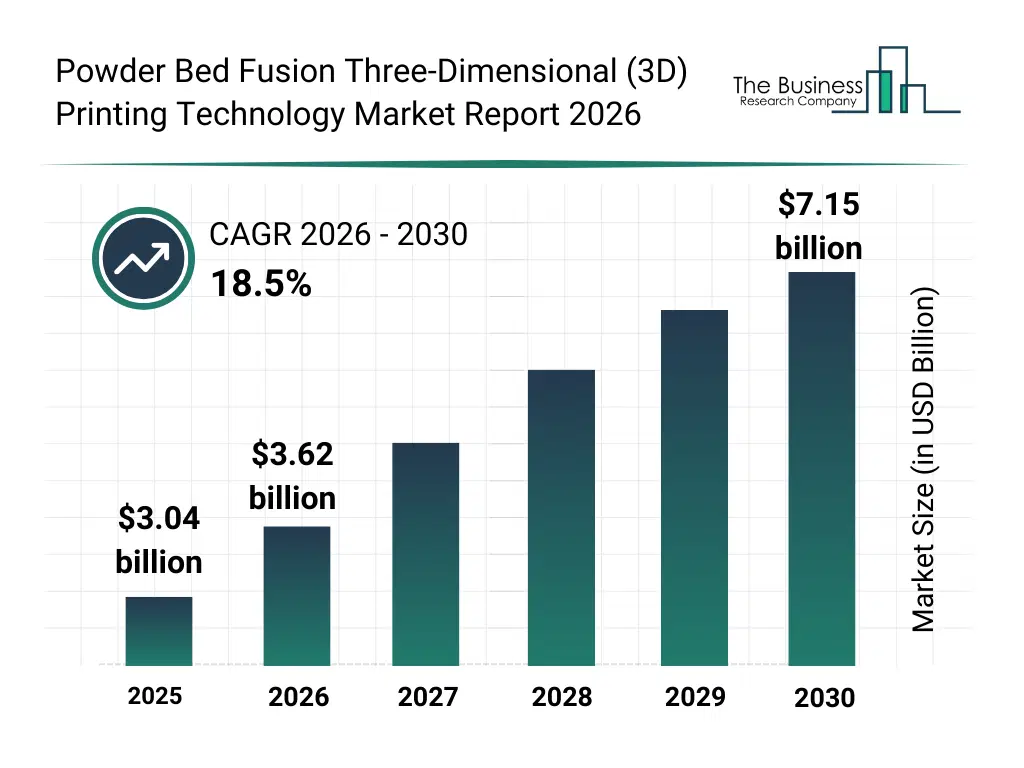
What Is The Powder Bed Fusion Three-Dimensional (3D) Printing Technology Market Size and Share 2026?
The powder bed fusion three-dimensional (3d) printing technology market size has grown rapidly in recent years. It will grow from $3.04 billion in 2025 to $3.62 billion in 2026 at a compound annual growth rate (CAGR) of 18.9%. The growth in the historic period can be attributed to demand for complex component geometries, early adoption in aerospace manufacturing, advances in laser technology, need for rapid prototyping, reduction of material waste.What Is The Powder Bed Fusion Three-Dimensional (3D) Printing Technology Market Growth Forecast?
The powder bed fusion three-dimensional (3d) printing technology market size is expected to see rapid growth in the next few years. It will grow to $7.15 billion in 2030 at a compound annual growth rate (CAGR) of 18.5%. The growth in the forecast period can be attributed to growth in aerospace and defense demand, expansion of medical implant manufacturing, advancements in metal powders, increased adoption in automotive production, focus on sustainable manufacturing. Major trends in the forecast period include high-precision metal additive manufacturing, lightweight component production, advanced material development, digital manufacturing workflows, customized low-volume production.
Global Powder Bed Fusion Three-Dimensional (3D) Printing Technology Market Segmentation
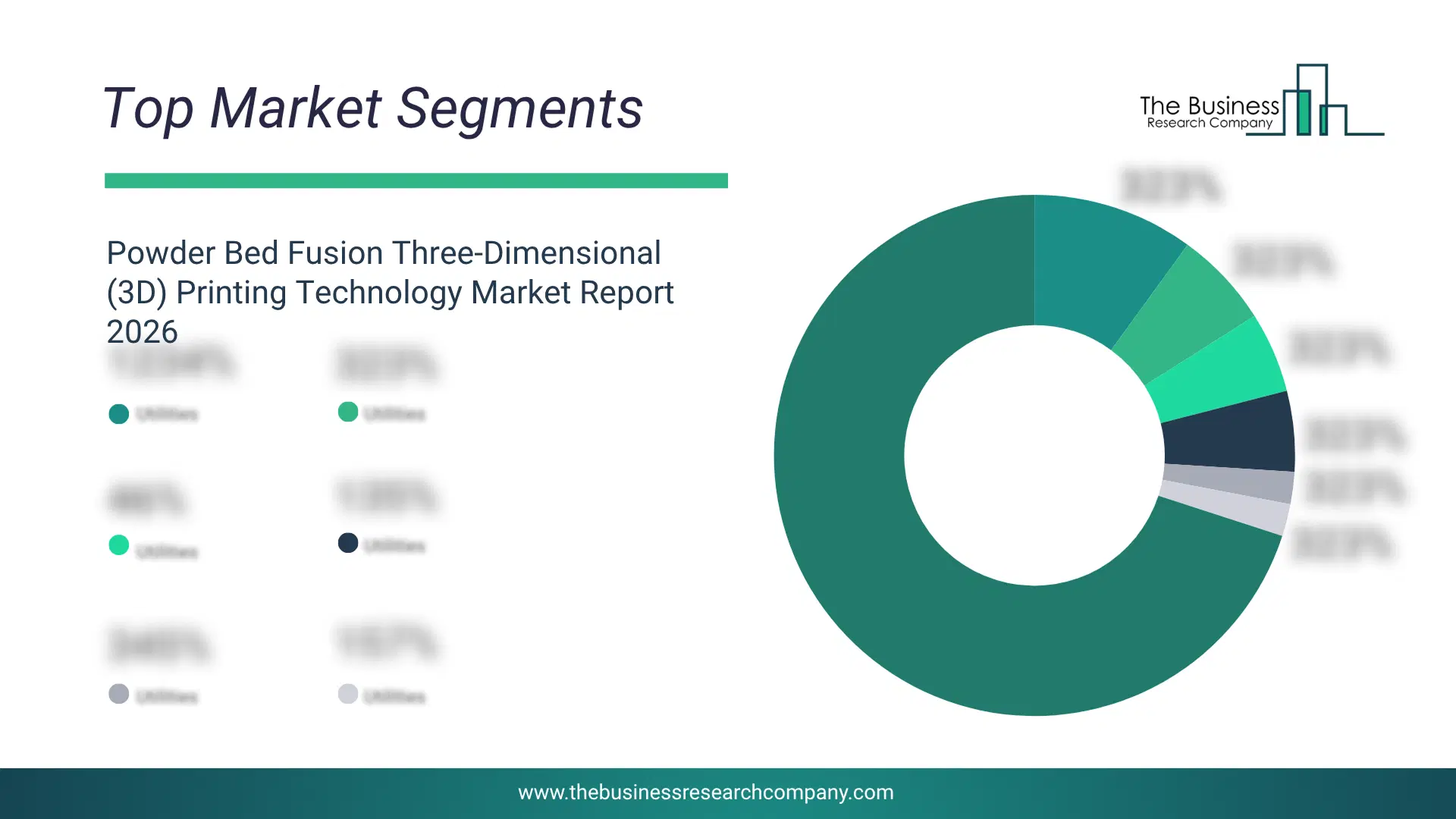
1) By Component: Hardware, Software, Services, Material 2) By Technology: Multi Jet Fusion, Selective Laser Sintering, Direct Metal Laser Sintering Or Selective Laser Melting, Electron Beam Melting 3) By End-User: Healthcare, Automotive, Aerospace And Defense, Other End-Users Subsegments: 1) By Hardware: 3D Printers, Scanners, Laser Systems 2) By Software: CAD Software, Slicing Software, Simulation Software 3) By Services: 3D Printing Services, Post-Processing Services, Design And Prototyping Services 4) By Material: Metal Powders, Plastic Powders, Ceramic PowdersWhat Is The Driver Of The Powder Bed Fusion Three-Dimensional (3D) Printing Technology Market?
The growing aerospace and defense industry is expected to propel the growth of the powder bed fusion (PBF) 3D printing technology market going forward. Aerospace and defense refers to the industries involved in developing, producing, and maintaining aircraft, spacecraft, and military systems, including technologies for national security, space exploration, and aviation. The growing aerospace and defense industry is driven by rising defense budgets, advancements in fuel-efficient technologies, and the need for next-generation military and commercial aircraft. Powder bed fusion (PBF) 3D printing technology is widely used in the aerospace and defense industry for manufacturing lightweight, high-strength, and complex components that traditional methods struggle to produce. This technology enhances aerospace and defense manufacturing efficiency, performance, and sustainability. For instance, in September 2024, according to the Aerospace Industries Association (AIA), a US-based aerospace and defense company, the U.S. aerospace and defense industry achieved a remarkable milestone, surpassing $955 billion in sales in 2023, a 7.1% growth compared to 2022. Therefore, the growing aerospace and defense industry is driving the growth of the powder bed fusion (PBF) 3D printing technology market.Key Players In The Global Powder Bed Fusion Three-Dimensional (3D) Printing Technology Market
Major companies operating in the powder bed fusion three-dimensional (3d) printing technology market are HP Inc., Dyndrite Corporation, TRUMPF GmbH + Co. KG, Renishaw plc, 3D Systems Inc., Protolabs Inc., Xometry Inc., Materialise, Velo3D Inc., ExOne Company, Farsoon Technologies, Eplus3D Tech GmbH, EOS GmbH, Aconity 3D GmbH, SLM Solutions AG, Bright Laser Technologies, Colibrium Additive, AddUp, Prima Additive, One Click Metal, Creatz3D, HBD, Shenzhen KINGS 3D Printing Technology, ZRapid Tech, XDM 3D Printing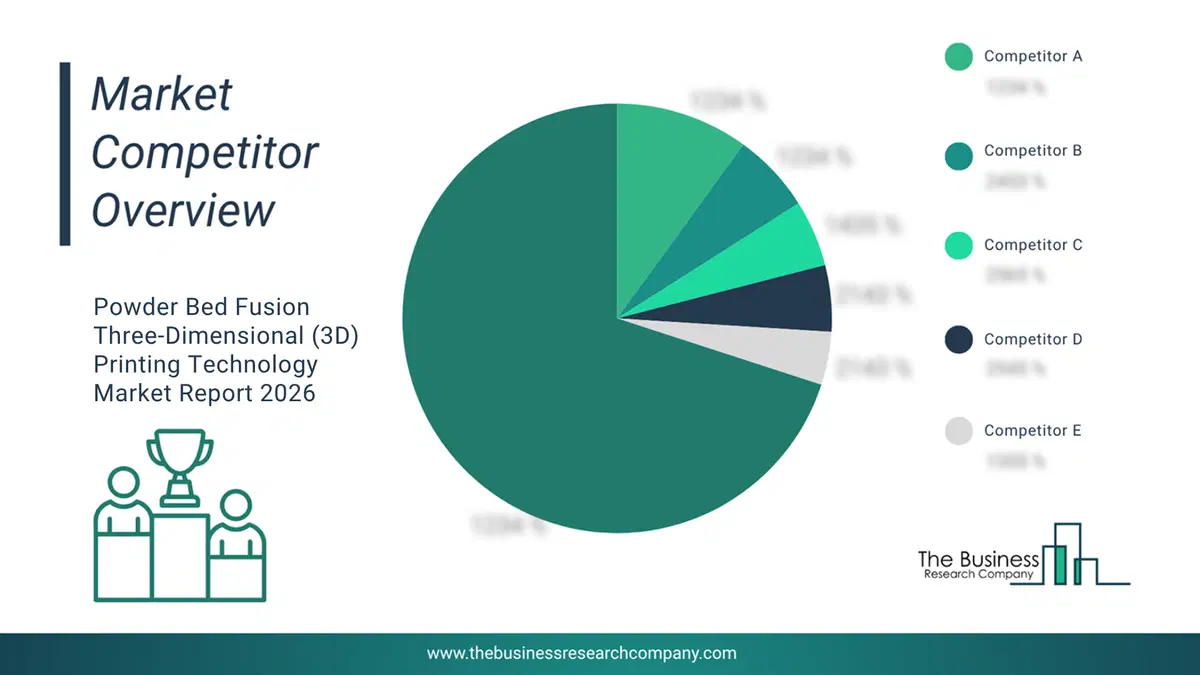
This chart is for illustrative purposes; the full report includes a detailed competitor analysis and comprehensive overview of the top 10 companies in the market.
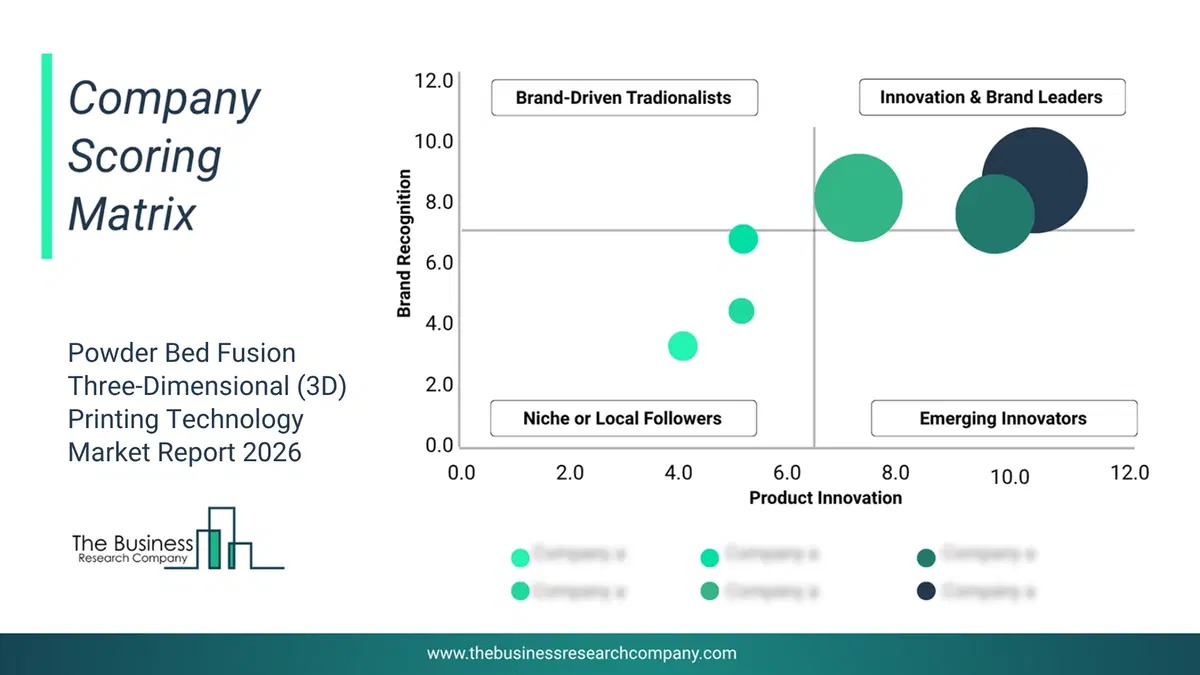
This chart maps companies by product innovation and brand strength, with bubble size indicating relative revenue, helping identify market leaders, challengers, and niche players. This is an illustrative chart; the full report provides a complete and accurate competitive analysis.
Global Powder Bed Fusion Three-Dimensional (3D) Printing Technology Market Trends and Insights
Major companies operating in the powder bed fusion (PBF) 3D printing technology market are focusing on developing advanced products, such as selective laser sintering (SLS) printers, to meet the growing demand for high-performance 3D-printed components. A selective laser sintering (SLS) printer is a 3D printer that uses a high-powered laser to fuse powdered materials layer by layer. The laser precisely heats specific areas based on a digital design, bonding the powder to form solid structures. For instance, in November 2024, EOS GmbH, a Germany-based provider of 3D printing solutions, launched the P3 NEXT 3D printer. This new printer promises up to 50% increased productivity and a 30% reduction in total cost of ownership compared to its predecessor, the EOS P 396. With a compact design and enhanced features such as improved scanning algorithms and material efficiency, the P3 NEXT supports various industries, including medical and aerospace, by enabling large-scale production runs while maintaining high quality and sustainability standards. EOS emphasizes that growth in additive manufacturing will stem from innovative production applications like those facilitated by the P3 NEXT.What Are Latest Mergers And Acquisitions In The Powder Bed Fusion Three-Dimensional (3D) Printing Technology Market?
In August 2024, Formlabs, Inc., a US-based technology company, acquired Micronics, Inc. for an undisclosed amount. With this acquisition, Formlabs aims to accelerate its selective laser sintering 3D printing capabilities, expand access to powerful and accessible 3D printing solutions, and enable product designers, engineers, and innovators to unleash more creativity and print robust end-use parts. Micronics, Inc. is a US-based 3D printing company that manufactures desktop Selective Laser Sintering 3D printers.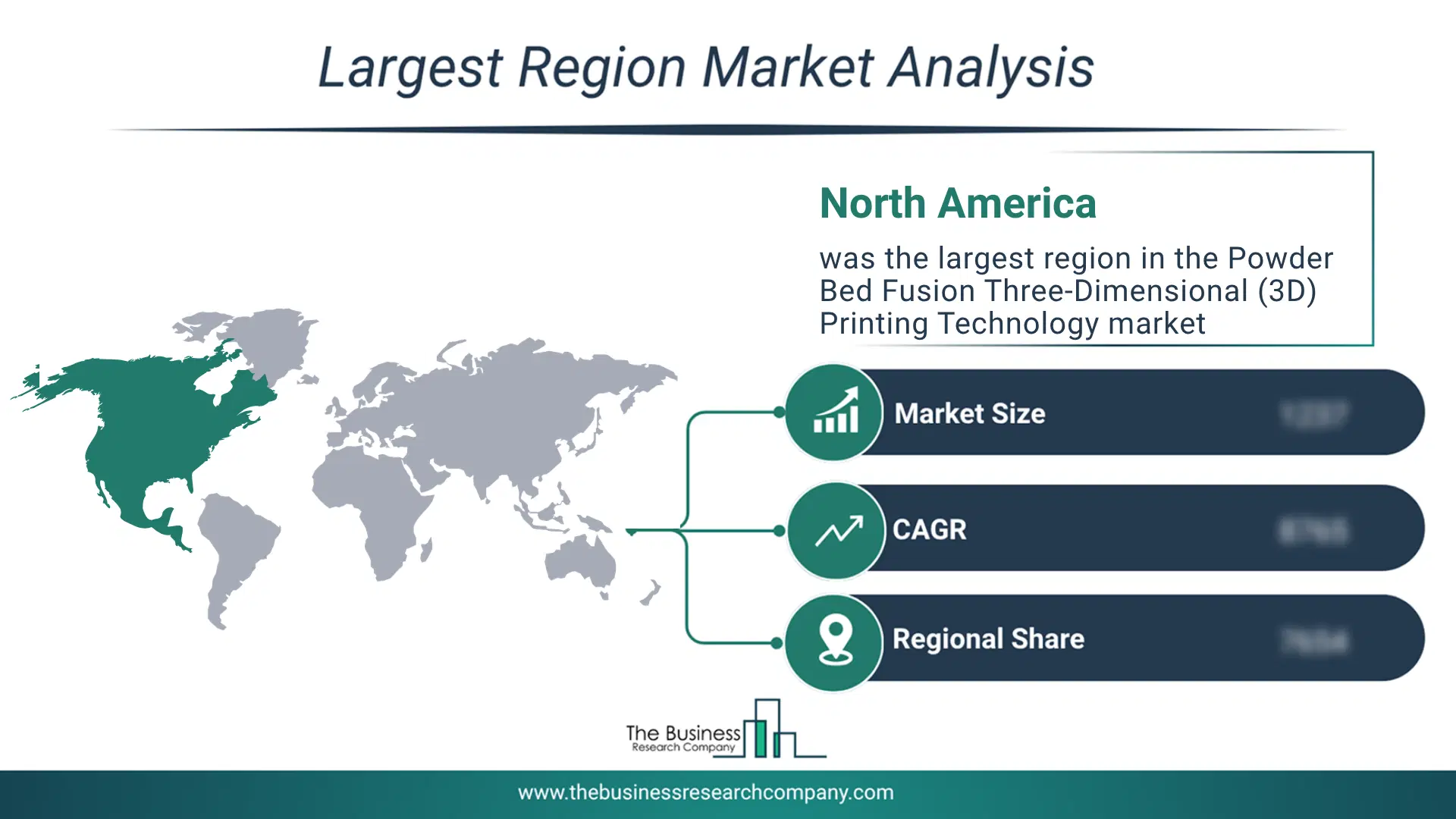
Regional Insights
North America was the largest region in the powder bed fusion three-dimensional (3D) printing technology market in 2025. Asia-Pacific is expected to be the fastest-growing region in the forecast period. The regions covered in this market report are Asia-Pacific, South East Asia, Western Europe, Eastern Europe, North America, South America, Middle East, Africa. The countries covered in this market report are Australia, Brazil, China, France, Germany, India, Indonesia, Japan, Taiwan, Russia, South Korea, UK, USA, Canada, Italy, Spain.What Defines the Powder Bed Fusion Three-Dimensional (3D) Printing Technology Market?
The powder bed fusion three-dimensional (3D) printing technology market consists of revenues earned by entities providing services such as rapid prototyping, custom part manufacturing, high-performance component production, and repair and replacement of critical parts. The market value includes the value of related goods sold by the service provider or included within the service offering. The powder bed fusion (PBF) 3D printing technology market also includes sales of build chambers, powder recoaters, high-energy heat sources, and post-processing equipment. Values in this market are ‘factory gate’ values, that is, the value of goods sold by the manufacturers or creators of the goods, whether to other entities (including downstream manufacturers, wholesalers, distributors, and retailers) or directly to end customers. The value of goods in this market includes related services sold by the creators of the goods.How is Market Value Defined and Measured?
The market value is defined as the revenues that enterprises gain from the sale of goods and/or services within the specified market and geography through sales, grants, or donations in terms of the currency (in USD unless otherwise specified). The revenues for a specified geography are consumption values that are revenues generated by organizations in the specified geography within the market, irrespective of where they are produced. It does not include revenues from resales along the supply chain, either further along the supply chain or as part of other products.
This chart presents market attractiveness based on a quantitative evaluation of growth, competition, strategic alignment, and risk, offering a clear view of opportunity areas for decision-making. This chart is for illustrative purposes; the full report contains the complete analysis.

This chart highlights the Total Addressable Market (TAM) by estimating the maximum revenue opportunity using an assumption-driven approach, supporting strategic planning and opportunity sizing across markets. The chart is illustrative; the full report provides a more comprehensive analysis.
What Key Data and Analysis Are Included in the Powder Bed Fusion Three-Dimensional (3D) Printing Technology Market Report 2026?
The powder bed fusion three-dimensional (3d) printing technology market research report is one of a series of new reports from The Business Research Company that provides market statistics, including industry global market size, regional shares, competitors with the market share, detailed market segments, market trends and opportunities, and any further data you may need to thrive in the powder bed fusion three-dimensional (3d) printing technology industry. The market research report delivers a complete perspective of everything you need, with an in-depth analysis of the current and future state of the industry.Powder Bed Fusion Three-Dimensional (3D) Printing Technology Market Report Forecast Analysis
| Report Attribute | Details |
|---|---|
| Market Size Value In 2026 | $3.62 billion |
| Revenue Forecast In 2030 | $7.15 billion |
| Growth Rate | CAGR of 18.5% from 2026 to 2030 |
| Base Year For Estimation | 2025 |
| Actual Estimates/Historical Data | 2020-2025 |
| Forecast Period | 2026 - 2030 |
| Market Representation | Revenue in USD Billion and CAGR from 2026 to 2030 |
| Segments Covered | Component, Technology, End-User |
| Regional Scope | Asia-Pacific, Western Europe, Eastern Europe, North America, South America, Middle East, Africa |
| Country Scope | The Countries Covered In This Market Report Are Australia, Brazil, China, France, Germany, India, Indonesia, Japan, Taiwan, Russia, South Korea, Uk, Usa, Canada, Italy, Spain. |
| Key Companies Profiled | HP Inc., Dyndrite Corporation, TRUMPF GmbH + Co. KG, Renishaw plc, 3D Systems Inc., Protolabs Inc., Xometry Inc., Materialise, Velo3D Inc., ExOne Company, Farsoon Technologies, Eplus3D Tech GmbH, EOS GmbH, Aconity 3D GmbH, SLM Solutions AG, Bright Laser Technologies, Colibrium Additive, AddUp, Prima Additive, One Click Metal, Creatz3D, HBD, Shenzhen KINGS 3D Printing Technology, ZRapid Tech, XDM 3D Printing |
| Customization Scope | Request for Customization |
| Pricing And Purchase Options | Explore Purchase Options |