
Power Generation Carbon Capture and Storage Market Report 2026
Global Outlook – By Technology (Post Combustion Capture, Pre Combustion Capture, Oxy Fuel Combustion, Direct Air Capture), By Capture Methodology (Absorption, Adsorption, Membrane Separation, Cryogenic Distillation), By Storage Method (Geological Storage, Ocean Storage, Mineral Carbonation, Utilization in Products), By Project Stage (Capture Technology And Engineering, Transportation (Pipeline And Shipping), Storage Site Characterization And Operation, Monitoring, Verification, And Reporting), By End User (Utility Sector, Industrial Sector, Government and Regulatory Bodies) – Market Size, Trends, Strategies, and Forecast to 2030
Power Generation Carbon Capture and Storage Market Overview
• Power Generation Carbon Capture and Storage market size has reached to $5.61 billion in 2025 • Expected to grow to $11.30 billion in 2030 at a compound annual growth rate (CAGR) of 15% • Growth Driver: Surge In Power Sector Emission-Reduction Initiatives Driving The Growth Of The Market Due To Rising Focus On Carbon Capture Technologies • Market Trend: Deploying Advanced Offshore Carbon Capture And Storage To Reduce Emissions And Enhance Energy Sustainability • North America was the largest region in 2025 and Asia-Pacific is the fastest growing region.What Is Covered Under Power Generation Carbon Capture and Storage Market?
Power generation carbon capture and storage is a process that captures carbon dioxide emissions produced from electricity generation and stores them securely to prevent their release into the atmosphere. It involves capturing carbon at the source, transporting it, and injecting it into geological formations or other secure storage solutions for long-term containment. This technology helps reduce greenhouse gas emissions, mitigate climate change, and support cleaner energy production while maintaining reliable power generation. The main technology of power generation carbon capture and storage includes post combustion capture, pre-combustion capture, oxy fuel combustion, and direct air capture. Post combustion capture refers to processes that remove carbon dioxide from flue gases after the combustion of fossil fuels, forming a critical step in reducing greenhouse gas emissions from power plants. The capture methodologies such as absorption, adsorption, membrane separation, and cryogenic distillation. The stored method via geological storage, ocean storage, mineral carbonation, and utilized in products. There are project stages including capture technology and engineering, transportation via pipeline and shipping, storage site characterization and operation, and monitoring, verification, and reporting. The key end users include utility sector companies, industrial sector players, and government and regulatory bodies.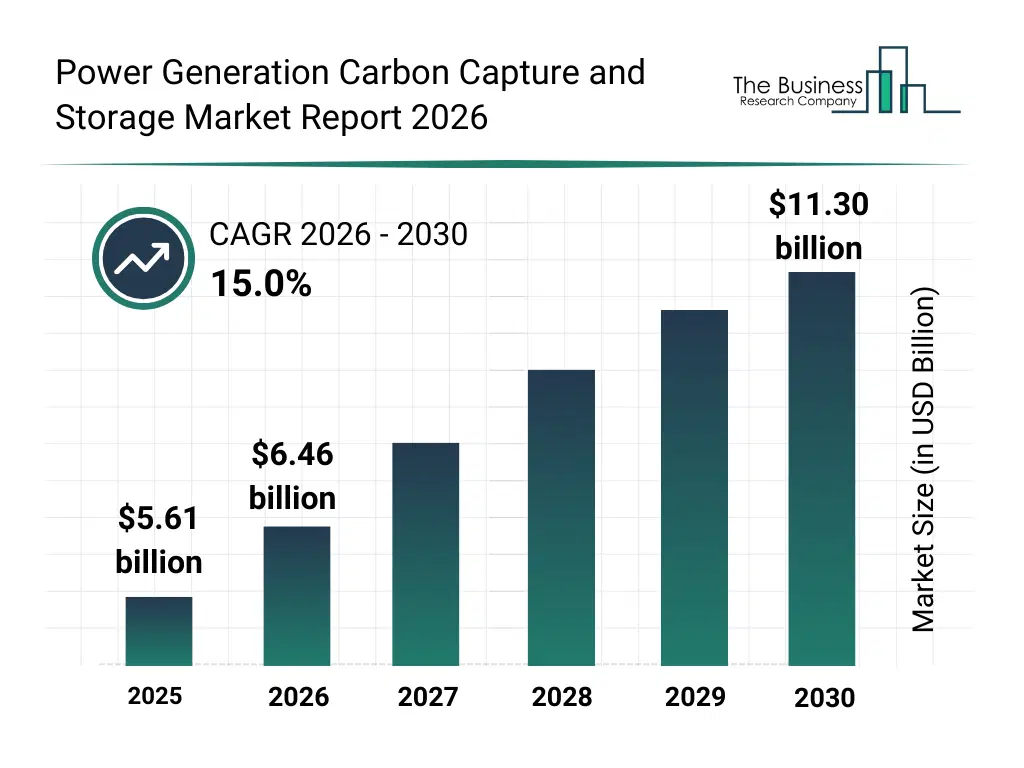
What Is The Power Generation Carbon Capture and Storage Market Size and Share 2026?
The power generation carbon capture and storage market size has grown rapidly in recent years. It will grow from $5.61 billion in 2025 to $6.46 billion in 2026 at a compound annual growth rate (CAGR) of 15.3%. The growth in the historic period can be attributed to increasing government climate mandates for emission reduction, growing reliance on fossil fuel power plants requiring decarbonization, rising investments in early carbon capture demonstration projects, expansion of regulatory frameworks supporting carbon storage, increasing adoption of post combustion capture technologies.What Is The Power Generation Carbon Capture and Storage Market Growth Forecast?
The power generation carbon capture and storage market size is expected to see rapid growth in the next few years. It will grow to $11.30 billion in 2030 at a compound annual growth rate (CAGR) of 15.0%. The growth in the forecast period can be attributed to growing incentives and financial schemes for carbon capture adoption, rising need to decarbonize existing coal and gas power fleets, expansion of regional carbon transport and storage infrastructure, increasing integration of biomass power with carbon capture, growing demand for negative emission technologies. Major trends in the forecast period include advancements in post combustion capture solvent technologies, innovations in direct air capture systems, developments in oxy-fuel combustion research, research and development in low energy penalty capture processes, advancements in digital monitoring and reservoir analytics.
Global Power Generation Carbon Capture and Storage Market Segmentation
1) By Technology: Post Combustion Capture, Pre Combustion Capture, Oxy Fuel Combustion, Direct Air Capture 2) By Capture Methodology: Absorption, Adsorption, Membrane Separation, Cryogenic Distillation 3) By Storage Method: Geological Storage, Ocean Storage, Mineral Carbonation, Utilization in Products 4) By Project Stage: Capture Technology And Engineering, Transportation (Pipeline And Shipping), Storage Site Characterization And Operation, Monitoring, Verification, And Reporting 5) By End User: Utility Sector, Industrial Sector, Government and Regulatory Bodies Subsgments: 1) By Post Combustion Capture: Chemical Absorption, Physical Absorption, Solid Sorbent Adsorption, Membrane Based Separation 2) By Pre Combustion Capture: Gasification Based Capture, Steam Reforming Based Capture, Carbon Monoxide Shift Conversion, Physical Solvent Separation 3) By Oxy Fuel Combustion: Oxygen Production Systems, Flue Gas Recirculation Systems, Integrated Combustion Units, High Purity Carbon Dioxide Separation Systems 4) By Direct Air Capture: Liquid Solvent Based Capture, Solid Sorbent Based Capture, Temperature Swing Adsorption, Pressure Swing AdsorptionWhat Is The Driver Of The Power Generation Carbon Capture and Storage Market?
The increasing emphasis on reducing power sector emissions is expected to propel the growth of the power generation carbon capture and storage market going forward. Reducing power sector emissions refers to government and regulatory measures designed to lower carbon dioxide (CO?) and other greenhouse gas outputs from electricity production, particularly from fossil fuel-based power plants. The rising focus on reducing power sector emissions is due to climate change concerns and international commitments that require substantial cuts in greenhouse gas levels. Power generation carbon capture and storage helps in reducing power sector emissions by capturing CO? before it is released into the atmosphere, enabling power plants to operate with a significantly reduced carbon footprint. For instance, in March 2024, the UK Department for Energy Security and Net Zero, a UK-based government entity, the greenhouse gas emissions from the country’s electricity supply declined by 19.6% (10.8 MtCO2e) in 2023 compared to 2022, driven largely by power-sector decarbonisation initiatives. Therefore, the increasing emphasis on reducing power sector emissions is driving the growth of the power generation carbon capture and storage industry.Key Players In The Global Power Generation Carbon Capture and Storage Market
Major companies operating in the power generation carbon capture and storage market are Exxon Mobil Corporation, Shell plc, TotalEnergies SE, Chevron Corporation, General Electric Co., Schlumberger Limited, Linde AG, Mitsubishi Heavy Industries Ltd., Air Liquide, Occidental Petroleum Corporation, Baker Hughes Company, Fluor Corporation, Woodside Energy Group Ltd., Doosan Enerbility Co. Ltd., Saipem S.p.A., Worley Limited, Technip Energies, Chart Industries Inc., Hatch Ltd., Calix Limited, Aker Carbon Capture ASA, Carbon Clean Solutions Ltd., DNV AS
This chart is for illustrative purposes; the full report includes a detailed competitor analysis and comprehensive overview of the top 10 companies in the market.
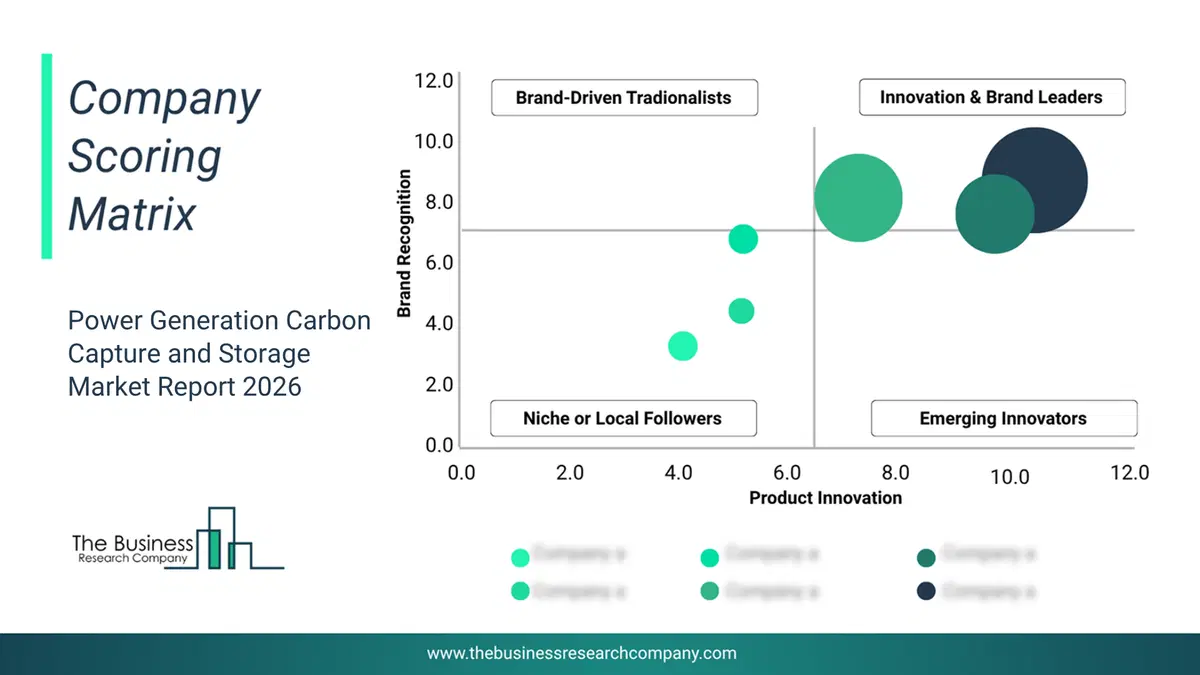
This chart maps companies by product innovation and brand strength, with bubble size indicating relative revenue, helping identify market leaders, challengers, and niche players. This is an illustrative chart; the full report provides a complete and accurate competitive analysis.
Global Power Generation Carbon Capture and Storage Market Trends and Insights
Major companies operating in the power generation carbon capture and storage market are focusing on deploying advanced offshore solutions, such as CO₂ compression and storage systems, to reduce emissions and enhance sustainability in energy production. CO₂ compression and storage system refers to technological processes that capture, purify, and inject carbon dioxide streams from energy facilities into secure geological formations, helping mitigate climate impact. For instance, in September 2025, China National Offshore Oil Corporation (CNOOC), a China-based energy company, launched its first offshore CCS project at the Enping 15‑1 platform, capable of capturing and storing more than 100,000 metric tons of CO₂ annually. The project supports nearby energy supply chains and power generation feedstocks while advancing practical CCS deployment.What Are Latest Mergers And Acquisitions In The Power Generation Carbon Capture and Storage Market?
In November 2023, Exxon Mobil Corporation, a US-based integrated energy company, acquired Denbury Inc. for approximately $4.9 billion. With this acquisition, ExxonMobil aims to strengthen its Low Carbon Solutions business by integrating Denbury’s extensive carbon capture, utilization, and storage (CCUS) infrastructure, including over 1,300 miles of CO₂ pipeline network and multiple onshore storage sites to accelerate deployment of carbon capture and sequestration solutions across North America. Denbury Inc. is a US-based energy company focused on carbon capture, utilization, and storage (CCUS) operations and CO₂ enhanced oil recovery infrastructure.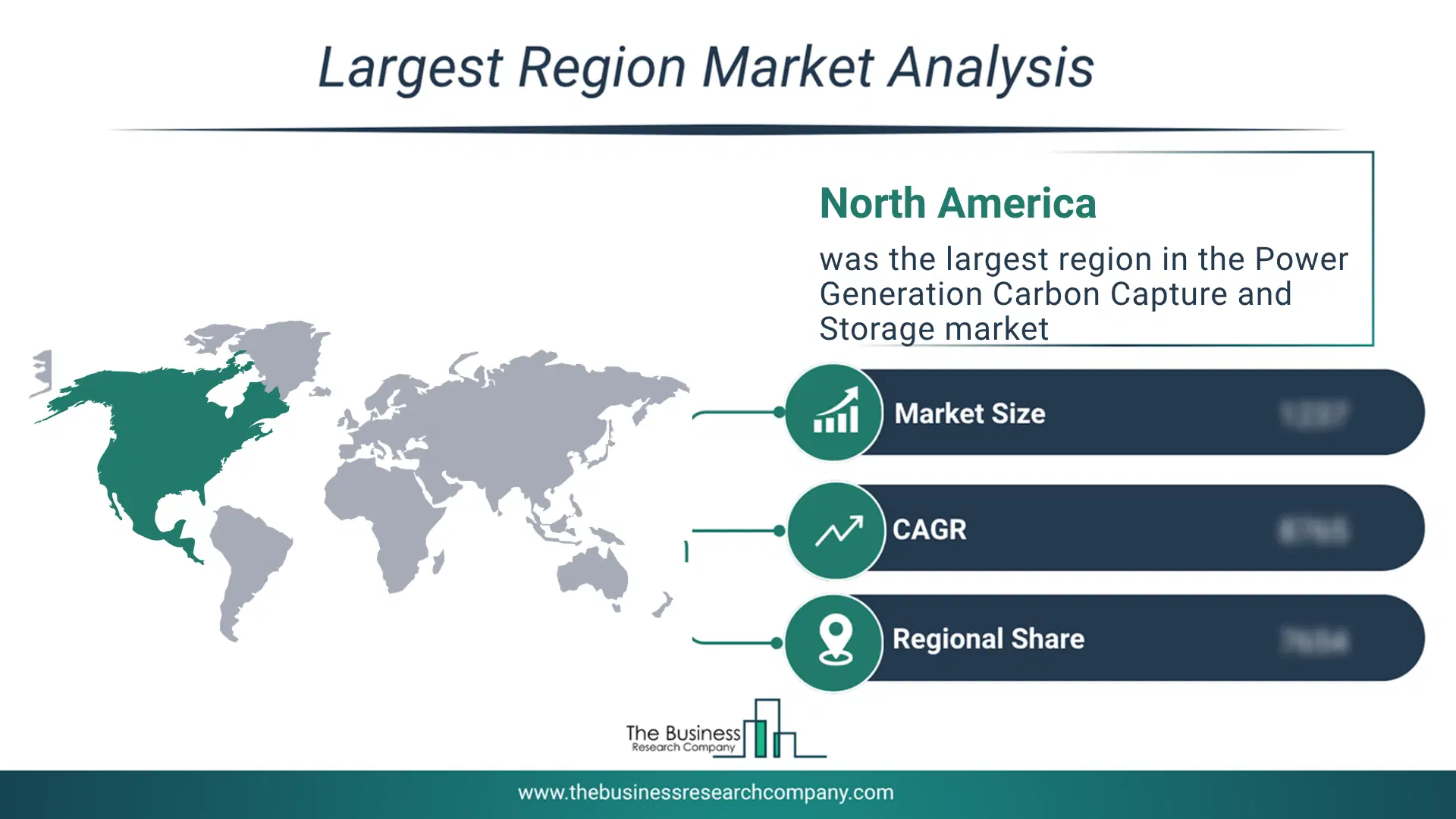
Regional Insights
North America was the largest region in the power generation carbon capture and storage market in 2025. Asia-Pacific is expected to be the fastest-growing region in the forecast period. The regions covered in this market report are Asia-Pacific, South East Asia, Western Europe, Eastern Europe, North America, South America, Middle East, Africa. The countries covered in this market report are Australia, Brazil, China, France, Germany, India, Indonesia, Japan, Taiwan, Russia, South Korea, UK, USA, Canada, Italy, Spain.What Defines the Power Generation Carbon Capture and Storage Market?
The power generation carbon capture and storage market consists of revenues earned by entities by providing services such as carbon capture consulting, CO2 transportation services, storage site assessment, monitoring and verification, installation and maintenance. The market value includes the value of related goods sold by the service provider or included within the service offering. The power generation carbon capture and storage market also includes sales of carbon capture units, compressors, pipelines, storage tanks, monitoring sensors. Values in this market are ‘factory gate’ values, that is the value of goods sold by the manufacturers or creators of the goods, whether to other entities (including downstream manufacturers, wholesalers, distributors and retailers) or directly to end customers. The value of goods in this market includes related services sold by the creators of the goods.How is Market Value Defined and Measured?
The market value is defined as the revenues that enterprises gain from the sale of goods and/or services within the specified market and geography through sales, grants, or donations in terms of the currency (in USD unless otherwise specified). The revenues for a specified geography are consumption values that are revenues generated by organizations in the specified geography within the market, irrespective of where they are produced. It does not include revenues from resales along the supply chain, either further along the supply chain or as part of other products.
This chart presents market attractiveness based on a quantitative evaluation of growth, competition, strategic alignment, and risk, offering a clear view of opportunity areas for decision-making. This chart is for illustrative purposes; the full report contains the complete analysis.

This chart highlights the Total Addressable Market (TAM) by estimating the maximum revenue opportunity using an assumption-driven approach, supporting strategic planning and opportunity sizing across markets. The chart is illustrative; the full report provides a more comprehensive analysis.
What Key Data and Analysis Are Included in the Power Generation Carbon Capture and Storage Market Report 2026?
The power generation carbon capture and storage market research report is one of a series of new reports from The Business Research Company that provides market statistics, including industry global market size, regional shares, competitors with the market share, detailed market segments, market trends and opportunities, and any further data you may need to thrive in the power generation carbon capture and storage industry. The market research report delivers a complete perspective of everything you need, with an in-depth analysis of the current and future state of the industry.Power Generation Carbon Capture and Storage Market Report Forecast Analysis
| Report Attribute | Details |
|---|---|
| Market Size Value In 2026 | $6.46 billion |
| Revenue Forecast In 2030 | $11.30 billion |
| Growth Rate | CAGR of 15.3% from 2026 to 2030 |
| Base Year For Estimation | 2025 |
| Actual Estimates/Historical Data | 2020-2025 |
| Forecast Period | 2026 - 2030 - 2030 |
| Market Representation | Revenue in USD Billion and CAGR from 2026 to 2030 |
| Segments Covered | Technology, Capture Methodology, Storage Method, Project Stage, End User, Post Combustion Capture, Pre Combustion Capture, Oxy Fuel Combustion, Direct Air Capture |
| Regional Scope | Asia-Pacific, Western Europe, Eastern Europe, North America, South America, Middle East, Africa |
| Country Scope | The countries covered in the report are Australia, Brazil, China, France, Germany, India, Indonesia, Japan, Taiwan, Russia, South Korea, UK, USA, Canada, Italy, Spain. |
| Key Companies Profiled | Exxon Mobil Corporation, Shell plc, TotalEnergies SE, Chevron Corporation, General Electric Co., Schlumberger Limited, Linde AG, Mitsubishi Heavy Industries Ltd., Air Liquide, Occidental Petroleum Corporation, Baker Hughes Company, Fluor Corporation, Woodside Energy Group Ltd., Doosan Enerbility Co. Ltd., Saipem S.p.A., Worley Limited, Technip Energies, Chart Industries Inc., Hatch Ltd., Calix Limited, Aker Carbon Capture ASA, Carbon Clean Solutions Ltd., DNV AS |
| Customization Scope | Request for Customization |
| Pricing And Purchase Options | Explore Purchase Options |