
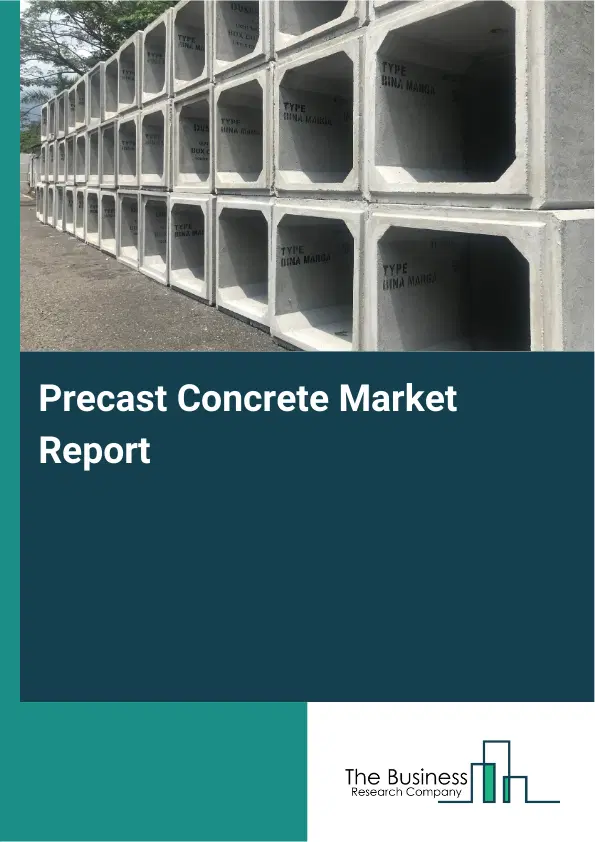
Precast Concrete Market Report 2026
Global Outlook – By Product (Structural Building Components, Architectural Building Components, Transportation Products, Water And Waste Handling Products, Other Products), By Precast Concrete Form (Concrete Masonry Units (CMUs), Pavers, Retaining Walls, Other Precast Concrete Forms), By Element (Columns And Beams, Floors And Roofs, Walls And Barriers, Girders, Pipes, Paving Slabs, Utility Vaults, Other Elements), By End-Use (Residential, Non-Residential, Infrastructure) – Market Size, Trends, Strategies, and Forecast to 2030
Precast Concrete Market Overview
• Precast Concrete market size has reached to $127.54 billion in 2025 • Expected to grow to $164.07 billion in 2030 at a compound annual growth rate (CAGR) of 5.1% • Growth Driver: Precast Concrete Market Soars With Rising Investments In Road And Water Projects • Market Trend: Graphene-Based Innovation Enhances Precast Concrete Efficiency And Sustainability • Europe was the largest region in 2025 and Asia-Pacific is the fastest growing region.What Is Covered Under Precast Concrete Market?
Precast concrete refers to a type of concrete that is prepared, cast, and cured off-site using reusable molds, typically in a controlled factory setting, as it is easier to control the mix, placement, and curing of precast because it is produced in a managed casting environment to provide functional versatility in parking garages, bridges, office buildings, stadiums, shops, and housing with repetitive and modular elements. The main precast concrete products are structural building components, architectural building components, transportation products, water and waste handling products, and others. Structural building components are used for rapid works of structural buildings. The precast building is made up of various precast components such as footings, beams, slabs, columns, walls, and facades, among others. The various types of precast concrete products are concrete masonry units (CMUS), pavers, retaining walls, and others. The elements of precast concrete include columns and beams, floors and roofs, walls and barriers, girders, pipes, paving slabs, utility vaults, and others that are used by end-users such as residential, non-residential, and infrastructure.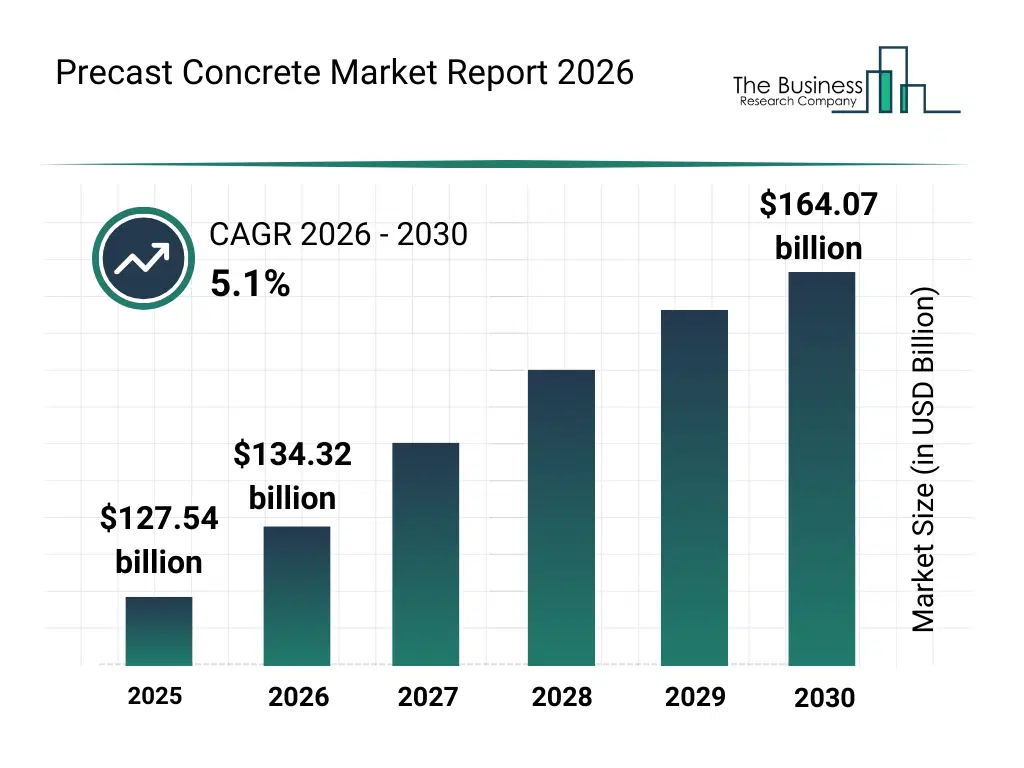
What Is The Precast Concrete Market Size and Share 2026?
The precast concrete market size has grown strongly in recent years. It will grow from $127.54 billion in 2025 to $134.32 billion in 2026 at a compound annual growth rate (CAGR) of 5.3%. The growth in the historic period can be attributed to growth in urban infrastructure projects, rising construction of commercial buildings, increasing government investment in public infrastructure, expansion of industrial facilities, development of standardized precast components.What Is The Precast Concrete Market Growth Forecast?
The precast concrete market size is expected to see strong growth in the next few years. It will grow to $164.07 billion in 2030 at a compound annual growth rate (CAGR) of 5.1%. The growth in the forecast period can be attributed to increasing adoption in residential construction, rising demand for sustainable and green buildings, growth in transportation infrastructure projects, expansion of industrial modular facilities, development of high-performance precast concrete technologies. Major trends in the forecast period include increasing use of precast concrete in modular construction, rising adoption of advanced concrete mix designs, growing implementation of automated casting processes, increasing focus on high-strength structural components, rising demand for eco-friendly and recyclable concrete products.
Global Precast Concrete Market Segmentation
1) By Product: Structural Building Components, Architectural Building Components, Transportation Products, Water And Waste Handling Products, Other Products 2) By Precast Concrete Form: Concrete Masonry Units (CMUs), Pavers, Retaining Walls, Other Precast Concrete Forms 3) By Element: Columns And Beams, Floors And Roofs, Walls And Barriers, Girders, Pipes, Paving Slabs, Utility Vaults, Other Elements 4) By End-Use: Residential, Non-Residential, Infrastructure Subsegments: 1) By Structural Building Components: Precast Concrete Beams, Precast Concrete Columns, Precast Concrete Wall Panels, Precast Concrete Slabs 2) By Architectural Building Components: Precast Concrete Facades, Precast Concrete Cladding, Precast Concrete Cornices and Caps, Precast Concrete Stairs 3) By Transportation Products: Precast Concrete Barriers, Precast Concrete Sound Walls, Precast Concrete Bridge Components, Precast Concrete Drainage Systems 4) By Water And Waste Handling Products: Precast Concrete Manholes, Precast Concrete Tanks, Precast Concrete Pipes, Precast Concrete Catch Basins 5) By Other Products: Precast Concrete Retaining Walls, Precast Concrete Fireproofing Products, Precast Concrete Septic Tanks, Precast Concrete Furniture and FixturesWhat Is The Driver Of The Precast Concrete Market?
The increasing expenditure on road and water infrastructure is significantly driving the growth of the precast concrete market. The use of precast concrete offers major time and user cost savings in comparison with the traditional cast-in-place methods of construction. Emerging and advanced economies are increasing their spending on road and water infrastructure to bridge the gap between the required infrastructure and available infrastructure. Governments of various countries are increasing their expenditure on infrastructural developments to bridge this gap. For instance, in September 2023, according to the Council on Foreign Relations, a US-based think tank specializing in U.S. foreign policy and international relations, the Infrastructure Investment and Jobs Act (IIJA) allocates $550 billion in new spending to enhance physical infrastructure, including roads, bridges, railways, airports, and water systems. The additional $650 million comes from regular infrastructure project funding. Therefore, the increasing expenditure on road and water infrastructure will drive the precast concrete industry over the coming years.Key Players In The Global Precast Concrete Market
Major companies operating in the precast concrete market report are Holcim Group, CRH plc, CEMEX S.A.B. de C.V., HeidelbergCement, Vicat, Cementos Molins, Boral Limited, Forterra Inc., Tindall Corporation, Gulf Precast Concrete Co., Olson Precast Company, Bianco Precast, Oldcastle Precast, Banagher Precast Concrete, BREMER AG, ELO Beton, United Precast Concrete Abu Dhabi LLC, Dubai Precast LLC, Abu Dhabi Precast LLC, Alfanar Precast Factory, Prainsa Saudi Arabia for Precast Concrete, Concretex
This chart is for illustrative purposes; the full report includes a detailed competitor analysis and comprehensive overview of the top 10 companies in the market.
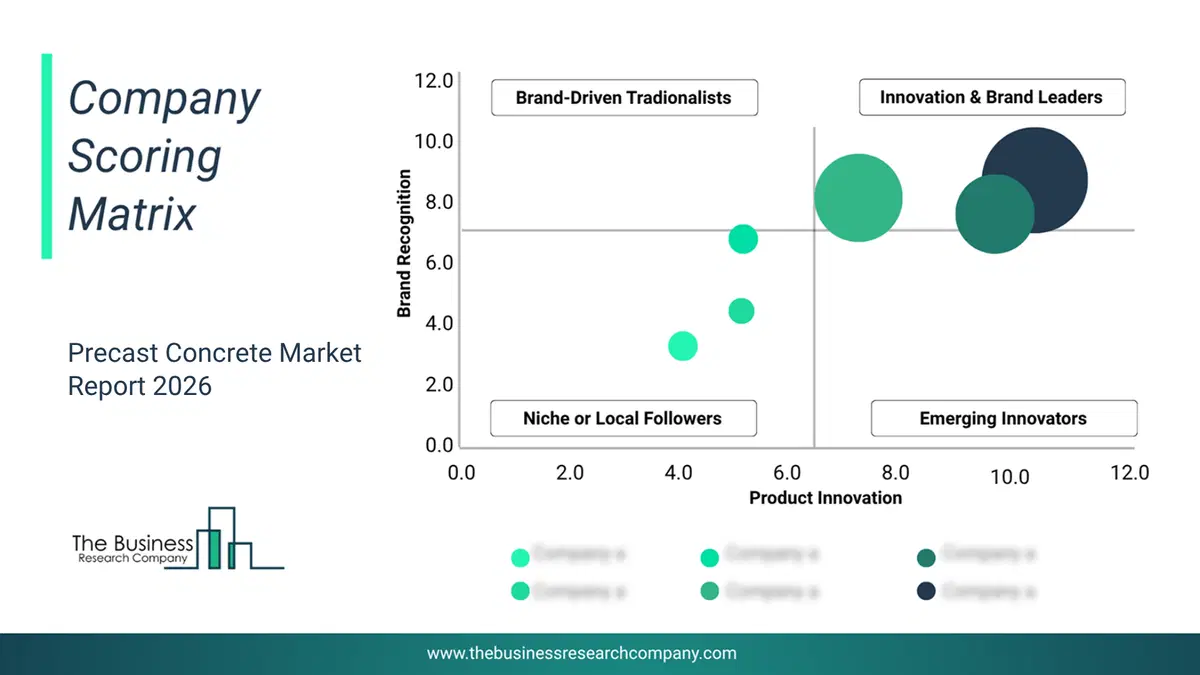
This chart maps companies by product innovation and brand strength, with bubble size indicating relative revenue, helping identify market leaders, challengers, and niche players. This is an illustrative chart; the full report provides a complete and accurate competitive analysis.
Global Precast Concrete Market Trends and Insights
Major companies operating in the precast concrete market are focusing on innovation, such as efficient water management, which facilitates a reduction in water consumption by 10% to 20% during concrete production. Efficient water management involves optimizing the use, distribution, and conservation of water resources to reduce waste, ensure sustainability, and meet current and future demand. For instance, in August 2024, Gerdau Graphene, a Brazil-based producer of graphene, launched NanoCONS specifically designed for precast concrete applications. A new graphene-based admixture for concrete significantly enhances strength, durability, and reduces porosity. It cuts water consumption by up to 20% and speeds up setting time by 30%, enabling faster construction. This innovative solution also helps lower carbon emissions in concrete production by reducing cement usage.What Are Latest Mergers And Acquisitions In The Precast Concrete Market?
In July 2024, Wells, a US-based full-service prefabricated building solutions provider, acquired GATE Precast for an undisclosed amount. This acquisition aims to enhance Wells' geographic reach and expand its portfolio of prefabricated building products. By integrating GATE Precast's expertise in precast concrete, the acquisition allowed Wells to strengthen its capabilities in delivering comprehensive building solutions across various sectors. GATE Precast is a US-based manufacturer of precast concrete systems.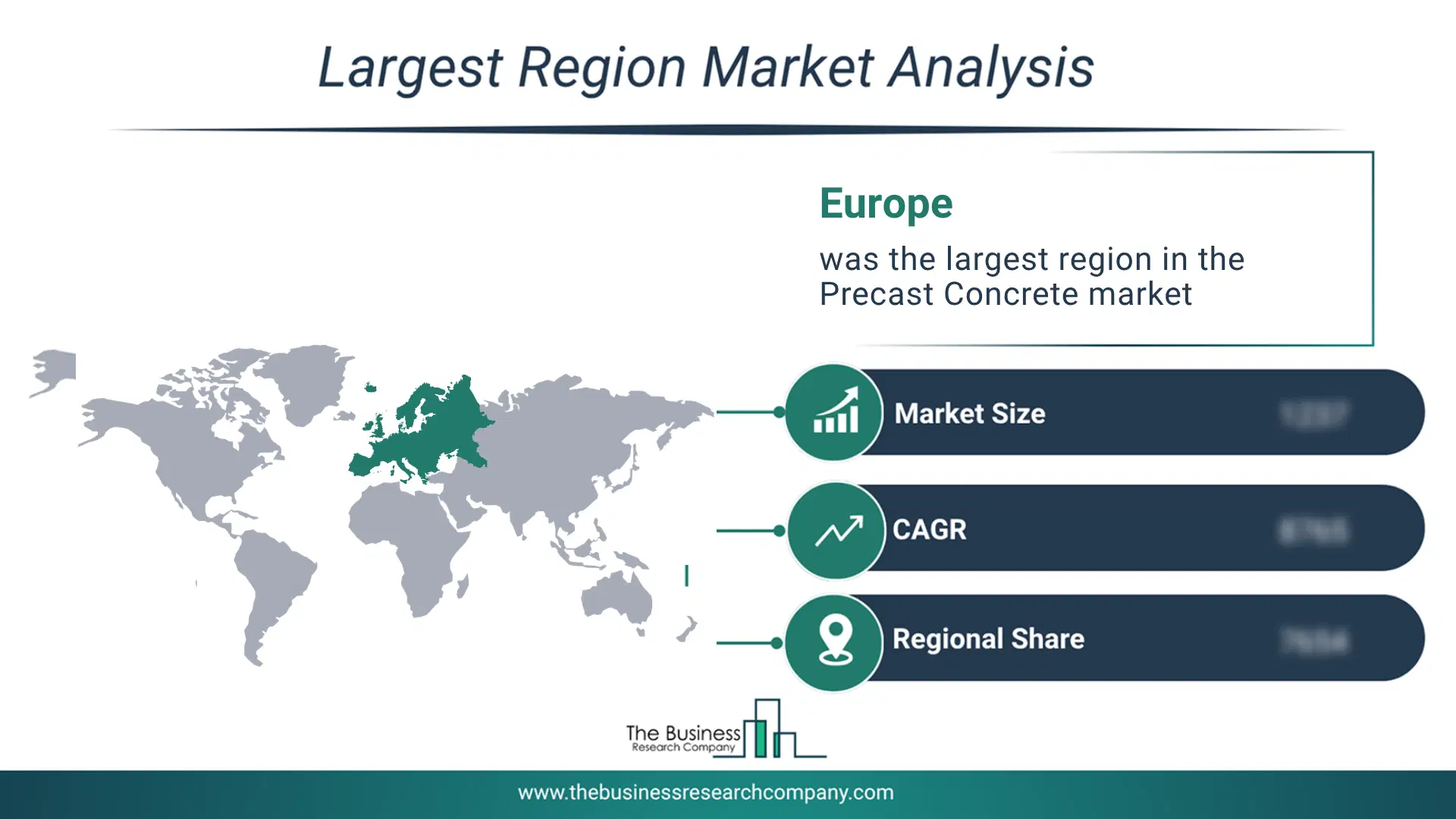
Regional Outlook
Europe was the largest region in the precast concrete market in 2025. Asia-Pacific is expected to be the fastest-growing region in the forecast period. The regions covered in the precast concrete market are Asia-Pacific, South East Asia, Western Europe, Eastern Europe, North America, South America, Middle East, Africa. The countries covered in the precast concrete market are Australia, Brazil, China, France, Germany, India, Indonesia, Japan, Taiwan, Russia, South Korea, UK, USA, Canada, Italy, Spain.What Defines the Precast Concrete Market?
The precast concrete market consists of sales of precast floor slabs, precast beams, precast walls, precast columns, and precast staircases. Values in this market are ‘factory gate’ values, that is the value of goods sold by the manufacturers or creators of the goods, whether to other entities (including downstream manufacturers, wholesalers, distributors and retailers) or directly to end customers. The value of goods in this market includes related services sold by the creators of the goods.How is Market Value Defined and Measured?
The market value is defined as the revenues that enterprises gain from the sale of goods and/or services within the specified market and geography through sales, grants, or donations in terms of the currency (in USD unless otherwise specified). The revenues for a specified geography are consumption values that are revenues generated by organizations in the specified geography within the market, irrespective of where they are produced. It does not include revenues from resales along the supply chain, either further along the supply chain or as part of other products.
This chart presents market attractiveness based on a quantitative evaluation of growth, competition, strategic alignment, and risk, offering a clear view of opportunity areas for decision-making. This chart is for illustrative purposes; the full report contains the complete analysis.

This chart highlights the Total Addressable Market (TAM) by estimating the maximum revenue opportunity using an assumption-driven approach, supporting strategic planning and opportunity sizing across markets. The chart is illustrative; the full report provides a more comprehensive analysis.
What Key Data and Analysis Are Included in the Precast Concrete Market Report 2026?
The precast concrete market research report is one of a series of new reports from The Business Research Company that provides market statistics, including Market Report 2026?global market size, regional shares, competitors with the market share, detailed market segments, market trends and opportunities, and any further data you may need to thrive in the precast concrete Market Report 2026? The market research report delivers a complete perspective of everything you need, with an in-depth analysis of the current and future state of the Market Report 2026?Precast Concrete Market Report Forecast Analysis
| Report Attribute | Details |
|---|---|
| Market Size Value In 2026 | $134.32 billion |
| Revenue Forecast In 2030 | $164.07 billion |
| Growth Rate | CAGR of 5.3% from 2026 to 2030 |
| Base Year For Estimation | 2025 |
| Actual Estimates/Historical Data | 2020-2025 |
| Forecast Period | 2026 - 2030 |
| Market Representation | Revenue in USD Billion and CAGR from 2026 to 2030 |
| Segments Covered | Product, Precast Concrete Form, Element, End-Use |
| Regional Scope | Asia-Pacific, Western Europe, Eastern Europe, North America, South America, Middle East, Africa |
| Country Scope | The countries covered in the report are Australia, Brazil, China, France, Germany, India, Indonesia, Japan, Taiwan, Russia, South Korea, UK, USA, Canada, Italy, Spain. |
| Key Companies Profiled | Holcim Group, CRH plc, CEMEX S.A.B. de C.V., HeidelbergCement, Vicat, Cementos Molins, Boral Limited, Forterra Inc., Tindall Corporation, Gulf Precast Concrete Co., Olson Precast Company, Bianco Precast, Oldcastle Precast, Banagher Precast Concrete, BREMER AG, ELO Beton, United Precast Concrete Abu Dhabi LLC, Dubai Precast LLC, Abu Dhabi Precast LLC, Alfanar Precast Factory, Prainsa Saudi Arabia for Precast Concrete, Concretex |
| Customization Scope | Request for Customization |
| Pricing And Purchase Options | Explore Purchase Options |