
Precision Parts Market Report 2026
Global Outlook – By Product Type (Microcomponents & Miniature Parts, Precision Shafts & Pins, Precision Rings & Retaining Components, Precision Tubes & Hollow Components, Precision Springs & Elastic Components, Precision Housings & Structural Components), By Material Type (Metal Precision Parts, Plastic Precision Parts, Ceramic & Advanced Material Precision Parts, Composite Precision Parts), By Manufacturing Process (CNC Machined Parts, Precision Turning Parts, Precision Milling Parts, EDM-Machined Parts (Wire & Sinker), Cold-Formed Precision Parts, Precision Stamped Parts, Electroformed Parts), By End-Use Industry (Aerospace & Defense, Automotive & Electric Vehicles, Electronics & Semiconductors, Medical & Healthcare Devices) – Market Size, Trends, Strategies, and Forecast to 2030
Precision Parts Market Overview
• Precision Parts market size has reached to $231.83 billion in 2025 • Expected to grow to $347.24 billion in 2030 at a compound annual growth rate (CAGR) of 8.4% • Growth Driver: Impact Of Vehicle Production On The Precision Parts Market • Market Trend: Innovative Solutions Innovations In CNC And Multitasking Machinery Enhance Precision Part Manufacturing Capabilities • North America was the largest region in 2025 and Asia-Pacific is the fastest growing region.Market Gains By 2030 – Top Opportunities By Segment
Market Gain identifies the most promising market opportunities by highlighting the segments or products expected to generate the highest incremental revenue growth over the next five years.
What Is Covered Under Precision Parts Market?
Precision parts refer to machine components that are designed and manufactured to exact specifications with a high degree of accuracy and precision. These parts, developed using advanced machining processes, ensure the overall quality and performance of tools and equipment by maintaining accurate dimensions and tolerances. The main types of precision parts materials are metal, plastic, and others. Metal is a fundamental material in the manufacturing of precision parts due to its inherent properties such as strength, durability, and machinability. The various product categories include cold-formed microcomponents, electroforms, retaining rings, metal stampings, tubing products, and spring anchors, which are distributed through online and offline channels. These are used by several end-use industries, such as aerospace and defense, automotive, electronics, healthcare, consumer packaged goods, and others.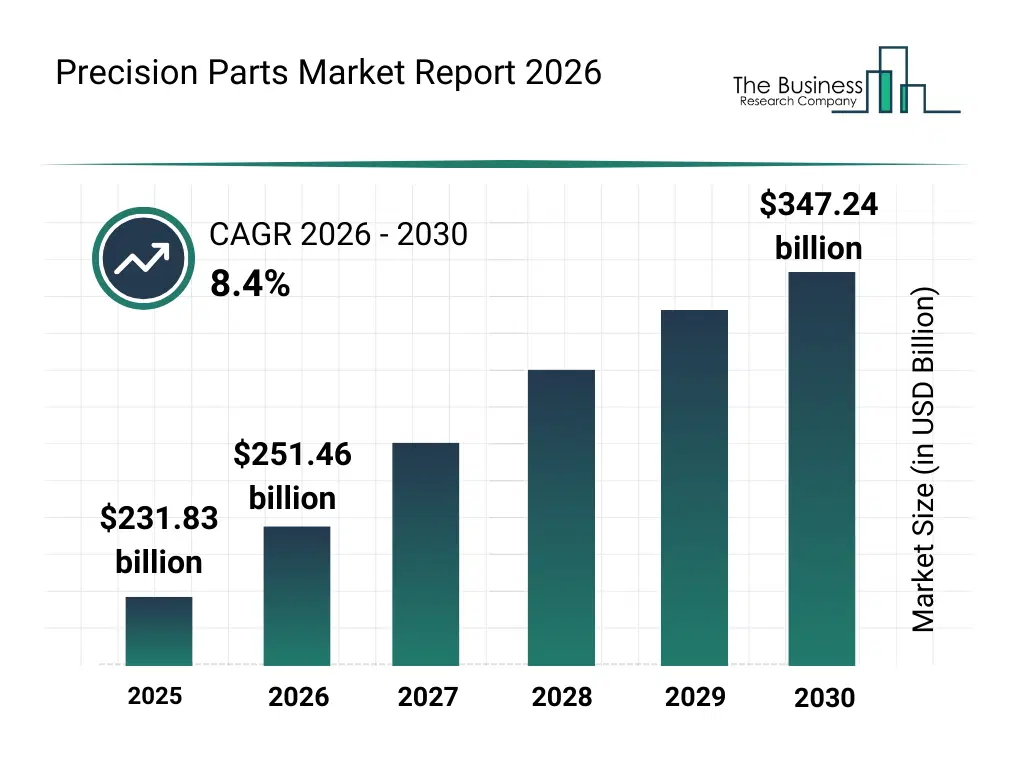
What Is The Precision Parts Market Size and Share 2026?
The precision parts market size has grown strongly in recent years. It will grow from $231.83 billion in 2025 to $251.46 billion in 2026 at a compound annual growth rate (CAGR) of 8.5%. The growth in the historic period can be attributed to growth in automotive component manufacturing, expansion of aerospace production programs, rising adoption of cnc machining, increasing electronics miniaturization, demand for high quality industrial equipment.What Is The Precision Parts Market Growth Forecast?
The precision parts market size is expected to see strong growth in the next few years. It will grow to $347.24 billion in 2030 at a compound annual growth rate (CAGR) of 8.4%. The growth in the forecast period can be attributed to electric vehicle component demand, increased aerospace defense spending, higher demand for medical devices, shift toward high precision automation, growth in advanced manufacturing facilities. Major trends in the forecast period include miniaturization of precision components, tighter dimensional tolerances in critical assemblies, growing use of multi axis cnc machining, rising demand for high durability materials, increasing customization of precision parts.
Global Precision Parts Market Segmentation
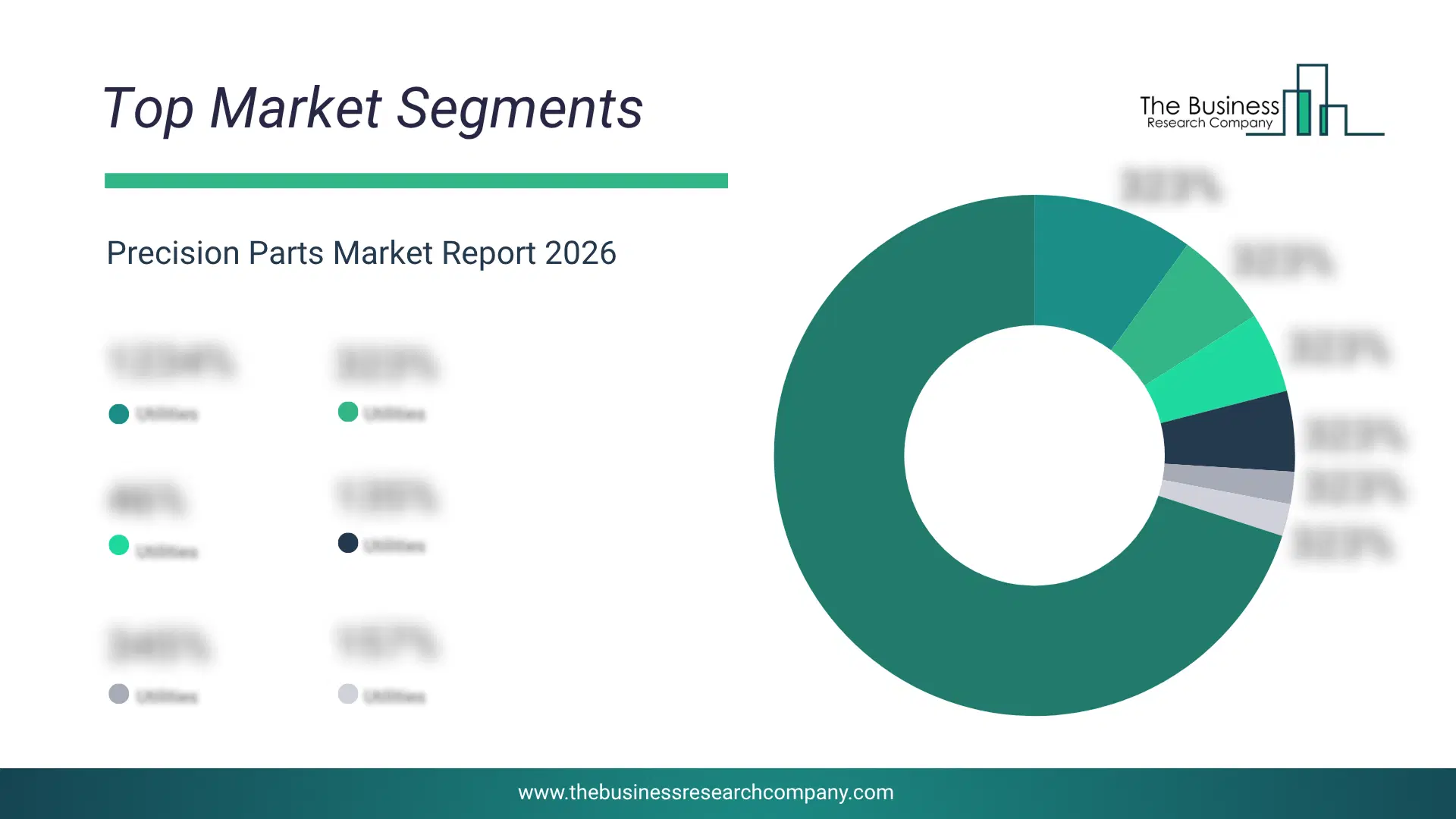
1) By Product Type: Microcomponents & Miniature Parts, Precision Shafts & Pins, Precision Rings & Retaining Components, Precision Tubes & Hollow Components, Precision Springs & Elastic Components, Precision Housings & Structural Components 2) By Material Type: Metal Precision Parts, Plastic Precision Parts, Ceramic & Advanced Material Precision Parts, Composite Precision Parts 3) By Manufacturing Process: CNC Machined Parts, Precision Turning Parts, Precision Milling Parts, EDM-Machined Parts (Wire & Sinker), Cold-Formed Precision Parts, Precision Stamped Parts, Electroformed Parts, Micro-Machined & Micro-Formed Parts 4) By End-Use Industry: Aerospace & Defense, Automotive & Electric Vehicles, Electronics & Semiconductors, Medical & Healthcare Devices, Industrial Machinery & Automation, Consumer & Precision Instruments Subsegments: 1) By Microcomponents And Miniature Parts: Micro Screws And Fasteners, Micro Gears And Gear Sets, Micro Bushings And Bearings, Micro Connectors And Contacts, Micro Clips And Clamps, Miniature Custom Machined Components 2) By Precision Shafts And Pins: Straight Precision Shafts, Stepped Shafts, Ground Shafts, Splined Shafts, Dowel Pins, Taper Pins, Grooved Pins, Custom Precision Pins 3) By Precision Rings And Retaining Components: Internal Retaining Rings, External Retaining Rings, Spiral Retaining Rings, Snap Rings, Lock Rings, Thrust Rings, Sealing Rings 4) By Precision Tubes And Hollow Components: Seamless Precision Tubes, Welded Precision Tubes, Thin-Wall Tubes, Thick-Wall Tubes, Precision Sleeves, Bushings And Spacers, Custom Hollow Cylindrical Components 5) By Precision Springs And Elastic Components: Compression Springs, Extension Springs, Torsion Springs, Flat Springs, Wave Springs, Disc Springs, Constant Force Springs, Custom Elastic Components 6) By Precision Housings And Structural Components: Bearing Housings, Gearbox Housings, Motor Housings, Enclosures And Casings, Frames And Mounting Brackets, Structural Precision Blocks, Custom Machined Structural Parts The top segments in the precision parts market will be: • Precision Housings And Structural Components will reach $98.46 Billion by 2030. • Precision Shafts And Pins will reach $78.21 Billion by 2030. • Precision Rings And Retaining Components will reach $61.6 Billion by 2030. • Precision Tubes And Hollow Components will reach $49.35 Billion by 2030. • Precision Springs And Elastic Components will reach $35.44 Billion by 2030.What Is The Driver Of The Precision Parts Market?
The increasing vehicle production is expected to propel the growth of the precision parts market going forward. Vehicle production refers to the process of manufacturing automobiles that involves assembling various components like engine parts, transmission systems, suspension systems, and braking systems to create a fully functional vehicle. Several factors contribute to the growth of vehicle production, including the growing popularity of electric vehicles, increasing demand for fleet renewal, and increasing investments in transportation infrastructure. Precision parts help vehicle production by ensuring the quality, functionality, and reliability of various components used in vehicles. These parts are designed to fit seamlessly together, reducing friction and wear and optimizing the overall efficiency of the vehicle. For instance, in April 2024, according to the International Organization of Motor Vehicle Manufacturers, a France-based trade association, automobile production rebounded notably in 2023, reaching 94 million vehicles, up from 85 million in 2022, reflecting a year-on-year increase of 9 million units. Therefore, increasing vehicle production is driving the growth of the precision part industry.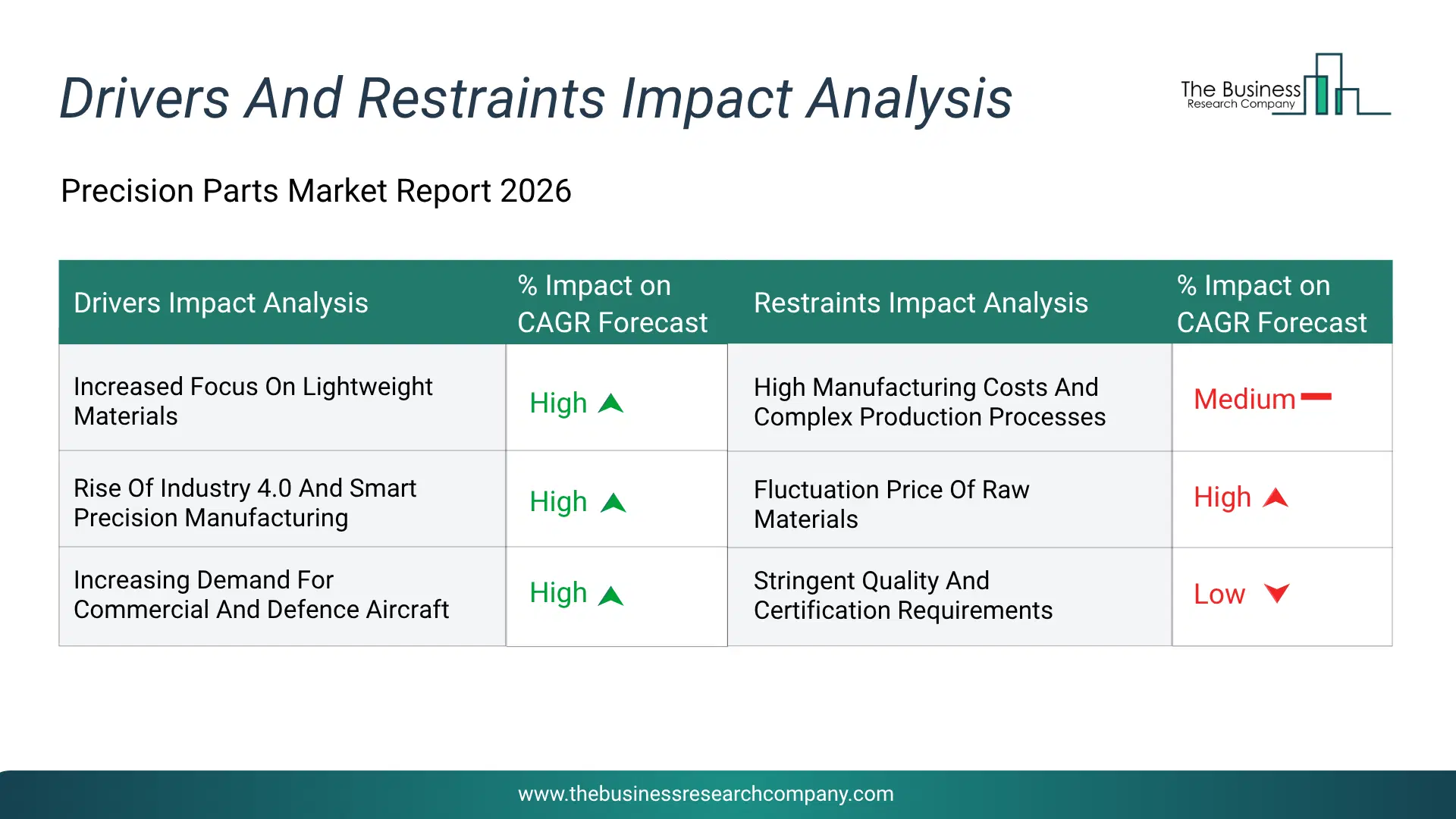
Infographic Chart Showing Key Market Drivers Analysis And Restraints For Precision Parts Market
The chart presents an impact analysis of key drivers and restraints, quantifying their relative influence on the market's growth rate and helping assess the balance between growth enablers and limiting factors. This chart offers a high-level perspective; the full report contains more detailed insights.
How Will The Drivers Impact Growth In The Global Precision Parts Market?
• Increased Focus On Lightweight Materials (High) – During the forecast period, the increased focus on lightweight materials is expected to become a key growth driver for the precision parts market by 2030. Increased focus on lightweight materials is a significant driver for the precision parts market because manufacturers increasingly require highly accurate components to support the use of lightweight metals, composites, and advanced alloys. Industries such as automotive, aerospace, and electronics are adopting lighter materials to improve fuel efficiency, reduce emissions, and enhance product performance. These materials often demand tight tolerances and specialized machining processes to maintain structural integrity. Precision parts ensure that lightweight components fit accurately and perform reliably under demanding operating conditions. The growing transition toward energy-efficient products further accelerates the need for advanced precision-engineered components. • Rise Of Industry 4.0 And Smart Precision Manufacturing (High) – During the forecast period, the rise of industry 4.0 and smart precision manufacturing is expected to emerge as a major factor driving the expansion of the precision parts market by 2030. Rise of industry 4.0 and smart precision manufacturing acts as a major growth driver by increasing the demand for highly accurate and consistent machine components. Smart factories rely on automation, robotics, sensors, and digitally connected equipment that require precision-engineered parts for seamless operation. Advanced manufacturing systems depend on components with exact dimensions to achieve higher productivity and minimize operational errors. The integration of artificial intelligence and real-time monitoring technologies further strengthens the need for superior-quality precision parts. Manufacturers are increasingly upgrading production facilities to improve efficiency and competitiveness. This modernization trend creates continuous demand for sophisticated precision components. • Increasing Demand For Commercial And Defence Aircraft (High) – During the forecast period, the increasing demand for commercial and defence aircraft is expected to act as a key growth catalyst for the precision parts market by 2030. Increasing demand for commercial and defence aircraft drives the precision parts market by creating substantial requirements for highly reliable and accurately manufactured aerospace components. Aircraft systems operate under extreme conditions and must comply with strict safety and performance standards. Precision parts are essential for engines, landing gear systems, structural assemblies, navigation equipment, and other critical applications. The growth of global air travel and rising defense modernization programs are encouraging higher aircraft production rates. Aerospace manufacturers continuously seek components with superior dimensional accuracy and durability. This increases investments in advanced machining and precision manufacturing capabilities.How Will The Restraints Impact Growth In The Global Precision Parts Market?
• High Manufacturing Costs And Complex Production Processes (High) – During the forecast period, the high manufacturing costs and complex production processes act as a major restraint on the precision parts market because producing high-accuracy components requires advanced machinery, sophisticated software, and skilled labor. Precision manufacturing involves multiple machining, inspection, and quality-control stages that increase operational expenses. Manufacturers must invest heavily in CNC machines, metrology equipment, and process optimization technologies to maintain strict tolerances. Small and medium-sized enterprises often face difficulties in absorbing these high capital and operating costs. Additionally, complex production workflows can lengthen manufacturing cycles and reduce flexibility in responding to market demand. Rising energy and maintenance expenses further add to the overall production burden. As a result, high manufacturing costs can limit profitability and slow market expansion. • Fluctuation Price Of Raw Materials (High) – During the forecast period, the fluctuation price of raw materials restrains the growth of the precision parts market by creating uncertainty in manufacturing costs and profit margins. Precision parts are commonly produced using metals such as steel, aluminum, titanium, brass, and specialty alloys, whose prices can vary significantly due to supply-demand imbalances and global economic conditions. Frequent changes in raw material costs make it difficult for manufacturers to maintain stable pricing strategies and long-term contracts. Unexpected price increases can raise production expenses and reduce competitiveness, particularly in price-sensitive industries. Supply chain disruptions and geopolitical factors can further intensify material cost volatility. Manufacturers may also face challenges in inventory planning and procurement decisions. Consequently, raw material price fluctuations can negatively affect production efficiency and overall market growth. • Stringent Quality And Certification Requirements (High) – During the forecast period, the stringent quality and certification requirements restrain the growth of the precision parts market by increasing compliance costs and extending production timelines. Industries such as aerospace, automotive, medical devices, and defense require precision parts to meet rigorous quality standards, dimensional accuracy, and regulatory certifications before commercial use. Manufacturers must invest in advanced inspection systems, testing equipment, documentation, and continuous quality assurance processes to achieve compliance. Certification procedures can be time-consuming and may delay product launches and customer deliveries. Smaller manufacturers often face difficulties in meeting these requirements due to limited financial and technical resources. These factors increase operational complexity and reduce production flexibility. As a result, stringent quality and certification requirements act as a significant restraint on the growth of the precision parts market.Key Players In The Global Precision Parts Market
Major companies operating in the precision parts market are Precision Castparts Corp. (PCC), Linamar Corporation, Martinrea International Inc., Barnes Group Inc., Mecachrome Group, ARC Group Worldwide, Sigma Components Ltd., Tessa Precision Products, Precision Products Group Inc., Doncasters Group Ltd., Senior plc, Howmet Aerospace Inc., GKN Aerospace, Triumph Group Inc., Bodycote plc, Ametek Inc., Nemak S.A.B. de C.V., Ryerson Precision Manufacturing, ThyssenKrupp Aerospace, Allegheny Technologies Incorporated (ATI), Nippon Steel Precision Components, Sumitomo Precision Products Co., Ltd., Misumi Group Inc. (manufacturing divisions), Sandvik Precision Components, Schaeffler Group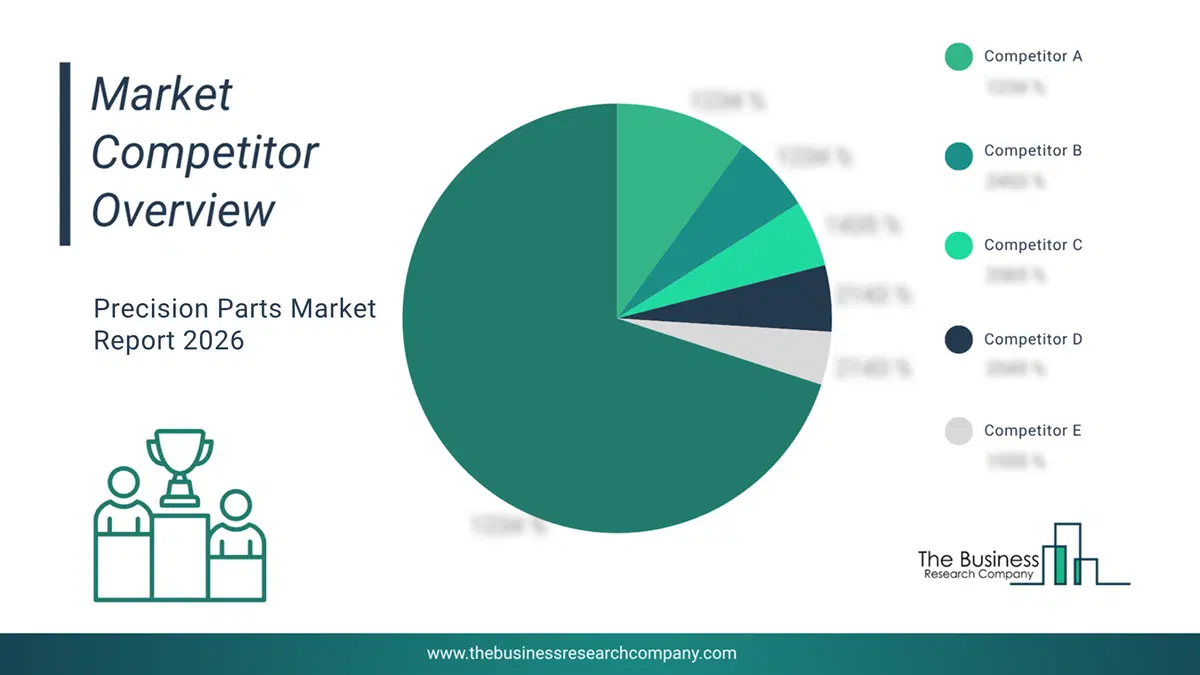
This chart is for illustrative purposes; the full report includes a detailed competitor analysis and comprehensive overview of the top 10 companies in the market.
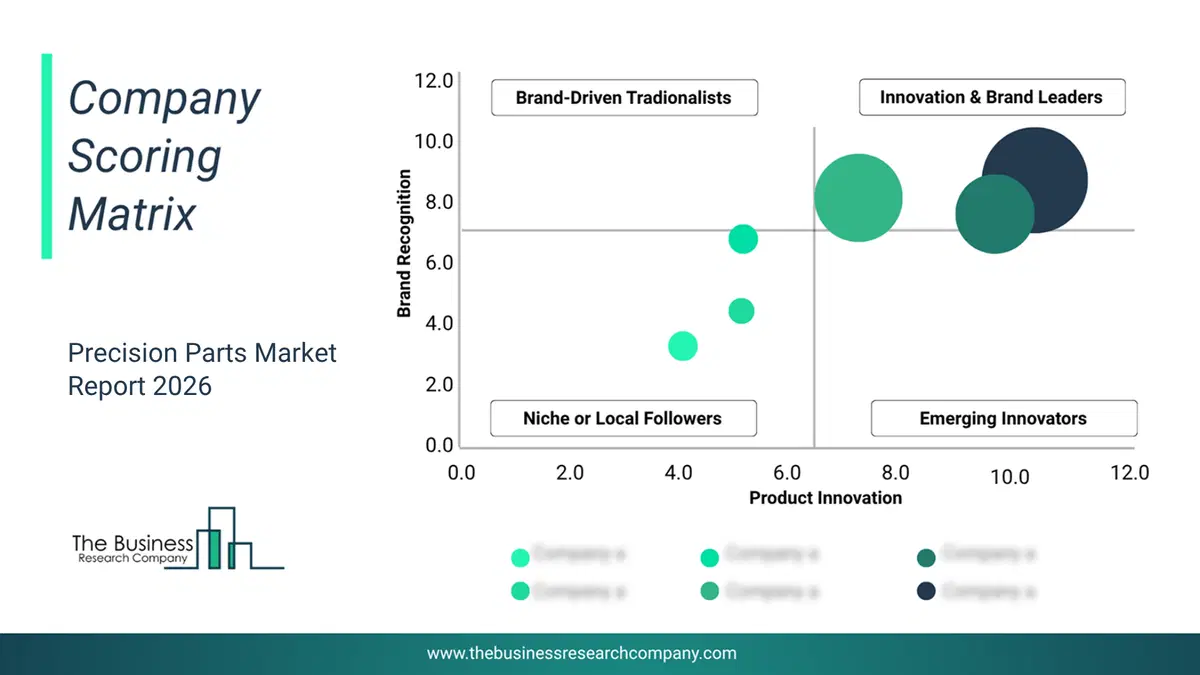
This chart maps companies by product innovation and brand strength, with bubble size indicating relative revenue, helping identify market leaders, challengers, and niche players. This is an illustrative chart; the full report provides a complete and accurate competitive analysis.
Global Precision Parts Market Trends and Insights
Major companies operating in the precision parts market are focusing on developing advanced solutions, such as multitasking CNC machines, to enhance manufacturing accuracy, reduce setup times, and improve operational efficiency. Multitasking CNC machines are advanced equipment capable of performing multiple machining operations such as turning, milling, and drilling on a single platform, allowing manufacturers to produce complex components with high precision. For instance, in August 2024, DN Solutions, a South Korea-based machine manufacturer, launched its next-generation multitasking machine series at IMTS 2024 and AMB 2024. Designed for complex, high-precision component production, the new machines offer simultaneous turning and milling, enhanced positional accuracy, and automation features that improve throughput and reduce operational costs. These innovations support manufacturers in producing intricate parts for industries such as aerospace, automotive, and medical devices with consistent quality and efficiency.What Are Latest Mergers And Acquisitions In The Precision Parts Market?
In January 2024, Deilh Defense, a Germany-based weapon manufacturer, acquired Allweier for an undisclosed amount. Through this acquisition, Deilh Defense aimed to leverage synergies, enhance capabilities, and drive strategic growth in the highly competitive defense market. Allweier GmbH is a Germany-based manufacturing company specializing in high-precision parts for industrial sectors.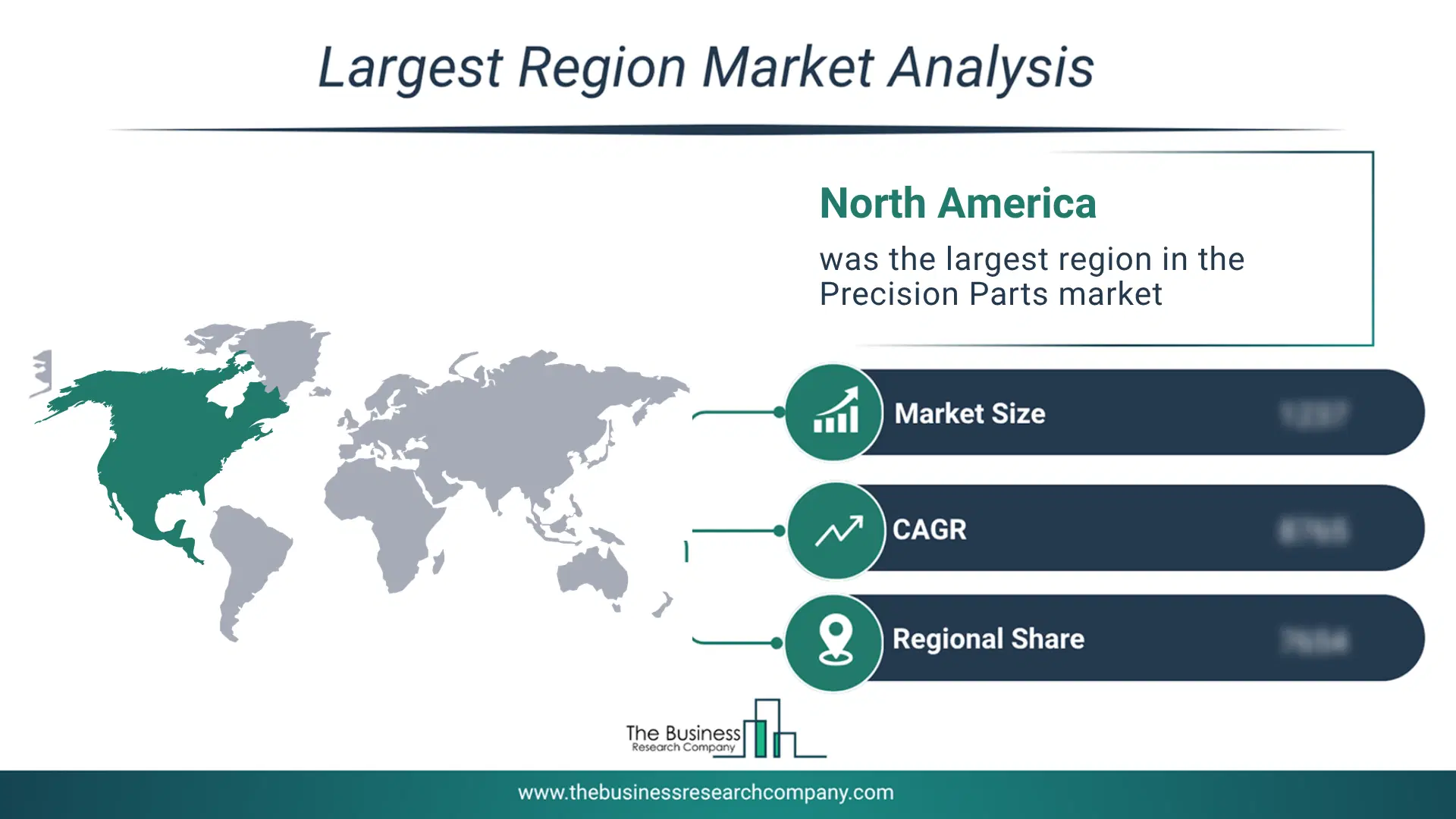
Regional Outlook
North America was the largest region in the precision parts market in 2025. Asia-Pacific is expected to be the fastest-growing region in the forecast period. The regions covered in this market report are Asia-Pacific, South East Asia, Western Europe, Eastern Europe, North America, South America, Middle East, Africa The countries covered in this market report are Australia, Brazil, China, France, Germany, India, Indonesia, Japan, Taiwan, Russia, South Korea, UK, USA, Canada, Italy, Spain.What Defines the Precision Parts Market?
The precision parts market consists of sales of bearings, gears, valves, pistons, and housings. Values in this market are ‘factory gate’ values, that is the value of goods sold by the manufacturers or creators of the goods, whether to other entities (including downstream manufacturers, wholesalers, distributors and retailers) or directly to end customers. The value of goods in this market includes related services sold by the creators of the goods.How is Market Value Defined and Measured?
The market value is defined as the revenues that enterprises gain from the sale of goods and/or services within the specified market and geography through sales, grants, or donations in terms of the currency (in USD unless otherwise specified). The revenues for a specified geography are consumption values that are revenues generated by organizations in the specified geography within the market, irrespective of where they are produced. It does not include revenues from resales along the supply chain, either further along the supply chain or as part of other products.
This chart presents market attractiveness based on a quantitative evaluation of growth, competition, strategic alignment, and risk, offering a clear view of opportunity areas for decision-making. This chart is for illustrative purposes; the full report contains the complete analysis.

This chart highlights the Total Addressable Market (TAM) by estimating the maximum revenue opportunity using an assumption-driven approach, supporting strategic planning and opportunity sizing across markets. The chart is illustrative; the full report provides a more comprehensive analysis.
What Key Data and Analysis Are Included in the Precision Parts Market Report 2026?
The precision parts market research report is one of a series of new reports from The Business Research Company that provides market statistics, including industry global market size, regional shares, competitors with the market share, detailed market segments, market trends and opportunities, and any further data you may need to thrive in the precision parts industry. The market research report delivers a complete perspective of everything you need, with an in-depth analysis of the current and future state of the industry.Precision Parts Market Report Forecast Analysis
| Report Attribute | Details |
|---|---|
| Market Size Value In 2026 | $251.46 billion |
| Revenue Forecast In 2030 | $347.24 billion |
| Growth Rate | CAGR of 8.5% from 2026 to 2030 |
| Base Year For Estimation | 2025 |
| Actual Estimates/Historical Data | 2020-2025 |
| Forecast Period | 2026 - 2030 |
| Market Representation | Revenue in USD Billion and CAGR from 2026 to 2030 |
| Segments Covered | Product Type, Material Type, Manufacturing Process, End-Use Industry |
| Regional Scope | Asia-Pacific, Western Europe, Eastern Europe, North America, South America, Middle East, Africa |
| Country Scope | The countries covered in the report are Australia, Brazil, China, France, Germany, India, ... |
| Key Companies Profiled | Precision Castparts Corp. (PCC), Linamar Corporation, Martinrea International Inc., Barnes Group Inc., Mecachrome Group, ARC Group Worldwide, Sigma Components Ltd., Tessa Precision Products, Precision Products Group Inc., Doncasters Group Ltd., Senior plc, Howmet Aerospace Inc., GKN Aerospace, Triumph Group Inc., Bodycote plc, Ametek Inc., Nemak S.A.B. de C.V., Ryerson Precision Manufacturing, ThyssenKrupp Aerospace, Allegheny Technologies Incorporated (ATI), Nippon Steel Precision Components, Sumitomo Precision Products Co., Ltd., Misumi Group Inc. (manufacturing divisions), Sandvik Precision Components, Schaeffler Group |
| Customization Scope | Request for Customization |
| Pricing And Purchase Options | Explore Purchase Options |