

Predictive Maintenance For Heavy Equipment Market Report 2026
Global Outlook – By Component (Hardware, Software, Services), By Deployment (Cloud Based, On Premises), By Technology (Artificial Intelligence And Machine Learning, Internet Of Things, Digital Twin Technology, Edge Computing, Advanced Analytics), By Application (Equipment Health Monitoring, Failure Prediction, Remote Diagnostics, Asset Performance Management, Maintenance Scheduling), By End User Industry (Construction, Mining, Agriculture, Oil And Gas, Manufacturing) – Market Size, Trends, Strategies, and Forecast to 2030
Predictive Maintenance For Heavy Equipment Market Overview
• Predictive Maintenance For Heavy Equipment market size has reached to $8.25 billion in 2025 • Expected to grow to $18.1 billion in 2030 at a compound annual growth rate (CAGR) of 16.9% • Growth Driver: Expansion Of Industry 4.0 Driving The Market Growth Due To Enhance Efficiency And Smart Manufacturing Integration • North America was the largest region in 2025 and Asia-Pacific is the fastest growing region.What Is Covered Under Predictive Maintenance For Heavy Equipment Market?
Predictive maintenance for heavy equipment refers to the use of data-driven monitoring techniques, sensor-based diagnostics, and analytical models to anticipate equipment failures before they occur in heavy-duty machinery used in industrial and operational environments. It focuses on improving equipment reliability, reducing unplanned downtime, and optimizing maintenance schedules by continuously analyzing machine condition, performance patterns, and operational stress indicators. The main components of predictive maintenance for heavy equipment include hardware, software, and services. Hardware refers to physical devices such as sensors and monitoring equipment used to collect real-time data from heavy machinery for predictive analysis. These systems are deployed through cloud based and on premises models and use technologies such as artificial intelligence and machine learning, internet of things, digital twin technology, edge computing, and advanced analytics. The various applications involved are equipment health monitoring, failure prediction, remote diagnostics, asset performance management, and maintenance scheduling, and they are used by several end user industries such as construction, mining, agriculture, oil and gas, and manufacturing.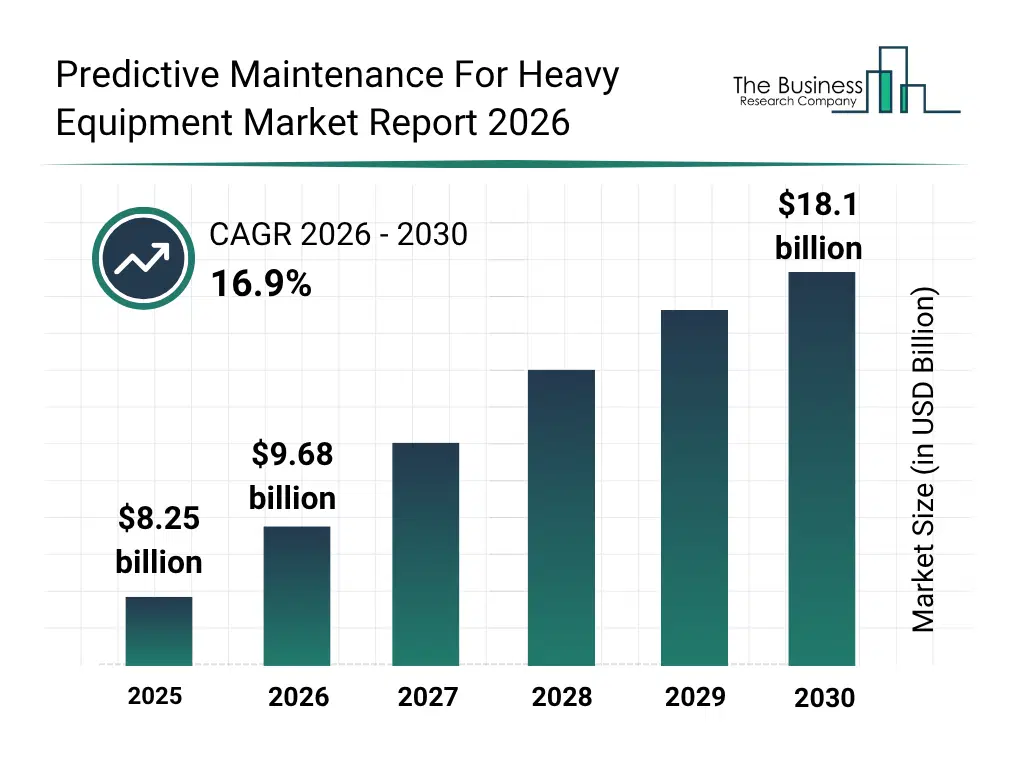
What Is The Predictive Maintenance For Heavy Equipment Market Size and Share 2026?
The predictive maintenance for heavy equipment market size has grown rapidly in recent years. It will grow from $8.25 billion in 2025 to $9.68 billion in 2026 at a compound annual growth rate (CAGR) of 17.4%. The growth in the historic period can be attributed to reactive maintenance practices in heavy industries, frequent unplanned equipment downtime, limited sensor adoption in industrial machinery, high maintenance and repair costs, lack of real-time equipment monitoring systems.What Is The Predictive Maintenance For Heavy Equipment Market Growth Forecast?
The predictive maintenance for heavy equipment market size is expected to see rapid growth in the next few years. It will grow to $18.1 billion in 2030 at a compound annual growth rate (CAGR) of 16.9%. The growth in the forecast period can be attributed to increasing adoption of IoT-enabled industrial equipment, rising demand for operational efficiency and downtime reduction, growth in smart manufacturing and industry 4.0 adoption, expansion of connected heavy machinery ecosystems, rising investment in AI-driven predictive analytics solutions. Major trends in the forecast period include rising adoption of sensor-based condition monitoring in heavy machinery, increasing use of digital twin models for equipment lifecycle simulation, growing deployment of edge analytics for real-time fault detection, expansion of cloud-based predictive maintenance platforms, increasing integration of telematics systems for remote equipment diagnostics.
Global Predictive Maintenance For Heavy Equipment Market Segmentation
1) By Component: Hardware; Software; Services 2) By Deployment: Cloud Based; On Premises 3) By Technology: Artificial Intelligence And Machine Learning; Internet Of Things; Digital Twin Technology; Edge Computing; Advanced Analytics 4) By Application: Equipment Health Monitoring; Failure Prediction; Remote Diagnostics; Asset Performance Management; Maintenance Scheduling 5) By End User Industry: Construction; Mining; Agriculture; Oil And Gas; Manufacturing Subsegments: 1) By Hardware: Internet Of Things Sensors For Heavy Equipment Monitoring; Condition Monitoring Devices; Edge Computing Hardware; Telematics And Connectivity Modules 2) By Software: Predictive Analytics Software; Machine Learning Based Maintenance Software; Equipment Health Monitoring Software; Failure Prediction And Diagnostics Software; Asset Performance Management Software 3) By Services: Implementation And Integration Services; Consulting And Advisory Services; Data Analytics And Modeling Services; Maintenance And Support Services; Training And Enablement ServicesWhat Are The Drivers Of The Predictive Maintenance For Heavy Equipment Market?
The expansion of industry 4.0 is expected to propel the growth of the predictive maintenance for heavy equipment market going forward. Industry 4.0 refers to the integration of advanced digital technologies such as automation, artificial intelligence, the internet of things (IoT), and data analytics into manufacturing and industrial processes to create smart and connected production systems. Industry 4.0 adoption is rising due to manufacturers investing in smart technologies and robotics to improve production efficiency, reduce operational costs, and stay competitive in rapidly evolving global markets. Predictive maintenance for heavy equipment supports the expansion of Industry 4.0 by enabling continuous machine data collection and analytics through IIoT connectivity, which improves operational efficiency and accelerates the integration of smart, data-driven manufacturing systems. For instance, in March 2024, according to Rockwell Automation Inc., a US-based automation company, manufacturers consider AI the leading capability for achieving significant business impact, with 83% anticipating the adoption of generative AI (GenAI) in their operations, while 95% are either using or evaluating smart manufacturing technologies, up from 84% in 2023, reflecting the rapid integration of advanced digital and intelligent systems across the manufacturing sector. Therefore, the expansion of industry 4.0 is driving the growth of the predictive maintenance for heavy equipment industry. The expansion of construction is expected to propel the growth of the predictive maintenance for heavy equipment market going forward. Construction refers to the large-scale development of residential, commercial, industrial, and public infrastructure through planned building activities supported by investment and urban development initiatives. The expansion of construction is increasing due to rising public and private investment in transport networks, which is leading to the development of new roads, railways, bridges, and other infrastructure projects that boost overall construction activity. Predictive maintenance for heavy equipment enhances construction by enabling continuous equipment monitoring, reducing unplanned breakdowns, and improving the operational efficiency of critical machinery such as excavators, cranes, and loaders on active job sites. For instance, in July 2025, according to the Office for National Statistics (ONS), a UK-based government department, total general government investment in infrastructure increased by 2.2% to $38.54 billion (£28.9 billion) in current prices compared with the previous year. Therefore, the expansion of construction is driving the growth of the predictive maintenance for heavy equipment industry. The increasing penetration of 5G is expected to propel the growth of the predictive maintenance for heavy equipment market going forward. 5G is the fifth generation of mobile network technology that delivers significantly faster data speeds, lower latency, and greater connectivity capacity than previous generations. 5G penetration is rising mainly due to increasing demand for high-speed, low-latency connectivity that supports data-intensive applications such as video streaming, IoT, and real-time industrial automation, which require more reliable and faster network performance than 4G can provide. 5G improves predictive maintenance for heavy equipment by allowing fast, real-time transfer of large volumes of machine sensor data to analytics systems, which enables quicker and more accurate identification of potential equipment failures. For instance, in November 2025, according to Ericsson, a Sweden-based networking and telecommunications company, 5G adoption continued to grow steadily, reaching 2.9 billion subscriptions by the end of 2025, representing about one-third of global mobile connections. Regionally, North America recorded the highest 5G penetration at 79%, followed by North East Asia at 61%, while both Western Europe and the Gulf Cooperation Council (GCC) countries reached 55% penetration. Therefore, the increasing penetration of 5G is driving the growth of the predictive maintenance for heavy equipment industry.Key Players In The Global Predictive Maintenance For Heavy Equipment Market
Major companies operating in the predictive maintenance for heavy equipment market are Caterpillar Inc.; Siemens AG; IBM Corporation; SAP SE; Schneider Electric; GE Vernova; ABB Ltd.; Honeywell International; Rockwell Automation; AVEVA; Hitachi Construction Machinery Co. Ltd.; Deere & Company; Emerson Electric Co.; Volvo Construction Equipment AB; Liebherr-International AG; PTC Inc.; C3.ai Inc.; Trimble Inc.; Hexagon AB; AB SKF; Samsara Inc.; Augury; Tractian; Samotics.Regional Outlook
North America was the largest region in the predictive maintenance for heavy equipment market in 2025. Asia-Pacific is expected to be the fastest-growing region in the forecast period. The regions covered in this market report are Asia-Pacific, South East Asia, Western Europe, Eastern Europe, North America, South America, Middle East, Africa. The countries covered in this market report are Australia, Brazil, China, France, Germany, India, Indonesia, Japan, Taiwan, Russia, South Korea, UK, USA, Canada, Italy, Spain.What Defines the Predictive Maintenance For Heavy Equipment Market?
The predictive maintenance for heavy equipment market consists of revenues earned by entities by providing services such as remote equipment monitoring, condition-based maintenance services, sensor data analytics, predictive failure detection, software platform subscriptions, fleet health management, maintenance planning and scheduling, and technical support services. The market value includes the value of related goods sold by the service provider or included within the service offering. The predictive maintenance for heavy equipment market also includes sales of IoT sensors, telematics devices, industrial control systems, diagnostic tools, edge computing hardware, and machine monitoring equipment. Values in this market are ‘factory gate’ values, that is the value of goods sold by the manufacturers or creators of the goods, whether to other entities (including downstream manufacturers, wholesalers, distributors and retailers) or directly to end customers. The value of goods in this market includes related services sold by the creators of the goods.How is Market Value Defined and Measured?
The market value is defined as the revenues that enterprises gain from the sale of goods and/or services within the specified market and geography through sales, grants, or donations in terms of the currency (in USD unless otherwise specified). The revenues for a specified geography are consumption values that are revenues generated by organizations in the specified geography within the market, irrespective of where they are produced. It does not include revenues from resales along the supply chain, either further along the supply chain or as part of other products.What Key Data and Analysis Are Included in the Predictive Maintenance For Heavy Equipment Market Report 2026?
The predictive maintenance for heavy equipment market research report is one of a series of new reports from The Business Research Company that provides market statistics, including industry global market size, regional shares, competitors with the market share, detailed market segments, market trends and opportunities, and any further data you may need to thrive in the predictive maintenance for heavy equipment industry. The market research report delivers a complete perspective of everything you need, with an in-depth analysis of the current and future state of the industry.Predictive Maintenance for Heavy Equipment Market Report Forecast Analysis
| Report Attribute | Details |
|---|---|
| Market Size Value In 2026 | $9.68 billion |
| Revenue Forecast In 2030 | $18.1 billion |
| Growth Rate | CAGR of 16.9% from 2026 to 2030 |
| Base Year For Estimation | 2025 |
| Actual Estimates/Historical Data | 2020-2025 |
| Forecast Period | 2026 - 2030 |
| Market Representation | Revenue in USD Billion and CAGR from 2026 to 2030 |
| Segments Covered | Component, Deployment, Technology, Application, End User Industry |
| Regional Scope | Asia-Pacific, Western Europe, Eastern Europe, North America, South America, Middle East, Africa |
| Country Scope | The countries covered in the report are Australia, Brazil, China, France, Germany, India, ... |
| Key Companies Profiled | Caterpillar Inc.; Siemens AG; IBM Corporation; SAP SE; Schneider Electric; GE Vernova; ABB Ltd.; Honeywell International; Rockwell Automation; AVEVA; Hitachi Construction Machinery Co. Ltd.; Deere & Company; Emerson Electric Co.; Volvo Construction Equipment AB; Liebherr-International AG; PTC Inc.; C3.ai Inc.; Trimble Inc.; Hexagon AB; AB SKF; Samsara Inc.; Augury; Tractian; Samotics. |
| Customization Scope | Request for Customization |
| Pricing And Purchase Options | Explore Purchase Options |