

Predictive Maintenance Market Report 2026
Global Outlook – By Component (Solutions, Service), By Deployment Mode (On-premises, Cloud), By Stakeholder (MRO, OEM Or ODM, Technology Integrators), By Application (Heavy Machinery, Small Machinery, Other Applications), By End User (Aerospace & Defense, Automotive & Transportation, Energy & Utilities, Healthcare, IT & Telecommunication, Manufacturing, Oil & Gas, Other End Users) – Market Size, Trends, Strategies, and Forecast to 2030
Predictive Maintenance Market Overview
• Predictive Maintenance market size has reached to $11.82 billion in 2025 • Expected to grow to $41.87 billion in 2030 at a compound annual growth rate (CAGR) of 28.6% • Growth Driver: Rising Focus On Predictive Maintenance To Minimize Equipment Downtime And Cut Maintenance Costs • Market Trend: Advancements In Predictive Maintenance With The Introduction Of AI-Powered Solutions • North America was the largest region in 2025 and Asia-Pacific is the fastest growing region.Market Gains By 2030 – Top Opportunities By Segment
Market Gain identifies the most promising market opportunities by highlighting the segments or products expected to generate the highest incremental revenue growth over the next five years.
What Is Covered Under Predictive Maintenance Market?
Predictive maintenance refers to data-driven condition monitoring tools and techniques designed to analyze equipment conditions and predict maintenance requirements. It uses testing methods such as data acquisition, data transformation, asset health evaluation, prognostics, a decision support system, and a human interface layer that helps various industries to reduce maintenance and protect their machinery by connecting all the data sources combined with data analytics. The key element used in the process is the Internet of things (IoT), allowing systems to work together to translate and analyze the recorded data. The main types of predictive maintenance include solutions and services. Predictive maintenance solutions are custom-designed software or platforms used for asset management, based on unique business requirements and operate on the internet of things (IoT) technology. They have deployed both on-premise and cloud infrastructure on stakeholders ranging from MRO, OEM/ODM, and technology integrators. They are used in heavy machinery, small machinery and others in industries ranging from aerospace & defense, automotive & transportation, energy & utilities, healthcare, IT & telecommunication, manufacturing, oil & gas, and other industries.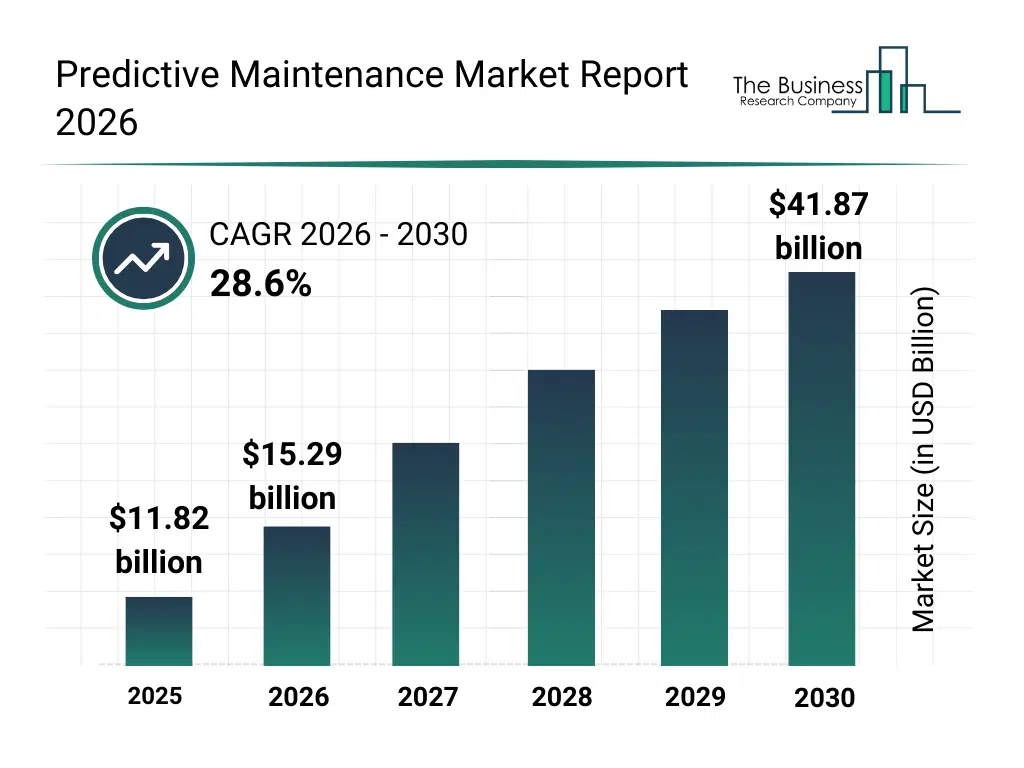
What Is The Predictive Maintenance Market Size and Share 2026?
The predictive maintenance market size has grown exponentially in recent years. It will grow from $11.82 billion in 2025 to $15.29 billion in 2026 at a compound annual growth rate (CAGR) of 29.4%. The growth in the historic period can be attributed to frequent equipment breakdowns and unplanned downtime, rising maintenance costs in asset-intensive industries, increasing complexity of industrial machinery, demand for improved asset lifecycle management, shortage of skilled maintenance workforce.What Is The Predictive Maintenance Market Growth Forecast?
The predictive maintenance market size is expected to see exponential growth in the next few years. It will grow to $41.87 billion in 2030 at a compound annual growth rate (CAGR) of 28.6%. The growth in the forecast period can be attributed to growing adoption across non-traditional industries, increasing focus on operational efficiency, rising pressure to extend equipment lifespan, expanding use of remote asset monitoring, increasing service-based maintenance models. Major trends in the forecast period include shift from reactive to condition-based maintenance strategies, increasing focus on asset reliability and uptime optimization, growing demand for cost reduction in maintenance operations, expansion of predictive maintenance across multi-asset environments, rising emphasis on workforce safety and maintenance planning.
Global Predictive Maintenance Market Segmentation
1) By Component: Solutions, Service 2) By Deployment Mode: On-premises, Cloud 3) By Stakeholder: MRO, OEM Or ODM, Technology Integrators 4) By Application: Heavy Machinery, Small Machinery, Other Applications 5) By End User: Aerospace & Defense, Automotive & Transportation, Energy & Utilities, Healthcare, IT & Telecommunication, Manufacturing, Oil & Gas, Other End Users Subsegments: 1) By Solutions: Software Platforms, Predictive Analytics Tools, Machine Learning Models, IoT Sensors And Devices 2) By Service: Consulting Services, Integration And Implementation, Support And Maintenance, Training And Education The top segments in the predictive maintenance market will be: • Solutions will reach $26.79 Billion by 2030. • Service will reach $14.91 Billion by 2030.What Is The Driver Of The Predictive Maintenance Market?
The growing demand to reduce maintenance costs, equipment failure and downtime is significantly contributing to the growth of the predictive maintenance market. Equipment downtime refers to the duration in which particular equipment is not in operation due to unplanned equipment failure. Frequent equipment failure and unplanned downtime of large equipment are hampering the business operations due to a temporary halt of production activities, idle staff time, financial penalties, and others. For instance, in February 2023, according to the National Center for Biotechnology Information, a US-based government-funded organization, manufacturing machinery maintenance costs are estimated to vary between 15% and 70% of the production costs. Therefore, growing demand to reduce maintenance costs, equipment failure, and downtime is expected to boost demand for predictive maintenance during the forecast period.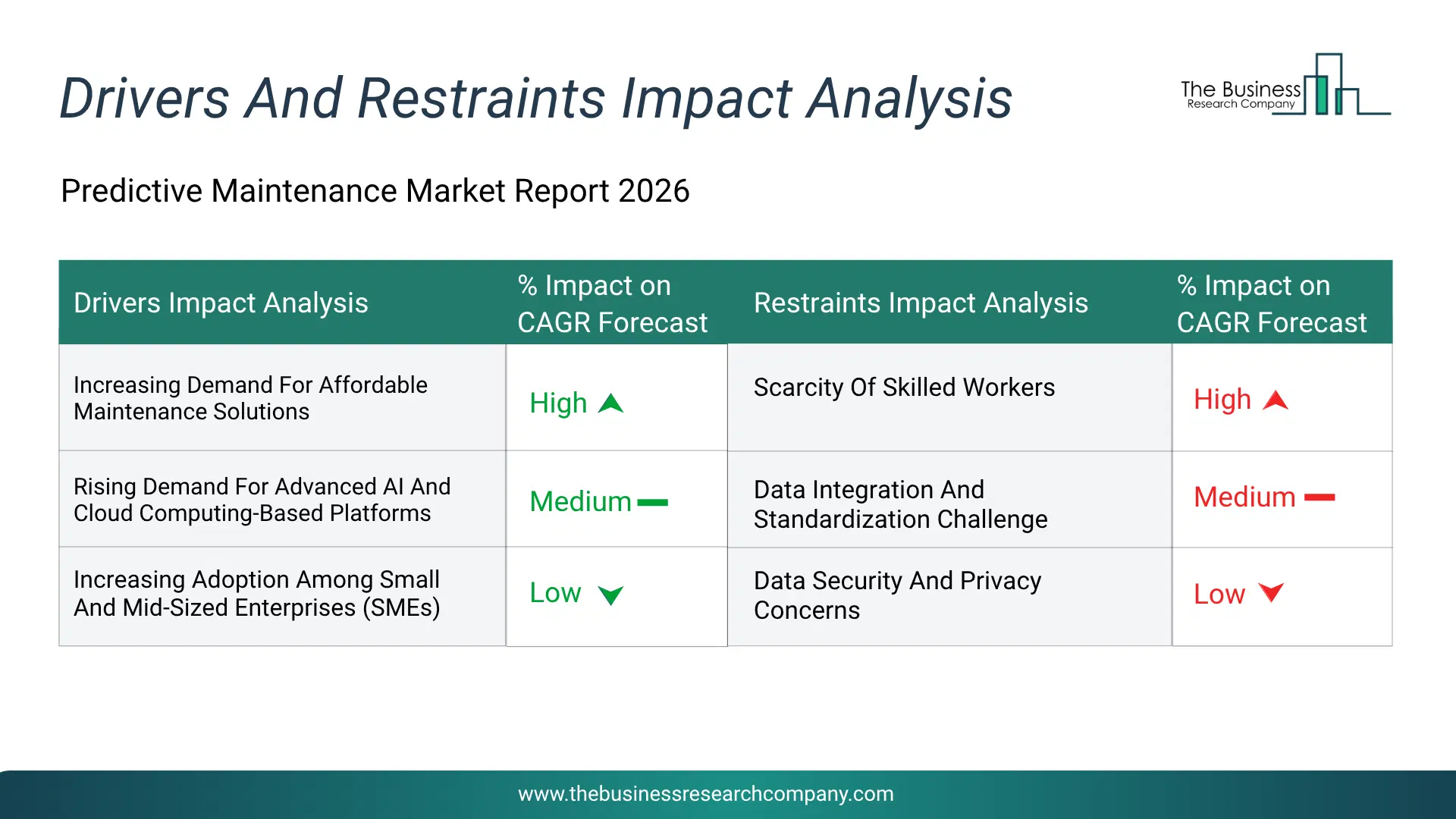
Infographic Chart Showing Key Market Drivers Analysis And Restraints For Predictive Maintenance Market
The chart presents an impact analysis of key drivers and restraints, quantifying their relative influence on the market's growth rate and helping assess the balance between growth enablers and limiting factors. This chart offers a high-level perspective; the full report contains more detailed insights.
How Will The Drivers Impact Growth In The Global Predictive Maintenance Market?
• Increasing Demand For Affordable Maintenance Solutions (High) – During the forecast period, the increasing demand for affordable maintenance solutions is expected to become a key growth driver for the predictive maintenance market by 2030. Organizations across industries are focusing on reducing maintenance costs while maintaining operational reliability, leading to a shift from reactive and preventive maintenance approaches toward cost-efficient predictive models. Predictive maintenance enables early fault detection and minimizes expensive breakdowns, thereby lowering repair and replacement expenses. Companies are increasingly adopting scalable solutions that deliver measurable cost savings without requiring heavy capital investments. This transition toward economically viable maintenance strategies is strengthening market expansion. • Rising Demand For Advanced AI And Cloud Computing-Based Platforms (Medium) – During the forecast period, the rising demand for advanced AI and cloud computing-based platforms is expected to emerge as a major factor driving the expansion of the predictive maintenance market by 2030. The integration of artificial intelligence with cloud infrastructure allows organizations to process large volumes of operational data, enabling real-time insights and predictive analytics across distributed assets. These platforms support remote monitoring, scalability, and seamless data integration across multiple facilities, improving decision-making efficiency. Enterprises are increasingly leveraging cloud-enabled predictive tools to enhance system visibility and responsiveness. • Increasing Adoption Among Small And Mid-Sized Enterprises (SMEs) (Low) – During the forecast period, the increasing adoption among small and mid-sized enterprises (SMEs) is expected to act as a key growth catalyst for the predictive maintenance market by 2030. SMEs are progressively embracing digital maintenance solutions to improve productivity, reduce operational risks, and extend equipment lifespan without significant infrastructure investments. The availability of flexible subscription-based models and easy-to-deploy platforms is making predictive maintenance accessible to smaller organizations. Additionally, the growing awareness of data-driven maintenance benefits is encouraging wider adoption across diverse industry segments. As SMEs expand their digital capabilities, the demand for predictive maintenance solutions is expected to rise steadily.How Will The Restraints Impact Growth In The Global Predictive Maintenance Market?
• Scarcity Of Skilled Workers (High) – During the forecast period, scarcity of skilled workers acts as a major restraint for the predictive maintenance market by limiting the effective implementation and utilization of advanced technologies. Predictive maintenance systems rely heavily on expertise in data science, machine learning, and industrial operations to interpret complex datasets and generate accurate insights. However, many organizations face challenges in finding professionals with the required interdisciplinary skill sets. This talent gap slows down deployment and reduces the efficiency of predictive models. Companies may also incur additional costs in training or hiring specialized personnel, increasing overall operational burden. Smaller enterprises are particularly affected due to limited access to skilled resources. As a result, the shortage of qualified professionals hampers widespread market adoption. • Data Integration And Standardization Challenge (Medium) – During the forecast period, data integration and standardization challenges restrain the predictive maintenance market by creating difficulties in consolidating data from multiple heterogeneous sources. Industrial environments often involve diverse equipment, legacy systems, and varying data formats, making seamless integration complex. Inconsistent or unstructured data can lead to inaccurate predictions and reduced system reliability. Organizations must invest significant time and resources to clean, harmonize, and standardize data before deriving meaningful insights. This complexity increases implementation costs and delays deployment timelines. Additionally, lack of universal data standards across industries further complicates interoperability. These challenges collectively hinder efficient adoption and scalability of predictive maintenance solutions. • Data Security And Privacy Concerns (Low) – During the forecast period, data security and privacy concerns act as a significant restraint for the predictive maintenance market by raising risks associated with sensitive operational data. Predictive maintenance systems collect and analyze large volumes of real-time data from critical assets, often stored and processed on cloud platforms. This creates vulnerabilities to cyberattacks, data breaches, and unauthorized access. Organizations handling confidential industrial or customer data are particularly cautious about adopting such technologies. Compliance with stringent data protection regulations further adds complexity and cost to implementation. Fear of potential financial and reputational damage discourages businesses from fully embracing predictive maintenance solutions. Consequently, security and privacy concerns slow down overall market growth.Key Players In The Global Predictive Maintenance Market
Major companies operating in the predictive maintenance market are Google LLC; Microsoft Corporation; Hitachi Ltd; Amazon Web Services Inc; Siemens AG; General Electric Company; International Business Machines Corporation; Cisco Systems Inc; Oracle Corporation; Schneider Electric SE; SAP SE; Hewlett Packard Enterprise Company; SAS Institute Inc; Splunk Inc; PTC Inc; TIBCO Software Inc; Fluke Corporation; Banner Engineering Corporation; Altair Engineering Inc; C3.AI Inc; SparkCognition Inc; Uptake Technologies Inc; RapidMiner Inc; Senseye Ltd; Aspen Technology Inc; Dassault Systèmes SE; Rockwell Automation Inc; Honeywell International Inc
This chart is for illustrative purposes; the full report includes a detailed competitor analysis and comprehensive overview of the top 10 companies in the market.
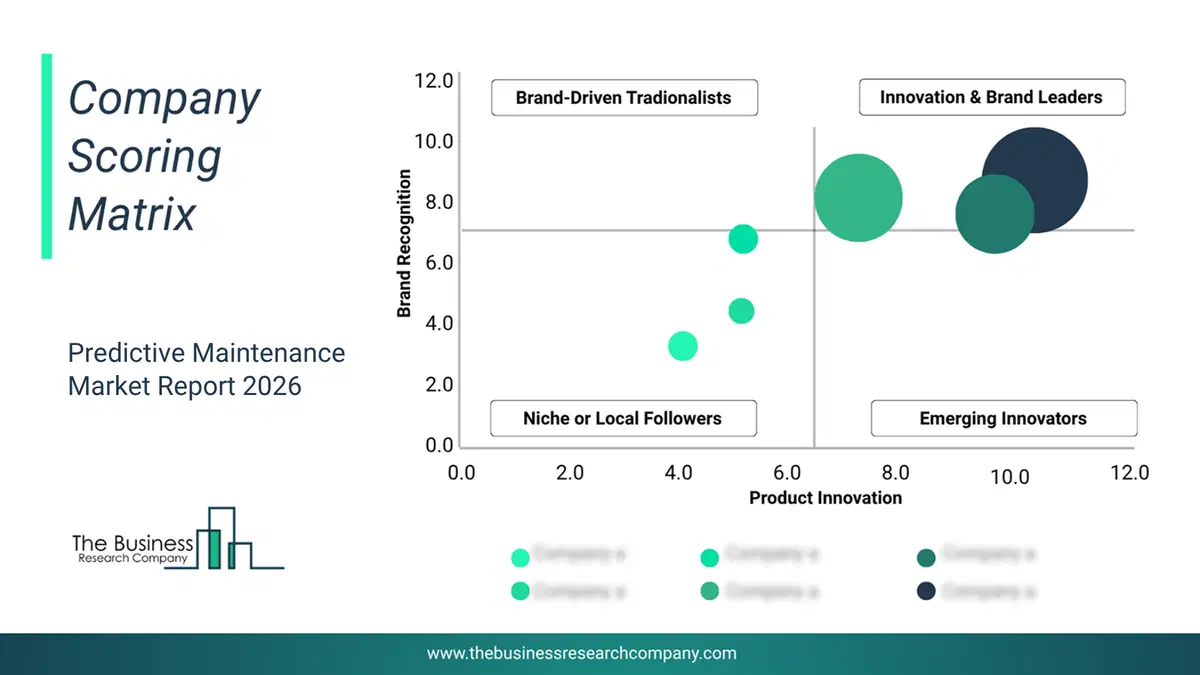
This chart maps companies by product innovation and brand strength, with bubble size indicating relative revenue, helping identify market leaders, challengers, and niche players. This is an illustrative chart; the full report provides a complete and accurate competitive analysis.
Global Predictive Maintenance Market Trends and Insights
Major companies operating in the predictive maintenance market are increasing their focus on introducing advanced solutions, such as the Asset Risk Predictor, to gain a competitive edge in the market. Asset Risk Predictor is a predictive maintenance solution that uses advanced analytics to assess and forecast the risk of equipment failure, helping industrial organizations optimize maintenance strategies and minimize downtime. For instance, in September 2023, Rockwell Automation Inc., a US-based automation company, launched its first artificial intelligence (AI) predictive maintenance software, Asset Risk Predictor. It uses artificial intelligence (AI) sensor data, machine recipes, and operational environments to predict asset health, which helps users spot and eliminate failures before they happen. The tool is capable of learning the signs of equipment failure and can predict breakdowns up to days in advance, allowing users to react to potential failures faster by automatically creating work orders in their computerized maintenance management system (CMMS).What Are Latest Mergers And Acquisitions In The Predictive Maintenance Market?
In July 2024, I-care Group, a Germany-based technology company, acquired predictive maintenance assets and licenses from Sensirion Connected Solutions for an undisclosed amount. With this acquisition, I-care Group aims to enhance its technological capabilities and expand its market presence both in Germany and internationally. Sensirion Connected Solutions AG is a Switzerland-based technology company that specializes in providing connected sensor solutions and predictive maintenance software to optimize equipment performance and reduce operational downtime.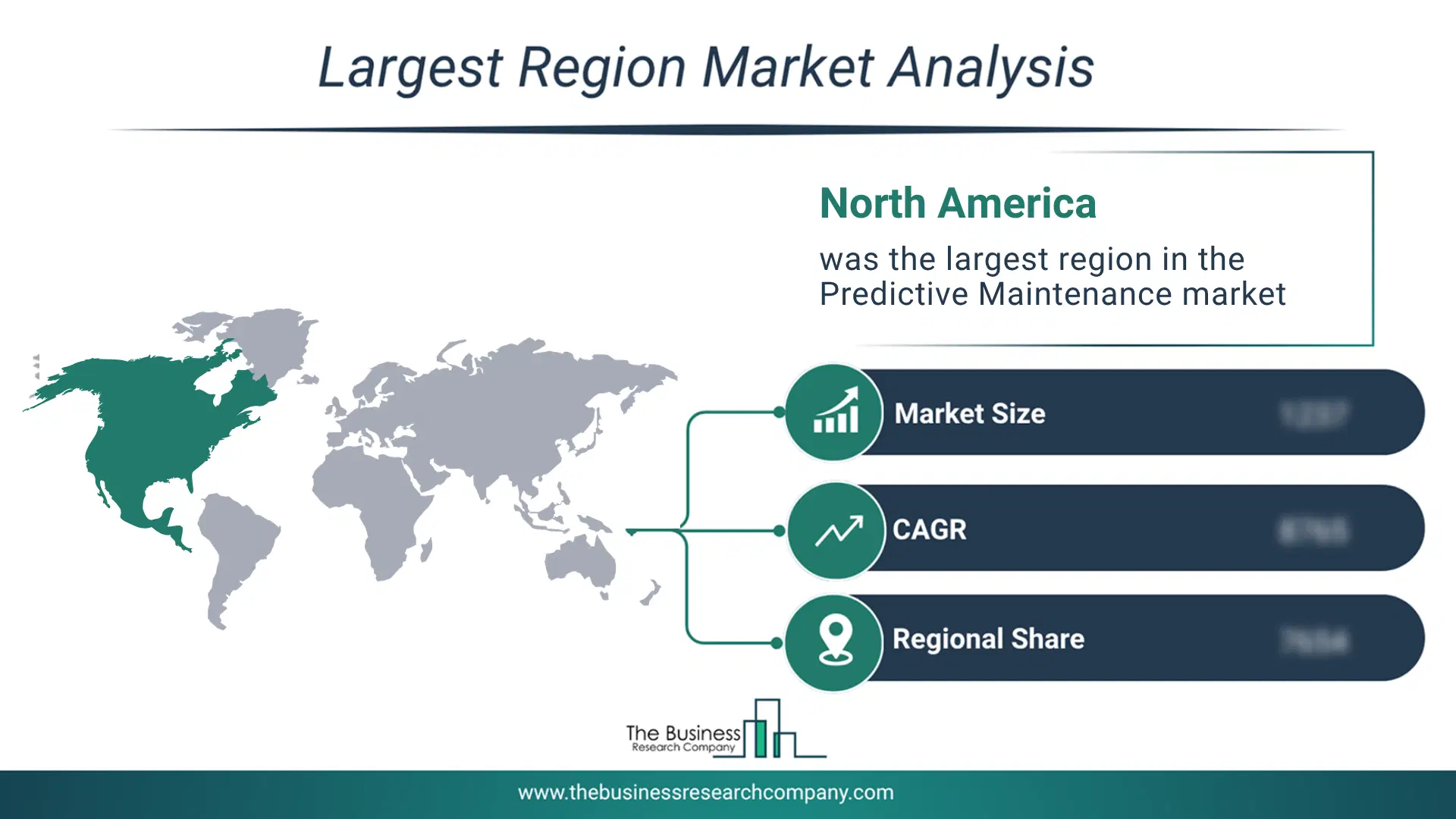
Regional Insights
North America was the largest region in the predictive maintenance market in 2025. Asia-Pacific is expected to be the fastest-growing region in the forecast period. The regions covered in this market report are Asia-Pacific, South East Asia, Western Europe, Eastern Europe, North America, South America, Middle East, Africa. The countries covered in this market report are Australia, Brazil, China, France, Germany, India, Indonesia, Japan, Taiwan, Russia, South Korea, UK, USA, Canada, Italy, SpainWhat Defines the Predictive Maintenance Market?
The predictive maintenance market includes revenues earned by entities by providing services such as monitoring equipment, failure mode, and condition. The market value includes the value of related goods sold by the service provider or included within the service offering. Only goods and services traded between entities or sold to end consumers are included.How is Market Value Defined and Measured?
The market value is defined as the revenues that enterprises gain from the sale of goods and/or services within the specified market and geography through sales, grants, or donations in terms of the currency (in USD unless otherwise specified). The revenues for a specified geography are consumption values that are revenues generated by organizations in the specified geography within the market, irrespective of where they are produced. It does not include revenues from resales along the supply chain, either further along the supply chain or as part of other products.
This chart presents market attractiveness based on a quantitative evaluation of growth, competition, strategic alignment, and risk, offering a clear view of opportunity areas for decision-making. This chart is for illustrative purposes; the full report contains the complete analysis.

This chart highlights the Total Addressable Market (TAM) by estimating the maximum revenue opportunity using an assumption-driven approach, supporting strategic planning and opportunity sizing across markets. The chart is illustrative; the full report provides a more comprehensive analysis.
What Key Data and Analysis Are Included in the Predictive Maintenance Market Report 2026?
The predictive maintenance market research report is one of a series of new reports from The Business Research Company that provides market statistics, including industry global market size, regional shares, competitors with the market share, detailed market segments, market trends and opportunities, and any further data you may need to thrive in the predictive maintenance industry. The market research report delivers a complete perspective of everything you need, with an in-depth analysis of the current and future state of the industry.Predictive Maintenance Market Report Forecast Analysis
| Report Attribute | Details |
|---|---|
| Market Size Value In 2026 | $15.29 billion |
| Revenue Forecast In 2030 | $41.87 billion |
| Growth Rate | CAGR of 29.4% from 2026 to 2030 |
| Base Year For Estimation | 2025 |
| Actual Estimates/Historical Data | 2020-2025 |
| Forecast Period | 2026 - 2030 |
| Market Representation | Revenue in USD Billion and CAGR from 2026 to 2030 |
| Segments Covered | Component, Deployment Mode, Stakeholder, Application, End User |
| Regional Scope | Asia-Pacific, Western Europe, Eastern Europe, North America, South America, Middle East, Africa |
| Country Scope | The countries covered in the report are Australia, Brazil, China, France, Germany, India, Indonesia, Japan, Taiwan, Russia, South Korea, UK, USA, Canada, Italy, Spain. |
| Key Companies Profiled | Google LLC; Microsoft Corporation; Hitachi Ltd; Amazon Web Services Inc; Siemens AG; General Electric Company; International Business Machines Corporation; Cisco Systems Inc; Oracle Corporation; Schneider Electric SE; SAP SE; Hewlett Packard Enterprise Company; SAS Institute Inc; Splunk Inc; PTC Inc; TIBCO Software Inc; Fluke Corporation; Banner Engineering Corporation; Altair Engineering Inc; C3.AI Inc; SparkCognition Inc; Uptake Technologies Inc; RapidMiner Inc; Senseye Ltd; Aspen Technology Inc; Dassault Systèmes SE; Rockwell Automation Inc; Honeywell International Inc |
| Customization Scope | Request for Customization |
| Pricing And Purchase Options | Explore Purchase Options |