
Prefab Wood Building Market Report 2026
Global Outlook – By Panel Systems (Cross-Laminated Timber Panels, Nail-Laminated Timber Panels, Dowel-Laminated Timber Panels, Glue-Laminated Timber Columns And Beams), By Application (Single Family Residential, Multi-Family Residential, Office, Hospitality), By End User (Private Sector, Public Sector) – Market Size, Trends, Strategies, and Forecast to 2030
Prefab Wood Building Market Overview
• Prefab Wood Building market size has reached to $34.36 billion in 2025 • Expected to grow to $47.75 billion in 2030 at a compound annual growth rate (CAGR) of 6.7% • Growth Driver: Rising Focus On Sustainable Construction Fueling The Growth Of The Market Due To Environmental Concerns And Green Certification Initiatives • Market Trend: Innovation In Engineered Wood Solutions Driving Sustainable And Efficient Construction Practices • North America was the largest region in 2025 and Asia?Pacific is the fastest growing region.What Is Covered Under Prefab Wood Building Market?
A prefab wood building is a structure made primarily from wood components that are manufactured off-site in a factory or workshop and then transported to the construction site for quick assembly. These buildings are pre-engineered and pre-cut to precise specifications, allowing for faster construction, reduced waste, and often lower costs compared to traditional on-site building methods. The main panel systems of prefab wood buildings include cross-laminated timber panels, nail-laminated timber panels, dowel-laminated timber panels, and glue-laminated timber columns and beams. Cross-laminated timber panels refer to engineered wood panels made by gluing layers of solid-sawn lumber together in alternating directions, offering high strength, stability, and fire resistance, making them ideal for load-bearing walls, floors, and roofs in modern timber construction. It is applied for single-family residential, multi-family residential, office, and hospitality by several end users, including the private and public sectors.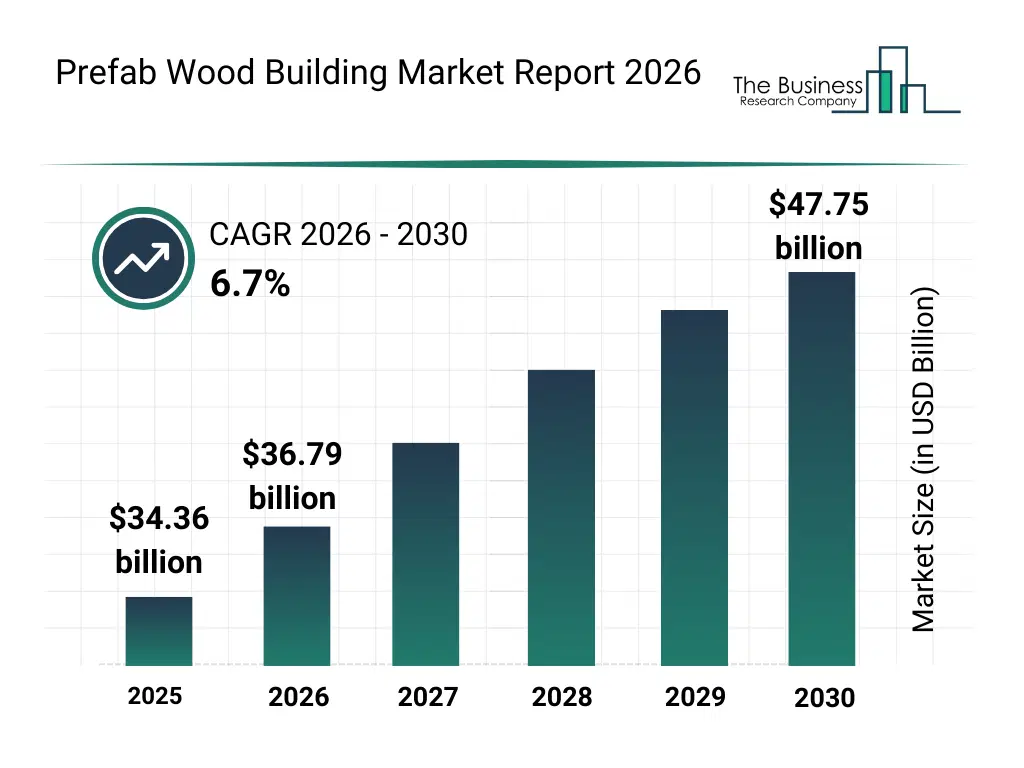
What Is The Prefab Wood Building Market Size and Share 2026?
The prefab wood building market size has grown strongly in recent years. It will grow from $34.36 billion in 2025 to $36.79 billion in 2026 at a compound annual growth rate (CAGR) of 7.0%. The growth in the historic period can be attributed to expansion of residential housing demand, increasing labor shortages in construction, adoption of prefabrication techniques, rising use of engineered wood products, availability of factory-built wood components.What Is The Prefab Wood Building Market Growth Forecast?
The prefab wood building market size is expected to see strong growth in the next few years. It will grow to $47.75 billion in 2030 at a compound annual growth rate (CAGR) of 6.7%. The growth in the forecast period can be attributed to increasing investments in sustainable building practices, rising demand for low-carbon construction materials, expansion of multi-family residential projects, growing use of modular construction, increasing adoption in commercial buildings. Major trends in the forecast period include increasing adoption of off-site wood construction methods, rising demand for fast-assembly building solutions, growing preference for engineered timber structures, expansion of modular residential projects, enhanced focus on construction efficiency.
Global Prefab Wood Building Market Segmentation
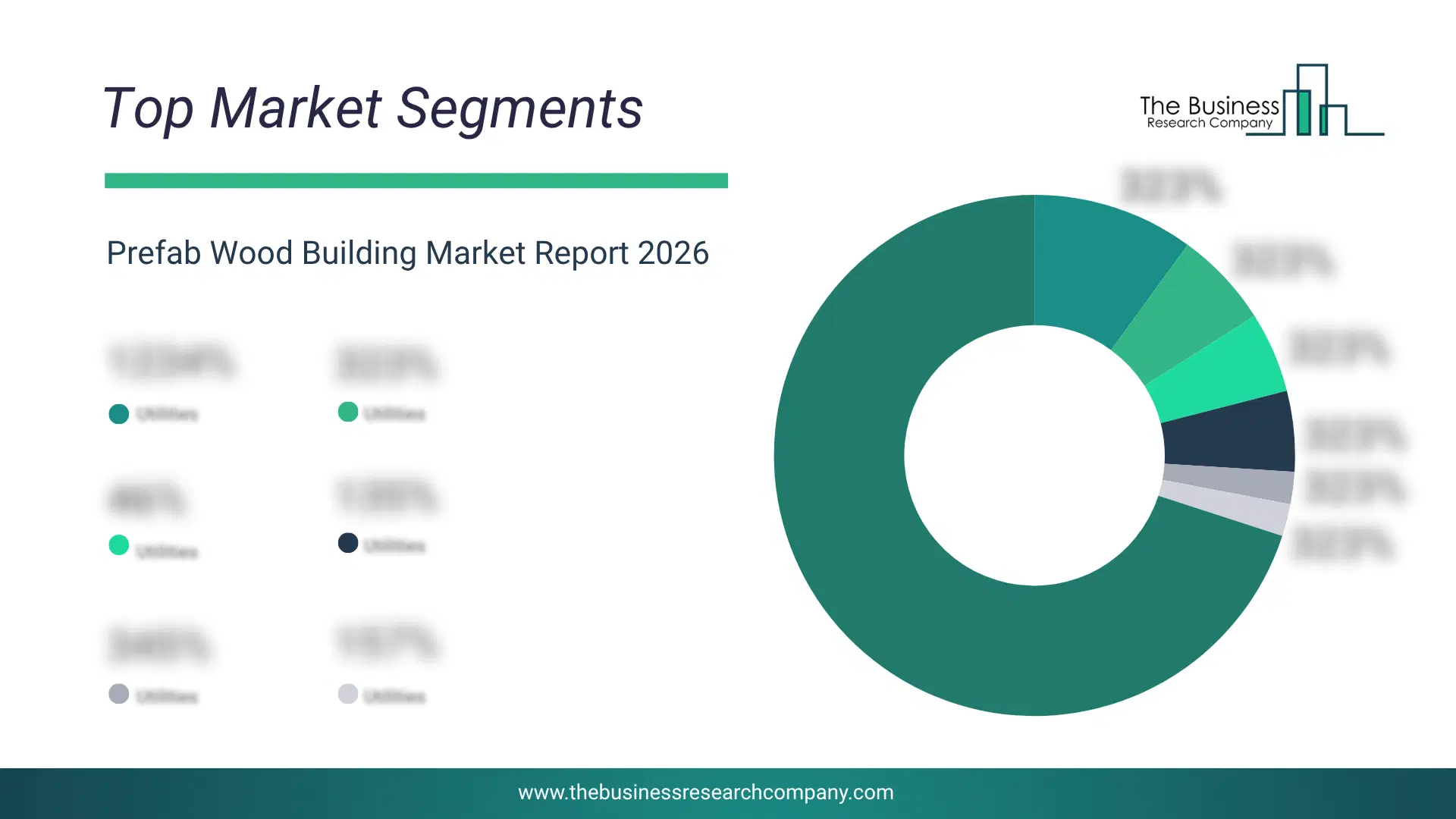
1) By Panel Systems: Cross-Laminated Timber Panels, Nail-Laminated Timber Panels, Dowel-Laminated Timber Panels, Glue-Laminated Timber Columns And Beams 2) By Application: Single Family Residential, Multi-Family Residential, Office, Hospitality 3) By End User: Private Sector, Public Sector Subsegments: 1) By Cross-Laminated Timber Panels: Layer Counts, Laminations Orientation, Panel Configurations 2) By Nail?Laminated Timber (NLT) Panels: Board Thicknesses, Board Widths, Fastening Methods 3) By Dowel?Laminated Timber (DLT) Panels: Lumber Stack With Hardwood Dowels, All-Wood System, Variants 4) By Glue-Laminated Timber Columns And Beams: Member Shape, Orientation, Appearance GradesWhat Is The Driver Of The Prefab Wood Building Market?
The growing demand for sustainable construction is expected to propel the growth of the prefab wood building market going forward. Sustainable construction is the process of creating buildings and infrastructure that reduce environmental harm, use resources efficiently, and support long-term ecological health. Sustainable construction is rising due to growing environmental concerns, as governments and industries increasingly prioritize reducing carbon emissions and conserving natural resources to combat climate change. Prefab wood buildings support sustainable construction by minimizing material waste and shortening on-site construction time, leading to lower environmental impact and more efficient use of resources. For instance, in December 2024, according to a report published by the Green Building Council, an Australia-based government agency, the Australian building sector achieved a milestone by surpassing 1, 000 buildings, fitouts, and precincts recognized with green star certification for their sustainability achievements in 2024. Additionally, the number of submissions for these certifications has doubled from 2023 levels, with more than 120 project applications and over 150 inquiries recorded in just three months. Therefore, the growing demand for sustainable construction is driving the growth of the prefab wood building industry.Key Players In The Global Prefab Wood Building Market
Major companies operating in the prefab wood building market are Clayton Homes, Skyline Champion Corporation, American Homestar, Palm Harbor Homes Inc., Morgan Building Systems Inc., Honkarakenne, Wick Buildings Inc., American Modular Systems, Southland Log Homes, Lindal Cedar Homes, Lester Building Systems , Fertighaus Weiss GmbH, Tumbleweed Houses, Wausau Homes, Praxis Modular, Perpetual Homes Inc., D.R. Johnson Wood Innovations LLC, Green‑R‑Panel LLC, Hixwood Structures, Appalachian Log Structures Inc.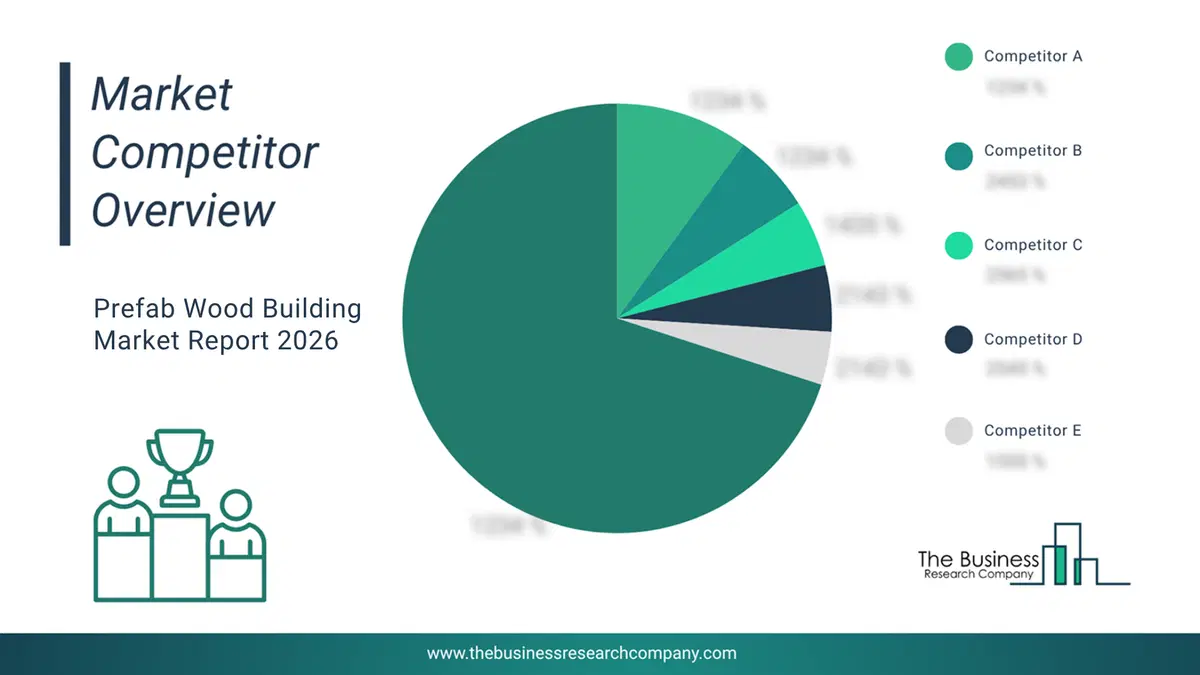
This chart is for illustrative purposes; the full report includes a detailed competitor analysis and comprehensive overview of the top 10 companies in the market.
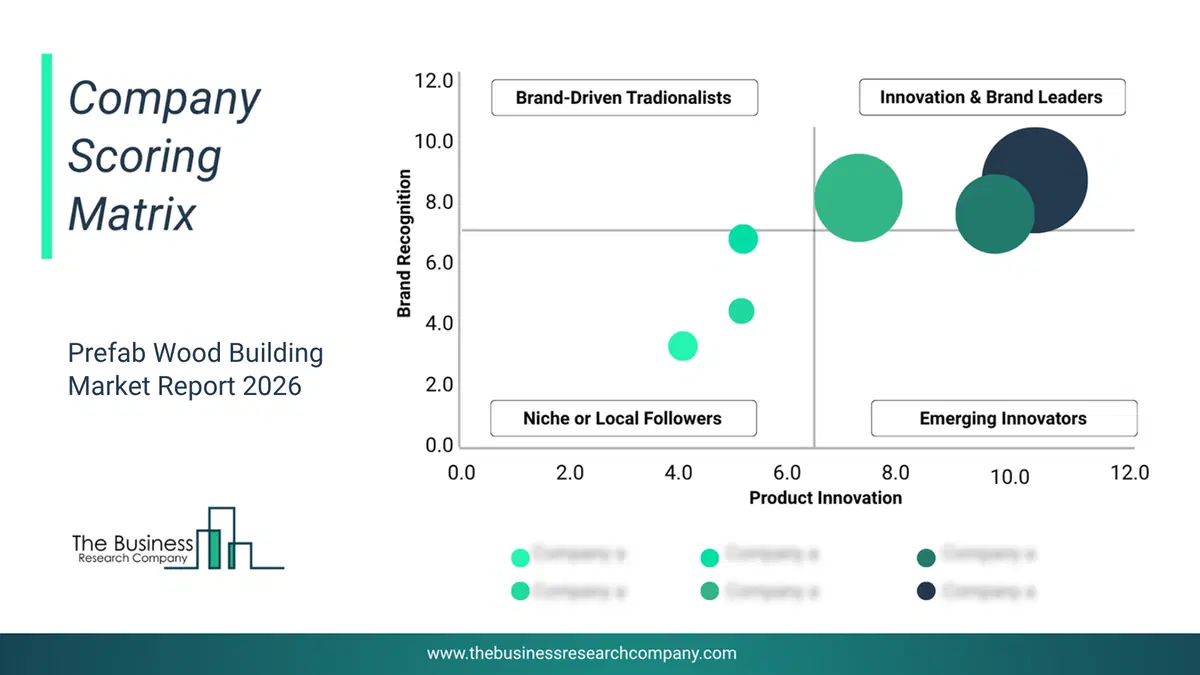
This chart maps companies by product innovation and brand strength, with bubble size indicating relative revenue, helping identify market leaders, challengers, and niche players. This is an illustrative chart; the full report provides a complete and accurate competitive analysis.
Global Prefab Wood Building Market Trends and Insights
Major companies operating in the prefab wood building market are focusing on developing innovative products, such as cross-laminated timber products, to offer faster and cleaner on-site assembly. Cross-laminated timber products are made by layering pieces of wood in alternating directions and bonding them together to form durable and stable panels used in construction. For instance, in February 2025, Cambium, a US-based company focusing on sustainable urban wood utilization, launched Carbon Smart Wood for mass timber, a cross-laminated timber (CLT) product created using reclaimed wood. Carbon Smart CLT is distinguished by its focus on carbon reduction, material traceability, and the use of engineered wood to promote sustainable construction. It is manufactured from reclaimed wood, sourced through a connected network of arborists, sawmills, and producers, enhancing supply chain efficiency. The product meets rigorous structural requirements while storing about one metric ton of CO₂ per cubic meter, making it a lower-carbon option compared to steel and concrete. Carbon Smart CLT contributes to a circular economy and integrates smoothly into current construction practices.What Are Latest Mergers And Acquisitions In The Prefab Wood Building Market?
In June 2023, Mercer International Inc., a Canada-based manufacturer of low-carbon, bio-based mass timber building materials, acquired Structurlam Mass Timber Corporation for an undisclosed amount. With this acquisition, Mercer aimed to expand its manufacturing capacity, broaden its product portfolio (adding both cross-laminated timber and glue-laminated timber), and strengthen its position as a leading mass-timber supplier in North America. Structurlam Mass Timber Corporation is a Canada–based provider of engineered mass timber products including cross-laminated timber (CLT) panels and glue-laminated (glulam) beams and columns used for sustainable building and industrial construction.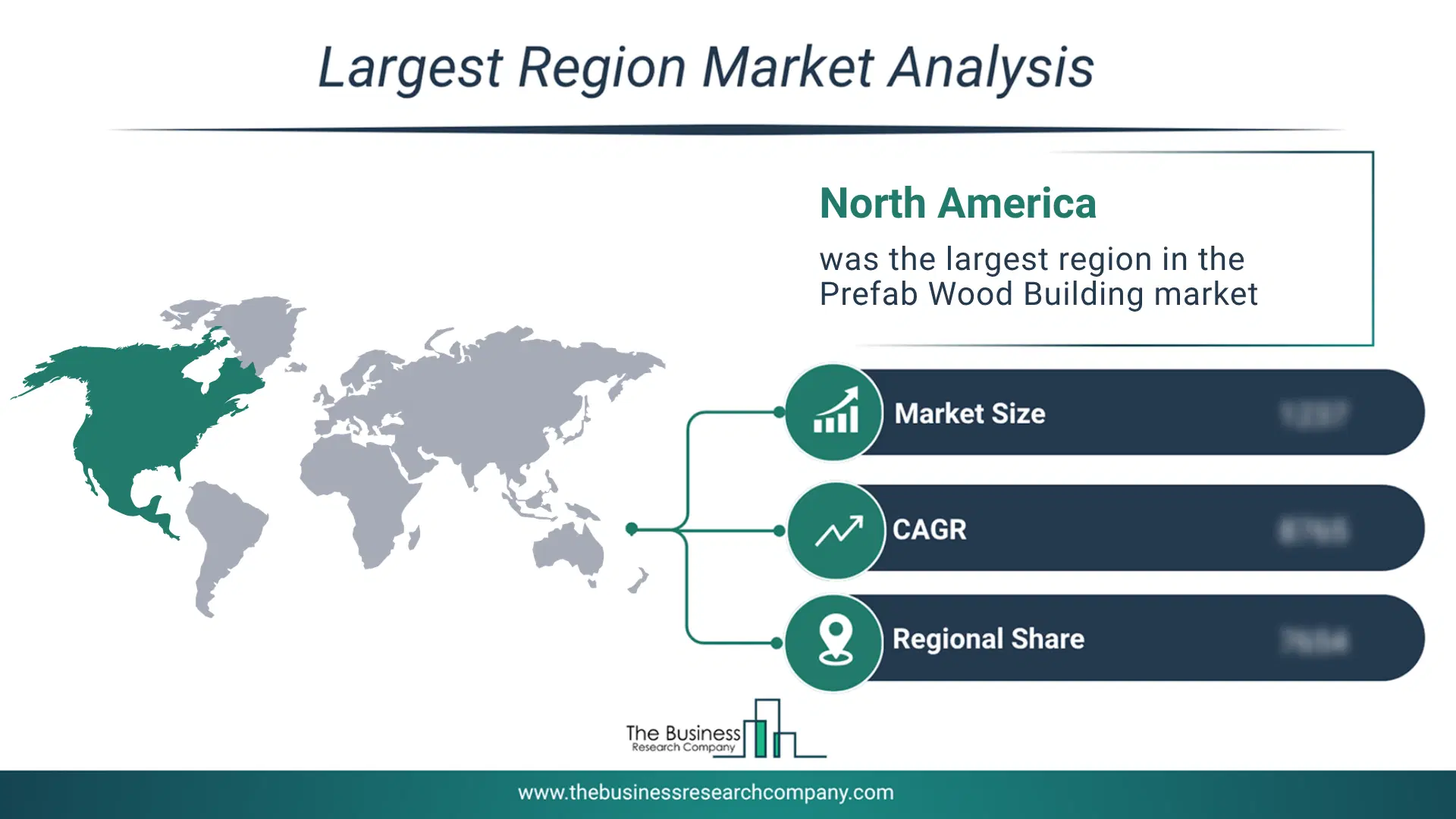
Regional Outlook
North America was the largest region in the prefab wood building Market in 2025. Asia‑Pacific is expected to be the fastest-growing region in the forecast period. The regions covered in this market report are Asia-Pacific, South East Asia, Western Europe, Eastern Europe, North America, South America, Middle East, Africa. The countries covered in this market report are Australia, Brazil, China, France, Germany, India, Indonesia, Japan, Taiwan, Russia, South Korea, UK, USA, Canada, Italy, Spain.What Defines the Prefab Wood Building Market?
The prefab wood building market consists of sales of modular wood buildings, wooden gazebo kits, panelized wood systems, and beam wood systems. Values in this market are factory gate values; that is, the value of goods sold by the manufacturers or creators of the goods, whether to other entities (including downstream manufacturers, wholesalers, distributors, and retailers) or directly to end customers.How is Market Value Defined and Measured?
The market value is defined as the revenues that enterprises gain from the sale of goods and/or services within the specified market and geography through sales, grants, or donations in terms of the currency (in USD unless otherwise specified). The revenues for a specified geography are consumption values that are revenues generated by organizations in the specified geography within the market, irrespective of where they are produced. It does not include revenues from resales along the supply chain, either further along the supply chain or as part of other products.
This chart presents market attractiveness based on a quantitative evaluation of growth, competition, strategic alignment, and risk, offering a clear view of opportunity areas for decision-making. This chart is for illustrative purposes; the full report contains the complete analysis.

This chart highlights the Total Addressable Market (TAM) by estimating the maximum revenue opportunity using an assumption-driven approach, supporting strategic planning and opportunity sizing across markets. The chart is illustrative; the full report provides a more comprehensive analysis.
What Key Data and Analysis Are Included in the Prefab Wood Building Market Report 2026?
The prefab wood building market research report is one of a series of new reports from The Business Research Company that provides market statistics, including Market Report 2026?global market size, regional shares, competitors with the market share, detailed market segments, market trends and opportunities, and any further data you may need to thrive in the prefab wood building Market Report 2026? The market research report delivers a complete perspective of everything you need, with an in-depth analysis of the current and future state of the Market Report 2026?Prefab Wood Building Market Report Forecast Analysis
| Report Attribute | Details |
|---|---|
| Market Size Value In 2026 | $36.79 billion |
| Revenue Forecast In 2030 | $47.75 billion |
| Growth Rate | CAGR of 7.0% from 2026 to 2030 |
| Base Year For Estimation | 2025 |
| Actual Estimates/Historical Data | 2020-2025 |
| Forecast Period | 2026 - 2030 |
| Market Representation | Revenue in USD Billion and CAGR from 2026 to 2030 |
| Segments Covered | Panel Systems, Application, End User |
| Regional Scope | Asia-Pacific, Western Europe, Eastern Europe, North America, South America, Middle East, Africa |
| Country Scope | The countries covered in the report are Australia, Brazil, China, France, Germany, India, Indonesia, Japan, Taiwan, Russia, South Korea, UK, USA, Canada, Italy, Spain. |
| Key Companies Profiled | Clayton Homes, Skyline Champion Corporation, American Homestar, Palm Harbor Homes Inc., Morgan Building Systems Inc., Honkarakenne, Wick Buildings Inc., American Modular Systems, Southland Log Homes, Lindal Cedar Homes, Lester Building Systems , Fertighaus Weiss GmbH, Tumbleweed Houses, Wausau Homes, Praxis Modular, Perpetual Homes Inc., D.R. Johnson Wood Innovations LLC, Green‑R‑Panel LLC, Hixwood Structures, Appalachian Log Structures Inc. |
| Customization Scope | Request for Customization |
| Pricing And Purchase Options | Explore Purchase Options |