
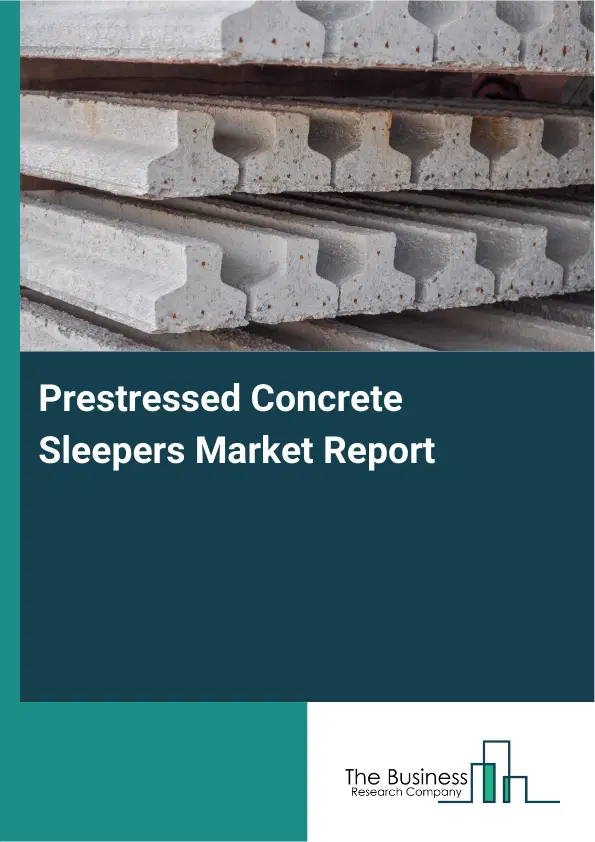
Prestressed Concrete Sleepers Market Report 2026
Global Outlook – By Type of Sleeper (Monoblock Sleepers, Double Block Sleepers, Composite Sleepers), By Material Type (High-Strength Concrete, Steel Reinforcement, Fiber-Reinforced Concrete), By Application (Railway Tracks, Transit Systems, Urban Transit, Heavy Haulage), By End-User (Passenger Rail, Freight Rail) – Market Size, Trends, Strategies, and Forecast to 2030
Prestressed Concrete Sleepers Market Overview
• Prestressed Concrete Sleepers market size has reached to $5.32 billion in 2025 • Expected to grow to $7.9 billion in 2030 at a compound annual growth rate (CAGR) of 8.2% • Growth Driver: Growth Of Railway Infrastructure Is Fueling The Market With Increasing Urbanization And Government Investments • Market Trend: Advancements Sleeper To Enhance Track Stability For Modern Rail Systems • Asia-Pacific was the largest region and fastest growing region.What Is Covered Under Prestressed Concrete Sleepers Market?
A prestressed concrete sleeper is a type of railway sleeper (or railroad tie) made from concrete that is internally compressed by high-strength steel tendons before any external load is applied. The primary purpose of prestressed concrete sleepers is to provide a strong, stable, and long-lasting foundation for railway tracks. They ensure proper alignment, reduce maintenance needs, withstand high dynamic loads, and improve the overall safety and efficiency of rail transport systems. The main types of prestressed concrete sleepers are monoblock sleepers, double block sleepers, and composite sleepers. Monoblock sleepers are single-unit concrete components that enhance track alignment, reduce maintenance, and offer durability under varying load conditions. It is made up of several material types, such as high-strength concrete, steel reinforcement, and fiber-reinforced concrete for various applications, including railway tracks, transit systems, urban transit, and heavy haulage, and is used by several end-users, including passenger rail and freight rail.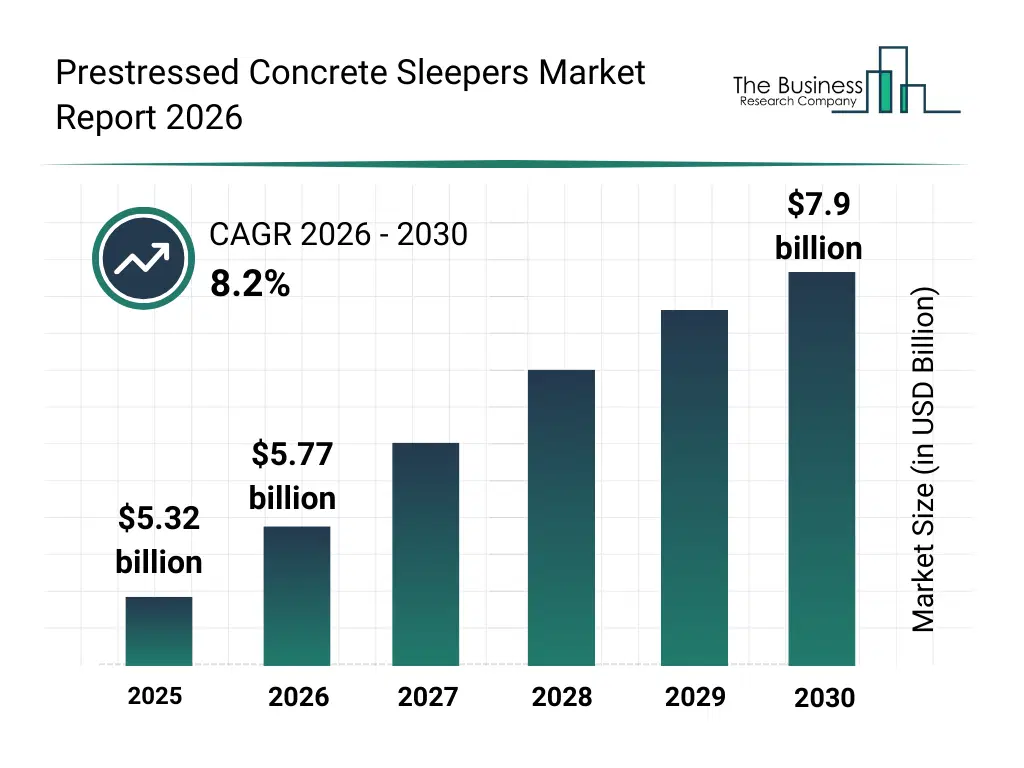
What Is The Prestressed Concrete Sleepers Market Size and Share 2026?
The prestressed concrete sleepers market size has grown strongly in recent years. It will grow from $5.32 billion in 2025 to $5.77 billion in 2026 at a compound annual growth rate (CAGR) of 8.4%. The growth in the historic period can be attributed to increasing adoption of prestressed sleepers in railways, growth in fiber-reinforced concrete use, rising demand for high-strength sleepers, expansion of urban transit projects, increasing use of composite sleeper technologies.What Is The Prestressed Concrete Sleepers Market Growth Forecast?
The prestressed concrete sleepers market size is expected to see strong growth in the next few years. It will grow to $7.9 billion in 2030 at a compound annual growth rate (CAGR) of 8.2%. The growth in the forecast period can be attributed to increasing integration of IoT monitoring, development of sustainable sleeper materials, rising adoption of hybrid and recycled composite sleepers, expansion of automated sleeper installation systems, growth in high-speed and heavy-haul rail infrastructure. Major trends in the forecast period include deployment of monoblock and double block prestressed concrete sleepers, integration of AI-based track stability monitoring, expansion of fiber-reinforced and composite sleepers, adoption of IOT-enabled sleeper maintenance systems, development of sustainable concrete sleeper materials.
Global Prestressed Concrete Sleepers Market Segmentation
1) By Type of Sleeper: Monoblock Sleepers, Double Block Sleepers, Composite Sleepers 2) By Material Type: High-Strength Concrete, Steel Reinforcement, Fiber-Reinforced Concrete 3) By Application: Railway Tracks, Transit Systems, Urban Transit, Heavy Haulage 4) By End-User: Passenger Rail, Freight Rail Subsegments: 1) By Monoblock Sleepers: Standard Gauge Monoblock Sleepers, Broad Gauge Monoblock Sleepers, Narrow Gauge Monoblock Sleepers, Turnout Monoblock Sleepers, Level Crossing Monoblock Sleepers, Bridge Deck Monoblock Sleepers 2) By Double Block Sleepers: Twin Block With Tie Rod Sleepers, Twin Block With Metal Plate Sleepers, Turnout Double Block Sleepers, Bridge Deck Double Block Sleepers, Heavy Haul Twin Block Sleepers 3) By Composite Sleepers: Fiber Reinforced Polymer Composite Sleepers, Recycled Plastic Composite Sleepers, Hybrid Composite Sleepers, Wood Polymer Composite Sleepers, Thermoset Composite Sleepers, Thermoplastic Composite SleepersWhat Is The Driver Of The Prestressed Concrete Sleepers Market?
Rising demand for railway infrastructure is expected to propel the growth of the prestressed concrete sleepers market going forward. Railway infrastructure refers to the foundational systems, including tracks, bridges, signaling, and stations, that support rail transport operations. Railway infrastructure is rising due to increasing urbanization, as city populations require efficient mass transit systems, prompting governments to invest in expanding and modernizing rail networks. Prestressed concrete sleepers improve railway infrastructure with superior strength, durability, and track stability. Their pre-tensioned design ensures efficient load distribution and resists dynamic forces, supporting high-speed and heavy-load operations. For instance, in July 2024, according to the European Commission, a Belgium-based governing body, by 2030, the European Union aims to double high-speed rail traffic and triple it by 2050. Therefore, rising demand for railway infrastructure is driving the growth of the prestressed concrete sleepers industry.Key Players In The Global Prestressed Concrete Sleepers Market
Major companies operating in the prestressed concrete sleepers market are Voestalpine Railway Systems GmbH, Patil Group, The Indian Hume Pipe Co. Ltd., Fuji P.S. Corporation, Sateba Group SAS, Daya Engineering Works (Poles) Pvt. Ltd., Vollert Group, P-TEC International GmbH, Taichang Zhongbo Railway Fastening Co. Ltd., Gilada Group, ROMIC Group Limited, Shanghai Bosheng Industries Co. Ltd., Track Tec GmbH, Rampurhat PSC Sleepers Limited, Plastwil De Bonte, Paramount Rail Infra Private Limited, GPT Infraprojects Limited, PCM Group (Prestressed Concrete Manufacturer), Wuxi Xitong Rail Sleeper Technology Co. Ltd., Austrak Pty Ltd.
This chart is for illustrative purposes; the full report includes a detailed competitor analysis and comprehensive overview of the top 10 companies in the market.
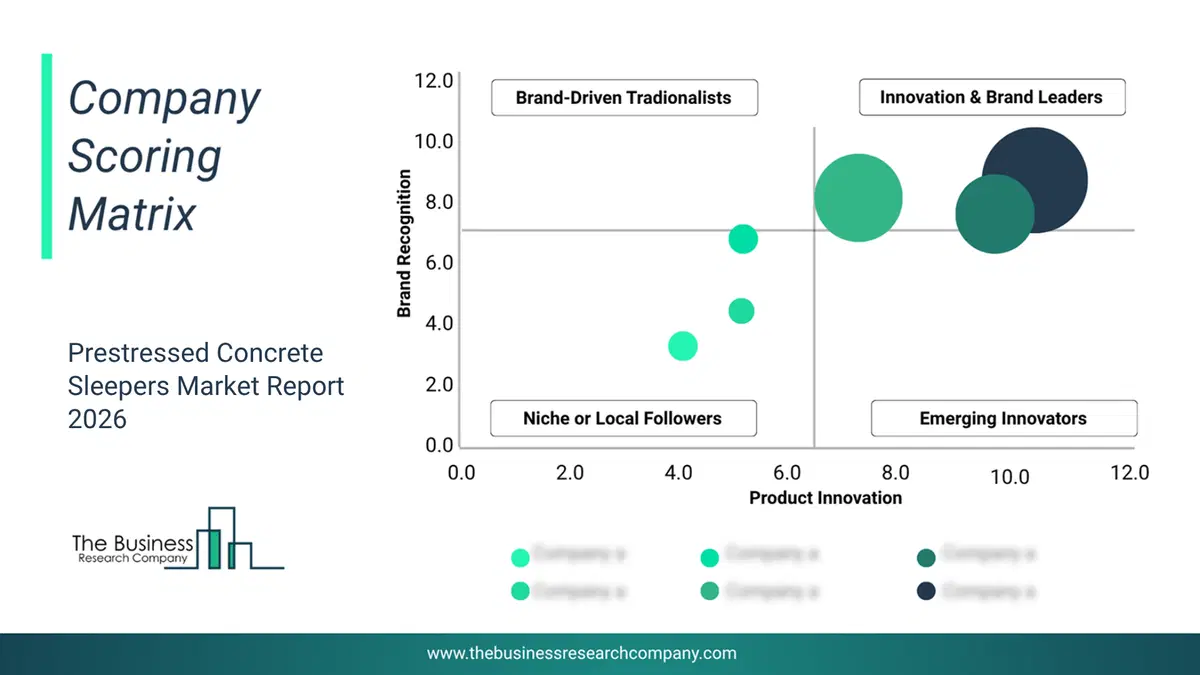
This chart maps companies by product innovation and brand strength, with bubble size indicating relative revenue, helping identify market leaders, challengers, and niche players. This is an illustrative chart; the full report provides a complete and accurate competitive analysis.
Global Prestressed Concrete Sleepers Market Trends and Insights
Major companies operating in the prestressed concrete sleeper market are focusing on developing innovative concrete sleepers to enhance the durability, load-bearing capacity, and longevity of railway infrastructure. These innovations often involve the use of advanced materials, optimized sleeper designs, and improved manufacturing techniques to meet the growing demands of high-speed rail and heavy-haul freight applications. For instance, in October 2023, Overail S.p.A., an Italy-based railway infrastructure company, showcased concrete sleepers for heritage & tourist lines at EXPO Ferroviaria. These sleepers offer improved durability for low-traffic railway lines, combining reinforced concrete strength with optimized profiles to protect historical track alignments, ideal for maintaining both safety and the authentic look of heritage railroads.What Are Latest Mergers And Acquisitions In The Prestressed Concrete Sleepers Market?
In April 2024, SATEBA Group, a France-based sustainable rail infrastructure technology company, acquired the rail business of De Bonte Group for an undisclosed amount. With this acquisition, Sateba aims to expand its European footprint and strengthen its leadership in low-carbon railway infrastructure by integrating De Bonte’s concrete sleeper production assets and expertise, thereby enhancing its manufacturing capabilities, research and development potential, and service coverage across Belgium and France. De Bonte Group is a Belgium-based producer of prestressed concrete sleepers.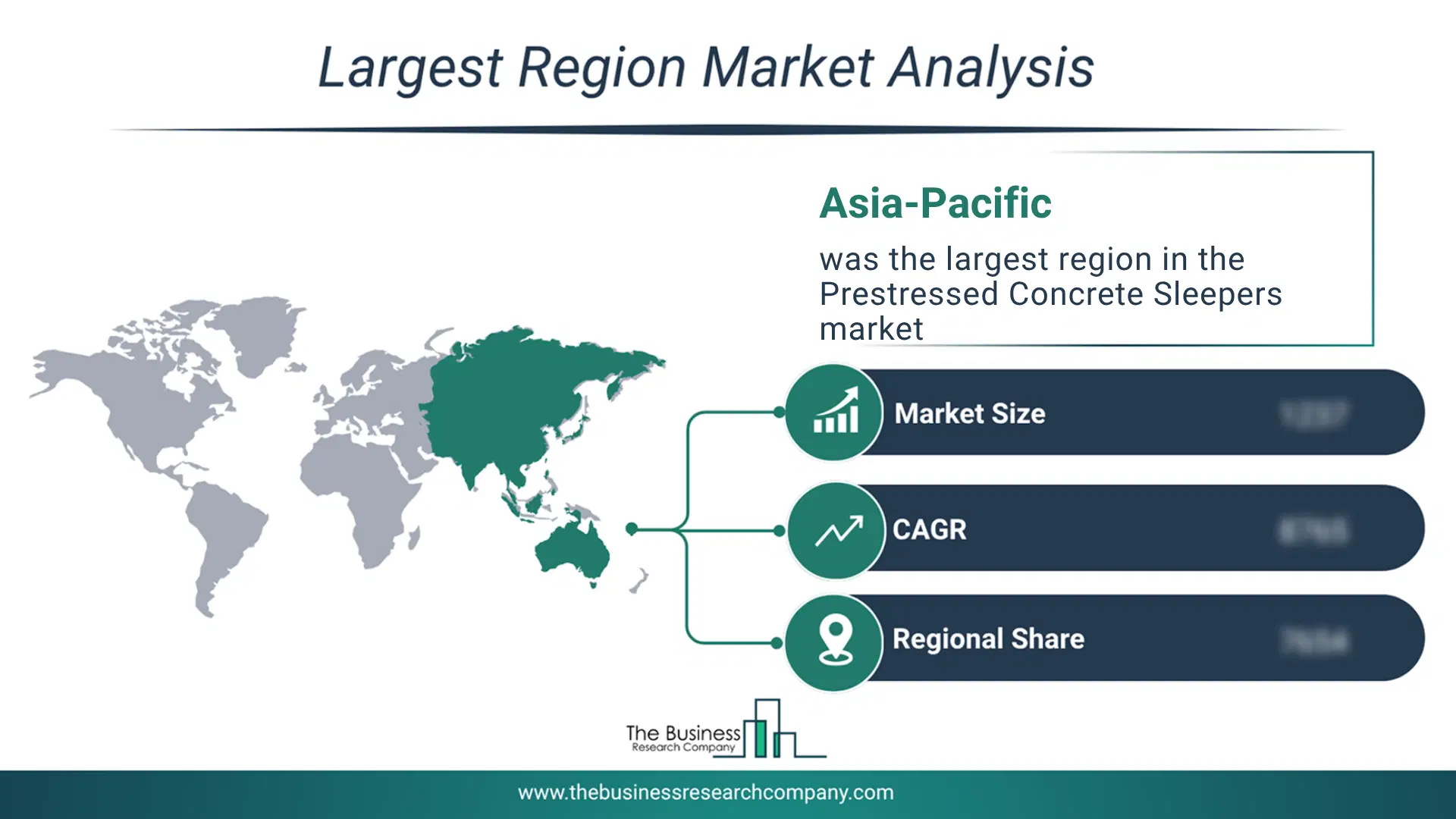
Regional Insights
Asia-Pacific was the largest region in the prestressed concrete sleepers market in 2025. The regions covered in this market report are Asia-Pacific, South East Asia, Western Europe, Eastern Europe, North America, South America, Middle East, Africa. The countries covered in this market report are Australia, Brazil, China, France, Germany, India, Indonesia, Japan, Taiwan, Russia, South Korea, UK, USA, Canada, Italy, Spain.What Defines the Prestressed Concrete Sleepers Market?
The prestressed concrete sleepers market consists of sales of steel moulds, grout, concrete admixtures, anchorages, and bearing plates. Values in this market are ‘factory gate’ values, that is, the value of goods sold by the manufacturers or creators of the goods, whether to other entities (including downstream manufacturers, wholesalers, distributors, and retailers) or directly to end customers. The value of goods in this market includes related services sold by the creators of the goods.How is Market Value Defined and Measured?
The market value is defined as the revenues that enterprises gain from the sale of goods and/or services within the specified market and geography through sales, grants, or donations in terms of the currency (in USD unless otherwise specified). The revenues for a specified geography are consumption values that are revenues generated by organizations in the specified geography within the market, irrespective of where they are produced. It does not include revenues from resales along the supply chain, either further along the supply chain or as part of other products.
This chart presents market attractiveness based on a quantitative evaluation of growth, competition, strategic alignment, and risk, offering a clear view of opportunity areas for decision-making. This chart is for illustrative purposes; the full report contains the complete analysis.

This chart highlights the Total Addressable Market (TAM) by estimating the maximum revenue opportunity using an assumption-driven approach, supporting strategic planning and opportunity sizing across markets. The chart is illustrative; the full report provides a more comprehensive analysis.
What Key Data and Analysis Are Included in thePrestressed Concrete Sleepers Market Report 2026?
The prestressed concrete sleepers market research report is one of a series of new reports from The Business Research Company that provides market statistics, including industry global market size, regional shares, competitors with the market share, detailed market segments, market trends and opportunities, and any further data you may need to thrive in the prestressed concrete sleepers industry. The market research report delivers a complete perspective of everything you need, with an in-depth analysis of the current and future state of the industry.Prestressed Concrete Sleepers Market Report Forecast Analysis
| Report Attribute | Details |
|---|---|
| Market Size Value In 2026 | $5.77 billion |
| Revenue Forecast In 2030 | $7.9 billion |
| Growth Rate | CAGR of 8.4% from 2026 to 2030 |
| Base Year For Estimation | 2025 |
| Actual Estimates/Historical Data | 2020-2025 |
| Forecast Period | 2026 - 2030 |
| Market Representation | Revenue in USD Billion and CAGR from 2026 to 2030 |
| Segments Covered | Type of Sleeper, Material Type, Application, End-User |
| Regional Scope | Asia-Pacific, Western Europe, Eastern Europe, North America, South America, Middle East, Africa |
| Country Scope | The countries covered in this market report are Australia, Brazil, China, France, Germany, India, Indonesia, Japan, Taiwan, Russia, South Korea, UK, USA, Canada, Italy, Spain |
| Key Companies Profiled | Voestalpine Railway Systems GmbH, Patil Group, The Indian Hume Pipe Co. Ltd., Fuji P.S. Corporation, Sateba Group SAS, Daya Engineering Works (Poles) Pvt. Ltd., Vollert Group, P-TEC International GmbH, Taichang Zhongbo Railway Fastening Co. Ltd., Gilada Group, ROMIC Group Limited, Shanghai Bosheng Industries Co. Ltd., Track Tec GmbH, Rampurhat PSC Sleepers Limited, Plastwil De Bonte, Paramount Rail Infra Private Limited, GPT Infraprojects Limited, PCM Group (Prestressed Concrete Manufacturer), Wuxi Xitong Rail Sleeper Technology Co. Ltd., Austrak Pty Ltd. |
| Customization Scope | Request for Customization |
| Pricing And Purchase Options | Explore Purchase Options |