
Prime Power Reciprocating Power Generating Engine Market Report 2026
Global Outlook – By Engine Type (Diesel Engines, Gas Engines, Dual-Fuel Engines, Biogas Engines), By Power Output Range (Up To 500 kW, 500 kW To 1 MW, 1 MW To 2 MW, Above 2 MW), By Application (Standby Power Generation, Prime Power Generation, Peak Shaving, Other Applications), By End-User (Oil And Gas, Mining, Construction, Manufacturing, Data Centers) – Market Size, Trends, Strategies, and Forecast to 2030
Prime Power Reciprocating Power Generating Engine Market Overview
• Prime Power Reciprocating Power Generating Engine market size has reached to $12.98 billion in 2025 • Expected to grow to $17.05 billion in 2030 at a compound annual growth rate (CAGR) of 5.5% • Growth Driver: Growing Industrialization Is Fueling The Market Due To Increasing Demand For Infrastructure And Reliable Power Supply • Market Trend: Advancements In Diesel Engine Technology Driving Efficiency And Sustainability • North America was the largest region in 2025.Market Gains By 2030 – Top Opportunities By Segment
Market Gain identifies the most promising market opportunities by highlighting the segments or products expected to generate the highest incremental revenue growth over the next five years.
What Is Covered Under Prime Power Reciprocating Power Generating Engine Market?
Prime power reciprocating power generating engines refer to internal combustion engines designed to provide continuous and reliable electricity generation in locations where utility power is unavailable or unreliable. They are used for supplying consistent power to remote facilities, industrial sites, and off-grid applications. The main types of engines in the prime power reciprocating power generating engine market are diesel engines, gas engines, dual-fuel engines, and biogas engines. Diesel engines refer to internal combustion engines that use diesel fuel to generate power through the compression-ignition process. The various power output ranges include up to 500 kilowatts (kW), 500 kW to 1 megawatt (MW), 1 MW to 2 MW, and above 2 MW. The various applications include standby power generation, prime power generation, peak shaving, and others, catering to end-users such as oil and gas, mining, construction, manufacturing, and data centers.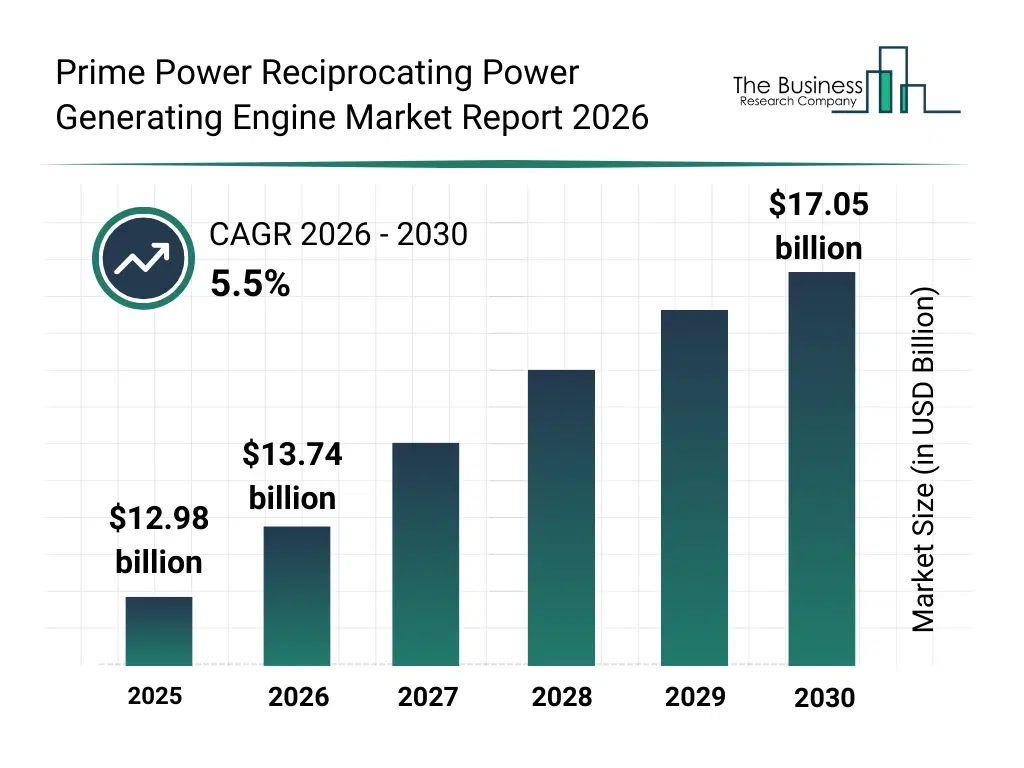
What Is The Prime Power Reciprocating Power Generating Engine Market Size and Share 2026?
The prime power reciprocating power generating engine market size has grown strongly in recent years. It will grow from $12.98 billion in 2025 to $13.74 billion in 2026 at a compound annual growth rate (CAGR) of 5.9%. The growth in the historic period can be attributed to expansion of remote industrial operations, rising need for reliable continuous power supply, limited grid access in developing regions, growth of mining and oil exploration sites, adoption of diesel-based prime power systems.What Is The Prime Power Reciprocating Power Generating Engine Market Growth Forecast?
The prime power reciprocating power generating engine market size is expected to see strong growth in the next few years. It will grow to $17.05 billion in 2030 at a compound annual growth rate (CAGR) of 5.5%. The growth in the forecast period can be attributed to increasing shift toward cleaner fuel engines, rising investments in decentralized power generation, growing demand from data centers, expansion of hybrid power systems, increasing focus on fuel efficiency and emission reduction. Major trends in the forecast period include increasing adoption of gas and dual-fuel engines, rising deployment in off-grid and remote locations, growing focus on high-efficiency engine designs, expansion of modular power generation systems, enhanced integration of advanced engine monitoring.
Global Prime Power Reciprocating Power Generating Engine Market Segmentation
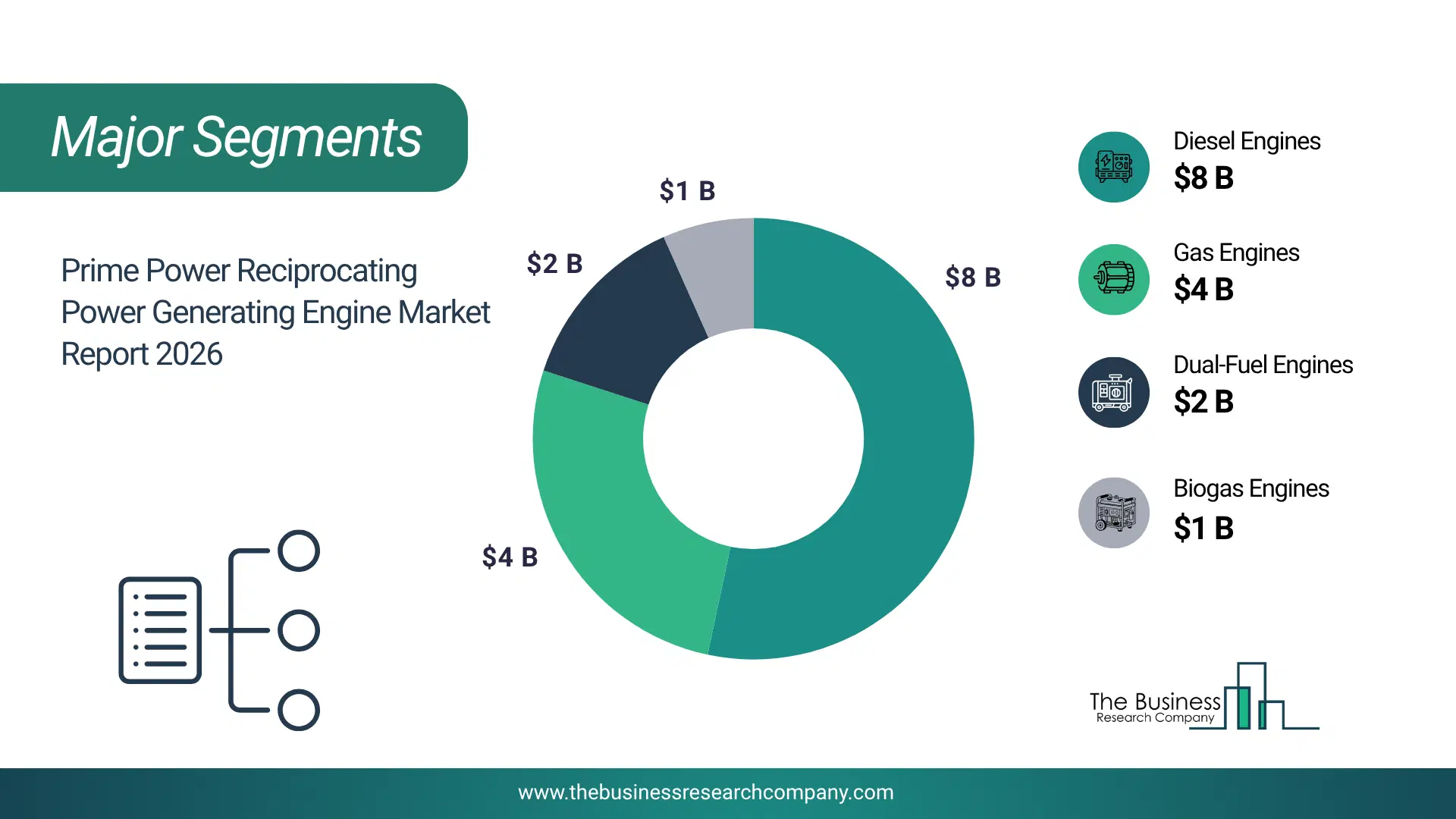
1) By Engine Type: Diesel Engines, Gas Engines, Dual-Fuel Engines, Biogas Engines 2) By Power Output Range: Up To 500 kW, 500 kW To 1 MW, 1 MW To 2 MW, Above 2 MW 3) By Application: Standby Power Generation, Prime Power Generation, Peak Shaving, Other Applications 4) By End-User: Oil And Gas, Mining, Construction, Manufacturing, Data Centers Subsegments: 1) By Diesel Engines: Low-Speed Diesel Engines, Medium-Speed Diesel Engines, High-Speed Diesel Engines 2) By Gas Engines: Natural Gas Engines, Propane Gas Engines, Liquefied Natural Gas (LNG) Engines 3) By Dual-Fuel Engines: Diesel-Natural Gas Dual-Fuel Engines, Diesel-Biogas Dual-Fuel Engines, Diesel-LPG Dual-Fuel Engines 4) By Biogas Engines: Agricultural Waste-Based Biogas Engines, Landfill Gas Engines, Sewage Gas Engines The top segments in the prime power reciprocating power generating engine market will be: • Diesel Engines will reach $8.45 Billion by 2030. • Gas Engines will reach $4.26 Billion by 2030. • Dual-Fuel Engines will reach $2.13 Billion by 2030. • Biogas Engines will reach $1.01 Billion by 2030.What Is The Driver Of The Prime Power Reciprocating Power Generating Engine Market?
The growing industrialization is expected to propel the growth of the prime power reciprocating power generating engine market going forward. Industrialization is the process by which an economy transforms from primarily agricultural to one based on the manufacturing of goods and services. Industrialization is increasing due to rapid technological advancements that enhance production efficiency and reduce manufacturing costs. Prime power reciprocating power generating engines support industrialization by providing a reliable and continuous energy supply essential for powering factories, machinery, and critical industrial operations. For instance, in May 2025, according to the Office for National Statistics, a UK-based government department, UK manufacturers' total product sales in 2023 were valued at £456.1 billion ($606.1 billion), up £17.2 billion ($22.9 billion) or 3.9% from 2022's £438.9 billion ($583.2 billion). Moreover, in 2024, according to the Department of Industry, Science, and Resources, an Australia-based government agency, global industrial production rose by 1.8% year-on-year in the September 2024 quarter. Therefore, growing industrialization is driving the expansion of the prime power reciprocating power generating engine industry.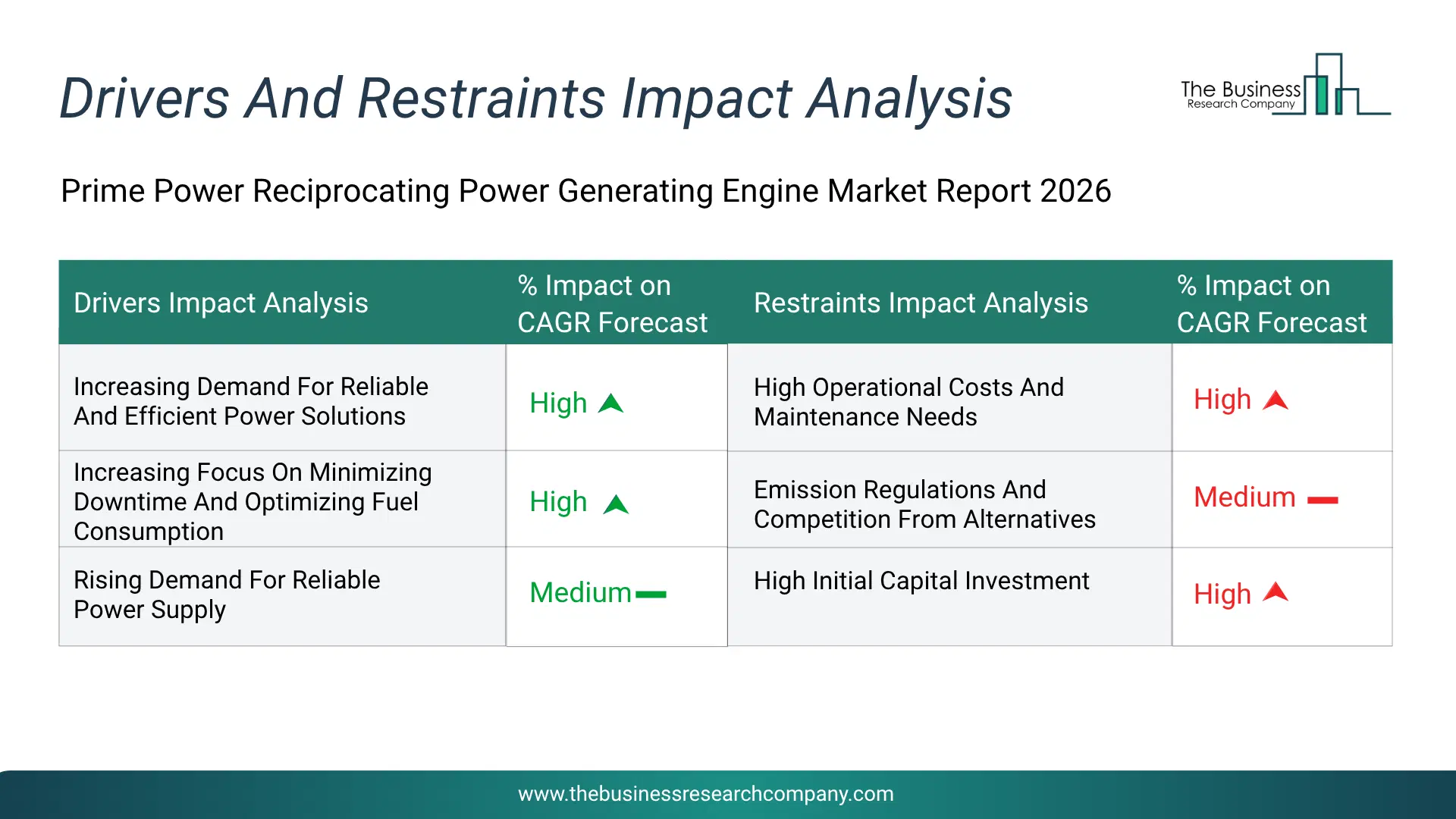
Infographic Chart Showing Key Market Drivers Analysis And Restraints For Prime Power Reciprocating Power Generating Engine Market
The chart presents an impact analysis of key drivers and restraints, quantifying their relative influence on the market's growth rate and helping assess the balance between growth enablers and limiting factors. This chart offers a high-level perspective; the full report contains more detailed insights.
How Will The Drivers Impact Growth In The Global Prime Power Reciprocating Power Generating Engine Market?
• Increasing Demand For Reliable And Efficient Power Solutions (High) – During the forecast period, the increasing demand for reliable and efficient power solutions is expected to become a key growth driver for the prime power reciprocating power generating engine market by 2030. Increasing demand for reliable and efficient power solutions is a major driver for the prime power reciprocating power generating engine market because industries, commercial facilities, and remote operations require continuous electricity to maintain productivity and operational stability. Reciprocating engines are valued for their ability to provide dependable power under varying load conditions while maintaining high operational efficiency. Their quick-start capability and flexibility make them suitable for locations where grid reliability is limited. Businesses increasingly prefer these systems to avoid disruptions that can lead to financial losses. Growing industrialization and expansion of critical infrastructure further strengthen the need for reliable prime power systems. In addition, advancements in engine technology are improving performance and fuel efficiency. • Increasing Focus On Minimizing Downtime And Optimizing Fuel Consumption (High) – During the forecast period, the increasing focus on minimizing downtime and optimizing fuel consumption is expected to emerge as a major factor driving the expansion of the prime power reciprocating power generating engine market by 2030. Increasing focus on minimizing downtime and optimizing fuel consumption is driving the prime power reciprocating power generating engine market as organizations seek cost-effective and uninterrupted power generation solutions. Modern reciprocating engines are designed to operate efficiently for extended periods while reducing fuel usage and maintenance requirements. Industries such as manufacturing, mining, and oil and gas depend on continuous operations, making downtime reduction a critical objective. These engines offer high reliability and can be serviced quickly, helping operators maintain productivity. Improved fuel efficiency also lowers operating expenses and enhances overall project economics. The integration of advanced monitoring and control systems further supports performance optimization. • Rising Demand For Reliable Power Supply (Medium) – During the forecast period, the rising demand for reliable power supply is expected to act as a key growth catalyst for the prime power reciprocating power generating engine market by 2030. Rising demand for reliable power supply serves as a significant driver for the prime power reciprocating power generating engine market due to increasing electricity needs across industrial, commercial, and residential sectors. Many regions continue to experience grid instability, power shortages, or limited access to centralized electricity networks. Reciprocating power generating engines provide a dependable source of continuous power in such environments. Their ability to deliver stable electricity supports essential operations in healthcare facilities, data centers, telecommunications networks, and industrial plants. Rapid urbanization and economic development are further increasing power consumption worldwide. These systems also offer operational flexibility and scalability to meet changing energy requirements.How Will The Restraints Impact Growth In The Global Prime Power Reciprocating Power Generating Engine Market?
• High Operational Costs And Maintenance Needs (High) – During the forecast period, the high operational costs and maintenance needs act as a significant restraint on the prime power reciprocating power generating engine market because these systems require continuous fuel consumption, routine servicing, and periodic component replacement to maintain optimal performance. Operating expenses can increase substantially, particularly in regions with volatile fuel prices or limited fuel availability. Regular maintenance activities, including engine inspections, lubrication, and overhaul procedures, add to the total cost of ownership. Smaller businesses and budget-constrained operators may find these expenses difficult to manage compared to alternative power solutions. In addition, unexpected maintenance requirements can result in operational interruptions and higher lifecycle costs. The need for skilled technicians and spare parts further increases expenditure. As a result, high operating and maintenance costs can limit wider market adoption. • Emission Regulations And Competition From Alternatives (High) – During the forecast period, the emission regulations and competition from alternatives restrain the prime power reciprocating power generating engine market by increasing compliance requirements and encouraging the adoption of cleaner energy technologies. Governments across many regions are implementing stricter environmental standards to reduce greenhouse gas emissions and improve air quality. Compliance with these regulations often requires additional investments in emission-control technologies and system upgrades, raising overall project costs. At the same time, renewable energy sources, battery energy storage systems, and other low-emission power generation technologies are becoming more cost-effective and widely available. Many organizations are shifting toward these alternatives to meet sustainability goals and regulatory expectations. The growing preference for cleaner energy solutions can reduce demand for conventional reciprocating engine systems. Consequently, regulatory pressure and alternative technologies present notable challenges to market expansion. • High Initial Capital Investment (Medium) – During the forecast period, the high initial capital investment acts as a significant restraint for the prime power reciprocating power generating engine market because deploying these systems requires substantial expenditure on engine units, generators, control systems, fuel handling infrastructure, installation, and grid integration. Large-scale projects also involve engineering, procurement, and commissioning costs that increase the overall financial burden. Smaller businesses and independent power producers may face difficulties securing adequate financing for such investments. Long payback periods and uncertain returns can further discourage project development. Consequently, high upfront costs can delay new installations and limit market growth.Key Players In The Global Prime Power Reciprocating Power Generating Engine Market
Major companies operating in the prime power reciprocating power generating engine market are Caterpillar Inc., John Deere, Mitsubishi Heavy Industries Ltd., Cummins Inc., Honda Motor Co. Ltd., Kubota Corporation, AB Volvo Penta, Rolls-Royce Holdings plc, Kohler Co., YANMAR Co. Ltd., Wärtsilä Corporation, MTU Friedrichshafen GmbH, Sulzer Ltd., DEUTZ AG, Perkins Engines Company Limited, Guangxi Yuchai Machinery Group Co. Ltd., Kirloskar Group, Himoinsa SL, Doosan Heavy Industries & Construction Co. Ltd., Kirloskar Oil Engines Ltd., Rehlko.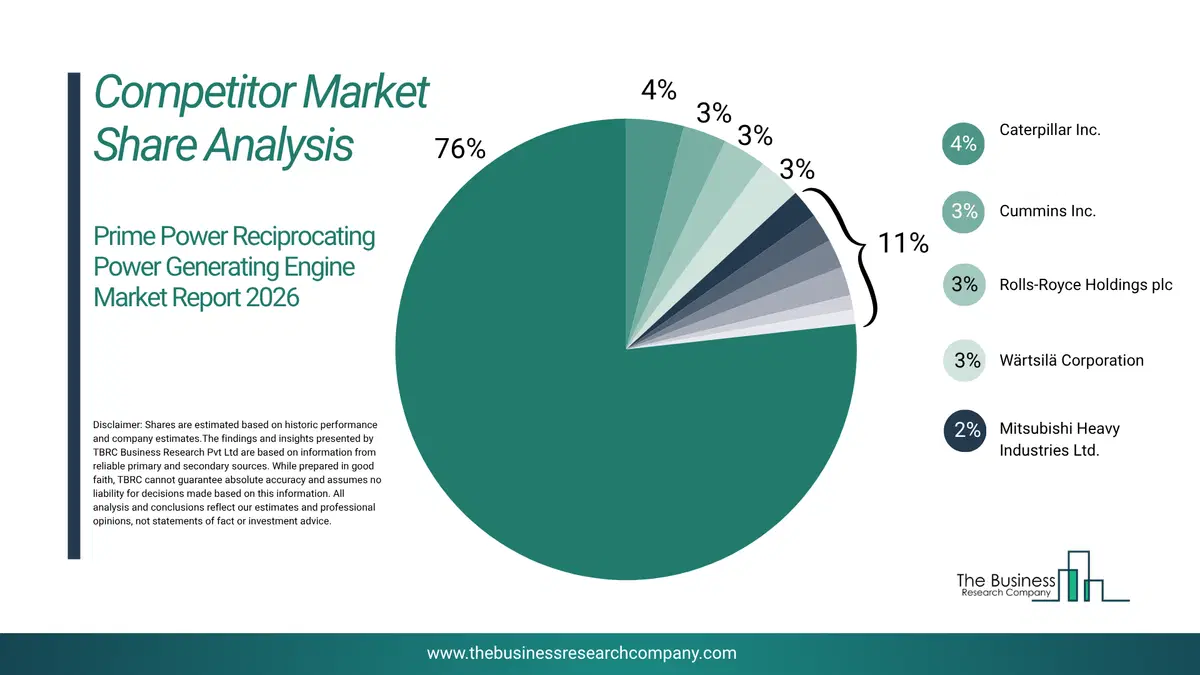
This chart is for illustrative purposes; the full report includes a detailed competitor analysis and comprehensive overview of the top 10 companies in the market.
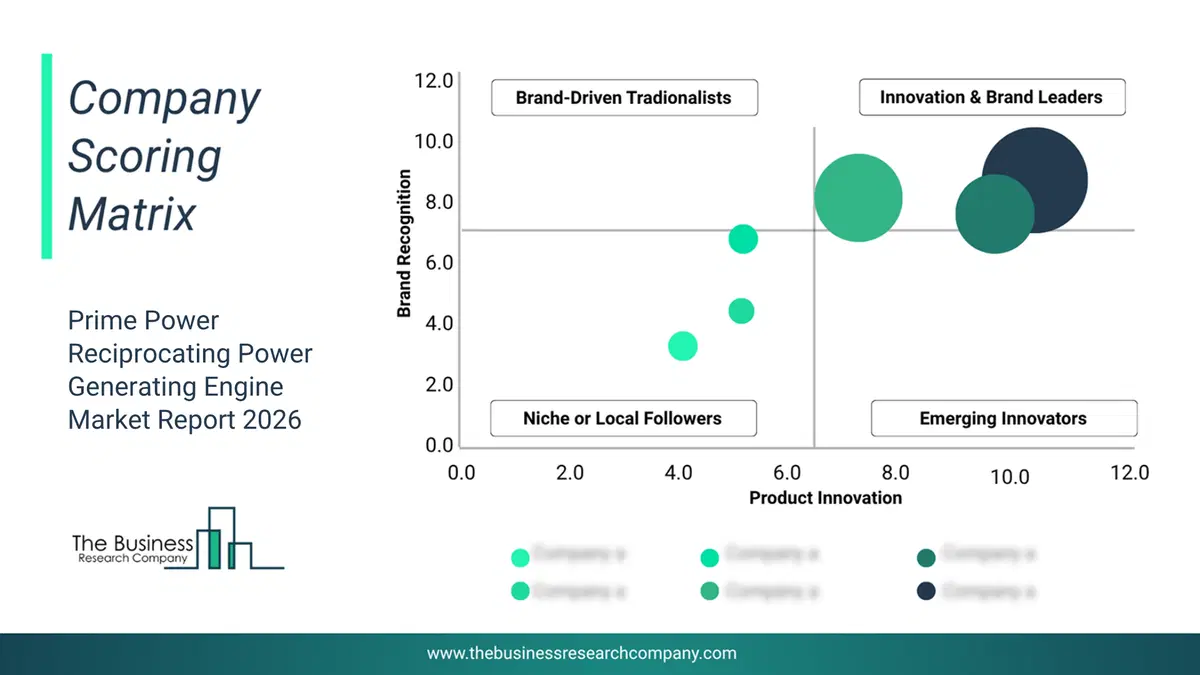
This chart maps companies by product innovation and brand strength, with bubble size indicating relative revenue, helping identify market leaders, challengers, and niche players. This is an illustrative chart; the full report provides a complete and accurate competitive analysis.
Global Prime Power Reciprocating Power Generating Engine Market Trends and Insights
Major companies operating in the prime power reciprocating power generating engine market are focusing on developing innovative solutions, such as power generation diesel engines, to enhance efficiency, reduce emissions, and support the integration of renewable energy sources. Power generation diesel engines are internal combustion engines that run on diesel fuel and are specifically designed to convert fuel energy into mechanical energy, which is then used to drive generators to produce electrical power. For instance, in September 2024, Perkins Engines Company Limited, a UK-based diesel and gas engine manufacturer, launched the 2606 power generation diesel engine, designed for high efficiency and low emissions in power generation applications. The engine features advanced common rail fuel injection and turbocharging technology, delivering up to 6% lower fuel consumption and reduced noise levels. It supports renewable fuels such as 100% hydrotreated vegetable oils (HVO) and offers extended service intervals up to 1,000 hours, enhancing operational efficiency and sustainability.What Are Latest Mergers And Acquisitions In The Prime Power Reciprocating Power Generating Engine Market?
In May 2024, Platinum Equity LLC, a US-based investment firm, acquired Kohler Energy for an undisclosed amount. Throughthis acquisition, Platinum Equity aims to strengthen Kohler Energy's position as an industry leader by investing in the development of a new generation of innovative energy resilience solutions. Kohler Energy is a US-based company that manufactures diesel and gas-powered generators, energy storage solutions, and prime power reciprocating engines.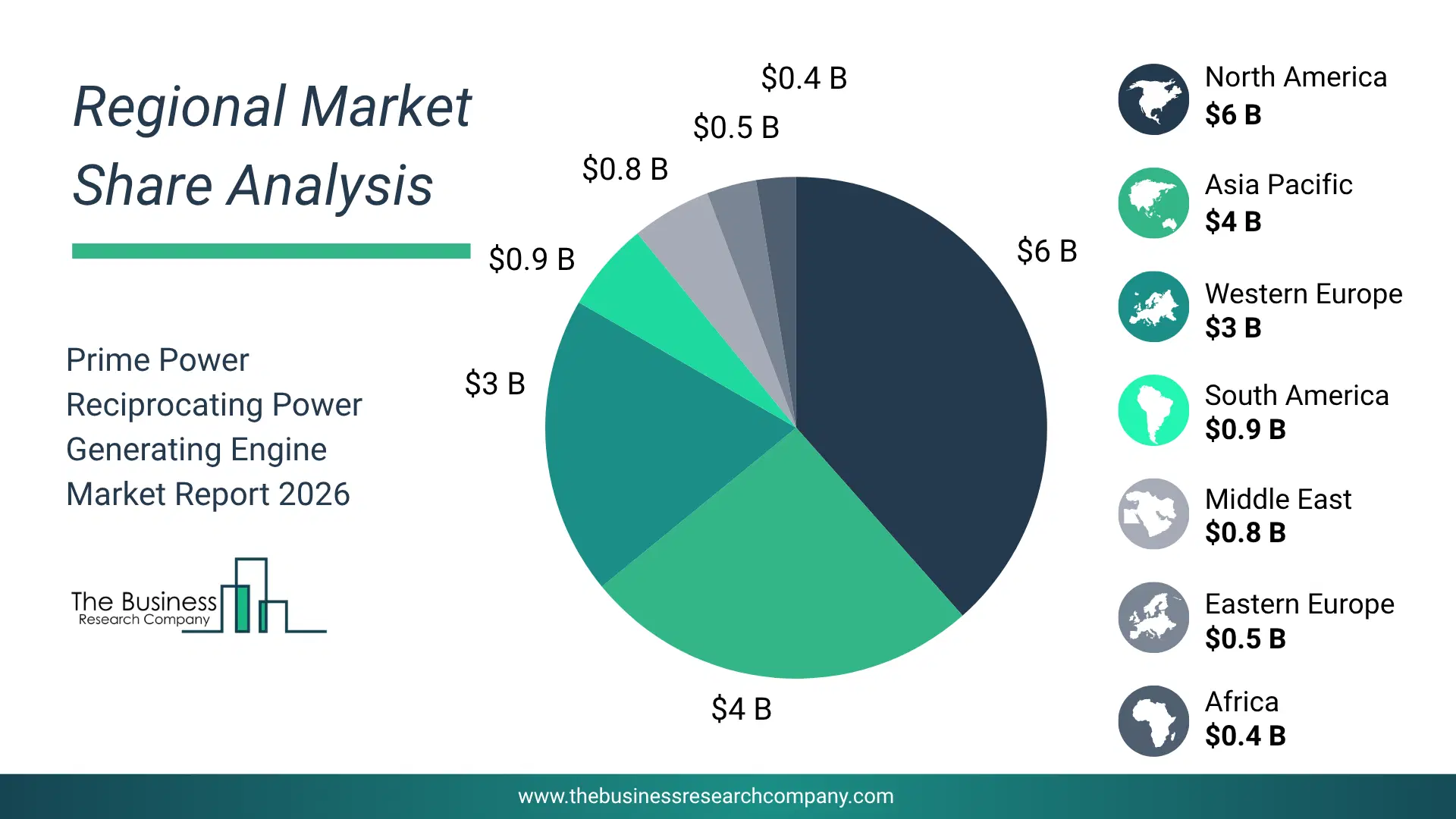
Regional Outlook
North America was the largest region in the prime power reciprocating power generating engine market in 2025. The regions covered in this market report are Asia-Pacific, South East Asia, Western Europe, Eastern Europe, North America, South America, Middle East, Africa. The countries covered in this market report are Australia, Brazil, China, France, Germany, India, Indonesia, Japan, Taiwan, Russia, South Korea, UK, USA, Canada, Italy, SpainWhat Defines the Prime Power Reciprocating Power Generating Engine Market?
The prime power reciprocating power generating engine market consists of sales of high-speed engines and low-speed engines. Values in this market are ‘factory gate’ values, that is the value of goods sold by the manufacturers or creators of the goods, whether to other entities (including downstream manufacturers, wholesalers, distributors and retailers) or directly to end customers. The value of goods in this market includes related services sold by the creators of the goods.How is Market Value Defined and Measured?
The market value is defined as the revenues that enterprises gain from the sale of goods and/or services within the specified market and geography through sales, grants, or donations in terms of the currency (in USD unless otherwise specified). The revenues for a specified geography are consumption values that are revenues generated by organizations in the specified geography within the market, irrespective of where they are produced. It does not include revenues from resales along the supply chain, either further along the supply chain or as part of other products.
This chart presents market attractiveness based on a quantitative evaluation of growth, competition, strategic alignment, and risk, offering a clear view of opportunity areas for decision-making. This chart is for illustrative purposes; the full report contains the complete analysis.

This chart highlights the Total Addressable Market (TAM) by estimating the maximum revenue opportunity using an assumption-driven approach, supporting strategic planning and opportunity sizing across markets. The chart is illustrative; the full report provides a more comprehensive analysis.
What Key Data and Analysis Are Included in the Prime Power Reciprocating Power Generating Engine Market Report 2026?
The prime power reciprocating power generating engine market research report is one of a series of new reports from The Business Research Company that provides market statistics, including Market Report 2026?global market size, regional shares, competitors with the market share, detailed market segments, market trends and opportunities, and any further data you may need to thrive in the prime power reciprocating power generating engine Market Report 2026? The market research report delivers a complete perspective of everything you need, with an in-depth analysis of the current and future state of the Market Report 2026?Prime Power Reciprocating Power Generating Engine Market Report Forecast Analysis
| Report Attribute | Details |
|---|---|
| Market Size Value In 2026 | $13.74 billion |
| Revenue Forecast In 2030 | $17.05 billion |
| Growth Rate | CAGR of 5.9% from 2026 to 2030 |
| Base Year For Estimation | 2025 |
| Actual Estimates/Historical Data | 2020-2025 |
| Forecast Period | 2026 - 2030 |
| Market Representation | Revenue in USD Billion and CAGR from 2026 to 2030 |
| Segments Covered | Engine Type, Power Output Range, Application, End-User |
| Regional Scope | Asia-Pacific, Western Europe, Eastern Europe, North America, South America, Middle East, Africa |
| Country Scope | The countries covered in the report are Australia, Brazil, China, France, Germany, India, ... |
| Key Companies Profiled | Caterpillar Inc., John Deere, Mitsubishi Heavy Industries Ltd., Cummins Inc., Honda Motor Co. Ltd., Kubota Corporation, AB Volvo Penta, Rolls-Royce Holdings plc, Kohler Co., YANMAR Co. Ltd., Wärtsilä Corporation, MTU Friedrichshafen GmbH, Sulzer Ltd., DEUTZ AG, Perkins Engines Company Limited, Guangxi Yuchai Machinery Group Co. Ltd., Kirloskar Group, Himoinsa SL, Doosan Heavy Industries & Construction Co. Ltd., Kirloskar Oil Engines Ltd., Rehlko. |
| Customization Scope | Request for Customization |
| Pricing And Purchase Options | Explore Purchase Options |