

Print On Demand Global Market Opportunities And Strategies To 2035
By Component (Software, Service), By Product (Apparel, Home Décor, Drinkware, Accessories, Other Products), By Technology (Direct-To-Garment (DTG), Dye-Sublimation, Direct-To-Film (DTF), Other Print Technology), By Distribution Channel (Online, Offline), By End-User (E-Commerce, Publishing, Fashion And Apparel, Art And Creative, Corporate, Education, Other End Users), And By Region, Opportunities And Strategies – Global Forecast To 2035
Print On Demand Market Definition
Print on demand (POD) is a production and fulfillment model in which products, such as books, apparel, accessories, or home décor, are printed or customized only after a customer places an order. This model relies on digital printing technology and third-party fulfillment services, eliminating the need for bulk inventory or upfront manufacturing. The primary purpose of print on demand is to reduce inventory risk, lower upfront costs, and enable customization. It allows businesses and creators to offer a wide range of designs and products, scale flexibly, and respond quickly to market demand while minimizing waste and operational overhead. The print on demand market consists of sales by entities (organizations, sole traders and partnerships) of print on demand software and services that are widely used by a range of users including entrepreneurs, artists, publishers, fashion designers, educators and corporations. It is used whenever individualized products are required, such as customized apparel for retail, branded merchandise for corporate events, or personalized books and artwork. Complementary products and services include e-commerce platforms, graphic design tools, logistics and shipping services and digital payment systems. Substitutes for print on demand include traditional bulk printing or mass manufacturing, which may be more economical for high-volume orders but lack customization flexibility.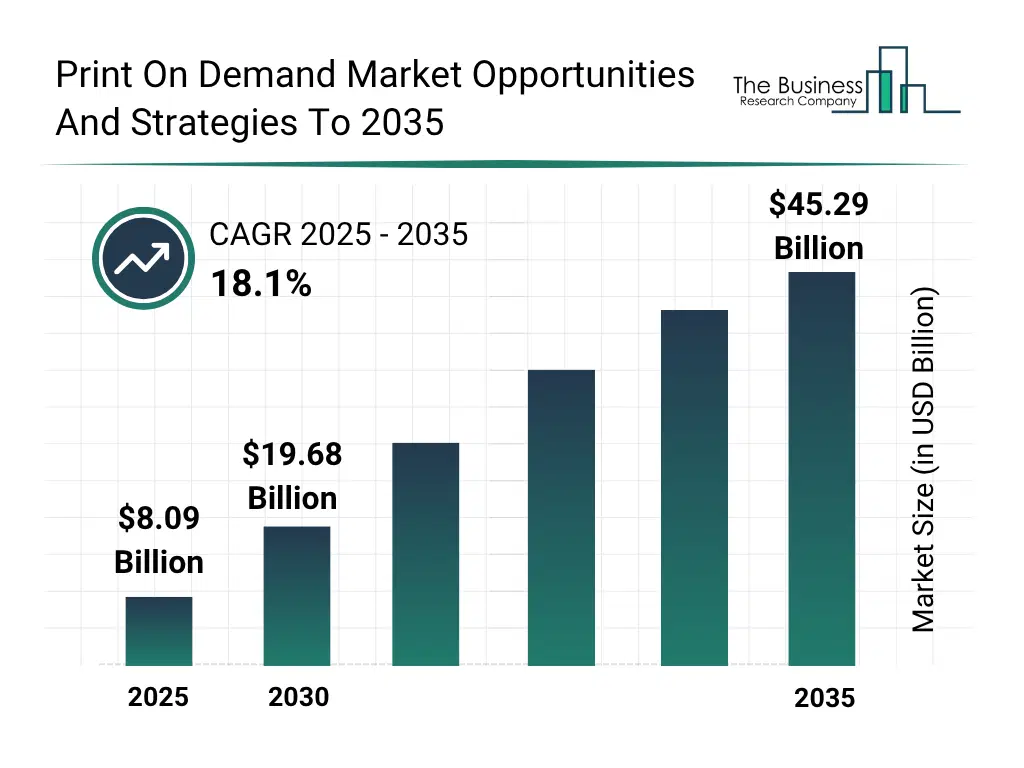
Print On Demand Market Size
The global print on demand market reached a value of nearly $8,091.8 million in 2025, having grown at a compound annual growth rate (CAGR) of 24.8% since 2020. The market is expected to grow from $8,091.8 million in 2025 to $19,683.7 million in 2030 at a rate of 19.5%. The market is then expected to grow at a CAGR of 18.1% from 2030 and reach $45,288.4 million in 2035. Growth in the historic period resulted from growth in online marketplaces, rising demand for product personalization and customization, shift toward just-in-time production models and increase in small online businesses. Factors that negatively affected growth in the historic period were higher per-unit production costs and lack of quality control. Going forward, increasing use of data analytics and AI in product design, rise of gifting culture, growth of direct-to-consumer brands and growing influence of social media and influencer marketing. Factors that could hinder the growth of the print on demand market in the future include longer delivery times compared to mass-produced goods, cross-border taxes and duties and impact of trade wars and tariffs.
Print On Demand Market Segmentation
The print on demand market is segmented by component, by product, by technology, by distribution channel and by end-user.By Component –
The print on demand market is segmented by component into:
- a) Software
- b) Service
By Product –
The print on demand market is segmented by product into:
- a) Apparel
- b) Home Décor
- c) Drinkware
- d) Accessories
- e) Other Products
By Technology –
The print on demand market is segmented by technology into:
- a) Direct-To-Garment (DTG)
- b) Dye-Sublimation
- c) Direct-To-Film (DTF)
- d) Other Print Technology
By Distribution Channel –
The print on demand market is segmented by distribution channel into:
- a) Online
- b) Offline
By End-User –
The print on demand market is segmented by end-user into:
- a) E-Commerce
- b) Publishing
- c) Fashion And Apparel
- d) Art And Creative
- e) Corporate
- f) Education
- g) Other End Users
By Geography - The print on demand market is segmented by geography into:
- China
- India
- Japan
- Australia
- Indonesia
- South Korea
- USA
- Canada
- Brazil
- France
- Germany
- UK
- Italy
- Spain
- Russia
-
o Asia Pacific
o Africa