
Printed Thin Film Battery Market Report 2026
Global Outlook – By Type ( Rechargeable, Non-Rechargeable), By Form Factor ( Flexible Batteries, Rigid Batteries, Micro Batteries, Stackable Batteries), By Technology ( Screen Printing, Inkjet Printing, Roll-To-Roll Processing, Vacuum Deposition), By Application ( Consumer Electronics, Wearable Devices, IoT Devices, Medical Devices), By End User ( Industrial, Commercial, Residential, Healthcare, Aerospace And Defense) – Market Size, Trends, Strategies, and Forecast to 2030
Printed Thin Film Battery Market Overview
• Printed Thin Film Battery market size has reached to $1.91 billion in 2025 • Expected to grow to $4.47 billion in 2030 at a compound annual growth rate (CAGR) of 18.4% • Growth Driver: The Growing Demand For Wearable Devices Is Driving The Market Through Enhanced Health Monitoring • Asia-Pacific was the largest region in 2025.What Is Covered Under Printed Thin Film Battery Market?
Printed thin-film batteries are ultra-thin, flexible power sources manufactured using printing techniques to deposit functional inks onto substrates. Their primary goal is to enable energy autonomy for compact, wearable, and connected electronics. They also provide customizable form factors, enhance product design flexibility, support the miniaturization of devices, and promote the development of disposable and sustainable electronics. The main types of printed thin film batteries are rechargeable and non-rechargeable. A rechargeable printed thin-film battery is a lightweight, flexible energy storage device fabricated by depositing thin layers of active materials onto a substrate, capable of being recharged multiple times. The form factors in these are flexible batteries, rigid batteries, micro batteries, and stackable batteries, using technologies including screen printing, inkjet printing, roll-to-roll processing, and vacuum deposition, used in applications such as consumer electronics, wearable devices, electric vehicles, IoT devices, and medical devices, with the end users including industrial, commercial, residential, healthcare, and aerospace and defense.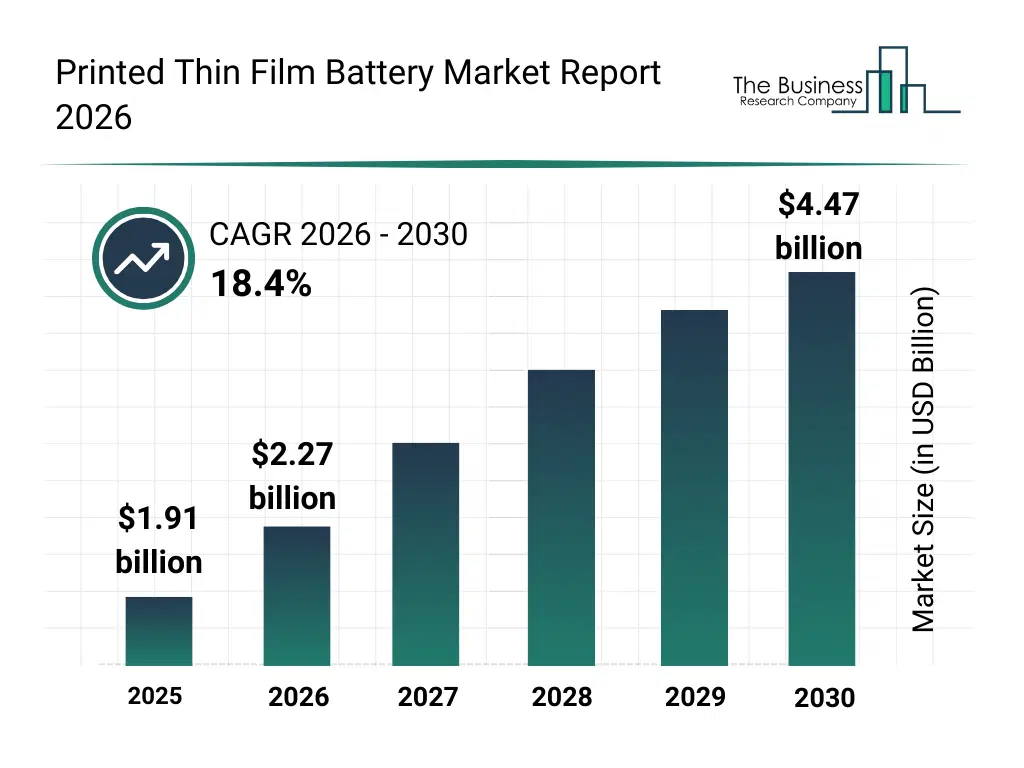
What Is The Printed Thin Film Battery Market Size 2026 And Growth Rate?
The printed thin film battery market size has grown rapidly in recent years. It will grow from $1.91 billion in 2025 to $2.27 billion in 2026 at a compound annual growth rate (CAGR) of 18.7%. The growth in the historic period can be attributed to advancements in printing technology, growth of wearable electronics, demand for compact energy storage, miniaturization of consumer devices, emergence of IoT applications.What Is The Printed Thin Film Battery Market Growth Forecast?
The printed thin film battery market size is expected to see rapid growth in the next few years. It will grow to $4.47 billion in 2030 at a compound annual growth rate (CAGR) of 18.4%. The growth in the forecast period can be attributed to integration with smart devices, expansion in electric mobility, development of biodegradable batteries, rising adoption in medical electronics, growth in industrial IoT applications. Major trends in the forecast period include flexible and miniaturized battery design, wearable electronics energy solutions, printable and customizable form factors, sustainable and disposable electronics, high-performance thin-film power sources.
Global Printed Thin Film Battery Market Segmentation
1) By Type: Rechargeable, Non-Rechargeable 2) By Form Factor: Flexible Batteries, Rigid Batteries, Micro Batteries, Stackable Batteries 3) By Technology: Screen Printing, Inkjet Printing, Roll-To-Roll Processing, Vacuum Deposition 4) By Application: Consumer Electronics, Wearable Devices, IoT Devices, Medical Devices 5) By End User: Industrial, Commercial, Residential, Healthcare, Aerospace And Defense Subsegments: 1) By Rechargeable: Lithium Ion, Nickel Metal Hydride, Silver Zinc 2) By Non Rechargeable: Lithium, Zinc Air, Silver Oxide, AlkalineWhat Is The Driver Of The Printed Thin Film Battery Market?
The growing demand for wearable devices is expected to drive the growth of the printed thin film battery market going forward. Wearable devices are electronic technologies designed to be worn on the body, often integrating sensors, software, and connectivity features to monitor, track, and enhance various aspects of personal health, fitness, and daily activities. A primary factor driving the growing demand for wearable devices is the increasing consumer focus on proactive health management, as individuals seek continuous, real-time insights into vital signs and lifestyle metrics, enabling informed decisions that promote well-being and prevent potential health issues. Printed thin film batteries support this demand by offering lightweight, flexible, and durable energy solutions that seamlessly integrate into compact wearable designs, enhancing usability and device performance. For instance, in December 2024, according to International Data Corporation (IDC), a US-based provider of market intelligence, advisory services, and technology industry analysis, China’s smartwatch market recorded shipments of 32.9 million units, reflecting a 23.3% year-over-year increase, while the global wristband segment reached 26.8 million units shipped, underscoring strong momentum in wearable device adoption. Therefore, the growing demand for wearable devices is driving the printed thin film battery industry.What Is The Driver Of The Printed Thin Film Battery Market?
The growth of Industry 4.0 is expected to propel the growth of the printed thin film battery market going forward. Industry 4.0 is the modern phase of industrial development where factories use smart technologies like automation, artificial intelligence, the Internet of Things, and data analytics to make production more efficient, flexible, and connected. Industry 4.0 is rising because businesses increasingly rely on real-time data and automation to improve efficiency, reduce costs, and respond faster to market demands. Printed thin-film batteries help Industry 4.0 by providing compact, flexible, and reliable power solutions that enable smart sensors, IoT devices, and automated systems to operate efficiently in connected industrial environments. For instance, in June 2024, according to the NEW Manufacturing Alliance, a US-based collaborative organization in Northeast Wisconsin that works to promote manufacturing by connecting manufacturers with educators, workforce development professionals, and state organizations, in 2024, investment growth within Industry 4.0 has been particularly strong in the Industrial Internet of Things (IoT) at 62%, Artificial Intelligence at 58%, and Generative AI at 57%. Therefore, the growth of Industry 4.0 is driving the growth of the printed thin film battery industry.Key Players In The Global Printed Thin Film Battery Market
Major companies operating in the printed thin film battery market are Applied Materials Inc., STMicroelectronics, Swatch Group, Molex, Agfa-Gevaert Group, VARTA AG, TNO, Kurt J. Lesker Company, Novacentrix, Jenax Inc, Angstrom Engineering Inc, BrightVolt, Blue Spark Technologies, Polyplus (Sartorius Stedim Biotech), ITN Energy Systems, Enfucell, Ilika, Saralon, Zinergy, Imprint Energy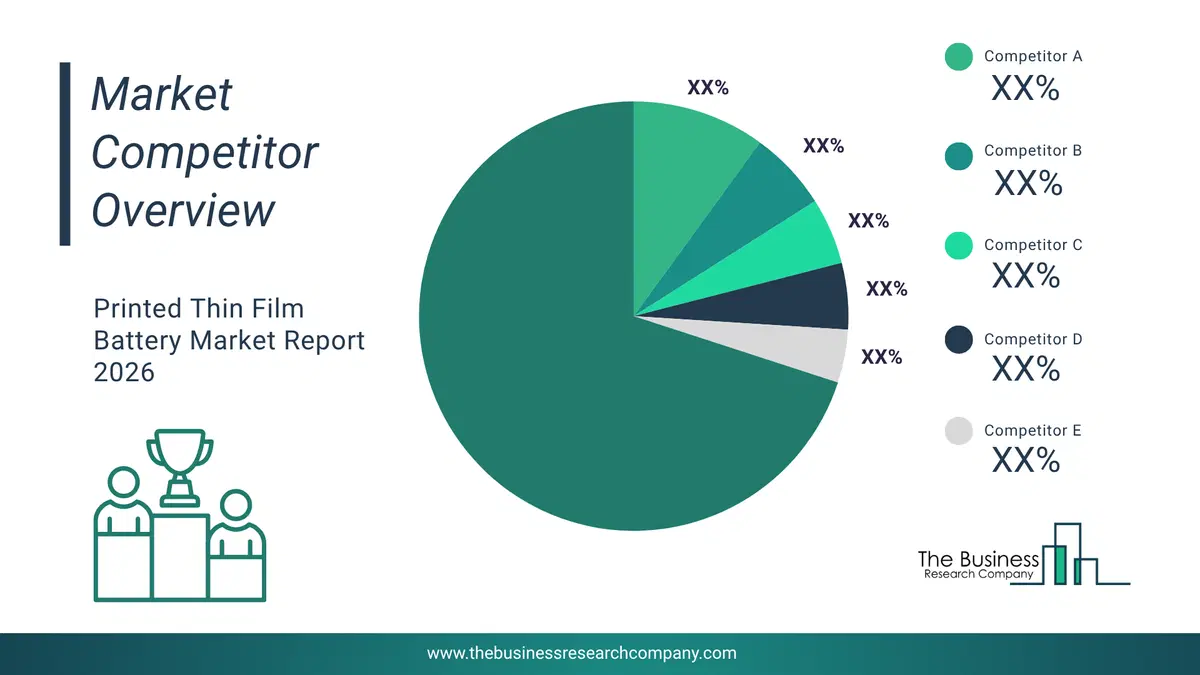
This chart is for illustrative purposes; the full report includes a detailed competitor analysis and comprehensive overview of the top 10 companies in the market.
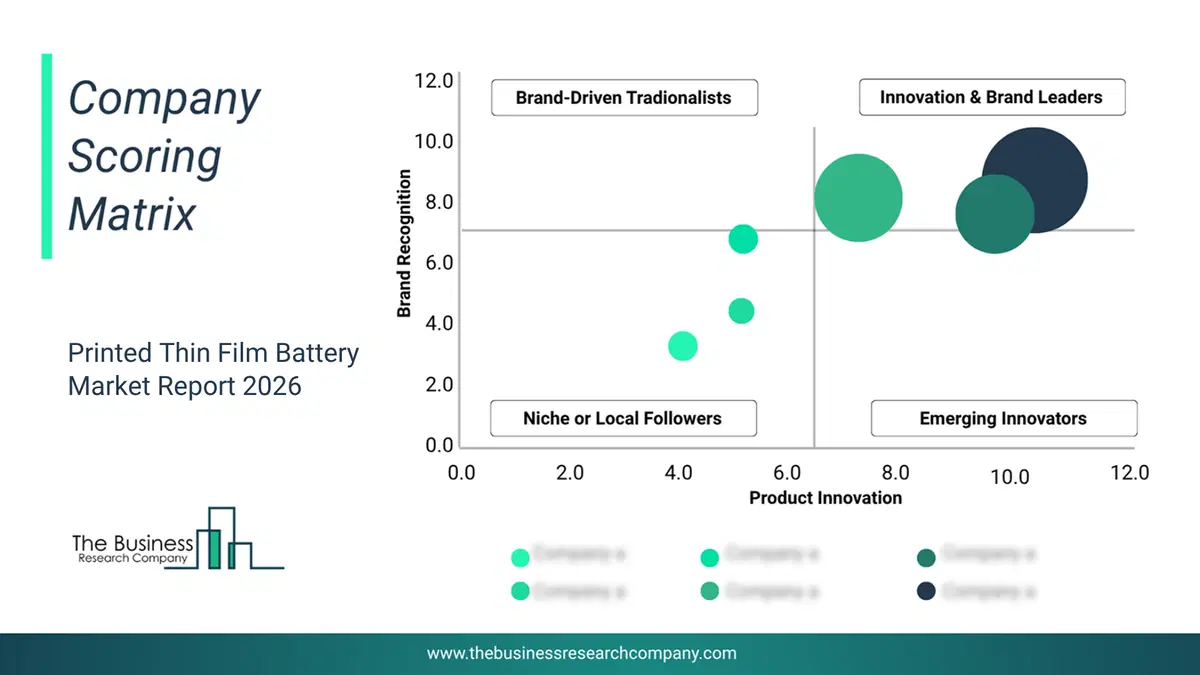
This chart maps companies by product innovation and brand strength, with bubble size indicating relative revenue, helping identify market leaders, challengers, and niche players. This is an illustrative chart; the full report provides a complete and accurate competitive analysis.
What Are Latest Mergers And Acquisitions In The Printed Thin Film Battery Market?
In March 2024, Printed Energy, a US-based company that develops novel battery technology based on screen printing, partnered with the IoT M2M Council (IMC) to advance ultra-streamlined battery technology. With this partnership, Printed Energy and IMC aim to leverage their respective expertise, combining Printed Energy’s ultra-thin, safe, flexible printed batteries with IMC’s network of 28,000 qualified enterprise users and product makers to promote adoption of compact, sustainable energy solutions for smart labels, RFID tags, wearable biosensors, and medical devices. Printed Energy is an Arizona-based company that specializes in printed thin-film batteries made from abundant, environmentally safe materials, designed to integrate into remote and IoT devices without wires. IMC is a global trade association dedicated to the IoT sector, connecting enterprise adopters and solution providers across 30 vertical markets.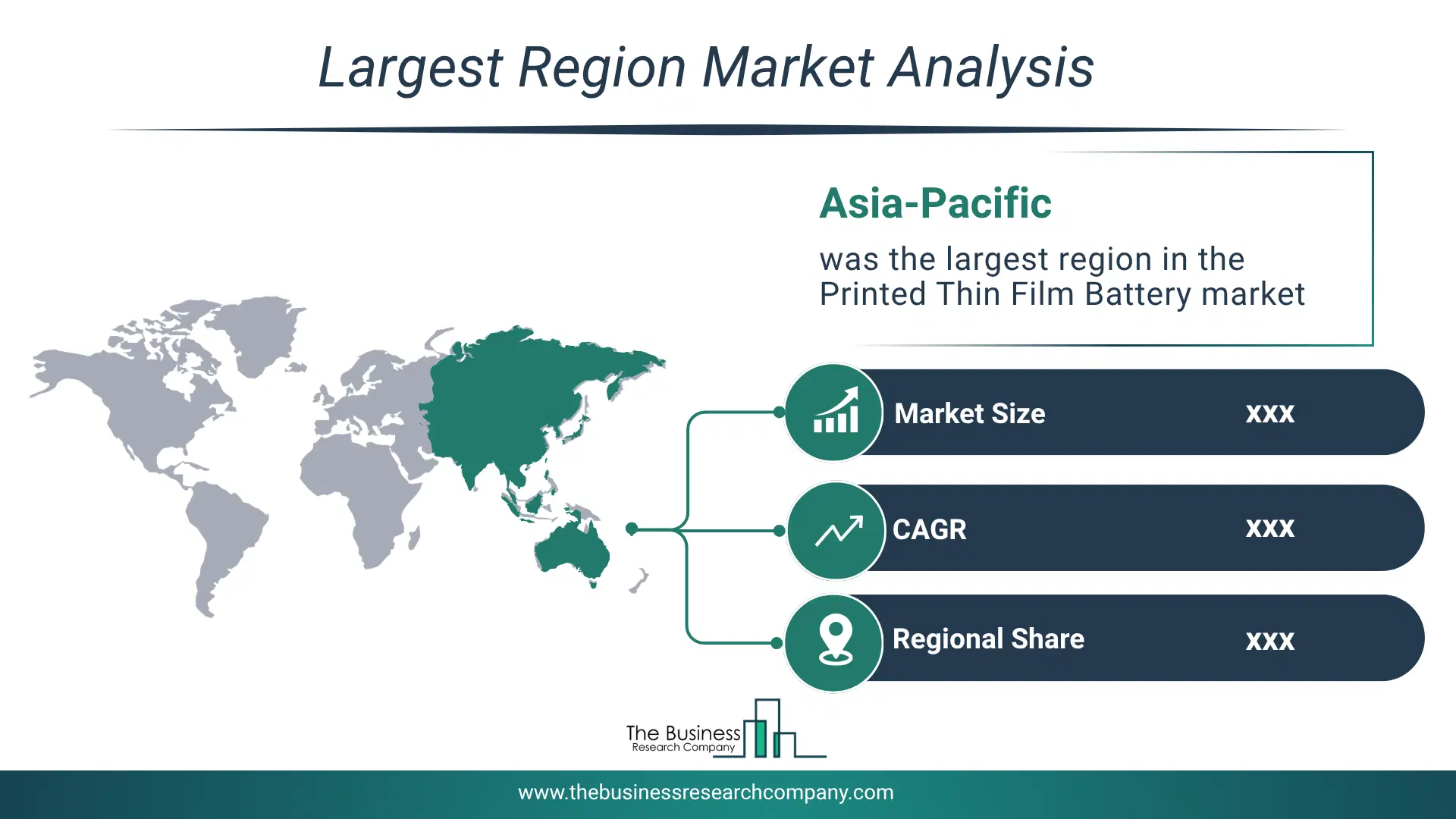
Regional Outlook
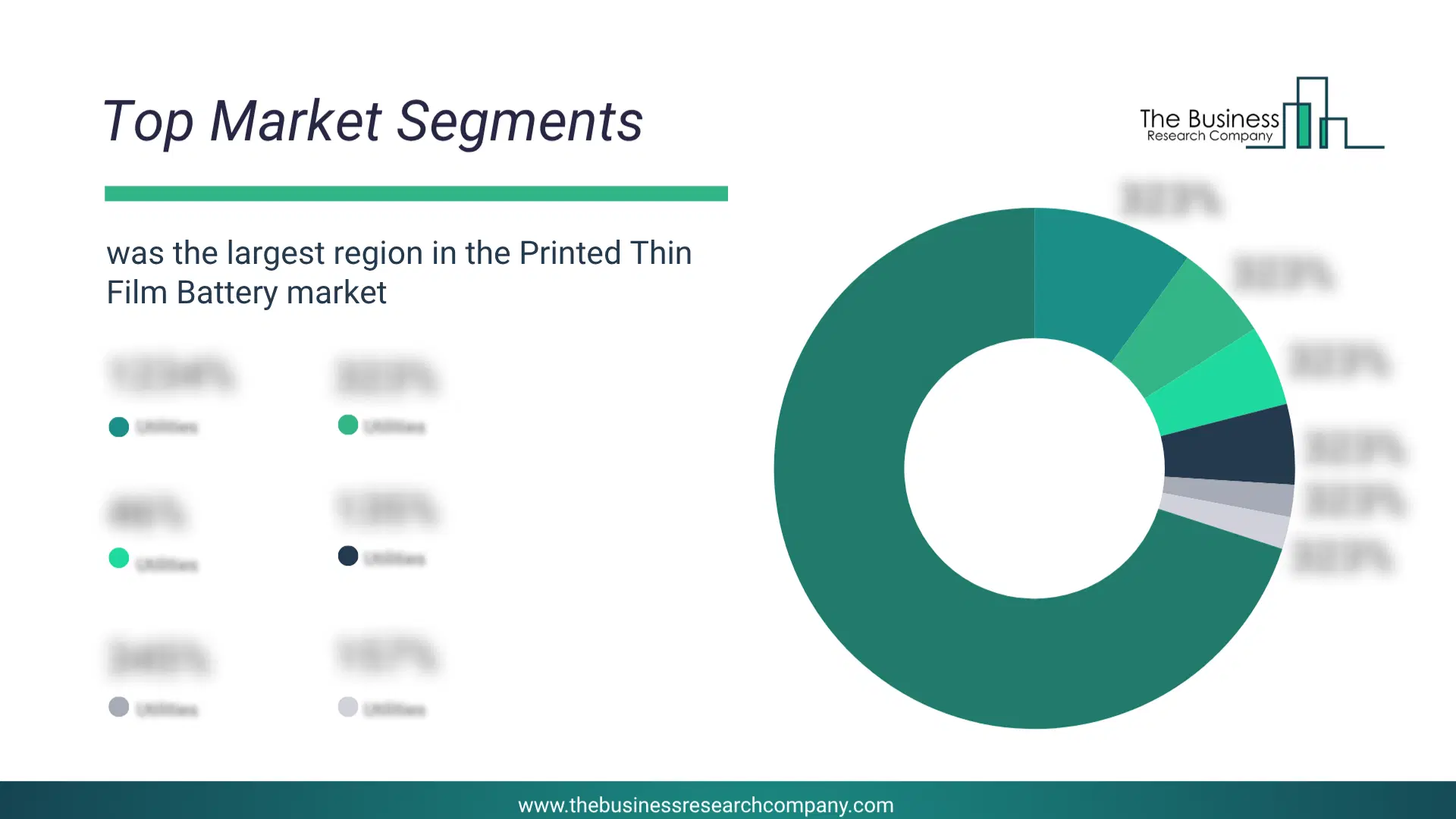
Asia-Pacific was the largest region in the printed thin film battery market in 2025. The regions covered in this market report are Asia-Pacific, South East Asia, Western Europe, Eastern Europe, North America, South America, Middle East, Africa. The countries covered in this market report are Australia, Brazil, China, France, Germany, India, Indonesia, Japan, Taiwan, Russia, South Korea, UK, USA, Canada, Italy, Spain.What Defines the Printed Thin Film Battery Market?
The printed thin film battery market consist of sales of flexible substrates, conductive inks, solid-state electrolytes, printing equipment, and integrated energy solutions. Values in this market are ‘factory gate’ values, that is, the value of goods sold by the manufacturers or creators of the goods, whether to other entities (including downstream manufacturers, wholesalers, distributors, and retailers) or directly to end customers. The value of goods in this market includes related services sold by the creators of the goods.How is Market Value Defined and Measured?
The market value is defined as the revenues that enterprises gain from the sale of goods and/or services within the specified market and geography through sales, grants, or donations in terms of the currency (in USD unless otherwise specified). The revenues for a specified geography are consumption values that are revenues generated by organizations in the specified geography within the market, irrespective of where they are produced. It does not include revenues from resales along the supply chain, either further along the supply chain or as part of other products.
This chart presents market attractiveness based on a quantitative evaluation of growth, competition, strategic alignment, and risk, offering a clear view of opportunity areas for decision-making. This chart is for illustrative purposes; the full report contains the complete analysis.

This chart highlights the Total Addressable Market (TAM) by estimating the maximum revenue opportunity using an assumption-driven approach, supporting strategic planning and opportunity sizing across markets. The chart is illustrative; the full report provides a more comprehensive analysis.
What Key Data and Analysis Are Included in the Printed Thin Film Battery Market Report 2026?
The printed thin film battery market research report is one of a series of new reports from The Business Research Company that provides market statistics, including industry global market size, regional shares, competitors with the market share, detailed market segments, market trends and opportunities, and any further data you may need to thrive in the printed thin film battery industry. The market research report delivers a complete perspective of everything you need, with an in-depth analysis of the current and future state of the industry.Printed Thin Film Battery Market Report Forecast Analysis
| Report Attribute | Details |
|---|---|
| Market Size Value In 2026 | $2.27 billion |
| Revenue Forecast In 2030 | $4.47 billion |
| Growth Rate | CAGR of 18.4% from 2026 to 2030 |
| Base Year For Estimation | 2025 |
| Actual Estimates/Historical Data | 2020-2025 |
| Forecast Period | 2026 - 2030 |
| Market Representation | Revenue in USD Billion and CAGR from 2026 to 2030 |
| Segments Covered | Type, Form Factor, Technology, Application, End User |
| Regional Scope | Asia-Pacific, Western Europe, Eastern Europe, North America, South America, Middle East, Africa |
| Country Scope | The countries covered in the report are Australia, Brazil, China, France, Germany, India, Indonesia, Japan, Taiwan, Russia, South Korea, UK, USA, Canada, Italy, Spain. |
| Key Companies Profiled | Applied Materials Inc., STMicroelectronics, Swatch Group, Molex, Agfa-Gevaert Group, VARTA AG, TNO, Kurt J. Lesker Company, Novacentrix, Jenax Inc, Angstrom Engineering Inc, BrightVolt, Blue Spark Technologies, Polyplus (Sartorius Stedim Biotech), ITN Energy Systems, Enfucell, Ilika, Saralon, Zinergy, Imprint Energy |
| Customization Scope | Request for Customization |
| Pricing And Purchase Options | Explore Purchase Options |