
Processed Animal Protein Market Report 2026
Global Outlook – By Product (Powder, Pellets, Granules, Liquids), By Animal Source (Beef, Pork, Poultry, Fish, Other Animal Sources), By Processing Methods (Rendering, Hydrolysis, Drying And Milling, Defatting And Fractionation, Sterilization And Heat Treatment), By Application (Livestock Feed, Aquaculture Feed, Industrial Uses, Pet Food, Organic Fertilizers, Other Applications), By End User (Compound Feed Manufacturers, Integrators And Large Farms, Aquaculture Producers, Pet Food Manufacturers, Fertilizer Producers, Distributors And Traders, Other End Users) – Market Size, Trends, Strategies, and Forecast to 2030
Processed Animal Protein Market Overview
• Processed Animal Protein market size has reached to $14.21 billion in 2025 • Expected to grow to $18.51 billion in 2030 at a compound annual growth rate (CAGR) of 5.4% • Growth Driver: Rising Pet Adoption Driving Market Growth Due To Growing Demand For High-Quality Protein-Rich Pet Nutrition • Market Trend: Technological Advancements Driving Quality And Safety In Protein Processing • North America was the largest region in 2025 and Asia-Pacific is the fastest growing region.What Is Covered Under Processed Animal Protein Market?
Processed animal protein (PAP) refers to animal-derived materials that have been treated, rendered, or processed to create protein-rich products for use in animal feed, pet food, or other industrial applications. These proteins are obtained from parts of animals not intended for direct human consumption, ensuring safety through controlled processing methods. PAP serves as a valuable source of nutrients, particularly protein and energy, for livestock and companion animals. Its production and use are regulated to prevent the spread of diseases and ensure quality. The main types of processed animal protein include powder, pellets, granules, and liquids. Processed animal protein (PAP) powder specifically refers to finely ground protein products made from rendered or treated animal by-products. These proteins are derived from various animal sources such as beef, pork, poultry, fish, and other sources, and are produced using processing methods such as rendering, hydrolysis, drying and milling, defatting and fractionation, and sterilization and heat treatment. Processed animal proteins are widely applied in livestock feed, aquaculture feed, industrial uses, pet food, organic fertilizers, and others. The key end-users include compound feed manufacturers, integrators and large farms, aquaculture producers, pet food manufacturers, fertilizer producers, distributors and traders, and others.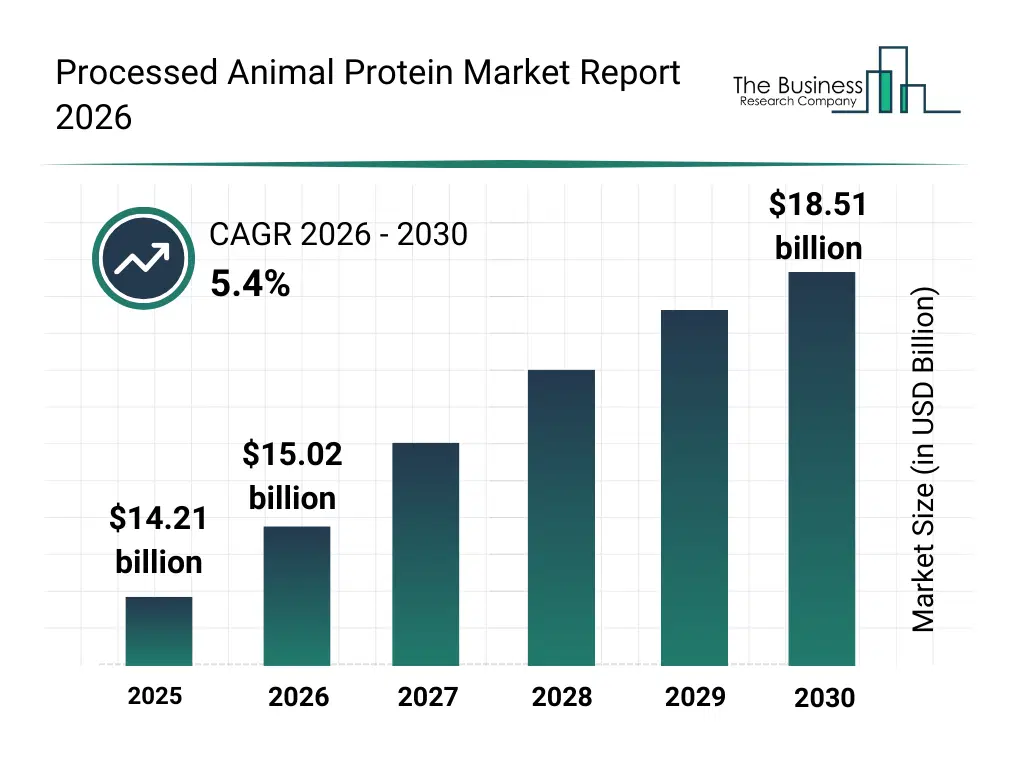
What Is The Processed Animal Protein Market Size and Share 2026?
The processed animal protein market size has grown strongly in recent years. It will grow from $14.21 billion in 2025 to $15.02 billion in 2026 at a compound annual growth rate (CAGR) of 5.6%. The growth in the historic period can be attributed to increasing livestock production volumes, expansion of commercial animal farming, rising demand for cost-efficient feed protein, development of rendering infrastructure, implementation of animal feed safety regulations.What Is The Processed Animal Protein Market Growth Forecast?
The processed animal protein market size is expected to see strong growth in the next few years. It will grow to $18.51 billion in 2030 at a compound annual growth rate (CAGR) of 5.4%. The growth in the forecast period can be attributed to growing demand for alternative and sustainable protein sources, rising aquaculture feed consumption, increasing investments in advanced processing technologies, expansion of pet food production, strengthening regulatory frameworks for feed safety. Major trends in the forecast period include increasing adoption of sustainable protein processing methods, rising demand for high-quality feed ingredients, growing focus on traceability and safety compliance, expansion of aquaculture feed applications, enhanced utilization of animal by-products.
Global Processed Animal Protein Market Segmentation
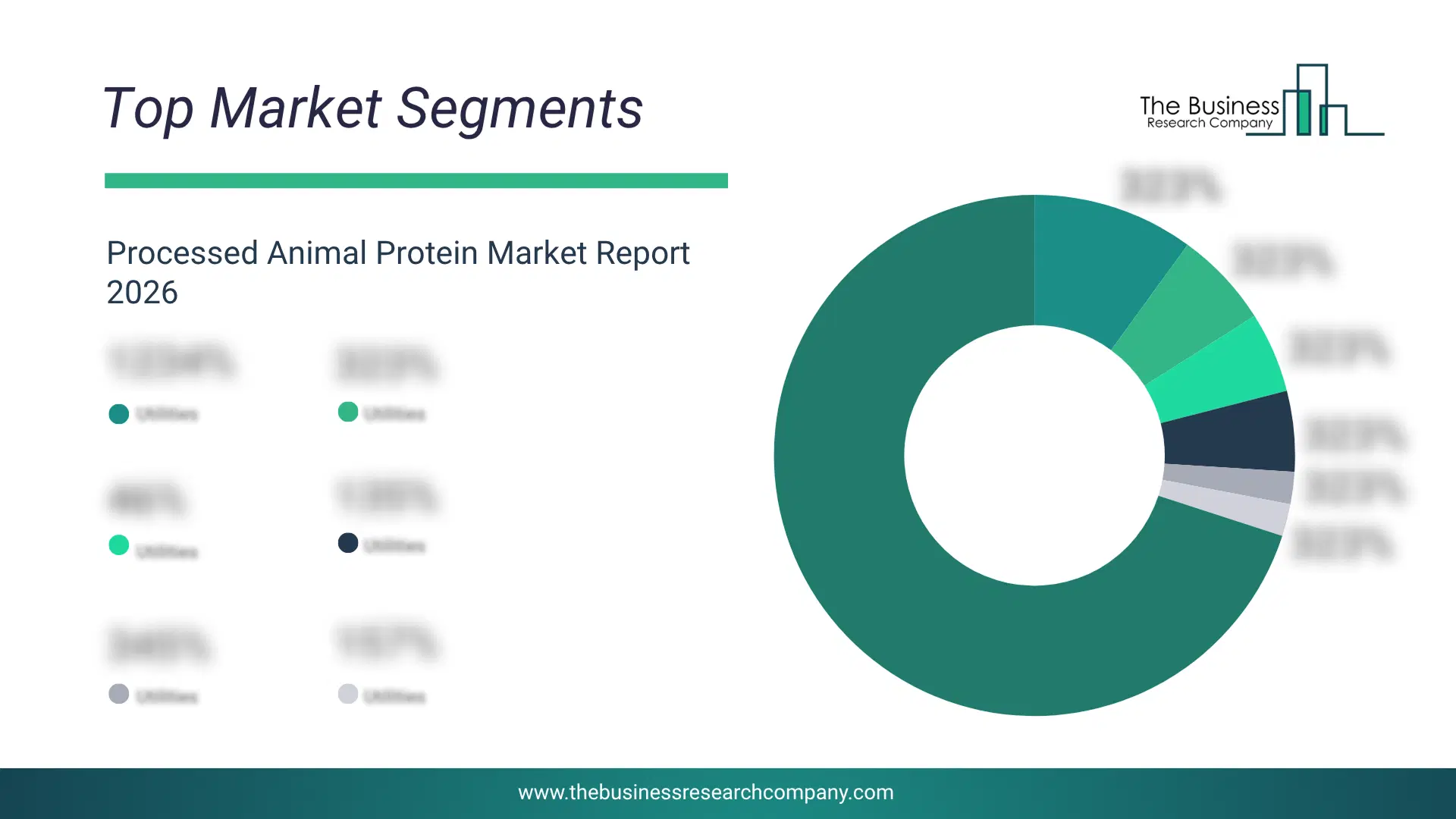
1) By Product: Powder, Pellets, Granules, Liquids 2) By Animal Source: Beef, Pork, Poultry, Fish, Other Animal Sources 3) By Processing Methods: Rendering, Hydrolysis, Drying And Milling, Defatting And Fractionation, Sterilization And Heat Treatment 4) By Application: Livestock Feed, Aquaculture Feed, Industrial Uses, Pet Food, Organic Fertilizers, Other Applications 5) By End User: Compound Feed Manufacturers, Integrators And Large Farms, Aquaculture Producers, Pet Food Manufacturers, Fertilizer Producers, Distributors And Traders, Other End Users Subsegments: 1) By Powder: Spray-Dried Powder, Freeze-Dried Powder, Meal-Based Powder, Defatted Powder 2) By Pellets: Fish Pellets, Poultry Pellets, Blood Pellets, Meat And Bone Pellets 3) By Granules: Extruded Granules, Agglomerated Granules, Coated Granules 4) By Liquids: Liquid Protein Concentrate, Hydrolyzed Protein Solution, Enzyme-treated Liquid ProteinWhat Is The Driver Of The Processed Animal Protein Market?
The increasing adoption of pets is expected to propel the growth of the processed animal protein market going forward. Pet ownership is rising due to the growing humanization of animals and the increasing trend of treating companion animals as family members. Demand for processed animal protein solutions is rising, driven by the rapid growth in pet ownership, which is prompting companies to incorporate high-quality, protein-rich ingredients to fulfill the nutritional requirements of pet food formulations. For instance, in July 2025, according to the World Animal Foundation, a US-based nonprofit animal welfare organization, the number of cats adopted from animal shelters recorded a modest 0.4% year-over-year growth in 2023, representing an increase of 17,153 adoptions compared to the previous year. Therefore, the increasing adoption of pets is driving the demand for the processed animal protein industry.Key Players In The Global Processed Animal Protein Market
Major companies operating in the processed animal protein market are Cargill Incorporated, JBS S.A., Tyson Foods Inc., Tönnies Holding ApS & Co. KG, Darling Ingredients Inc., Tessenderlo Group N.V., SARIA SE & Co. KG, Sanimax Inc., Baker Commodities Inc., West Coast Reduction Inc., LEO Group Ltd., SRC Companies LLC, Boyer Valley Company LLC, nextProtein SAS, J G Pears (Holdings) Limited, Allanasons Private Limited, Kaluzny Bros. Inc., Nordfeed GmbH, Natural Proteins, Ridley Corporation Limited, FASA Group, Advanced Proteins, S.F. Rendering Ltd.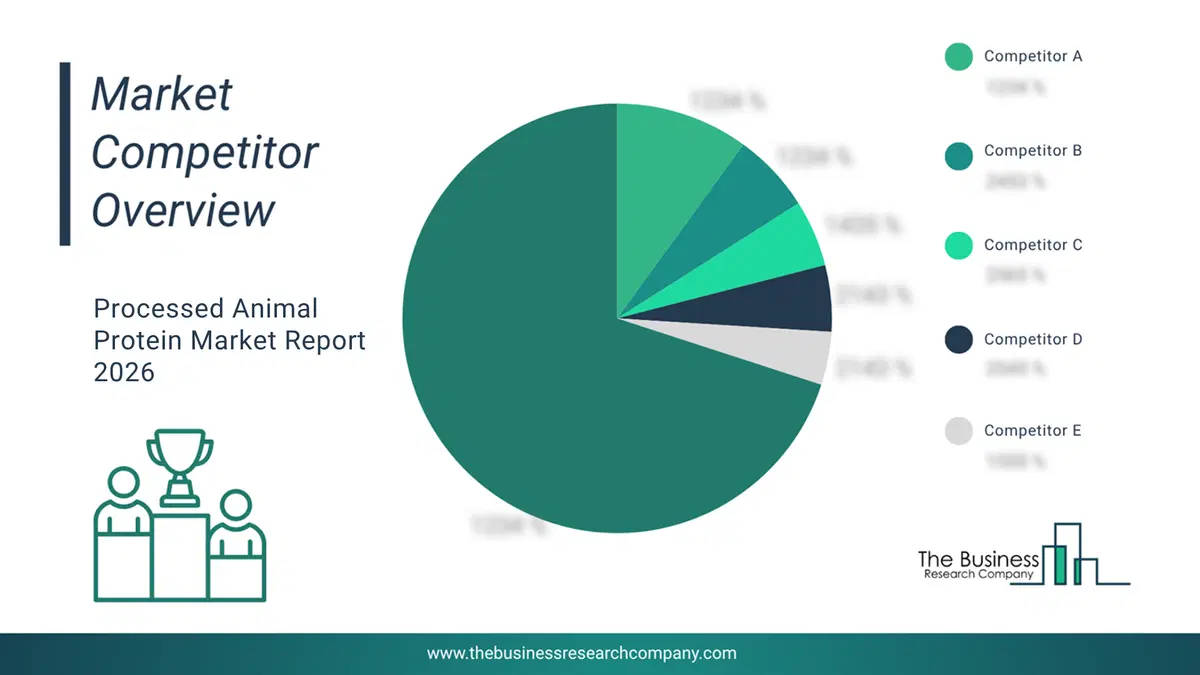
This chart is for illustrative purposes; the full report includes a detailed competitor analysis and comprehensive overview of the top 10 companies in the market.
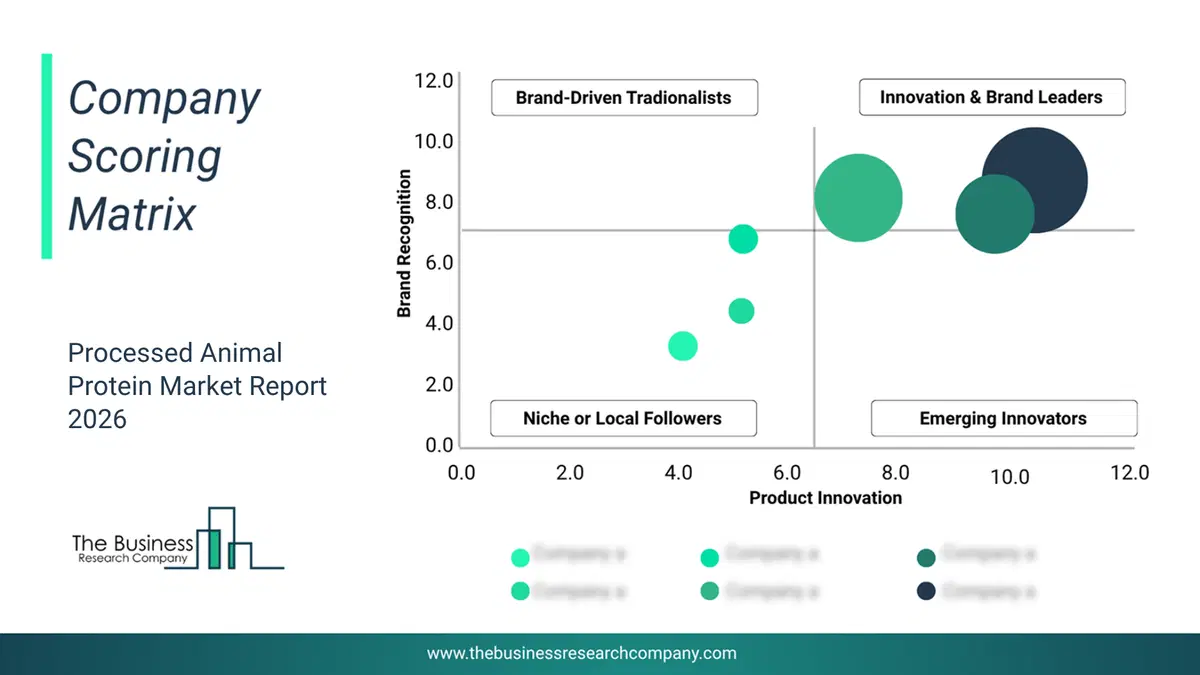
This chart maps companies by product innovation and brand strength, with bubble size indicating relative revenue, helping identify market leaders, challengers, and niche players. This is an illustrative chart; the full report provides a complete and accurate competitive analysis.
Global Processed Animal Protein Market Trends and Insights
Major companies operating in the processed animal protein market are focusing on adopting technological advancements in processing techniques, such as X-ray imaging systems, to improve processing efficiency, quality control, and contamination detection. X-ray imaging systems are advanced inspection technologies that utilize high-resolution X-rays and image analysis software to identify bones, foreign objects, and defects in animal protein products during processing, enabling capabilities such as real-time analysis, automated defect rejection, and yield optimization. For instance, in August 2023, Eagle Product Inspection, a US-based company specializing in inspection and processing technologies for the animal protein sector, launched MAXIMIZER RMI, an X-ray inspection system designed to enhance bone detection and contaminant removal in poultry and meat processing lines, featuring dual-lane capability for up to 120 pieces per lane per minute, integration with SimulTask PRO image analysis software, and automated reject management. MAXIMIZER RMI improves the production of processed animal proteins by boosting automation, throughput, and product quality, while reducing manual inspection requirements and ensuring safer, higher-quality protein outputs.What Are Latest Mergers And Acquisitions In The Processed Animal Protein Market?
In September 2025, Mukka Proteins Limited, an India-based animal protein company, acquired a 51% stake in FABBCO Bio Cycle & Bio Protein for an undisclosed amount. Through this acquisition, Mukka Proteins aims to enhance its capabilities in sustainable protein production and strengthen its presence in the bio-based animal nutrition segment. FABBCO Bio Cycle & Bio Protein is an India-based company engaged in the production of bio-proteins and organic fertilizers derived from recycling and bioconversion processes.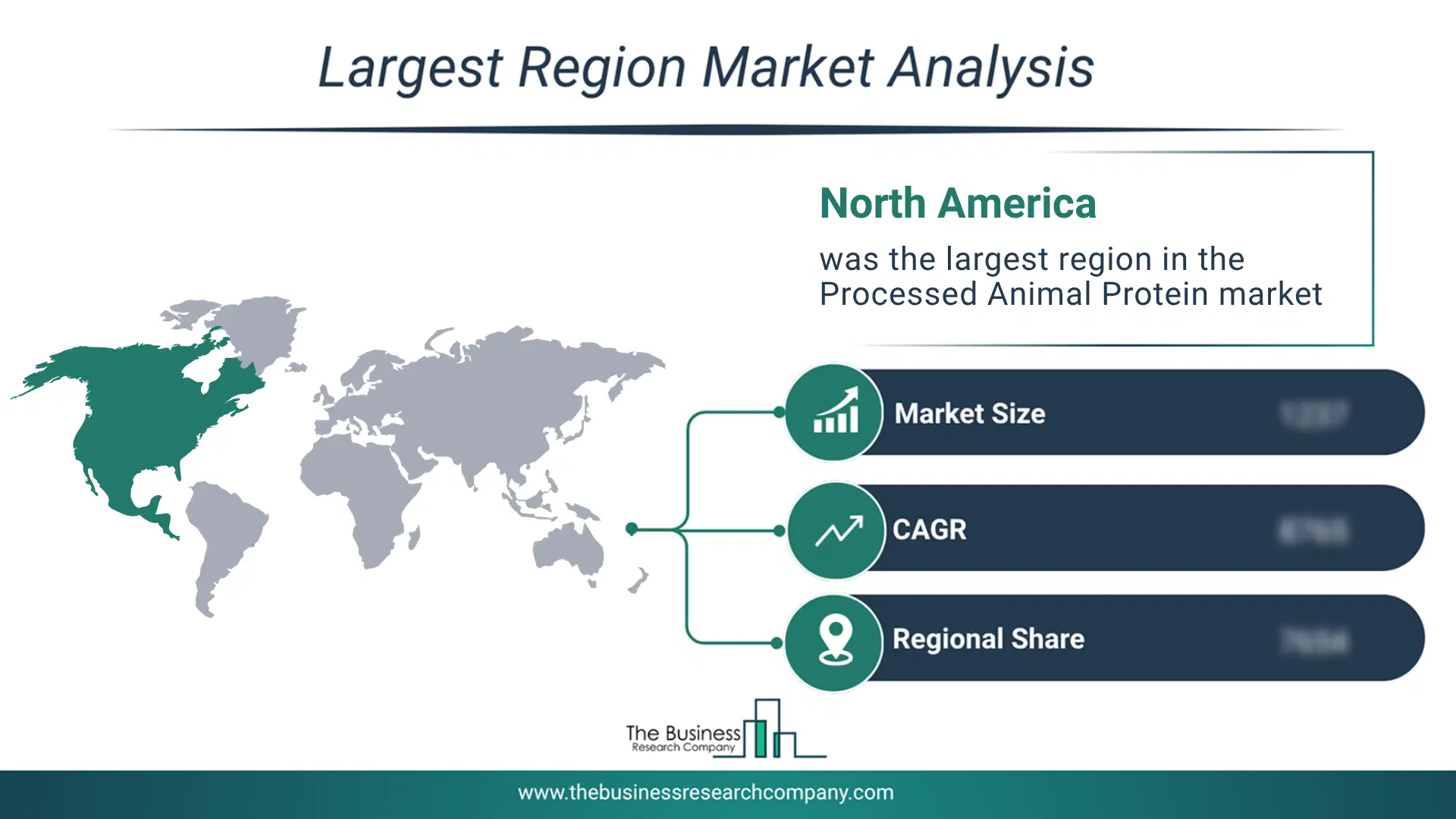
Regional Outlook
North America was the largest region in the processed animal protein market in 2025. Asia-Pacific is expected to be the fastest-growing region in the forecast period. The regions covered in this market report are Asia-Pacific, South East Asia, Western Europe, Eastern Europe, North America, South America, Middle East and Africa. The countries covered in this market report are Australia, Brazil, China, France, Germany, India, Indonesia, Japan, Taiwan, Russia, South Korea, UK, USA, Italy, Spain, CanadaWhat Defines the Processed Animal Protein Market?
The processed animal protein market consists of sales of animal fat, spray-dried plasma, hemoglobin powder, plasma protein, collagen protein, and gelatin. Values in this market are ‘factory gate’ values, that is the value of goods sold by the manufacturers or creators of the goods, whether to other entities (including downstream manufacturers, wholesalers, distributors and retailers) or directly to end customers. The value of goods in this market includes related services sold by the creators of the goods.How is Market Value Defined and Measured?
The market value is defined as the revenues that enterprises gain from the sale of goods and/or services within the specified market and geography through sales, grants, or donations in terms of the currency (in USD unless otherwise specified). The revenues for a specified geography are consumption values that are revenues generated by organizations in the specified geography within the market, irrespective of where they are produced. It does not include revenues from resales along the supply chain, either further along the supply chain or as part of other products.
This chart presents market attractiveness based on a quantitative evaluation of growth, competition, strategic alignment, and risk, offering a clear view of opportunity areas for decision-making. This chart is for illustrative purposes; the full report contains the complete analysis.

This chart highlights the Total Addressable Market (TAM) by estimating the maximum revenue opportunity using an assumption-driven approach, supporting strategic planning and opportunity sizing across markets. The chart is illustrative; the full report provides a more comprehensive analysis.
What Key Data and Analysis Are Included in the Processed Animal Protein Market Report 2026?
The processed animal protein market research report is one of a series of new reports from The Business Research Company that provides market statistics, including industry global market size, regional shares, competitors with the market share, detailed market segments, market trends and opportunities, and any further data you may need to thrive in the processed animal protein industry. The market research report delivers a complete perspective of everything you need, with an in-depth analysis of the current and future state of the industry.Processed Animal Protein Market Report Forecast Analysis
| Report Attribute | Details |
|---|---|
| Market Size Value In 2026 | $15.02 billion |
| Revenue Forecast In 2030 | $18.51 billion |
| Growth Rate | CAGR of 5.6% from 2026 to 2030 |
| Base Year For Estimation | 2025 |
| Actual Estimates/Historical Data | 2020-2025 |
| Forecast Period | 2026 - 2030 |
| Market Representation | Revenue in USD Billion and CAGR from 2026 to 2030 |
| Segments Covered | Product, Animal Source, Processing Methods, Application, End User |
| Regional Scope | Asia-Pacific, Western Europe, Eastern Europe, North America, South America, Middle East, Africa |
| Country Scope | The countries covered in the report are Australia, Brazil, China, France, Germany, India, Indonesia, Japan, Taiwan, Russia, South Korea, UK, USA, Canada, Italy, Spain. |
| Key Companies Profiled | Cargill Incorporated, JBS S.A., Tyson Foods Inc., Tönnies Holding ApS & Co. KG, Darling Ingredients Inc., Tessenderlo Group N.V., SARIA SE & Co. KG, Sanimax Inc., Baker Commodities Inc., West Coast Reduction Inc., LEO Group Ltd., SRC Companies LLC, Boyer Valley Company LLC, nextProtein SAS, J G Pears (Holdings) Limited, Allanasons Private Limited, Kaluzny Bros. Inc., Nordfeed GmbH, Natural Proteins, Ridley Corporation Limited, FASA Group, Advanced Proteins, S.F. Rendering Ltd. |
| Customization Scope | Request for Customization |
| Pricing And Purchase Options | Explore Purchase Options |