
Procymidone Fungicide Market Report 2026
Global Outlook – By Formulation (Wettable Powder, Emulsifiable Concentrate, Suspension Concentrate, Other Formulations), By Mode Of Action (Contact, Systemic), By Distribution Channel (Direct Sales, Agrochemical Stores, Online Retail, Other Distribution Channels), By Application (Fruits And Vegetables, Cereals And Grains, Oilseeds And Pulses, Other Applications), By End User (Farmers, Commercial Growers, Agricultural Cooperatives) – Market Size, Trends, Strategies, and Forecast to 2035
Procymidone Fungicide Market Overview
• Procymidone Fungicide market size has reached to $1.34 billion in 2025 • Expected to grow to $1.72 billion in 2030 at a compound annual growth rate (CAGR) of 5.2% • Growth Driver: Surge In Rising Incidence Of Fungal Crop Diseases Fueling The Growth Of The Market Due To Increasing Climate-Driven Crop Disease Pressure • Market Trend: BASF And ADAMA Collaborate To Develop Next-Generation Gilboa Fungicide Technology For Advanced Crop Protection • North America was the largest region in 2025 and Asia-Pacific is the fastest growing region.What Is Covered Under Procymidone Fungicide Market?
Procymidone fungicide refers to a dicarboximide-based chemical fungicide used in agriculture to control fungal diseases in crops such as fruits, vegetables, and ornamentals. Its primary purpose is to inhibit fungal growth, particularly by disrupting spore germination and mycelial development, thereby protecting crop yield and quality. The main formulations of procymidone fungicide include wettable powder, emulsifiable concentrate, suspension concentrate, and other formulations. Wettable powder refers to a dry pesticide formulation that is mixed with water before application to control fungal diseases in crops. These products are categorized by mode of action including contact and systemic and are distributed through direct sales, agrochemical stores, online retail, and other distribution channels. They are used in applications such as fruits and vegetables, cereals and grains, oilseeds and pulses, and others, while the end-use includes farmers, commercial growers, and agricultural cooperatives.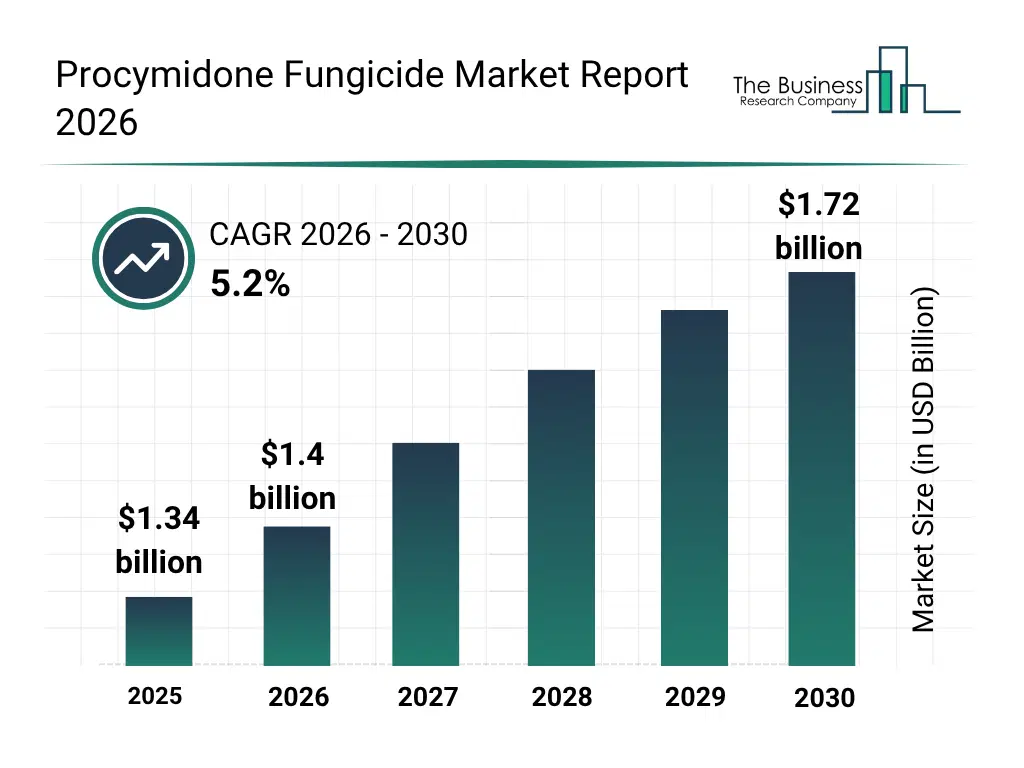
What Is The Procymidone Fungicide Market Size and Share 2026?
The procymidone fungicide market size has grown steadily in recent years. It will grow from $1.34 billion in 2025 to $1.4 billion in 2026 at a compound annual growth rate (CAGR) of 4.9%. The growth in the historic period can be attributed to rising prevalence of fungal crop diseases globally, increasing dependence on agrochemical crop protection solutions, growth in commercial farming and horticulture production, expanding use of synthetic fungicides for yield protection, increasing awareness of post-harvest loss prevention.What Is The Procymidone Fungicide Market Growth Forecast?
The procymidone fungicide market size is expected to see strong growth in the next few years. It will grow to $1.72 billion in 2030 at a compound annual growth rate (CAGR) of 5.2%. The growth in the forecast period can be attributed to growing demand for sustainable and low-residue crop protection chemicals, increasing adoption of precision agriculture technologies, rising innovation in controlled-release fungicide formulations, expanding organic and hybrid farming practices requiring optimized fungicide use, increasing regulatory focus on safer agrochemical usage standards. Major trends in the forecast period include increasing adoption of targeted fungicide solutions in high-value crop protection, rising demand for residue-compliant agrochemical formulations, growing preference for integrated pest and disease management practices, expansion of precision agriculture-driven fungicide application techniques, increasing use of advanced suspension and microencapsulated fungicide formulations.
Global Procymidone Fungicide Market Segmentation
1) By Formulation: Wettable Powder, Emulsifiable Concentrate, Suspension Concentrate, Other Formulations 2) By Mode Of Action: Contact, Systemic 3) By Distribution Channel: Direct Sales, Agrochemical Stores, Online Retail, Other Distribution Channels 4) By Application: Fruits And Vegetables, Cereals And Grains, Oilseeds And Pulses, Other Applications 5) By End User: Farmers, Commercial Growers, Agricultural Cooperatives Subsegments: 1) By Wettable Powder: Soluble Powder Formulations, Dust Free Powder Formulations, High Concentration Powder Formulations 2) By Emulsifiable Concentrate: Oil Based Emulsions, Water Compatible Emulsions, High Stability Liquid Concentrates 3) By Suspension Concentrate: Flowable Liquid Suspensions, High Solid Content Suspensions, Stable Dispersion Concentrates 4) By Other Formulations: Water Dispersible Granules, Granular Formulations, Microencapsulated Formulations, Liquid Flowable ConcentratesWhat Is The Driver Of The Procymidone Fungicide Market?
Rising incidence of fungal crop diseases is expected to propel the growth of the procymidone fungicide market going forward. Fungal crop diseases are plant infections caused by fungi that damage crops by affecting their growth, yield, and quality, often leading to spots, rotting, wilting, or decay in various plant parts. Rising incidence of fungal crop diseases is increasing due to rising climate variability that elevates temperature and humidity levels, which accelerates fungal pathogen growth, survival, and transmission across major crop systems. Procymidone fungicide effectively inhibits fungal growth and preventing the spread of key pathogens such as Botrytis and Sclerotinia, which helps farmers protect crop yield and maintain quality under increasing disease pressure. For instance, in July 2024, according to Multidisciplinary Digital Publishing Institute Aktiengesellschaft, a Switzerland-based journal, 70–80% of crop diseases are caused by fungi, making them the most dominant plant pathogens worldwide. Therefore, rising incidence of fungal crop diseases drives the procymidone fungicide industry.Key Players In The Global Procymidone Fungicide Market
Major companies operating in the procymidone fungicide market are Sumitomo Chemical Co. Ltd., Nufarm Limited, Zhejiang Rayfull Chemicals Co. Ltd., Shijiazhuang Awiner Biotech Co. Ltd., Nanjing Essence Fine-Chemical Co. Ltd., Nanjing Aceagrochem Co. Ltd., Shanghai Bosman Industrial Co. Ltd., Natursim Science Co. Ltd., Hangzhou Tianlong Biotechnology Co. Ltd., ADAMA Ltd., FMC Corporation, Nippon Soda Co. Ltd., Shandong Weifang Rainbow Chemical Co. Ltd., Hebei Shuangji Chemical Co. Ltd., Jiangsu Fengshan Group Co. Ltd., Zhengzhou Ulike Chemical Co. Ltd., Jiangsu Good Harvest-Weien Agrochemical Co. Ltd., Hubei Sanonda Co. Ltd., Tagros Chemicals Pvt. Ltd., Crystal Crop Protection Ltd.Global Procymidone Fungicide Market Trends and Insights
Major companies operating in the procymidone fungicide market are increasingly focusing on advanced fungicide technologies with novel modes of action to strengthen disease control efficiency, enhance resistance management, and improve crop yield stability across major cereals and oilseed crops. Fungicide technologies refer to scientifically developed chemical or bio-based solutions designed to prevent, inhibit, or eliminate fungal pathogens in crops while ensuring broad-spectrum protection and sustainable agricultural productivity. For instance, in December 2025, BASF Agricultural Solutions, a Germany-based company that offers fungicides and ADAMA, an Israel-based agriculture company partnered to co-develop the breakthrough Gilboa fungicide technology, a next-generation crop protection innovation aimed at delivering enhanced control of key fungal diseases in cereal crops. This collaboration integrates complementary research capabilities to accelerate the development of advanced fungicidal chemistry with improved efficacy and resistance management potential. The Gilboa technology is designed to provide more reliable field performance against evolving fungal pathogens, extend the durability of disease control solutions, and support farmers in maintaining higher yield potential under increasing disease pressure. Additionally, it also strengthens sustainable farming practices by reducing the risk of resistance buildup, improving application efficiency, and enabling more targeted and effective crop protection strategies across diverse agricultural environmentsWhat Are Latest Mergers And Acquisitions In The Procymidone Fungicide Market?
In January 2025, Sumitomo Chemical Co., Ltd., a Japan-based provider of crop protection chemicals, agrochemicals, and advanced agricultural solutions, acquired Philagro Holding and Kenogard for an undisclosed amount. With this acquisition, Sumitomo Chemical aims to strengthen its distribution network and expand its crop protection business presence across key European markets while enhancing its access to customers and regional capabilities. Philagro Holding is a France-based provider of crop protection products, including fungicides. Kenogard is a Spain-based company that offers procymidone fungicide.Regional Outlook/Insights
North America was the largest region in the procymidone fungicide market in 2025. Asia-Pacific is expected to be the fastest-growing region in the forecast period. The regions covered in this market report are Asia-Pacific, South East Asia, Western Europe, Eastern Europe, North America, South America, Middle East, Africa. The countries covered in this market report are Australia, Brazil, China, France, Germany, India, Indonesia, Japan, Taiwan, Russia, South Korea, UK, USA, Canada, Italy, Spain.What Defines the Procymidone Fungicide Market?
The procymidone fungicide market consists of sales of procymidone technical grade, wettable powders, and suspension concentrates. Values in this market are ‘factory gate’ values, that is, the value of goods sold by the manufacturers or creators of the goods, whether to other entities (including downstream manufacturers, wholesalers, distributors, and retailers) or directly to end customers. The value of goods in this market includes related services sold by the creators of the goods.How is Market Value Defined and Measured?
The market value is defined as the revenues that enterprises gain from the sale of goods and/or services within the specified market and geography through sales, grants, or donations in terms of the currency (in USD unless otherwise specified). The revenues for a specified geography are consumption values that are revenues generated by organizations in the specified geography within the market, irrespective of where they are produced. It does not include revenues from resales along the supply chain, either further along the supply chain or as part of other products.What Key Data and Analysis Are Included in the Procymidone Fungicide Market Report 2026?
The procymidone fungicide market research report is one of a series of new reports from The Business Research Company that provides market statistics, including industry global market size, regional shares, competitors with the market share, detailed market segments, market trends and opportunities, and any further data you may need to thrive in the procymidone fungicide industry. The market research report delivers a complete perspective of everything you need, with an in-depth analysis of the current and future state of the industry.Procymidone Fungicide Market Report Forecast Analysis
| Report Attribute | Details |
|---|---|
| Market Size Value In 2026 | $1.4 billion |
| Revenue Forecast In 2035 | $1.72 billion |
| Growth Rate | CAGR of 5.2% from 2026 to 2035 |
| Base Year For Estimation | 2025 |
| Actual Estimates/Historical Data | 2020-2025 |
| Forecast Period | 2026 - 2030 - 2035 |
| Market Representation | Revenue in USD Billion and CAGR from 2026 to 2035 |
| Segments Covered | Formulation, Mode Of Action, Distribution Channel, Application, End User |
| Regional Scope | Asia-Pacific, Western Europe, Eastern Europe, North America, South America, Middle East, Africa |
| Country Scope | The countries covered in the report are Australia, Brazil, China, France, Germany, India, Indonesia, Japan, Taiwan, Russia, South Korea, UK, USA, Canada, Italy, Spain. |
| Key Companies Profiled | Sumitomo Chemical Co. Ltd., Nufarm Limited, Zhejiang Rayfull Chemicals Co. Ltd., Shijiazhuang Awiner Biotech Co. Ltd., Nanjing Essence Fine-Chemical Co. Ltd., Nanjing Aceagrochem Co. Ltd., Shanghai Bosman Industrial Co. Ltd., Natursim Science Co. Ltd., Hangzhou Tianlong Biotechnology Co. Ltd., ADAMA Ltd., FMC Corporation, Nippon Soda Co. Ltd., Shandong Weifang Rainbow Chemical Co. Ltd., Hebei Shuangji Chemical Co. Ltd., Jiangsu Fengshan Group Co. Ltd., Zhengzhou Ulike Chemical Co. Ltd., Jiangsu Good Harvest-Weien Agrochemical Co. Ltd., Hubei Sanonda Co. Ltd., Tagros Chemicals Pvt. Ltd., Crystal Crop Protection Ltd. |
| Customization Scope | Request for Customization |
| Pricing And Purchase Options | Explore Purchase Options |