
Produced Water Treatment Market Report 2026
Global Outlook – By Treatment (Chemical Treatment, Reverse Osmosis Or Membrane Treatment, Biological Treatment, Physical Treatment, Combined Systems, Other Treatments), By Production Source (Crude Oil, Natural Gas), By Application (Onshore, Offshore), By End User (Oil And Gas, Industrial, Power Generation, Other End Users) – Market Size, Trends, Strategies, and Forecast to 2030
Produced Water Treatment Market Overview
• Produced Water Treatment market size has reached to $7.52 billion in 2025 • Expected to grow to $10.56 billion in 2030 at a compound annual growth rate (CAGR) of 7% • Growth Driver: Growth In Global Oil And Gas Production Fuels Expansion Of The Produced Water Treatment Market • Market Trend: Innovative Microbubble Technology Enhances Produced Water Treatment • North America was the largest region in 2025 and Asia-Pacific is the fastest growing region.What Is Covered Under Produced Water Treatment Market?
Produced water treatment refers to the process of treating water that is a byproduct of oil and gas extraction. This water contains hydrocarbons, salts, and other contaminants that need to be removed before disposal, reuse, or safe release into the environment. Treatment methods include physical, chemical, and biological processes. The main types of produced water treatment are chemical treatment, reverse osmosis or membrane treatment, biological treatment, physical treatment, combined systems, and others. Chemical treatment in the context of produced water treatment involves adding chemicals to remove contaminants and improve water quality. This process can include coagulation, flocculation, and the use of various chemical agents to neutralize or precipitate impurities. The production sources include crude oil and natural gas. Applications cover onshore and offshore, and the treatment is utilized by different end users such as oil and gas, industrial, power generation, and others.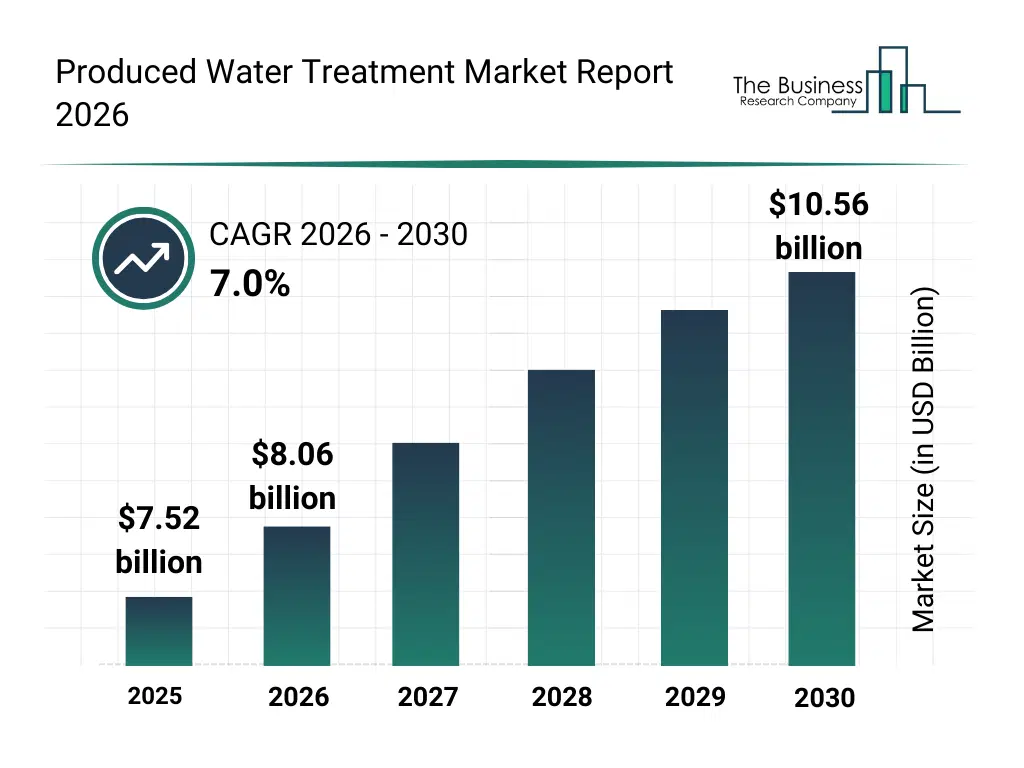
What Is The Produced Water Treatment Market Size and Share 2026?
The produced water treatment market size has grown strongly in recent years. It will grow from $7.52 billion in 2025 to $8.06 billion in 2026 at a compound annual growth rate (CAGR) of 7.1%. The growth in the historic period can be attributed to increase in oil and gas production volumes, rising environmental discharge regulations, growth in onshore drilling activities, high costs of freshwater sourcing, expansion of offshore operations.What Is The Produced Water Treatment Market Growth Forecast?
The produced water treatment market size is expected to see strong growth in the next few years. It will grow to $10.56 billion in 2030 at a compound annual growth rate (CAGR) of 7.0%. The growth in the forecast period can be attributed to stricter wastewater disposal norms, growth in water reuse initiatives, expansion of unconventional oil and gas production, technological advancements in treatment systems, sustainability driven investments. Major trends in the forecast period include increasing adoption of advanced water reuse technologies, rising deployment of membrane based treatment systems, growth in integrated chemical and physical treatment solutions, expansion of onsite produced water treatment facilities, rising focus on zero liquid discharge operations.
Global Produced Water Treatment Market Segmentation
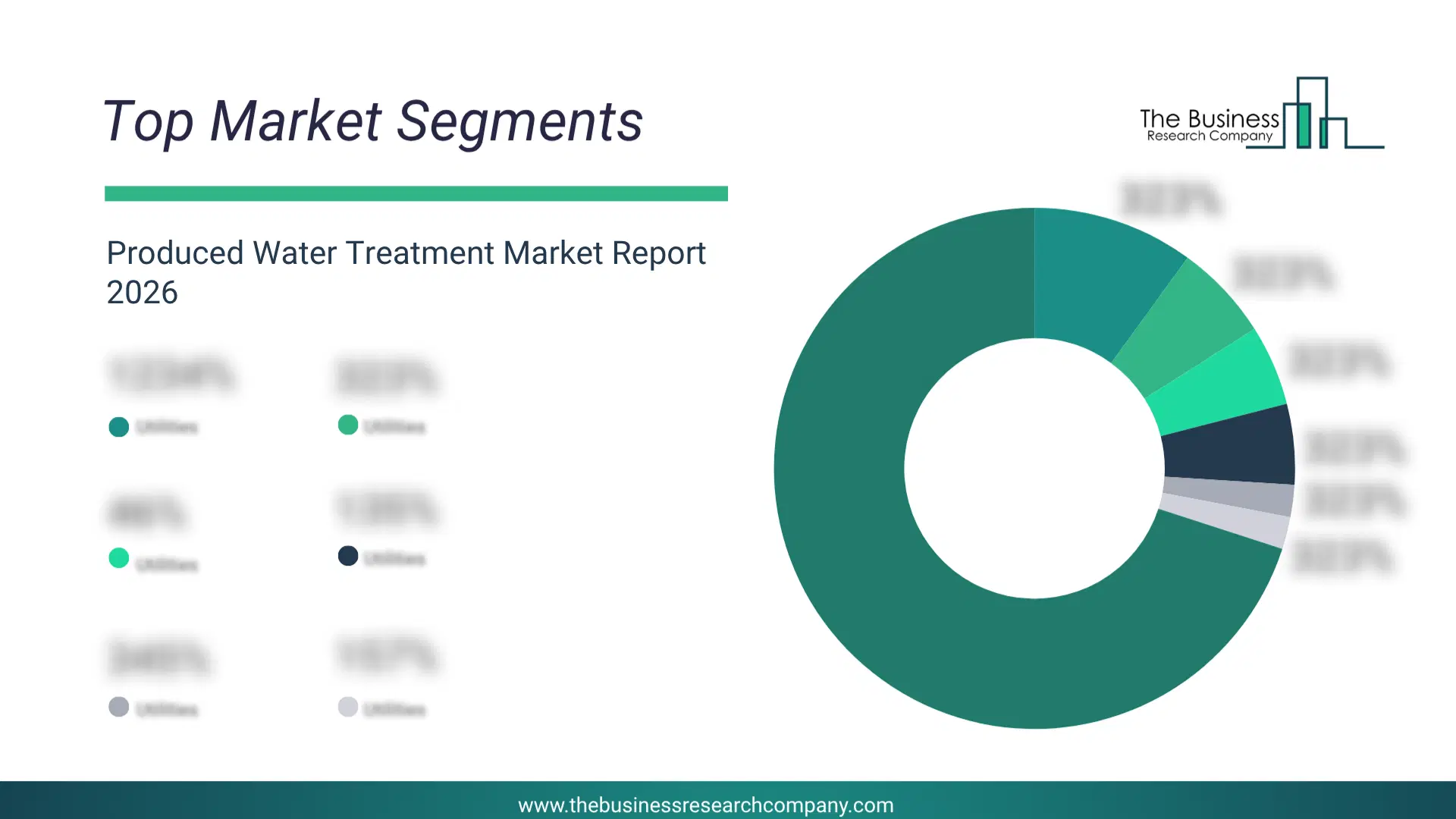
1) By Treatment: Chemical Treatment, Reverse Osmosis Or Membrane Treatment, Biological Treatment, Physical Treatment, Combined Systems, Other Treatments 2) By Production Source: Crude Oil, Natural Gas 3) By Application: Onshore, Offshore 4) By End User: Oil And Gas, Industrial, Power Generation, Other End Users Subsegments: 1) By Chemical Treatment: Coagulation and Flocculation, Disinfection, Oxidation, Precipitation 2) By Reverse Osmosis Or Membrane Treatment: Microfiltration, Ultrafiltration, Nanofiltration, Reverse Osmosis 3) By Biological Treatment: Activated Sludge Process, Biofilm Reactors, Engineered Biological Treatment Systems, Anaerobic Digestion 4) By Physical Treatment: Filtration, Sedimentation, Oil-Water Separation, Centrifugation 5) By Combined Systems: Chemical And Physical Treatment Systems, Biological And Chemical Treatment Systems, Membrane And Chemical Treatment Systems 6) By Other Treatments: Thermal Treatment, Electrocoagulation, Advanced Oxidation ProcessesWhat Is The Driver Of The Produced Water Treatment Market?
The rising global oil and gas production is expected to propel the growth of the produced water treatment market going forward. The rise in oil and gas production is driven by increasing global energy demand and advancements in extraction technologies such as fracking and deep-water drilling. Produced water treatment helps oil and gas production by enabling safe disposal, recycling, and compliance with environmental regulations, thereby sustaining operations. For instance, in December 2025, according to the United States Energy Information Administration (EIA), a US-based principal agency, in December 2023, U.S. oil production, which includes crude oil and lease condensate, averaged 13.3 million barrels per day (b/d), and U.S. natural gas production (gross withdrawals) averaged 128.0 billion cubic feet per day (Bcf/d). Therefore, the rising global oil and gas production is driving the growth of the produced water treatment industry.Key Players In The Global Produced Water Treatment Market
Major companies operating in the produced water treatment market are Dow Inc., Veolia Group, Schlumberger Ltd., Baker Hughes Company, Halliburton Company, Emerson Electric Co., DuPont Inc., SUEZ Group, National Oilwell Varco Inc., TechnipFMC plc., Pall Corporation, Mineral Technologies Inc., Tetra Technologies Inc., GE Water & Process Technologies, Aquatech International, Ovivo, Alderley plc, IDE Technologies Ltd., Samco Technologies Inc., DAS Environmental Expert GMBH, Enviro-Tech Systems , Dryden Aqua Ltd., Condorchem Envitech SL, Microvi Biotech Inc.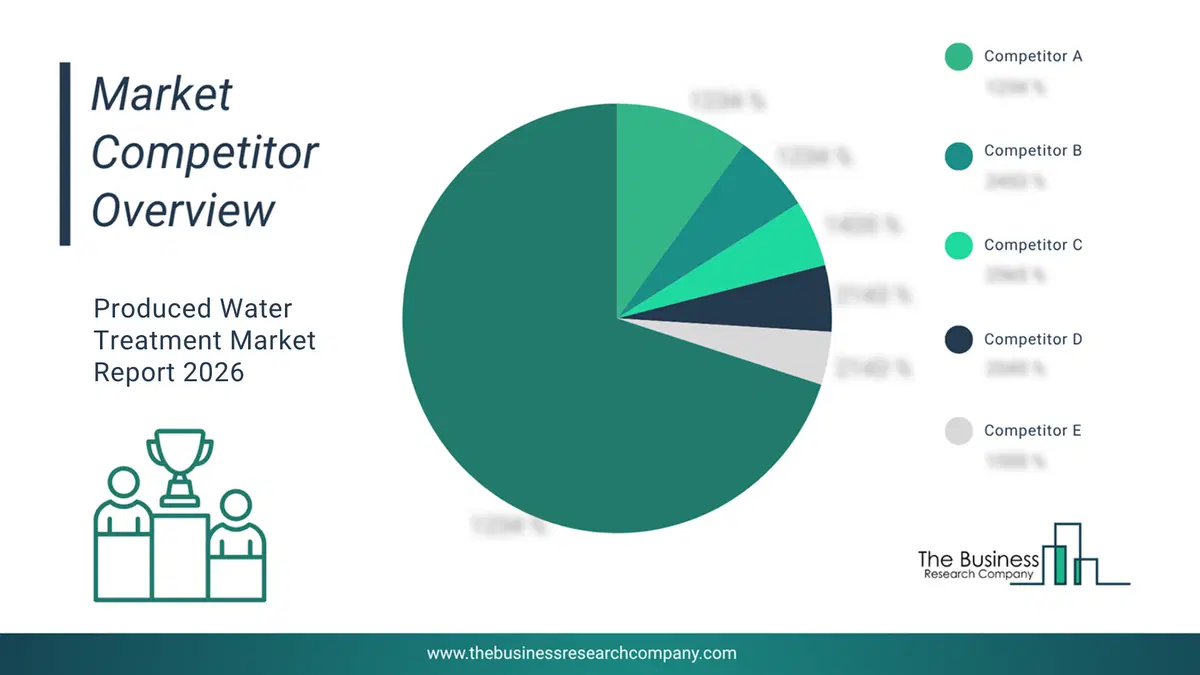
This chart is for illustrative purposes; the full report includes a detailed competitor analysis and comprehensive overview of the top 10 companies in the market.
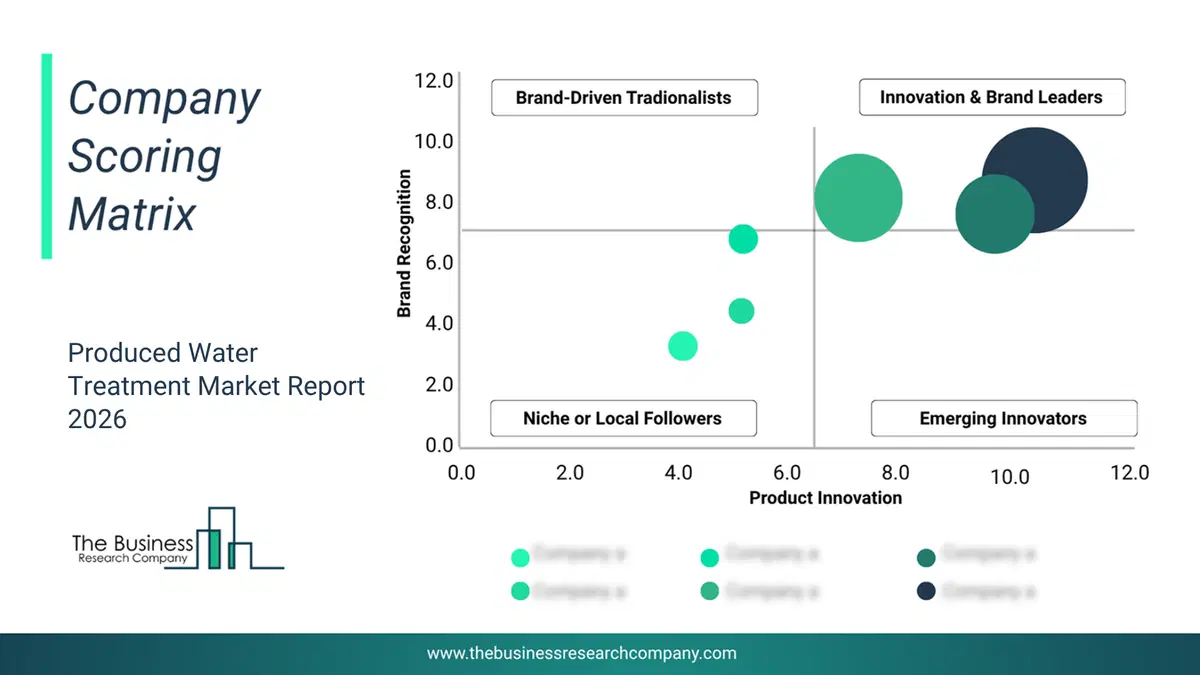
This chart maps companies by product innovation and brand strength, with bubble size indicating relative revenue, helping identify market leaders, challengers, and niche players. This is an illustrative chart; the full report provides a complete and accurate competitive analysis.
Global Produced Water Treatment Market Trends and Insights
Major companies operating in the produced water treatment market are developing innovative technology, such as microbubble technology, to enhance the efficiency and effectiveness of contaminant removal and water recycling processes. Microbubble technology utilizes tiny gas bubbles, usually between 10 and 100 micrometers in size, to enhance processes such as contaminant removal. In water treatment, these small bubbles improve the separation of pollutants by adhering to them and making it easier to extract them from the water. For instance, in January 2024, Adaptive Process Solutions (APS), a US-based water and wastewater treatment technology, launched the Microbubble Infusion Unit (MiFU), a cutting-edge system. It is designed to optimize the removal of contaminants in produced water. This new unit leverages microbubble technology to generate extremely fine gas bubbles that effectively attach to pollutants, enhancing their separation and extraction. The MiFU aims to significantly improve the efficiency and effectiveness of water recycling processes, contributing to more sustainable and cost-effective water management solutions.What Are Latest Mergers And Acquisitions In The Produced Water Treatment Market?
In October 2025, WaterTectonics Inc., a US-based industrial water treatment company, partnered with Clearvale Water Solutions LLC to launch WT Oil & Gas, aimed at delivering high-volume produced water recycling and reuse across the Permian Basin. With this partnership, WaterTectonics Inc. and Clearvale Water Solutions, LLC aim to provide scalable, high-performance water treatment solutions that reduce freshwater consumption and disposal costs for oil and gas operators, leveraging WaterTectonics’ technical expertise and Clearvale’s energy investment capabilities. Clearvale Water Solutions LLC is a US-based energy investment company supporting water management and sustainability solutions for the oil and gas industry.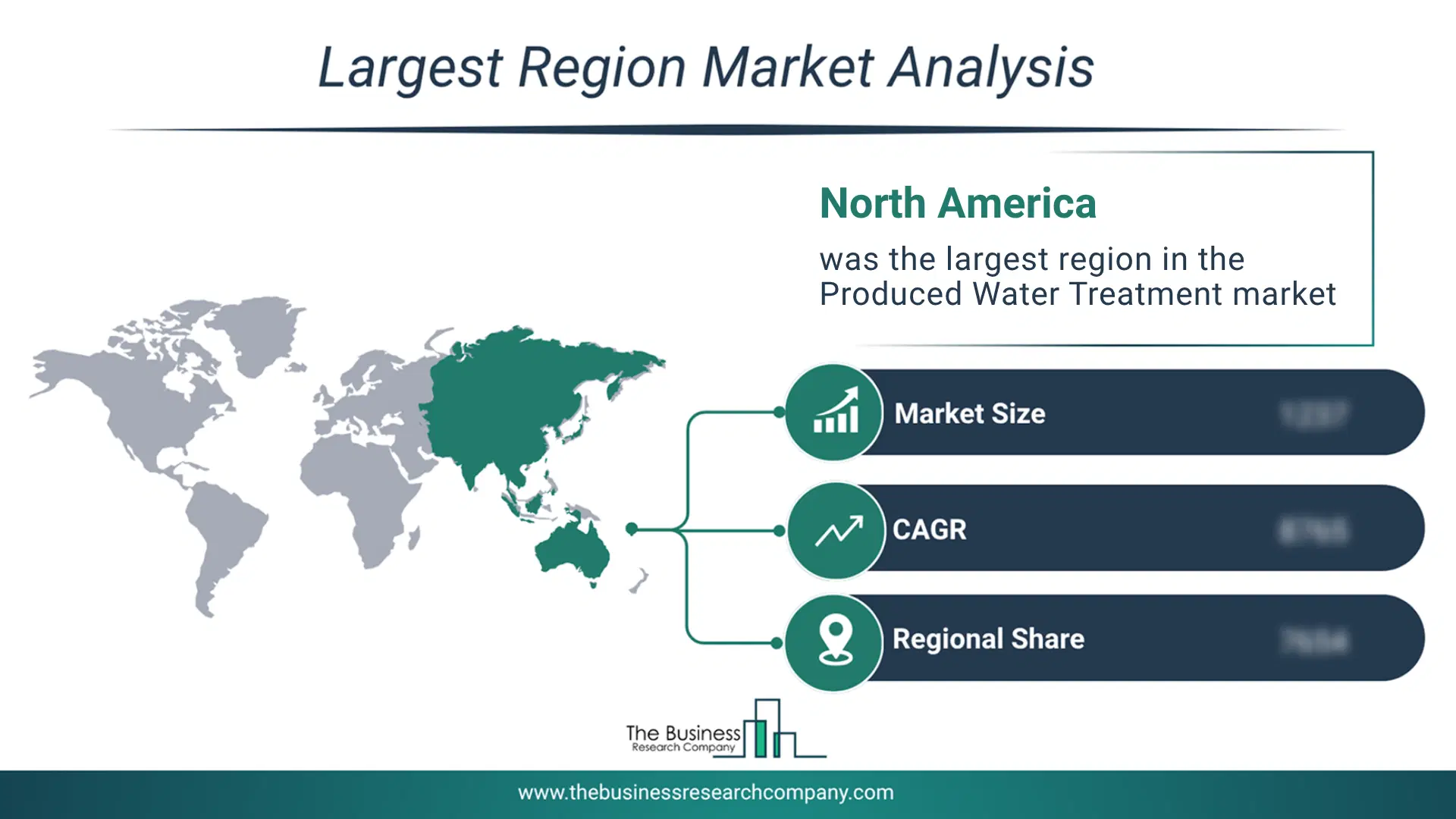
Regional Outlook
North America was the largest region in the produced water treatment market in 2025. Asia-Pacific is expected to be the fastest-growing region in the forecast period. The regions covered in this market report are Asia-Pacific, South East Asia, Western Europe, Eastern Europe, North America, South America, Middle East, Africa. The countries covered in this market report are Australia, Brazil, China, France, Germany, India, Indonesia, Japan, Taiwan, Russia, South Korea, UK, USA, Canada, Italy, SpainWhat Defines the Produced Water Treatment Market?
The produced water treatment market includes revenues earned by entities by providing services such as filtration, flotation, precipitation, and oxidation. The market value includes the value of related goods sold by the service provider or included within the service offering. Only goods and services traded between entities or sold to end consumers are included.How is Market Value Defined and Measured?
The market value is defined as the revenues that enterprises gain from the sale of goods and/or services within the specified market and geography through sales, grants, or donations in terms of the currency (in USD unless otherwise specified). The revenues for a specified geography are consumption values that are revenues generated by organizations in the specified geography within the market, irrespective of where they are produced. It does not include revenues from resales along the supply chain, either further along the supply chain or as part of other products.
This chart presents market attractiveness based on a quantitative evaluation of growth, competition, strategic alignment, and risk, offering a clear view of opportunity areas for decision-making. This chart is for illustrative purposes; the full report contains the complete analysis.

This chart highlights the Total Addressable Market (TAM) by estimating the maximum revenue opportunity using an assumption-driven approach, supporting strategic planning and opportunity sizing across markets. The chart is illustrative; the full report provides a more comprehensive analysis.
What Key Data and Analysis Are Included in the Produced Water Treatment Market Report 2026?
The produced water treatment market research report is one of a series of new reports from The Business Research Company that provides market statistics, including industry global market size, regional shares, competitors with the market share, detailed market segments, market trends and opportunities, and any further data you may need to thrive in the produced water treatment industry. The market research report delivers a complete perspective of everything you need, with an in-depth analysis of the current and future state of the industry.Produced Water Treatment Market Report Forecast Analysis
| Report Attribute | Details |
|---|---|
| Market Size Value In 2026 | $8.06 billion |
| Revenue Forecast In 2030 | $10.56 billion |
| Growth Rate | CAGR of 7% from 2026 to 2030 |
| Base Year For Estimation | 2025 |
| Actual Estimates/Historical Data | 2020-2025 |
| Forecast Period | 2026 - 2030 |
| Market Representation | Revenue in USD Billion and CAGR from 2026 to 2030 |
| Segments Covered | Treatment, Production Source, Application, End User |
| Regional Scope | Asia-Pacific, Western Europe, Eastern Europe, North America, South America, Middle East, Africa |
| Country Scope | The countries covered in the report are Australia, Brazil, China, France, Germany, India, Indonesia, Japan, Taiwan, Russia, South Korea, UK, USA, Canada, Italy, Spain. |
| Key Companies Profiled | Dow Inc., Veolia Group, Schlumberger Ltd., Baker Hughes Company, Halliburton Company, Emerson Electric Co., DuPont Inc., SUEZ Group, National Oilwell Varco Inc., TechnipFMC plc., Pall Corporation, Mineral Technologies Inc., Tetra Technologies Inc., GE Water & Process Technologies, Aquatech International, Ovivo, Alderley plc, IDE Technologies Ltd., Samco Technologies Inc., DAS Environmental Expert GMBH, Enviro-Tech Systems , Dryden Aqua Ltd., Condorchem Envitech SL, Microvi Biotech Inc. |
| Customization Scope | Request for Customization |
| Pricing And Purchase Options | Explore Purchase Options |