
Product Carbon Footprint Verification Market Report 2026
Global Outlook – By Service Type (Carbon Footprint Assessment, Carbon Footprint Verification, Consulting Services, Software Solutions, Training And Education), By Verification Type (Third-Party Verification, Self-Verification, Regulatory Verification), By Verification Standard (ISO 14064, ISO 14067, GHG Protocol, Science Based Targets Initiative (SBTI), Global Reporting Initiative (GRI)), By Organization Size (Small Enterprises, Medium Enterprises, Large Enterprises), By Industry (Manufacturing, Food And Beverage, Retail And E-Commerce, Transportation And Logistics, Energy And Utilities, Textiles And Apparel, Aerospace And Defense) – Market Size, Trends, Strategies, and Forecast to 2030
Product Carbon Footprint Verification Market Overview
• Product Carbon Footprint Verification market size has reached to $14.63 billion in 2025 • Expected to grow to $37.51 billion in 2030 at a compound annual growth rate (CAGR) of 20.6% • Growth Driver: Rising Greenhouse Gas Emissions Driving The Growth Of The Market Due To Increasing Demand For Sustainable Practices • Market Trend: Technological Advancements Driving Innovative Calculation Tools • North America was the largest region in 2025 and Asia-Pacific is the fastest growing region.What Is Covered Under Product Carbon Footprint Verification Market?
Product carbon footprint verification is the process of assessing and certifying the total greenhouse gas (GHG) emissions generated throughout a product’s lifecycle, from raw material extraction to disposal. It ensures accuracy, transparency, and compliance with international standards, helping businesses validate their environmental impact claims, meet regulatory requirements, and enhance sustainability credentials. The main services of product carbon footprint verification are carbon footprint assessment, carbon footprint verification, consulting services, software solutions, training, and education. Carbon footprint assessment measures the total amount of greenhouse gases, mainly carbon dioxide, released into the atmosphere by a product, organization, or activity. The verification types involved are third-party verification, self-verification, and regulatory verification based on SO 14064, iso 14067, GHG protocol, science-based targets initiative (SBTI), and global reporting initiative (GRI) verification standards. The organization sizes involved are small enterprises, medium enterprises, and large enterprises in manufacturing, food and beverage, retail and e-commerce, transportation and logistics, energy and utilities, textiles and apparel, aerospace and defense.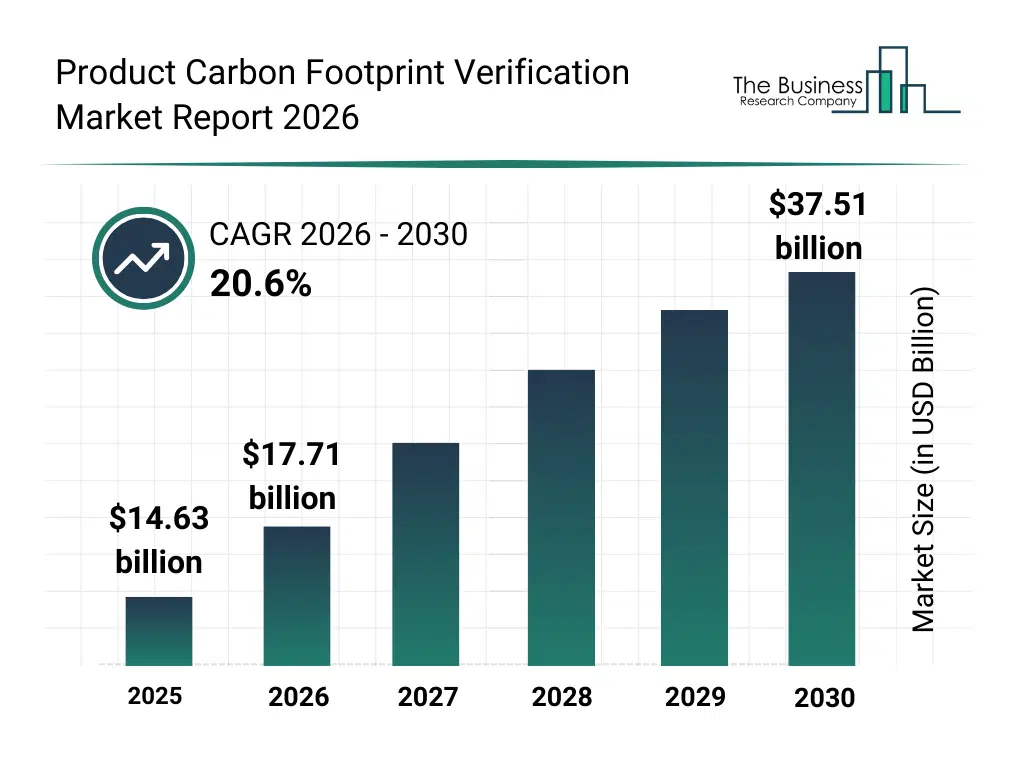
What Is The Product Carbon Footprint Verification Market Size and Share 2026?
The product carbon footprint verification market size has grown exponentially in recent years. It will grow from $14.63 billion in 2025 to $17.71 billion in 2026 at a compound annual growth rate (CAGR) of 21.0%. The growth in the historic period can be attributed to introduction of international carbon reporting standards, early corporate sustainability initiatives, increasing investor focus on esg disclosures, adoption of lifecycle assessment methodologies, rising voluntary carbon reporting.What Is The Product Carbon Footprint Verification Market Growth Forecast?
The product carbon footprint verification market size is expected to see exponential growth in the next few years. It will grow to $37.51 billion in 2030 at a compound annual growth rate (CAGR) of 20.6%. The growth in the forecast period can be attributed to increasing enforcement of carbon regulations, growing adoption of science-based targets, expansion of mandatory product labeling requirements, rising demand for automated carbon verification tools, increasing integration of carbon metrics in procurement decisions. Major trends in the forecast period include increasing adoption of lifecycle carbon assessment services, rising demand for third-party verification, growing use of carbon accounting software, expansion of regulatory carbon disclosure requirements, enhanced focus on supply chain emission transparency.
Global Product Carbon Footprint Verification Market Segmentation
1) By Service Type: Carbon Footprint Assessment, Carbon Footprint Verification, Consulting Services, Software Solutions, Training And Education 2) By Verification Type: Third-Party Verification, Self-Verification, Regulatory Verification 3) By Verification Standard: ISO 14064, ISO 14067, GHG Protocol, Science Based Targets Initiative (SBTI), Global Reporting Initiative (GRI) 4) By Organization Size: Small Enterprises, Medium Enterprises, Large Enterprises 5) By Industry: Manufacturing, Food And Beverage, Retail And E-Commerce, Transportation And Logistics, Energy And Utilities, Textiles And Apparel, Aerospace And Defense Subsegments: 1) By Carbon Footprint Assessment: Life Cycle Assessment (LCA), Greenhouse Gas (GHG) Emissions Calculation, Scope 1, Scope 2, and Scope 3 Emissions Analysis, Product-Specific Carbon Footprint Evaluation, Carbon Reduction Strategy Development, Carbon Footprint Verification 2) By Third-Party Verification And Certification: Compliance Audits, Supply Chain Emission Verification, Corporate Sustainability Reporting Verification, Regulatory Compliance And Assurance 3) By Consulting Services: Carbon Neutrality Roadmap Development, Corporate Sustainability Strategy, Science-Based Targets (SBTi) Consulting, Carbon Offsetting And Reduction Planning, ESG (Environmental, Social, and Governance) Reporting 4) By Software Solutions: Carbon Accounting And Tracking Software, Emissions Data Management Platforms, AI-Based Carbon Footprint Analytics, Supply Chain Carbon Impact Monitoring, Carbon Footprint Reporting And Compliance Tools 5) By Training and Education: Corporate Sustainability And Carbon Management Training, Carbon Accounting And Reporting Workshops, Certification Programs on Carbon Footprint Standards, Employee Awareness And Engagement Programs, Industry-Specific Carbon Footprint EducationWhat Is The Driver Of The Product Carbon Footprint Verification Market?
The rising greenhouse gas emissions are expected to propel the growth of the product carbon footprint verification going forward. The rising greenhouse gas (GHG) emissions are due to the increasing reliance on fossil fuels for energy production, transportation, and industrial activities. As global energy demand grows, coal, oil, and natural gas remain the primary power generation sources, releasing large amounts of carbon dioxide (CO2) and methane (CH4) into the atmosphere. The product carbon footprint verification encourages the adoption of low-carbon alternatives, such as sustainable materials, energy-efficient production methods, and optimized transportation. Verified carbon footprint data enhances consumer awareness, driving demand for eco-friendly products and promoting a greener supply chain.For instance, in November 2025, according to the Office for National Statistics (ONS), a UK-based government agency, residence-based greenhouse gas (GHG) emissions were 1.70 tonnes of carbon dioxide equivalent (CO2e) per head in Quarter 2 (April to June) 2025. Therefore, the rising greenhouse gas emissions are driving the growth of the product carbon footprint verification industry.Key Players In The Global Product Carbon Footprint Verification Market
Major companies operating in the product carbon footprint verification market report are SGS SA, Bureau Veritas, DEKRA SE, Intertek Group plc, TÜV SÜD AG, UL Solutions, Applus+ Services SA, TÜV Nord AG, BSI Group, Verra, LRQA, DQS Holding, Carbon Trust, SCS Global Services, ClimatePartner, Circular Ecology, Carbon Footprint Ltd, DNV GL, GEP Environmental, Carbon Credentials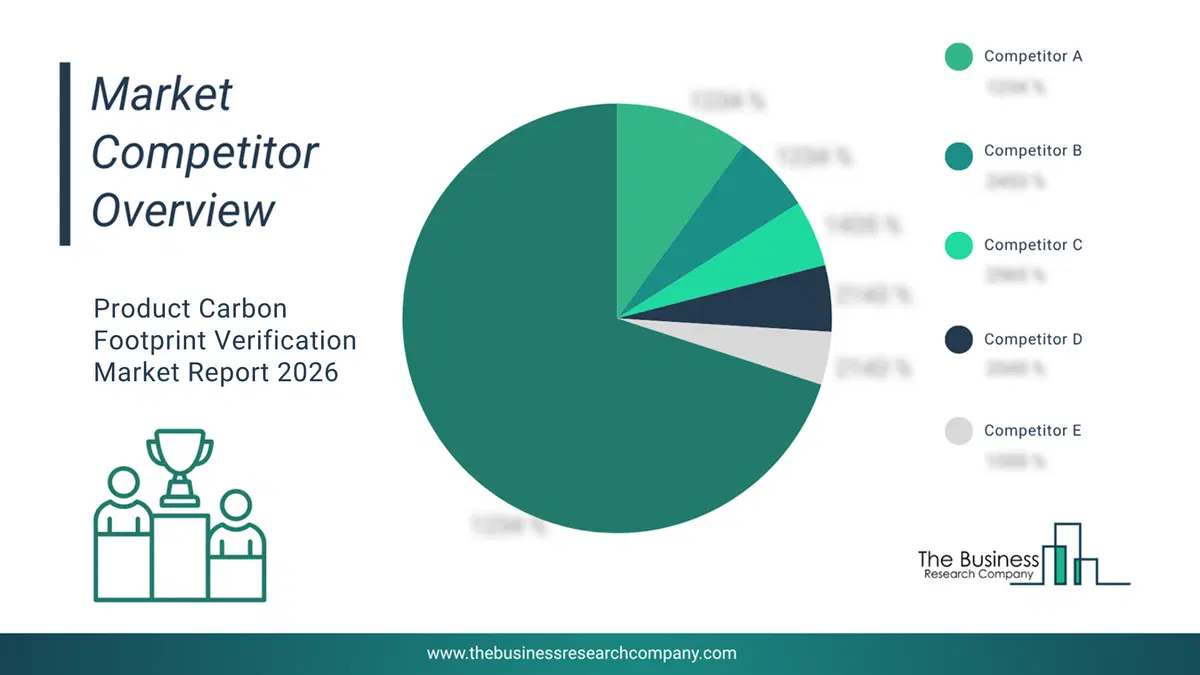
This chart is for illustrative purposes; the full report includes a detailed competitor analysis and comprehensive overview of the top 10 companies in the market.
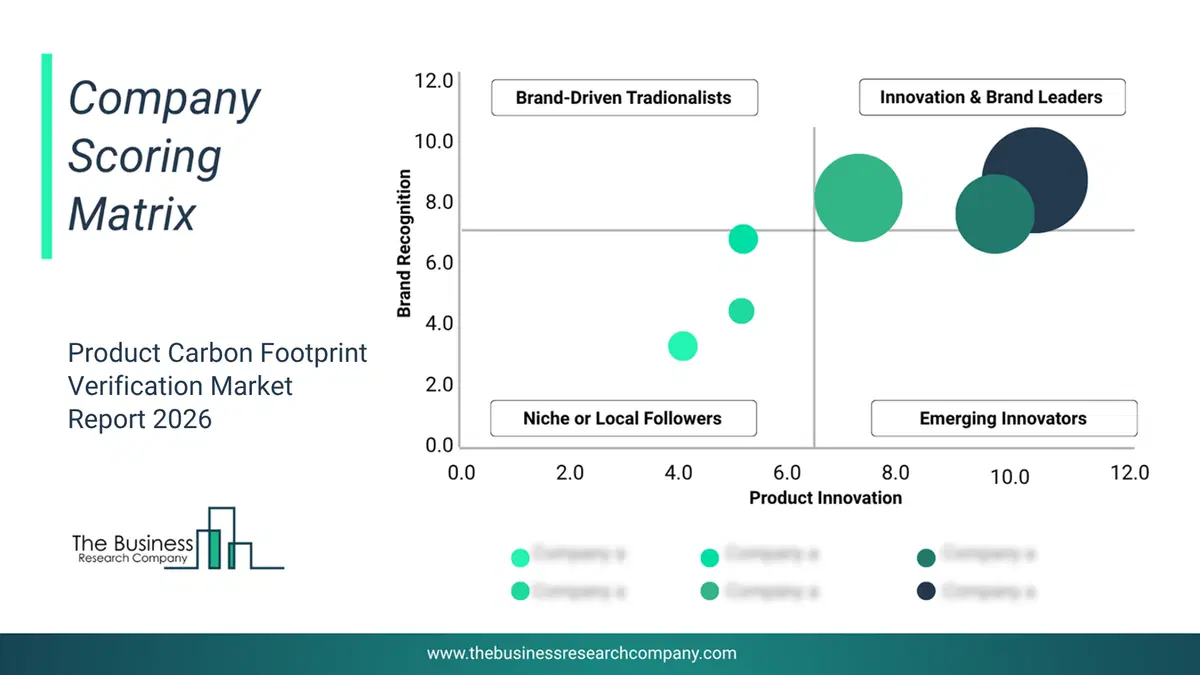
This chart maps companies by product innovation and brand strength, with bubble size indicating relative revenue, helping identify market leaders, challengers, and niche players. This is an illustrative chart; the full report provides a complete and accurate competitive analysis.
Global Product Carbon Footprint Verification Market Trends and Insights
Major companies operating in the product carbon footprint verification market are focusing on technological advancements, such as product carbon footprint tools, to enhance accuracy, streamline reporting processes, and provide real-time, data-driven insights for businesses. A product carbon footprint (PCF) Tool is a software or methodology used to measure, analyze, and report a product's total greenhouse gas (GHG) emissions throughout its lifecycle. For instance, in March 2023, HEINZ-GLAS GmbH & Co. KGaA, a Germany-based glass packaging manufacturer, introduced a Product Carbon Footprint (PCF) Tool to deliver precise, real-time CO₂ emission measurements, independently verified by TÜV SÜD in compliance with ISO 14067:2019 standards. Unlike conventional methods that rely on rough estimations, this tool provides highly accurate calculations down to the gram within five minutes, setting a new benchmark for sustainability reporting and transparency in the industry.What Are Latest Mergers And Acquisitions In The Product Carbon Footprint Verification Market?
In January 2025, Societe Generale de Surveillance SA., a Switzerland-based testing, inspection, and certification company, acquired Aster Global Environmental Solutions, Inc. for an undisclosed amount. With this acquisition, Societe Generale is leveraging Aster Global’s expertise in greenhouse gas (GHG) emissions validation and verification, forestry, and corporate social responsibility services to strengthen its position in sustainability solutions and support its Strategy 27 initiatives. Aster Global Environmental Solutions, Inc. is a US-based company that provides auditing, validation, and verification services for Greenhouse gas emissions.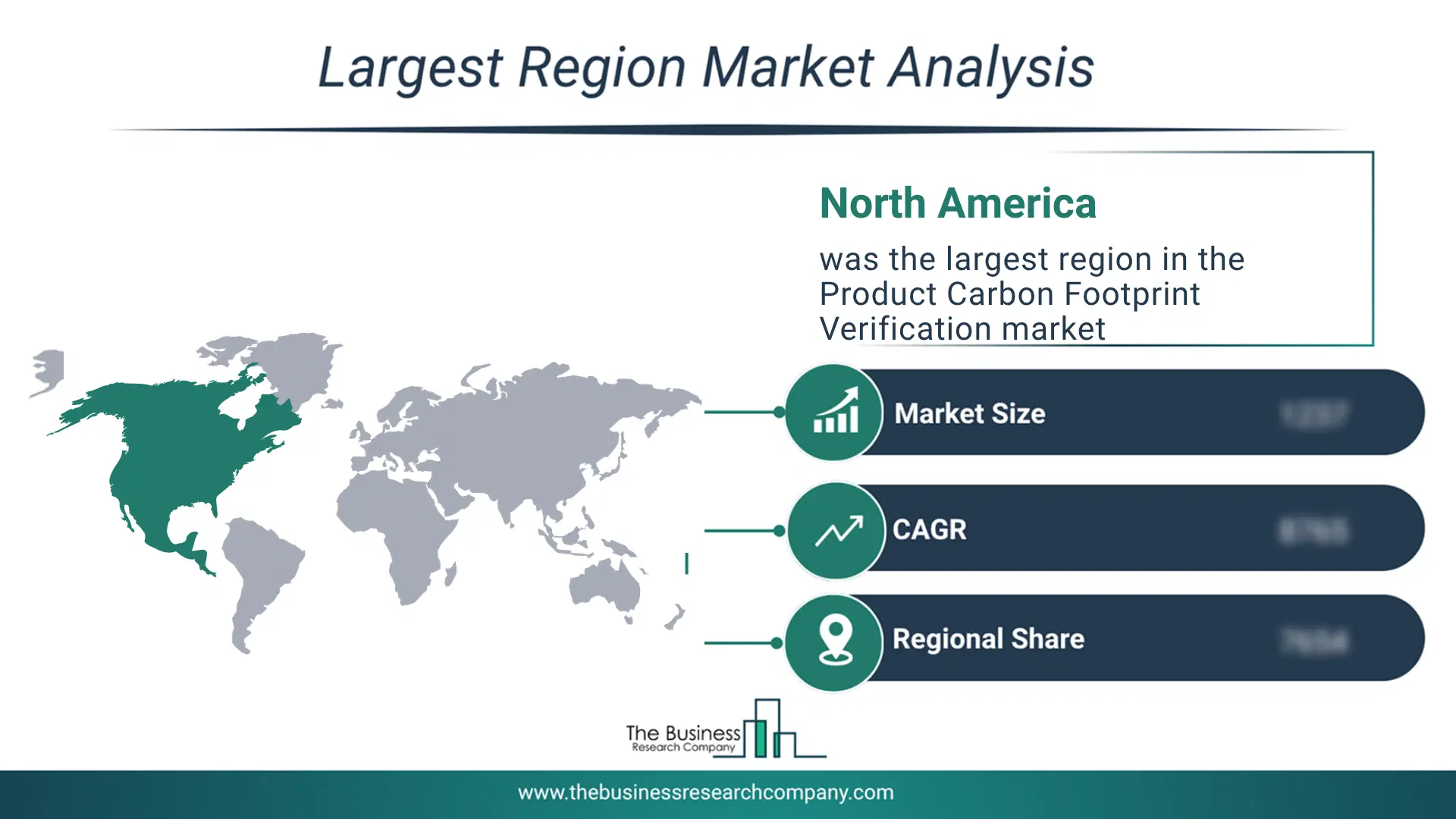
Regional Outlook
North America was the largest region in the product carbon footprint verification market in 2025. Asia-Pacific is expected to be the fastest-growing region in the forecast period. The regions covered in this market report are Asia-Pacific, South East Asia, Western Europe, Eastern Europe, North America, South America, Middle East, Africa. The countries covered in this market report are Australia, Brazil, China, France, Germany, India, Indonesia, Japan, Taiwan, Russia, South Korea, UK, USA, Canada, Italy, SpainWhat Defines the Product Carbon Footprint Verification Market?
The product carbon footprint verification market includes revenues earned by supply chain carbon footprint analysis, carbon neutrality validation, and carbon offset project validation and verification. The market value includes the value of related goods sold by the service provider or included within the service offering. Only goods and services traded between entities or sold to end consumers are included.How is Market Value Defined and Measured?
The market value is defined as the revenues that enterprises gain from the sale of goods and/or services within the specified market and geography through sales, grants, or donations in terms of the currency (in USD unless otherwise specified). The revenues for a specified geography are consumption values that are revenues generated by organizations in the specified geography within the market, irrespective of where they are produced. It does not include revenues from resales along the supply chain, either further along the supply chain or as part of other products.
This chart presents market attractiveness based on a quantitative evaluation of growth, competition, strategic alignment, and risk, offering a clear view of opportunity areas for decision-making. This chart is for illustrative purposes; the full report contains the complete analysis.

This chart highlights the Total Addressable Market (TAM) by estimating the maximum revenue opportunity using an assumption-driven approach, supporting strategic planning and opportunity sizing across markets. The chart is illustrative; the full report provides a more comprehensive analysis.
What Key Data and Analysis Are Included in the Product Carbon Footprint Verification Market Report 2026?
The product carbon footprint verification market research report is one of a series of new reports from The Business Research Company that provides market statistics, including industry global market size, regional shares, competitors with the market share, detailed market segments, market trends and opportunities, and any further data you may need to thrive in the product carbon footprint verification industry. The market research report delivers a complete perspective of everything you need, with an in-depth analysis of the current and future state of the industry.Product Carbon Footprint Verification Market Report Forecast Analysis
| Report Attribute | Details |
|---|---|
| Market Size Value In 2026 | $17.71 billion |
| Revenue Forecast In 2030 | $37.51 billion |
| Growth Rate | CAGR of 21.0% from 2026 to 2030 |
| Base Year For Estimation | 2025 |
| Actual Estimates/Historical Data | 2020-2025 |
| Forecast Period | 2026 - 2030 - 2030 |
| Market Representation | Revenue in USD Billion and CAGR from 2026 to 2030 |
| Segments Covered | Service Type, Verification Type, Verification Standard, Organization Size, Industry |
| Regional Scope | Asia-Pacific, Western Europe, Eastern Europe, North America, South America, Middle East, Africa |
| Country Scope | The countries covered in the report are Australia, Brazil, China, France, Germany, India, Indonesia, Japan, Taiwan, Russia, South Korea, UK, USA, Canada, Italy, Spain. |
| Key Companies Profiled | SGS SA, Bureau Veritas, DEKRA SE, Intertek Group plc, TÜV SÜD AG, UL Solutions, Applus+ Services SA, TÜV Nord AG, BSI Group, Verra, LRQA, DQS Holding, Carbon Trust, SCS Global Services, ClimatePartner, Circular Ecology, Carbon Footprint Ltd, DNV GL, GEP Environmental, Carbon Credentials |
| Customization Scope | Request for Customization |
| Pricing And Purchase Options | Explore Purchase Options |