

Product Lifecycle Management Market Report 2026
Global Outlook – By Component (Software, Services), By Deployment (On-Premise, On-Cloud), By End-User (Automotive and Transportation, Industrial Machinery, Electronics and Semiconductors, Retail, Energy and Utilities, Aerospace and Defense, Pharmaceuticals, IT and Telecomm, Other End Users) – Market Size, Trends, Strategies, and Forecast to 2030
Product Lifecycle Management Market Overview
• Product Lifecycle Management market size has reached to $41.08 billion in 2025 • Expected to grow to $63.53 billion in 2030 at a compound annual growth rate (CAGR) of 9.1% • Growth Driver: The Role of Digitalization in Accelerating Product Lifecycle Management Market Growth • Market Trend: Innovative Centralized Data Management Enhances Asset Lifecycle Management Efficiency • North America was the largest region in 2025.What Is Covered Under Product Lifecycle Management Market?
Product Lifecycle Management (PLM) refers to managing every step of the process involved with a product from raw material to finished product. The PLM process is inclusive of the manufacturing and marketing of the goods. From pricing and advertising to expansion or cost-cutting, the concept of product life cycle assists organizations in making smart business decisions. The main components of the product lifecycle management market include software and services. PLM software enables businesses to strategically collaborate with partners and customers using trusted, up-to-date product information. PLM can be deployed either on-premises or on-cloud. The end-users of PLM include the automotive and transportation industry, industrial machinery, electronics and semiconductors, retail, energy and utilities, aerospace and defense, pharmaceuticals, IT and telecom, and others.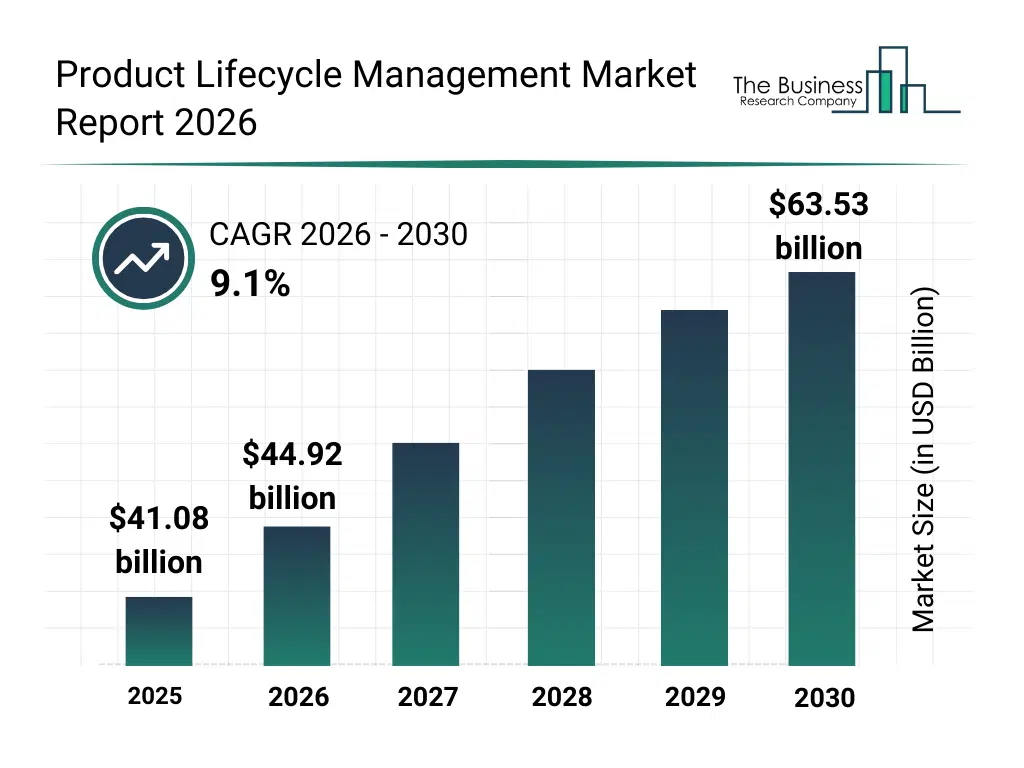
What Is The Product Lifecycle Management Market Size and Share 2026?
The product lifecycle management market size has grown strongly in recent years. It will grow from $41.08 billion in 2025 to $44.92 billion in 2026 at a compound annual growth rate (CAGR) of 9.4%. The growth in the historic period can be attributed to increasing product complexity across industries, need for centralized product information management, globalization of manufacturing operations, demand for improved design efficiency, rising competition in product-based industries.What Is The Product Lifecycle Management Market Growth Forecast?
The product lifecycle management market size is expected to see strong growth in the next few years. It will grow to $63.53 billion in 2030 at a compound annual growth rate (CAGR) of 9.1%. The growth in the forecast period can be attributed to growing adoption among mid-sized enterprises, increasing need for product customization, rising focus on sustainable product design, expansion of digital manufacturing ecosystems, increasing integration with enterprise systems. Major trends in the forecast period include increasing adoption of end-to-end product data integration, growing focus on cross-functional collaboration in product development, rising demand for faster time-to-market management, expansion of lifecycle cost and performance optimization, greater emphasis on compliance and product traceability.
Global Product Lifecycle Management Market Segmentation
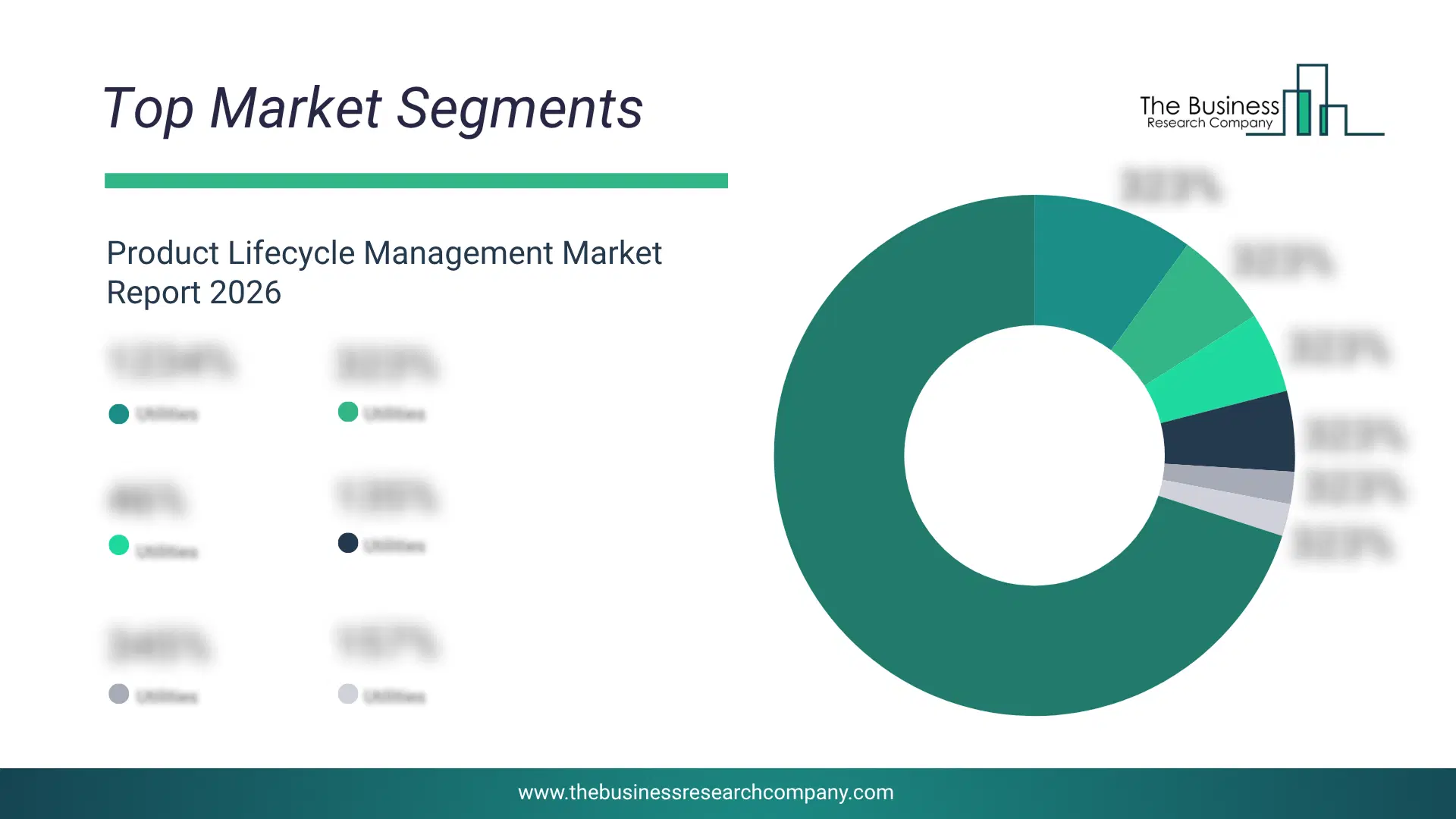
1) By Component: Software, Services 2) By Deployment: On-Premise, On-Cloud 3) By End-User: Automotive and Transportation, Industrial Machinery, Electronics and Semiconductors, Retail, Energy and Utilities, Aerospace and Defense, Pharmaceuticals, IT and Telecomm, Other End Users Subsegments: 1) By Software: Collaborative Product Development Software, Product Data Management (PDM) Software, Quality Management Software, Configuration Management Software 2) By Services: Consulting Services, Implementation Services, Training Services, Support And Maintenance Services, Integration ServicesWhat Is The Driver Of The Product Lifecycle Management Market?
Increased adoption of digitalization is expected to propel the growth of the product lifecycle management market. The adoption of digitalization is attributed to the need for improved efficiency, streamlined workflows, and enhanced collaboration across product development cycles, enabling companies to innovate faster and stay competitive in dynamic markets. Product lifecycle management (PLM) facilitates digitalization by providing a centralized platform for managing product data, processes, and collaboration, enabling organizations to integrate digital technologies, streamline workflows, and enhance decision-making throughout the entire product lifecycle. For instance, in November 2023, according to a report published by the Central Digital and Data Office, a UK-based government entity, the government’s focus on digital transformation has resulted in a 9% growth in the Government Digital and Data profession over the past six months, bringing the total number of professionals in this field to 28,337. Therefore, increased adoption of digitalization is driving the growth of the product lifecycle management industry.Key Players In The Global Product Lifecycle Management Market
Major companies operating in the product lifecycle management market are Oracle Corporation; Siemens AG; PTC Inc.; Dassault Systèmes SE; Autodesk, Inc; SAP SE; Arena Solutions; Infor; Aras Corporation; Odoo; Jama Connect; Anvyl; PDXper; OpenBOM; Diota; Masters of Pie; Sopheon PLC; Capgemini; Accenturs; Lectra SA; IBM Corporation; Epicor Software Corporation; Deloitte Consulting and TCS; IFS; Propel; FusePLM; Bamboo Rose; Inflectra; DXC Technology Co.; Gerber Technology; Centric Software, Inc; Biglever software; Selerant Corporation; Metalfor; ISO Qualitas; Indish Technologies; Mckit Systems; Product one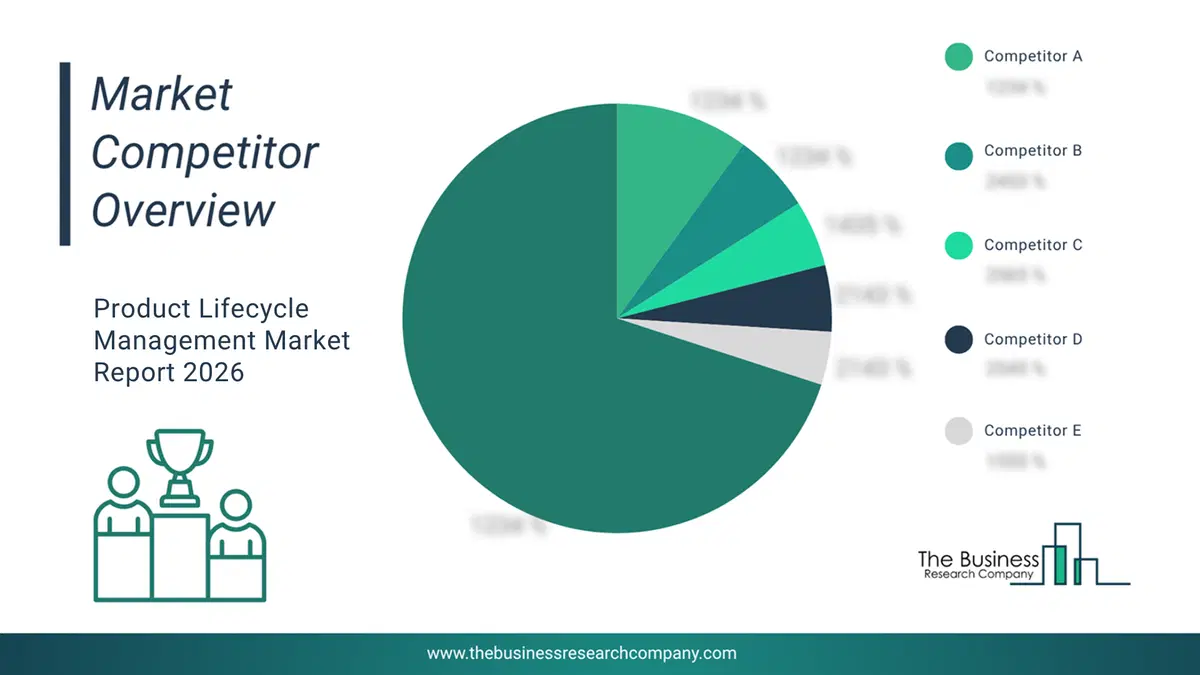
This chart is for illustrative purposes; the full report includes a detailed competitor analysis and comprehensive overview of the top 10 companies in the market.
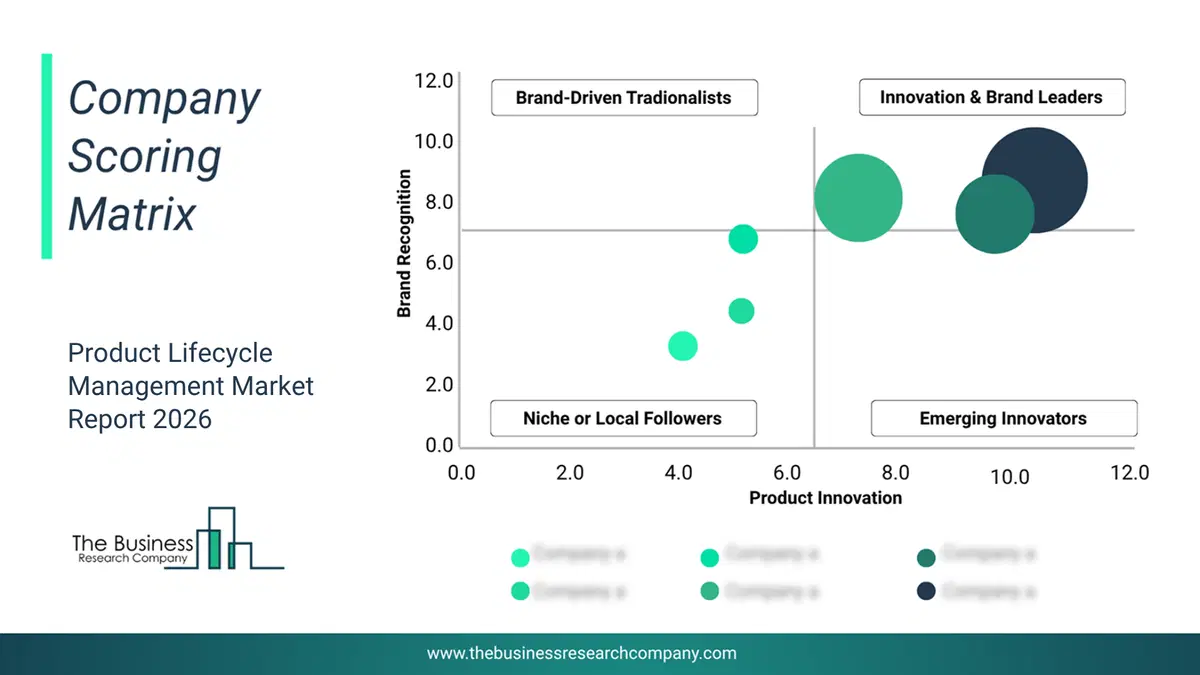
This chart maps companies by product innovation and brand strength, with bubble size indicating relative revenue, helping identify market leaders, challengers, and niche players. This is an illustrative chart; the full report provides a complete and accurate competitive analysis.
Global Product Lifecycle Management Market Trends and Insights
Major companies operating in the product lifecycle management market are focusing on developing innovation, such as centralized data management, which provides a unified platform that enhances data visibility and control over asset management processes. Centralized data management refers to the approach of storing, organizing, and managing data in a single, central repository or system. For instance, in July 2024, Trimble Inc., a US-based software company, launched Trimble Unity, designed for comprehensive asset lifecycle management. An end-to-end asset lifecycle management software suite aims to enhance asset performance, stakeholder collaboration, and budget optimization. The solution integrates cloud-based construction management, GIS-centric enterprise asset management, and efficient permitting capabilities. It centralizes data management to improve visibility and reduce asset ownership costs by up to 40%. This cohesive platform unifies various existing tools, streamlining accessibility and collaboration across asset data.What Are Latest Mergers And Acquisitions In The Product Lifecycle Management Market?
In October 2023, Akkodis AG, a France-based technology company, acquired Progneur Technologies for an undisclosed amount. With this acquisition, Akkodis aims to enhance its product lifecycle management (PLM) capabilities and expand its technological offerings to better serve clients across multiple industries. Progneur Technologies Private Limited is an India-based technology company that specializes in providing advanced PLM solutions, including software and consulting services that optimize product development, collaboration, and operational efficiency.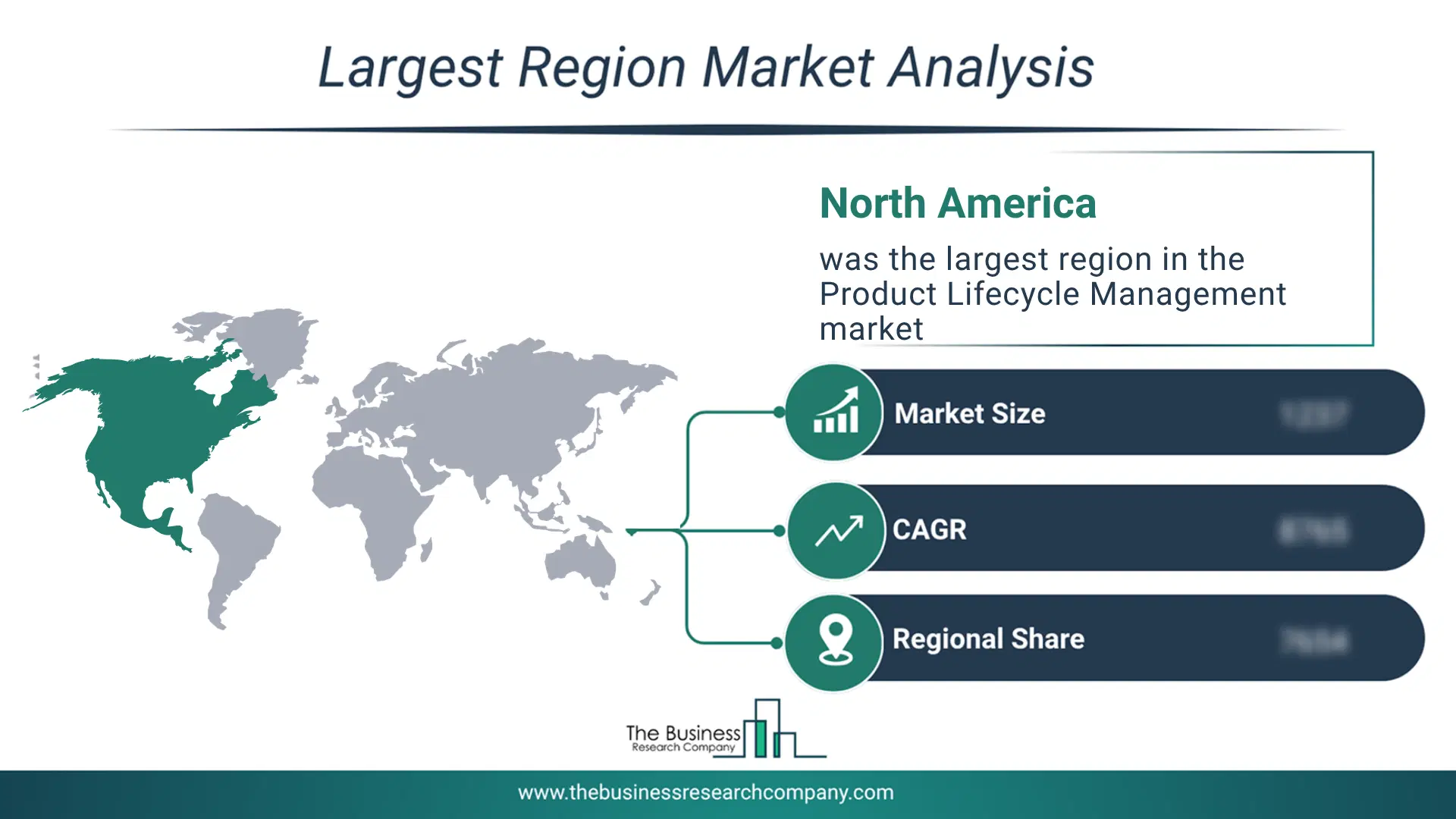
Regional Insights
North America was the largest region in the product lifecycle management market in 2025. The regions covered in this market report are Asia-Pacific, South East Asia, Western Europe, Eastern Europe, North America, South America, Middle East, Africa. The countries covered in this market report are Australia, Brazil, China, France, Germany, India, Indonesia, Japan, Taiwan, Russia, South Korea, UK, USA, Canada, Italy, SpainWhat Defines the Product Lifecycle Management Market?
The product life cycle management market includes revenues earned by entities by providing solutions and services that provide solution such as initial design through manufacturing, supply chain management and operations, and asset maintenance by incorporating digital solutions, data, and data processing. The market value includes the value of related goods sold by the service provider or included within the service offering. Only goods and services traded between entities or sold to end consumers are included.How is Market Value Defined and Measured?
The market value is defined as the revenues that enterprises gain from the sale of goods and/or services within the specified market and geography through sales, grants, or donations in terms of the currency (in USD unless otherwise specified). The revenues for a specified geography are consumption values that are revenues generated by organizations in the specified geography within the market, irrespective of where they are produced. It does not include revenues from resales along the supply chain, either further along the supply chain or as part of other products.
This chart presents market attractiveness based on a quantitative evaluation of growth, competition, strategic alignment, and risk, offering a clear view of opportunity areas for decision-making. This chart is for illustrative purposes; the full report contains the complete analysis.

This chart highlights the Total Addressable Market (TAM) by estimating the maximum revenue opportunity using an assumption-driven approach, supporting strategic planning and opportunity sizing across markets. The chart is illustrative; the full report provides a more comprehensive analysis.
What Key Data and Analysis Are Included in the Product Lifecycle Management Market Report 2026?
The product lifecycle management market research report is one of a series of new reports from The Business Research Company that provides market statistics, including industry global market size, regional shares, competitors with the market share, detailed market segments, market trends and opportunities, and any further data you may need to thrive in the product lifecycle management industry. The market research report delivers a complete perspective of everything you need, with an in-depth analysis of the current and future state of the industry.Product Lifecycle Management Market Report Forecast Analysis
| Report Attribute | Details |
|---|---|
| Market Size Value In 2026 | $44.92 billion |
| Revenue Forecast In 2030 | $63.53 billion |
| Growth Rate | CAGR of 9.1% from 2026 to 2030 |
| Base Year For Estimation | 2025 |
| Actual Estimates/Historical Data | 2020-2025 |
| Forecast Period | 2026 - 2030 |
| Market Representation | Revenue in USD Billion and CAGR from 2026 to 2030 |
| Segments Covered | Component, Deployment, End-User |
| Regional Scope | Asia-Pacific, Western Europe, Eastern Europe, North America, South America, Middle East, Africa |
| Country Scope | The Countries Covered In This Market Report Are Australia, Brazil, China, France, Germany, India, Indonesia, Japan, Taiwan, Russia, South Korea, Uk, Usa, Canada, Italy, Spain. |
| Key Companies Profiled | Oracle Corporation, Siemens AG, PTC Inc., Dassault Systèmes SE, Autodesk, Inc, SAP SE, Arena Solutions, Infor, Aras Corporation, Odoo, Jama Connect, Anvyl, PDXper, OpenBOM, Diota, Masters of Pie, Sopheon PLC, Capgemini, Accenturs, Lectra SA, IBM Corporation, Epicor Software Corporation, Deloitte Consulting and TCS, IFS, Propel, FusePLM, Bamboo Rose, Inflectra, DXC Technology Co., Gerber Technology, Centric Software, Inc, Biglever software, Selerant Corporation, Metalfor, ISO Qualitas, Indish Technologies, Mckit Systems, Product one |
| Customization Scope | Request for Customization |
| Pricing And Purchase Options | Explore Purchase Options |