
Professional Lighting Market Report 2026
Global Outlook – By Product Type (Light Emitting Diode Lighting, Fluorescent Lighting, Incandescent Lighting, High-Intensity Discharge Lighting, Smart Lighting Solutions), By Distribution Channel (Direct Sales, Distributors Or Wholesalers, Retailers, Online Sales), By Application (Commercial Buildings, Industrial Facilities, Architectural Projects, Outdoor And Public Infrastructure, Entertainment And Events, Warehouses And Logistics, Emergency And Safety Lighting), By End User (Offices, Retail Stores, Hospitality, Healthcare Facilities, Educational Institutions, Manufacturing Plants, Government And Municipalities, Transportation Hubs) – Market Size, Trends, Strategies, and Forecast to 2030
Professional Lighting Market Overview
• Professional Lighting market size has reached to $38.42 billion in 2025 • Expected to grow to $53.45 billion in 2030 at a compound annual growth rate (CAGR) of 6.9% • Growth Driver: Surge In Iot-Enabled Smart Lighting Integration Fueling The Growth Of The Market Due To Rising Demand For Automation • Market Trend: Advanced Multi-Channel Platforms Enable Precise Independent Light Management For Creators • Asia-Pacific was the largest region and fastest growing region.Market Gains By 2030 – Top Opportunities By Segment
Market Gain identifies the most promising market opportunities by highlighting the segments or products expected to generate the highest incremental revenue growth over the next five years.
What Is Covered Under Professional Lighting Market?
Professional lighting is a category of lighting solutions engineered for specialized environments that require reliable, high-quality, and controllable illumination. It is commonly used in workplaces, performance venues, and large-scale facilities to ensure optimal visual performance and energy-efficient operation. The main product types of professional lighting include light emitting diode lighting, fluorescent lighting, incandescent lighting, high-intensity discharge lighting, and smart lighting solutions. Light emitting diode lighting refers to energy-efficient lighting systems that use semiconductor technology to provide long-lasting and high-performance illumination for professional and commercial environments. They are distributed through channels include direct sales, distributors or wholesalers, retailers, and online sales. The various applications involved are commercial buildings, industrial facilities, architectural projects, outdoor and public infrastructure, entertainment and events, warehouses and logistics, and emergency and safety lighting, and they are used by several end users such as offices, retail stores, hospitality, healthcare facilities, educational institutions, manufacturing plants, government and municipalities, and transportation hubs.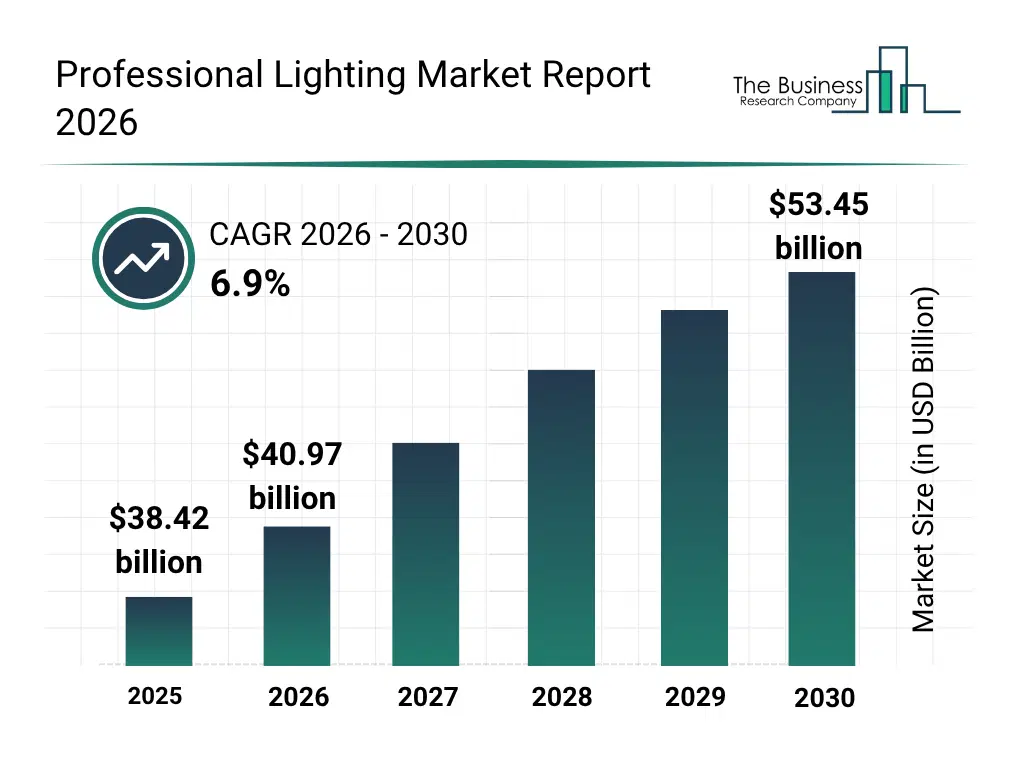
What Is The Professional Lighting Market Size and Share 2026?
The professional lighting market size has grown strongly in recent years.It will grow from $38.42 billion in 2025 to $40.97 billion in 2026 at a compound annual growth rate (CAGR) of 6.6%. The growth in the historic period can be attributed to growing demand for energy-efficient lighting solutions, expansion of commercial infrastructure development, increasing adoption of LED technology, rising investments in smart building projects, growth in entertainment and event industries.What Is The Professional Lighting Market Growth Forecast?
The professional lighting market size is expected to see strong growth in the next few years.It will grow to $53.45 billion by 2030 at a compound annual growth rate (CAGR) of 6.9%. The growth in the forecast period can be attributed to increasing deployment of connected lighting systems, rising demand for intelligent lighting automation, growing investments in sustainable infrastructure projects, expansion of smart city development initiatives, increasing adoption of adaptive workplace lighting solutions.Major trends in the forecast period include increasing adoption of energy-efficient LED lighting systems, rising demand for customizable illumination solutions, growing integration of wireless lighting controls, expansion of human-centric lighting applications, increasing use of professional lighting in entertainment and architectural projects.
Global Professional Lighting Market Segmentation
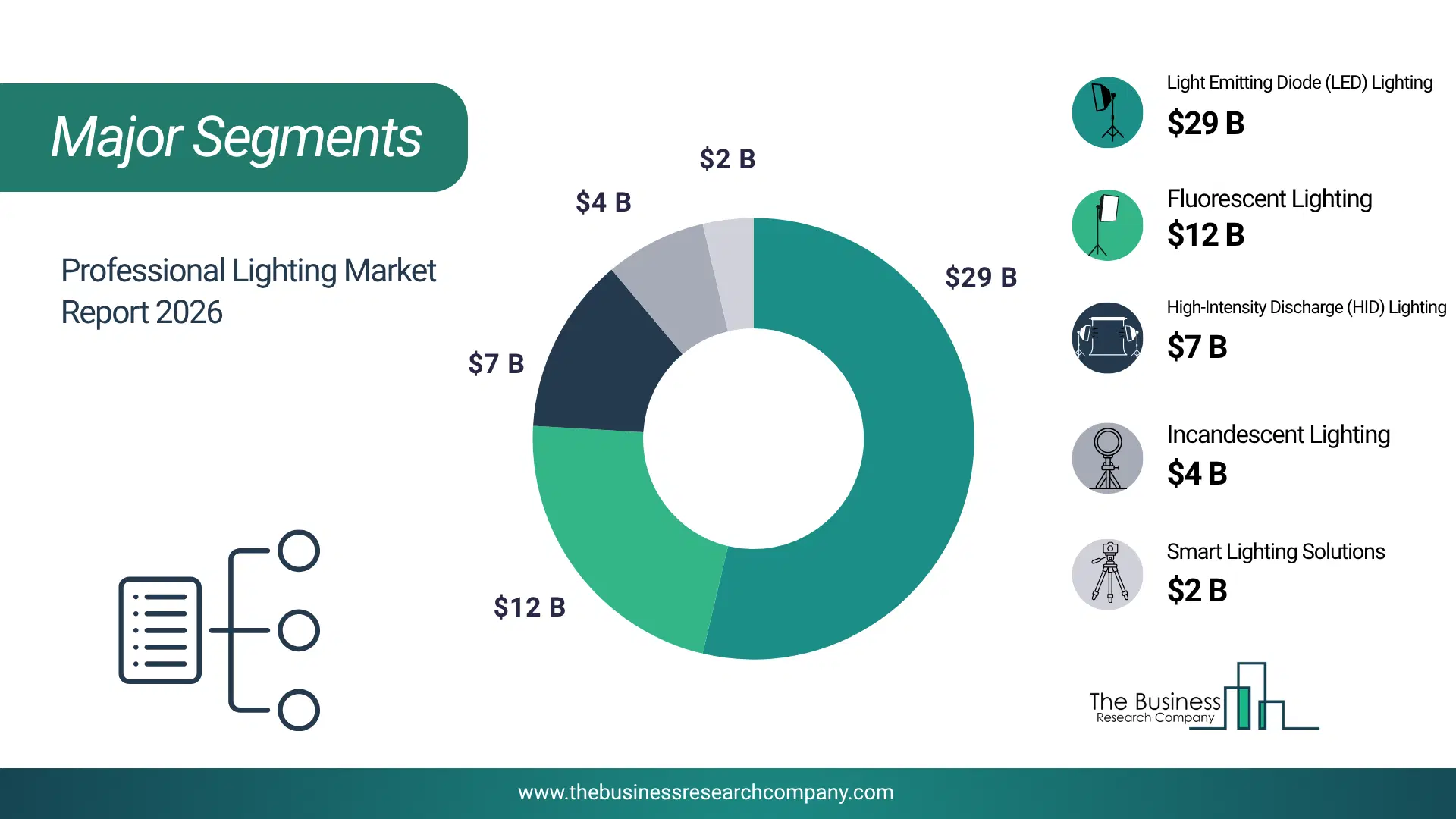
1) By Product Type: Light Emitting Diode Lighting, Fluorescent Lighting, Incandescent Lighting, High-Intensity Discharge Lighting, Smart Lighting Solutions 2) By Distribution Channel: Direct Sales, Distributors Or Wholesalers, Retailers, Online Sales 3) By Application: Commercial Buildings, Industrial Facilities, Architectural Projects, Outdoor And Public Infrastructure, Entertainment And Events, Warehouses And Logistics, Emergency And Safety Lighting 4) By End User: Offices, Retail Stores, Hospitality, Healthcare Facilities, Educational Institutions, Manufacturing Plants, Government And Municipalities, Transportation Hubs Subsegments: 1) By Light Emitting Diode Lighting: Light Emitting Diode Bulbs, Light Emitting Diode Tube Lights, Light Emitting Diode Panel Lights, Light Emitting Diode Downlights, Light Emitting Diode Strip Lighting Systems, Light Emitting Diode High Bay Lighting Fixtures, Light Emitting Diode Flood Lighting Fixtures, Light Emitting Diode Street Lighting Fixtures, Light Emitting Diode Troffer Lighting Systems 2) By Fluorescent Lighting: Linear Fluorescent Tube Lights Of T Five Specification, Linear Fluorescent Tube Lights Of T Eight Specification, Linear Fluorescent Tube Lights Of T Twelve Specification, Compact Fluorescent Lamps, Circular Fluorescent Lamps, U-Shaped Fluorescent Tube Lights, High Output Fluorescent Lamps 3) By Incandescent Lighting: Standard Incandescent Light Bulbs, Halogen Incandescent Light Bulbs, Reflector Type Incandescent Lamps, Decorative Incandescent Light Bulbs, Specialty Incandescent Lighting Lamps 4) By High-Intensity Discharge Lighting: Metal Halide Lamps, High-Pressure Sodium Vapor Lamps, Low-Pressure Sodium Vapor Lamps, Mercury Vapor Lamps 5) By Smart Lighting Solutions: Smart Light Bulbs, Smart Lighting Fixtures, Sensor Integrated Lighting Systems, Internet Of Things Enabled Lighting Control Systems, Wireless Controllable Dimmable Lighting Systems, Tunable White And Color Changing Lighting Systems The top segments in the professional lighting market will be: • Light Emitting Diode (LED) Lighting will reach $28.92 Billion by 2030. • Fluorescent Lighting will reach $11.5 Billion by 2030. • High-Intensity Discharge (HID) Lighting will reach $6.8 Billion by 2030. • Incandescent Lighting will reach $4.45 Billion by 2030. • Smart Lighting Solutions will reach $1.78 Billion by 2030.What Is The Driver Of The Professional Lighting Market?
The increasing integration of IoT-enabled smart lighting is expected to propel the growth of the professional lighting industry going forward.IoT-enabled smart lighting is a connected lighting system that uses sensors and internet connectivity to automatically control and optimize lighting based on real-time conditions and user needs.The adoption of IoT-enabled smart lighting is increasing because it significantly improves energy efficiency by automatically adjusting lighting based on occupancy and natural light availability, thereby reducing unnecessary electricity consumption and lowering operational costs.Professional lighting supports IoT-enabled smart lighting by combining high-performance lighting hardware with connected controls and sensors, enabling intelligent automation, energy optimization, and seamless remote operation across buildings and infrastructure.For instance, in March 2026, according to the Energy Information Administration, a US-based government agency, in 2024, home automation technology enabled the control of both indoor and outdoor lighting through smart speakers.Around 47 million households, representing 36% of all homes, owned at least one smart speaker, and nearly 14 million of these households used the devices specifically to manage their lighting.Therefore, the increasing integration of IoT-enabled smart lighting is driving the growth of the professional lighting industry.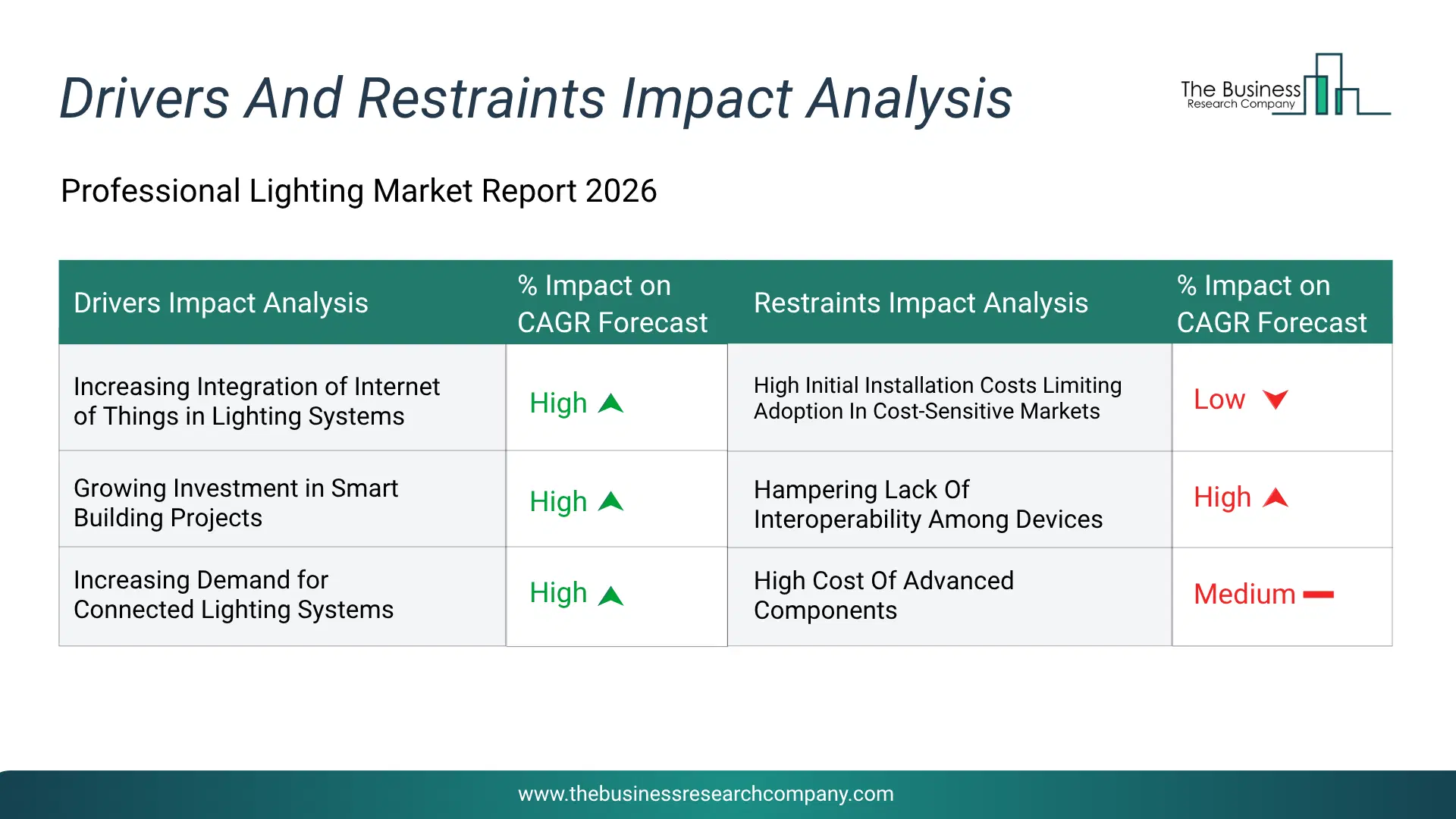
Infographic Chart Showing Key Market Drivers Analysis And Restraints For Professional Lighting Market
The chart presents an impact analysis of key drivers and restraints, quantifying their relative influence on the market's growth rate and helping assess the balance between growth enablers and limiting factors. This chart offers a high-level perspective; the full report contains more detailed insights.
How Will The Drivers Impact Growth In The Global Professional Lighting Market?
• Increasing Integration of Internet of Things in Lighting Systems (High) – During the forecast period, the increasing integration of internet of things (IoT) in lighting systems is expected to become a key growth driver for the professional lighting market by 2030. The growing adoption of IoT-enabled lighting solutions is enhancing operational efficiency and enabling real-time monitoring and control across commercial and industrial environments. Smart lighting systems equipped with sensors and connectivity features allow automated adjustments based on occupancy, daylight availability, and energy consumption patterns. This technological shift is encouraging businesses and municipalities to transition toward intelligent lighting infrastructures that optimize performance and reduce operational costs. Furthermore, the integration of IoT platforms supports data-driven decision-making and predictive maintenance capabilities. • Growing Investment in Smart Building Projects (High) – During the forecast period, the growing investment in smart building projects is expected to emerge as a major factor driving the expansion of the professional lighting market by 2030. Increasing construction of smart commercial complexes and intelligent infrastructure is accelerating the adoption of advanced lighting systems designed to enhance building performance and occupant experience. These projects prioritize energy optimization, automation, and integrated control systems, which significantly increase the demand for technologically advanced lighting solutions. Additionally, developers and facility managers are focusing on implementing centralized lighting controls that align with modern building management systems. The expansion of green building initiatives and sustainable construction practices further reinforces the deployment of efficient lighting technologies. • Increasing Demand for Connected Lighting Systems (High) – During the forecast period, the increasing demand for connected lighting systems is expected to act as a key growth catalyst for the professional lighting market by 2030. The rising need for seamless integration of lighting with digital networks and control platforms is driving the adoption of connected solutions across commercial and industrial settings. Connected lighting enables remote access, centralized control, and enhanced flexibility in managing lighting environments, which improves operational efficiency and user convenience. This trend is particularly prominent in large-scale facilities such as offices, warehouses, and public infrastructure where efficient lighting management is critical. Moreover, advancements in wireless communication technologies are supporting the rapid deployment of connected lighting systems.How Will The Restraints Impact Growth In The Global Professional Lighting Market?
• High Initial Installation Costs Limiting Adoption In Cost-Sensitive Markets (High) – During the forecast period, high initial installation costs significantly restrain the growth of professional lighting, especially in cost-sensitive commercial and industrial applications. Advanced lighting systems such as architectural, smart, and studio lighting require expensive fixtures, control systems, and professional installation services. These high upfront costs discourage small and mid-sized enterprises from upgrading existing lighting infrastructure. As a result, adoption rates remain slower despite long-term efficiency benefits. This limits factory-gate sales volumes and delays replacement cycles across developing and price-conscious regions. • Hampering Lack Of Interoperability Among Devices (High) – During the forecast period, hampering lack of interoperability among devices restricts the widespread deployment of professional smart lighting systems. Many advanced lighting solutions use proprietary communication protocols, making it difficult to integrate fixtures, sensors, and control platforms from different manufacturers. This increases system complexity and reduces flexibility for large commercial and entertainment installations. Organizations may delay or avoid investments due to integration risks and vendor lock-in concerns. Consequently, demand for connected lighting solutions and related services is constrained, affecting overall revenue growth. • High Cost Of Advanced Components (High) – During the forecast period, the high cost of advanced components such as LED chips, drivers, sensors, and control modules acts as a major restraint on professional lighting growth. These components are essential for achieving precise light control, automation, and energy efficiency in specialized environments. Elevated component costs increase the final product price at the factory gate level, impacting purchasing decisions for large-scale projects. This limits adoption in budget-restricted commercial and public infrastructure projects. Over time, this restraint slows the pace of technological penetration despite rising performance expectations.Key Players In The Global Professional Lighting Market
Major companies operating in the professional lighting market are Signify NV, Panasonic Holdings Corp., Samsung Electronics Co. Ltd., Zumtobel Group AG, Toshiba Corp., Hubbell Inc., Opple Lighting Co. Ltd., MIDEA Group Co. Ltd., TCL Industries Holdings Co. Ltd., Glamox AS, Dialight PLC, Wipro Ltd., GE Lighting, Energizer Holdings Inc., The Feilo Sylvania Group, NVC Lighting Ltd., TRILUX GmbH and Co. KG, CHAUVET Professional, HUAYI Lighting Company Ltd., US LED Ltd., Holectron, Lumega, Leedarson IoT Technology Inc., Topstar Inc.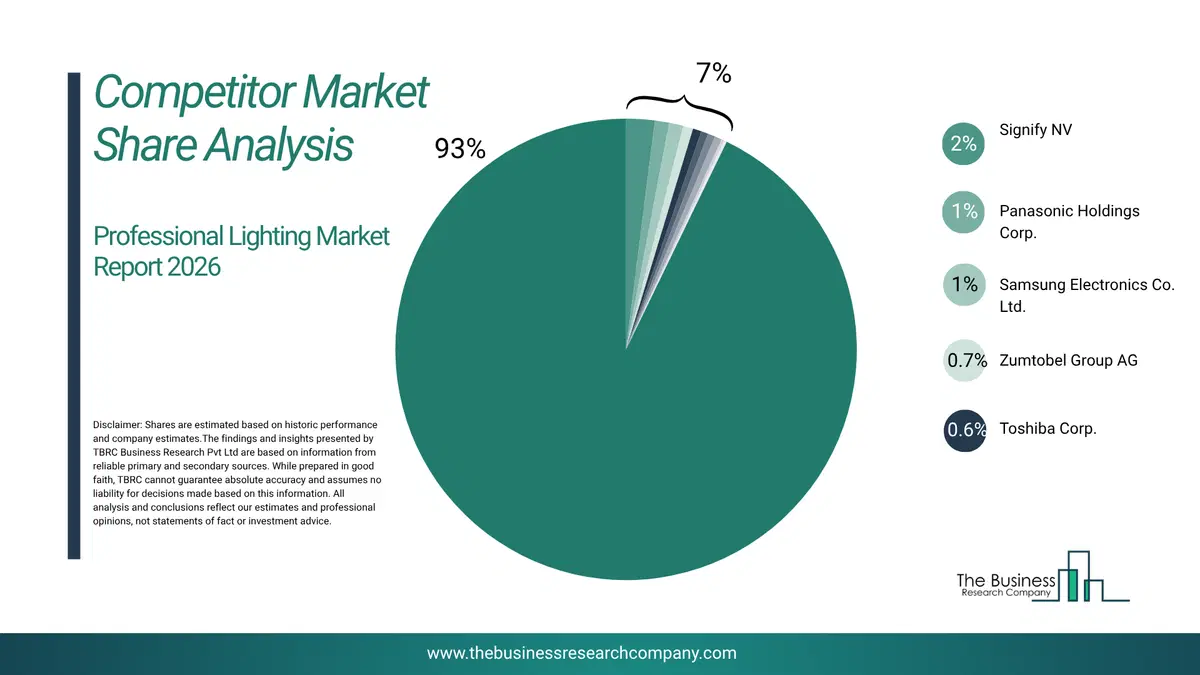
This chart is for illustrative purposes; the full report includes a detailed competitor analysis and comprehensive overview of the top 10 companies in the market.
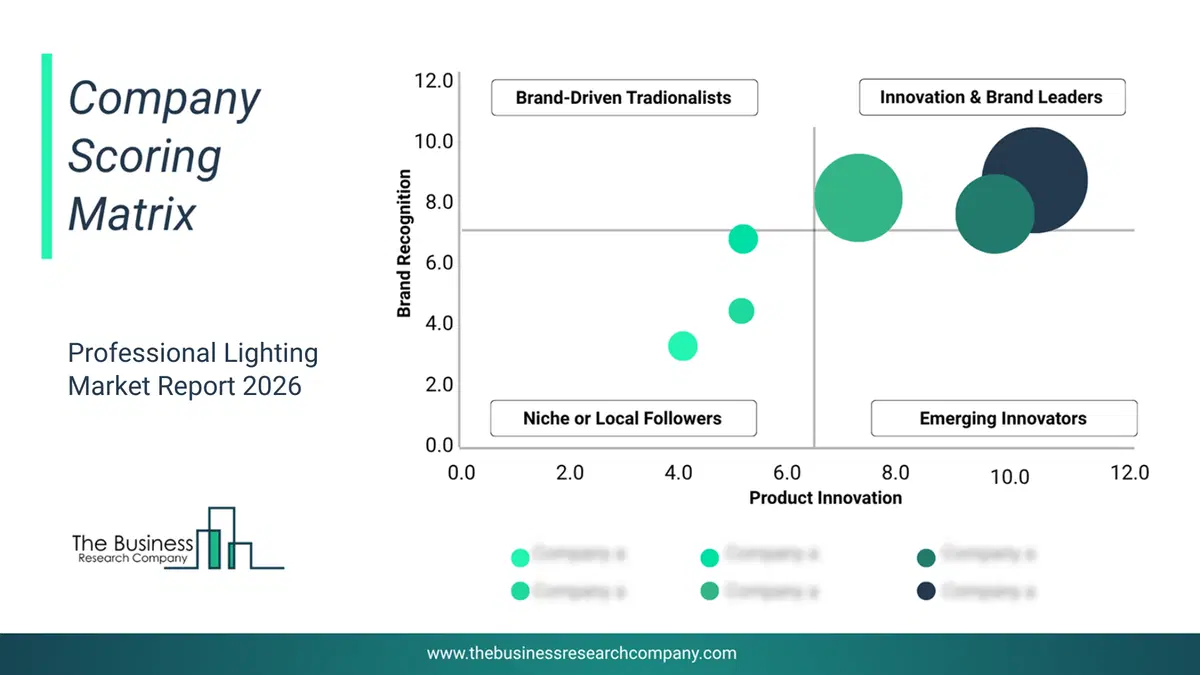
This chart maps companies by product innovation and brand strength, with bubble size indicating relative revenue, helping identify market leaders, challengers, and niche players. This is an illustrative chart; the full report provides a complete and accurate competitive analysis.
Global Professional Lighting Market Trends and Insights
Major companies operating in the professional lighting market are focusing on developing innovative solutions, such as dual-power intelligent lighting platforms to enable photographers and studios to control multiple light sources independently, with precise regulation of power output, color temperature, and flash timing, all through a unified integrated interface. Dual-power intelligent lighting platforms refer to lighting systems capable of operating on both AC mains and high-capacity batteries, providing flexibility for studio and on-location shoots while supporting full customization via touchscreens, mobile applications, or programmable APIs. For instance, in June 2023, Bron Elektronik AG, a Switzerland-based high-end manufacturer specializing in professional lighting systems for photography and videography, launched its next-generation professional lighting equipment featuring the Satos power pack and Pulso S lamp. The system delivers rapid recycle times, ultra-short flash durations, and seamless compatibility with existing Broncolor products while enabling alternative, delayed, and sequential triggering for advanced lighting effects without requiring additional power packs. Additionally, Satos supports remote control via the bronControl app and Python API, allowing studios to design highly customized lighting configurations for professional photography across diverse environments.What Are Latest Mergers And Acquisitions In The Professional Lighting Market?
In November 2025, Cooper Lighting Solutions, a US-based manufacturing company, acquired Nemalux Inc. for an undisclosed amount. With this acquisition, Cooper Lighting Solutions aims to expand its industrial lighting portfolio and strengthen its position in hazardous-location and harsh-environment applications across North America. Nemalux Inc. is a Canada-based manufacturing company that offers professional lighting solutions.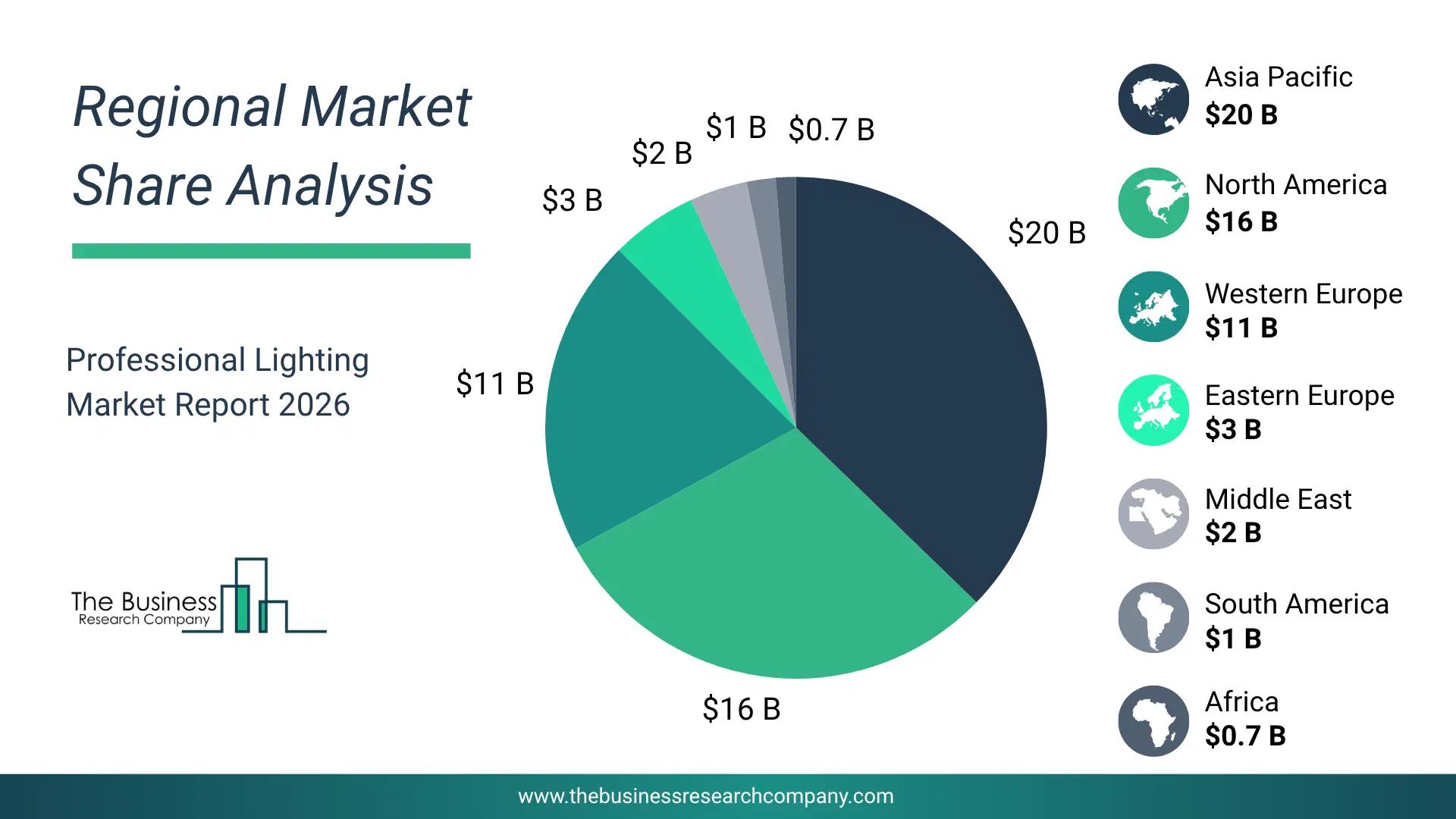
Regional Insights
Asia-Pacific was the largest region in the professional lighting market in 2025 and is expected to be the fastest-growing region in the forecast period. The regions covered in this market report are Asia-Pacific, South East Asia, Western Europe, Eastern Europe, North America, South America, Middle East and Africa. The countries covered in this market report are Australia, Brazil, China, France, Germany, India, Indonesia, Japan, Taiwan, Russia, South Korea, UK, USA, Canada, Italy, Spain.What Defines the Professional Lighting Market?
The professional lighting market consists of sales of linear lighting systems, track lighting systems, and smart lighting control systems. Values in this market are ‘factory gate’ values, that is, the value of goods sold by the manufacturers or creators of the goods, whether to other entities (including downstream manufacturers, wholesalers, distributors, and retailers) or directly to end customers. The value of goods in this market includes related services sold by the creators of the goods.What is the Market Assessment and Strategic Outlook for the Professional Lighting Industry?
The professional lighting market research report is one of a series of new reports from The Business Research Company that provides market statistics, including industry global market size, regional shares, competitors with the market share, detailed market segments, market trends and opportunities, and any further data you may need to thrive in the professional lighting industry. The market research report delivers a complete perspective of everything you need, with an in-depth analysis of the current and future state of the industry.
This chart presents market attractiveness based on a quantitative evaluation of growth, competition, strategic alignment, and risk, offering a clear view of opportunity areas for decision-making. This chart is for illustrative purposes; the full report contains the complete analysis.

This chart highlights the Total Addressable Market (TAM) by estimating the maximum revenue opportunity using an assumption-driven approach, supporting strategic planning and opportunity sizing across markets. The chart is illustrative; the full report provides a more comprehensive analysis.
What is the Market Assessment and Strategic Outlook for the Professional Lighting Market Report 2026?
The professional lighting market research report is one of a series of new reports from The Business Research Company that provides professional lighting market statistics, including professional lighting industry global market size, regional shares, competitors with a professional lighting market share, detailed professional lighting market segments, market trends and opportunities, and any further data you may need to thrive in the professional lighting industry. This professional lighting market research report delivers a complete perspective of everything you need, with an in-depth analysis of the current and future scenario of the industry.Professional Lighting Market Report Forecast Analysis
| Report Attribute | Details |
|---|---|
| Market Size Value In 2026 | $40.97 billion |
| Revenue Forecast In 2030 | $53.45 billion |
| Growth Rate | CAGR of 6.9% from 2026 to 2030 |
| Base Year For Estimation | 2025 |
| Actual Estimates/Historical Data | 2020-2025 |
| Forecast Period | 2026 - 2030 |
| Market Representation | Revenue in USD Billion and CAGR from 2026 to 2030 |
| Segments Covered | Product Type, Distribution Channel, Application, End User |
| Regional Scope | Asia-Pacific, Western Europe, Eastern Europe, North America, South America, Middle East, Africa |
| Country Scope | The countries covered in the report are Australia, Brazil, China, France, Germany, India, Indonesia, Japan, Taiwan, Russia, South Korea, UK, USA, Canada, Italy, Spain. |
| Key Companies Profiled | Signify NV, Panasonic Holdings Corp., Samsung Electronics Co. Ltd., Zumtobel Group AG, Toshiba Corp., Hubbell Inc., Opple Lighting Co. Ltd., MIDEA Group Co. Ltd., TCL Industries Holdings Co. Ltd., Glamox AS, Dialight PLC, Wipro Ltd., GE Lighting, Energizer Holdings Inc., The Feilo Sylvania Group, NVC Lighting Ltd., TRILUX GmbH and Co. KG, CHAUVET Professional, HUAYI Lighting Company Ltd., US LED Ltd., Holectron, Lumega, Leedarson IoT Technology Inc., Topstar Inc. |
| Customization Scope | Request for Customization |
| Pricing And Purchase Options | Explore Purchase Options |